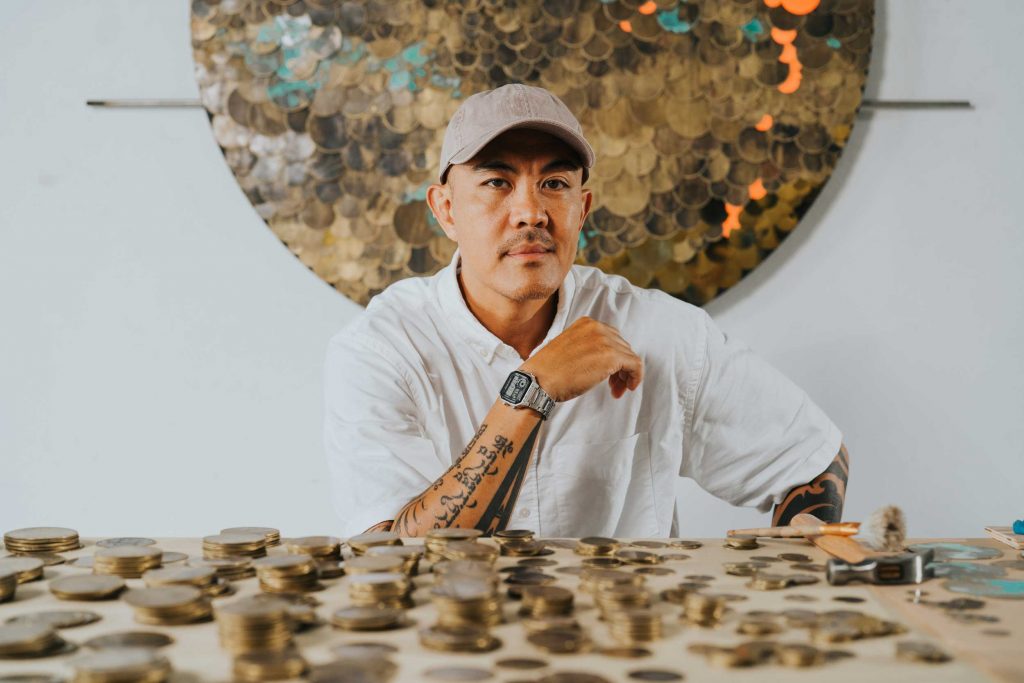
Tuan Andrew Nguyen
Featured on the cover is Shattered Arms, the work of Vietnamese American artist Tuan Andrew Nguyen. A 2025 MacArthur Grant recipient, Nguyen is the subject of this issue’s portfolio, “Disarming, Recasting, Rearming.” Nguyen was born in Saigon in 1976. Three years later, his family immigrated to the United States as refugees. After earning his MFA from California Institute of the Arts in 2004, Nguyen returned to Vietnam, and has been working in Ho Chi Minh City for over twenty years. By using the metal of salvaged shell casings as his main medium, he infuses his sculptures and moving-image pieces with themes of colonialism and collective memory. His most recent Buddha sculpture, The Light That Shines Through the Universe, is currently on display at the High Line park in New York City.

Simon Wu
In “Ascension,” the Burmese American writer and curator Simon Wu contemplates meditation, his relationship with his immigrant parents, and killing video game zombies. “I never thought I would be writing about Call of Duty, but after my brother Nick introduced me to it, I couldn’t stop thinking about it, even when I was entering a period of my life where I was reflecting on my Buddhist upbringing quite a bit,” he told Tricycle. “It was a challenge to figure out why they were interconnected in my life but rewarding to recreate that exploratory mindset here.” Wu’s writing has been featured in publications such as the New Yorker, the Paris Review, Bookforum, and the Drift, among others. He is currently pursuing his PhD in art history at Yale University.

Jenn Pelly
Jenn Pelly is a New York–based music journalist, critic, and longtime contributor to the online magazine Pitchfork. Over her fifteen-year-long career she has also written for publications such as the New York Times, the Guardian, NPR, and Oxford American. She is the author of The Raincoats, a short book on the feminist punk band, which was published in 2017. In this issue, Pelly, who is also a hobbyist poet herself, profiles the American poet Anne Waldman. “The way I think about and engage poetry—as something to perform and to embody, and to believe in and commit to, as a nexus of beauty and justice—is enormously influenced by Anne,” she says. “I’ve seen her perform countless times at the Poetry Project, which is really my church, and I’ve hoped to interview her for years. I was so grateful to get to speak with her for Tricycle.”

Thank you for subscribing to Tricycle! As a nonprofit, we depend on readers like you to keep Buddhist teachings and practices widely available.