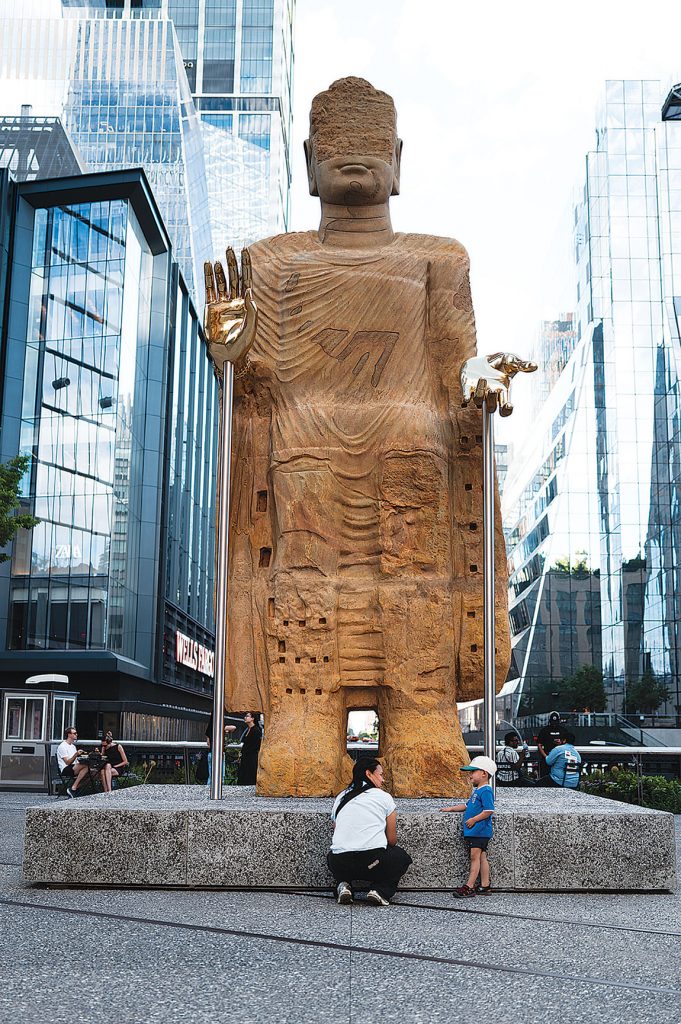
Amid the steel-and-glass skyscrapers of New York City’s Hudson Yards stands a 27-foot-tall sandstone Buddha. Perched on the High Line, the elevated public greenway on the city’s West Side, the sculpture towers over the avenue below. As a world art capital, the city has seen its share of arresting sculptures, but the park’s latest contemporary art installation is piquing the curiosity of New Yorkers and tourists alike.
Unveiled in April 2026, The Light That Shines Through the Universe is the work of Vietnamese American artist Tuan Andrew Nguyen as a bow to the Buddhas of Bamiyan, two monumental statues carved into a cliff in the Bamiyan Valley of Afghanistan 1,500 years ago. The Buddhas were one of the most celebrated archaeological sites in the region. Despite centuries of degradation due to time, war, and neglect, their presence was a testament to the region’s unique Buddhist history. The valley was once a vibrant hub along the Silk Road—the vast, interconnected network of Asian trade routes that created opportunities for economic, cultural, political, and religious exchange until the middle of the 15th century.
“The Buddhas of Bamiyan have always carried for me a profound lesson about impermanence and the instability of what we imagine to be permanent.”
Both statues were destroyed by the Taliban—the Islamic fundamentalist political and military organization that operates as Afghanistan’s de facto government—over the course of twenty-five days in March 2001. “The Buddhas of Bamiyan have always carried for me a profound lesson about impermanence and the instability of what we imagine to be permanent,” Nguyen told Tricycle in a recent episode of Tricycle Talks. He was in his mid-20s when he witnessed their destruction on television. For him, the devastating act was not just about the loss of an important cultural heritage site but also a way to reflect on the Buddhist idea of emptiness. “In Buddhist philosophy, emptiness is not simply about absence or loss—it’s a space for potential.”
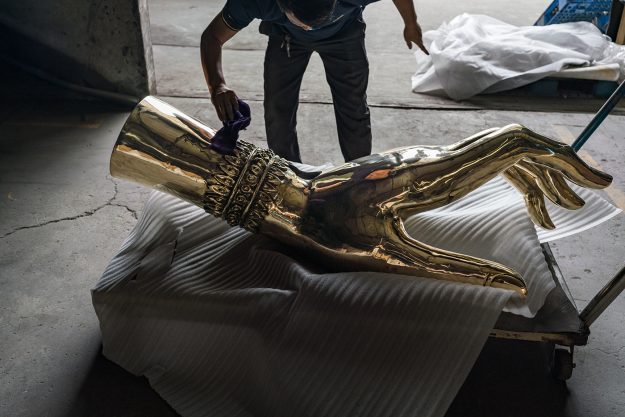
The statue is a reimagining of the larger of the two original Buddhas of Bamiyan before they were destroyed. In this new representation, the sculpture exists in two parts: a body and a set of hands. The body is crafted from sandstone, but the face is incomplete. The phantom forearms and hands, which were destroyed centuries ago, are considered speculative and made with brass, buffed to a high-gloss sheen. Each hand expresses a different mudra: The right displays the abhaya mudra, symbolizing fearlessness, while the left gestures generosity through the varada mudra. The brass appendages are separate from the body, supported by a silver, cylindrical base. On sunny days, beams of light asynchronously refract off the hands, making Nguyen’s title, “The Light That Shines Through the Universe,” an inspired coincidence. (The original, larger Buddha in Afghanistan was known as Salsal, which comes from the Hazaragi language, meaning “the light that shines through the universe.”)
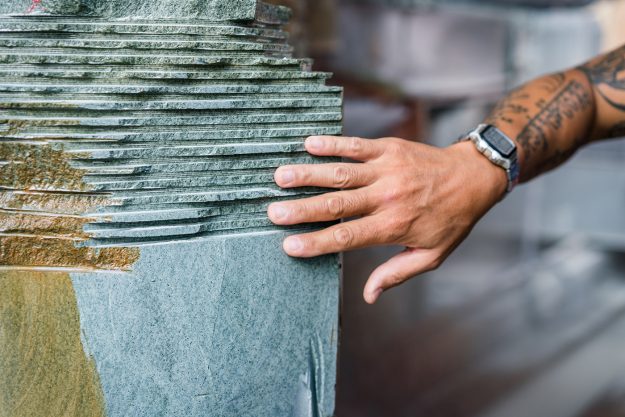
As a multidisciplinary artist, Nguyen invites collaboration in his work in both film and the visual arts. For the High Line installation, the sandstone body was hand-carved in Vietnam by generational master stone carvers. The brass hands were created from artillery shell remnants found in Afghanistan, a country plagued by armed conflict since the late 1970s. The shells were melted down and cast as bowls before they were transported out of the country—first to Pakistan, then to Vietnam, where Nguyen lives and works.
In order to source the weapons fragments, Nguyen got help through a friend and visual artist named Khadim Ali, who fled Afghanistan as a refugee when he was a child. Ali is Hazara, an ethnic and religious minority group native to the Bamiyan Valley. Targeted by the Taliban, the Hazara are persecuted for their religious beliefs. Many of them have fled the country, but they have long considered themselves the custodians of the Bamiyan Buddhas, and Ali has distinct memories of playing on the feet of the iconic statues as a child. “It has turned out to be a very emotional project for him and many Hazaras throughout the world,” Nguyen said. When the sculpture was unveiled in New York, a contingent of Hazaras from around the state attended the opening and presented a certificate of appreciation to Nguyen. “I feel honored to be able to enter into a dialogue with the Hazaras and to understand their story of persecution, marginalization, and displacement,” he said.
The use of art to transmute trauma, loss, and memory into a balm for the collective by repurposing materials of war into objects representing peace and resilience is a common thread in Nguyen’s work. His storied career is informed by his life as a Vietnamese American who came to the US as a refugee when he was 3 years old. Listening to his grandparents and parents tell stories around the dinner table about life in Vietnam had a lasting influence on him. “I came to understand that stories are a very powerful form of forgetting,” he said. “Memory for me is never just archival. It’s active, it’s contested, it’s often embodied, especially in communities like my own that are shaped by colonialism and war.”
In 2025, Nguyen was awarded a MacArthur Fellowship, and his work has appeared in the Smithsonian American Art Museum, the Guggenheim, the Whitney, and the San Francisco Museum of Modern Art. Winning the commission for the High Line Plinth marks yet another milestone for the artist. His piece was selected out of fifty-six proposals submitted by forty-nine artists from around the world. Cecilia Alemani, director and chief curator of High Line Art, said commissions rotate every eighteen months in order to showcase a variety of artists from different backgrounds. It is also an opportunity to “go way beyond what is normally accepted as the language of public art,” she continues. “The Buddha is a very good example of that—an artwork that is made in a very traditional way, such as sculptures made in ancient Greece or Mesopotamia, in the middle of a contemporary cityscape where everything is made of glass.”
“In Buddhist philosophy, emptiness is not simply about absence or loss—it’s a space for potential.”
The High Line Plinth is one of the most competitive commissions in the art world, and also one of the most coveted. That has much to do with where it is situated. It does not live within the walls of a museum or gallery but rather within a landscape that is forever vying for the attention of its inhabitants. In this instance, it is the only place in New York City where a public work of art can be seen from multiple directions. It is situated at 30th Street and Tenth Avenue, so unsuspecting travelers can catch a glimpse of the Buddha while moving by foot or car on the street below, just before the right-hand turn for the Lincoln Tunnel. Those living or working in one of the neighboring skyscrapers are given the bird’s-eye view. But to fully appreciate the scope of the work in its totality is to see it as it stands on the Plinth at the area known as “The Spur,” which is the widest point of the 1.4-mile elevated greenway.
“There are not that many public images of Buddhas in the United States or in New York City,” said Annabella Pitkin, a practicing Buddhist and a New York City resident. “To be in the center of this cityscape that’s very familiar to me, and then to have this kind of cosmic proportion of the Buddha embedded in this organic way within an industrial landscape, it is very powerful.” Pitkin, a scholar of Buddhism and East Asian religions at Lehigh University, notes that the artist’s choice to not reconstruct the face of the Buddha creates an opportunity for the viewer to interpret and supply what is missing. “That is a really interesting way to think about the power of public art—that we supply something, we complete the work by the way we engage with it.”
The reviews from other New York City residents, such as Kamil and Kevin, both 26, were mixed. “I didn’t expect it to be like this,” Kamil said. He was expecting a rounder, happier version of the Buddha. Kevin thought it was “cool,” but they both missed the previous installation titled Dinosaur, a 21-foot statue of a pigeon. “The pigeon was like a staple. It was giving New York vibes,” Kevin said. “Everyone was talking about it on social media.”
This reaction is not a surprise to Alemani. She says that this is one of the ways public art is meant to function. “That’s what makes it so exciting for artists who are maybe used to working in clean institutional spaces like museums or galleries,” she said. An artist relinquishes control in that “the sculpture is no longer yours—it belongs to the city.”
There is a beauty in witnessing the way people interact with the Buddha in our current moment. How it will be perceived in the future is anyone’s guess. But its conspicuous presence among Manhattan’s glass, concrete, and steel is for this moment and then the next.

Thank you for subscribing to Tricycle! As a nonprofit, we depend on readers like you to keep Buddhist teachings and practices widely available.