Tricycle is pleased to offer the Tricycle Talks podcast for free. If you would like to support this offering, please consider donating. Thank you!
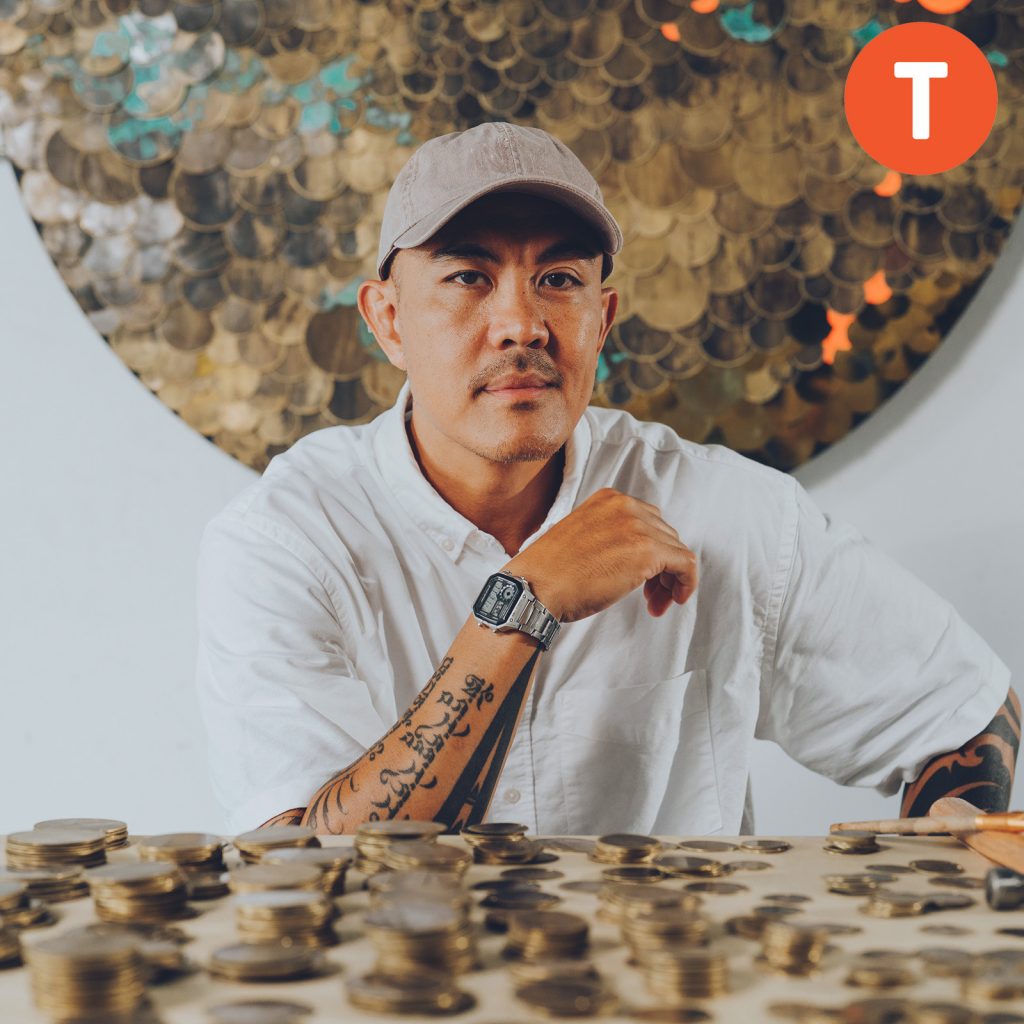
Tuan Andrew Nguyen is a multidisciplinary artist whose work focuses on history, memory, and the ongoing impact of colonial violence and war, particularly in his native Vietnam. He recently unveiled a new project on New York City’s High Line, which is a twenty-seven-foot-tall Buddha sculpture inspired by the Buddhas of Bamiyan titled The Light That Shines Through the Universe.
In this episode of Tricycle Talks, Tricycle’s editor-in-chief, James Shaheen, sits down with Nguyen to discuss the backstory for his new installation, his process of transforming remnants of war into works of art, how storytelling can be an instrument of healing and resistance, and how teachings on reincarnation influence his artistic practice.
Read more about Tuan Andrew Nguyen in the Summer 2026 issue of Tricycle.
Tricycle Talks is a podcast series featuring leading voices in the contemporary Buddhist world. You can listen to more Tricycle Talks on Spotify, Apple Podcasts, and iHeartRadio.
♦
We’d love to hear your thoughts about our podcast. Write us at feedback@tricycle.org.
Tuan Andrew Nguyen: I think materials absorb energy. They absorb ideology. They absorb violence. A bomb or a shell casing is designed with, you know, a very singular purpose, to destroy, to fragment, to impose power. But I think once these objects are removed from their military function, they enter another cycle of meaning potentially. So my work is really in conversation with that kind of existing knowledge. Yeah, it’s really looking at how materials can carry memory and how they can be transformed to tell another story. James Shaheen: Hello and welcome to Tricycle Talks. I’m James Shaheen, and you just heard Tuan Andrew Nguyen. Tuan is a multidisciplinary artist whose work focuses on history, memory, and the ongoing impact of violence and war, particularly in his native Vietnam. He recently unveiled a new project on New York City’s High Line, which is a twenty-seven-foot tall Buddha sculpture inspired by the Buddhas of Bamiyan titled “The Light That Shines Through the Universe.” In my conversation with Tuan, we talk about the backstory for his new installation, his process of transforming remnants of war into works of art, how storytelling can be an instrument of healing and resistance, and how he uses supernatural themes of ghosts and hauntings to explore stories that have been forgotten or erased. So here’s my conversation with Tuan Andrew Nguyen. James Shaheen: Okay, so I’m here with Tuan Andrew Nguyen. Hi, Tuan. It’s great to be with you. Tuan Andrew Nguyen: It’s such an honor to be here with you, James. James Shaheen: So Tuan, you’re calling in from Saigon, is that right? Tuan Andrew Nguyen: Yeah, I’m calling in from Saigon. I’m here for a few days. My studio is here in Saigon, but the family and I have recently moved out to a small beach town called Hoi An, near the central region in Vietnam. James Shaheen: And when did you move back to Vietnam? I know you grew up in the US. When did you go back? Tuan Andrew Nguyen: Yeah, I was in the US for about twenty years, but I’ve also been in Vietnam for about twenty years. So the amount of time that I was in the US and the amount of time that I’ve been in Vietnam kind of weighs very equally now. I returned to Vietnam right after graduate school in 2004. I left as soon as I got my MFA. James Shaheen: Great. And you just got back from the Venice Biennale, so how was that? Tuan Andrew Nguyen: The Venice Biennale was amazing. It was also very emotional. It was curated by a dear friend of mine named Koyo Kouoh, and she had transitioned. She passed last year almost at exactly this time, which is kind of like an uncanny coincidence maybe. But it was an amazing moment to celebrate her, her life, her work, her vision for the Biennale, and to be with friends who also loved her and respected her dearly. James Shaheen: Yeah, that must’ve been very special. Tuan Andrew Nguyen: Yeah, it was bittersweet, to say the least. James Shaheen: So Tuan, you recently unveiled a new project on New York City’s High Line. It’s an elevated park, an old railway that runs up Manhattan. You installed a twenty-seven-foot-tall Buddha modeled after one of the two Buddhas of Bamiyan. So for our listeners who might not be familiar with this history, could you tell us about the Buddhas of Bamiyan and why you decided to create a sculpture based on them? Tuan Andrew Nguyen: Oh, yeah. The Buddhas of Bamiyan have always carried for me a profound lesson about impermanence and the instability of what we imagine to be permanent. These monumental figures stood in the cliffs of the Bamiyan Valley in Afghanistan for I think over 1,500 years. They were built in the 6th century at a place and at a moment where many cultures, religions, and trade routes intersected. It was at the end of the Silk Road. In a way, they embodied the idea of interdependence, this idea of interdependence before that language kind of became familiar in contemporary daily discourse. They were really big. The tallest one was fifty-five meters tall. And they were shaped by many cultures: Greek culture, Persian culture, Central Asian culture, and Buddhist culture all at once. So they were a spectacular kind of moment but also a spectacular object especially, for that time. These Bamiyan Buddhas were destroyed in 2001 by the Taliban. The event is often framed as the destruction of cultural heritage, which of course it was. But I’ve been interested in the kind of emptiness that that act of destruction has left in its wake. In Buddhist philosophy, emptiness is not simply about absence or loss; it’s a space for potential. And I think for me, these ideas of reincarnation are quite interesting. So when I got the chance to propose something for the High Line, I thought immediately to return to that moment in our recent history to see what I could do with it. James Shaheen: You know, referring to the sculpture itself, you use brass hands that you cast out of ballistic shell casings found in Afghanistan. Is that right? Tuan Andrew Nguyen: That’s correct. James Shaheen: So can you tell us about the process of actually building the sculpture and sourcing the shell casings? Tuan Andrew Nguyen: Yeah. So the sculpture really has two parts. The main part, which is an echo of the original larger Buddha called Salsal, is made of sandstone, and it was carved by hand in Da Nang in the central region of Vietnam, where I’m currently living. Part of why I’m there is because of this project, actually. It was carved by a dear friend of mine, Mr. Hang and Mr. Yung. Mr. Hang is from the fifth generation of stone carvers widely known in this region. So that’s the stone part. There are hands that are suspended, not directly attached, but suspended in front of the stone. These hands are speculative in that the Bamiyan Buddhas had been marred and scarred and have worn the evidence of destruction over hundreds and hundreds of years through different political regimes and different attacks throughout history. So we’ve created these hands out of brass. They glisten in the New York sunlight rather beautifully, I have to say. And they’re cast from artillery shells that we acquired in Afghanistan. It was a very difficult process, and I could not have done it without a friend of mine named Khadim Ali. He’s an artist who I first met in 2018, and he was telling me stories about how, as a young child, he would play on the feet of the Bamiyan Buddhas. He’s a Hazara, and for many Hazara people, the Bamiyan Buddhas are a significant icon. The Hazaras are the primary inhabitants of the Bamiyan region today, and they have been for a very long time. The Buddhas have been a part of their landscape for a very long time. And even though the Buddha statues were created in a Buddhist context many, many centuries before Islam became the dominant religion in the region, for the Hazaras, who are mostly Muslim, the Buddhas are less about Buddhism specifically, but they’ve become like an icon of their their identity, their cultural memory, and their local heritage. The Hazara people have been kind of custodial caretakers of this valley region for a very long time. So through his remaining networks in Afghanistan, second cousins and distant uncles, Khadim was able to help me acquire brass shells from Afghanistan. We had to cast them into bowls to get them across the Afghan border to Pakistan, and from Pakistan, we cast them again into more decorative bowls, something more convincing, in order to ship them to Vietnam. And it’s in Vietnam where we cast them into Buddha hands. James Shaheen: So Khadim himself is a Hazara? Tuan Andrew Nguyen: Khadim is a Hazara, yes. James Shaheen: I see. So for him, it must have been a way of commemorating this too, is that right? Tuan Andrew Nguyen: Completely. It was a very emotional project for him. The whole project is very collaborative, and he played a crucial role in it. But it was very emotional for him, and it has turned out to be a very emotional project for many Hazaras throughout the world. I remember, we just opened it two weeks ago, but on opening night a whole large group of Hazaras from the greater New York area came to the opening and presented me with a certificate of appreciation, which I felt very honored to receive. James Shaheen: Yeah, we so often forget how collaborative these works can be, so you must feel very good about that. Tuan Andrew Nguyen: Yeah, I feel very honored to actually be able to work with Khadim and to be able to kind of enter into a dialogue with the Hazaras and to understand their story—their story of persecution, their story of marginalization, and their story of displacement. James Shaheen: So repurposing weapons and remnants of war has been a major theme of your work, and in Vietnam, you’ve worked with community members to collect unexploded ordnance and recast them as sculptures. So tell us about this process of transforming these instruments of war. Tuan Andrew Nguyen: Okay, I think the transformation of war remnants for me into sculpture or sculptural objects began as a way to think about material memory, to think about memory materially. In Vietnam, war is not only something located in the past or in archives. It still exists physically in the soil, in rivers, in bodies, in landscapes that continue to carry unexploded ordnance and the toxins of war even half a century later. The war ended in 1975. We’ve just passed the fifty-year mark. So the war persists. It persists as a latent presence. And so my working with this material is actually a material form of my relation with the communities that live with this material. I think materials absorb energy. They absorb ideology. They absorb violence. A bomb or a shell casing is designed with a very singular purpose: to destroy, to fragment, to impose power. But I think once these objects are removed from their military function, they enter another cycle of meaning potentially. In many communities in Vietnam, especially in the region where I work in Quang Trị, war remnants have long been repurposed into daily life. So people turn them into spoons, pots, shovels, fences, even children’s toys. So there’s already a kind of vernacular practice of transformation that emerged out of necessity and resilience. So my work is really in conversation with that existing knowledge. It’s really looking at how materials can carry memory and how they can be transformed to tell another story. James Shaheen: You know what I found especially interesting is that you shape and tune a number of your sculptures to ring at a very specific frequency. So can you tell us about the frequency of 432 Hz and why it’s thought to be therapeutic? Tuan Andrew Nguyen: Yeah, I’m interested in 432 Hz less as an absolute truth or a scientific truth. There are a lot of claims surrounding 432 Hz, that it is somehow more natural, more harmonious with the body or with the cosmos. A German scientist discovered that the Earth resonates at a frequency of 7.83 Hz, so 432 is a multiple of that. But I’m not trying to make kind of scientifically authoritative statements through using this frequency. What interests me is the symbolic and experiential space that this frequency opens. There’s been a lot of research about how this frequency helps to calm the body and aligns the body with the frequencies and the resonances of the Earth. I’m also interested in this idea of attunement, because Buddhism speaks of the idea of tuning and attunement as a practice to lean in more clearly and compassionately to our present moment. Meditation itself is a kind of tuning of our attention. So the frequency becomes less important as a kind of numerical value than as an invitation to a different mode of listening, I would say. James Shaheen: I think of sitting, and then when you hear the bell, if you’re very tense and you don’t realize it, as soon as you hear that bell, your whole body relaxes. And so I often think of the role of sound in practice. Tuan Andrew Nguyen: Yeah. James Shaheen: So when you display these sound sculptures, there’s often a process to activate them. Can you say something about the process of activation? Tuan Andrew Nguyen: It’s important to me in these recent projects that these sound objects that I’m making from ordnance are activated. The sound only exists through the action of participants. And I think there’s something very important in that act. I think there’s something quite beautiful when we think of sound and its nature and its ephemerality. A sound happens, and then it begins to fade away almost immediately. I think there’s something quite beautiful and poetic when an active participant in the work engages in that and finds a kind of presence in that kind of ephemerality. It’s actually a very Buddhist practice, I think. I grew up in a very Buddhist environment, and before I could understand what all the chanting and all the sounds were, you kind of understand it physically, right? You understand it through your body before it even becomes language. And I think there’s something quite important that happens when your body experiences that sound, especially if you’re the one activating that experience for yourself. James Shaheen: Right, so you talk about growing up surrounded by chanting and other Buddhist rituals. So can you talk about how these practices have influenced your work? Tuan Andrew Nguyen: Yeah, I mean, for me, chanting is a way of attuning yourself to the rhythms of a collective. I think there’s something fascinating about that. When you work through a communal rhythm, I think that attunes you and moves you outside of your ego and places you in a larger kind of presence. For me, chanting and all of the sound rituals and traditions in Buddhist practice bring you at once to be present in your body and also to be connected to everything around you. For me as a young witness of Buddhist practice, it was very confusing: How do you do both at once? But as I grow older, I find that if you can understand those dualities at the same time, you’re actually reaching and understanding what Buddhism is about. It’s quite fascinating. James Shaheen: You know, we ran an article about a particular form of Buddhism in Vietnam that was a bit of a hybrid between Zen, or Chan, and Shin or Pure Land together which combines, say, also meditation, there’s chanting. Is that the sort of Buddhism that you grew up with? Tuan Andrew Nguyen: I’m not sure. My father actually, when I was in high school, he started a nonprofit foundation in California inspired by Lama Geshe-la. Lama Geshe-la was a Tibetan lama who had a temple in Long Beach. I don’t know if you’re familiar. I was still in high school, but he would raise money to sponsor Tibetan monks in exile, mostly from Nepal and northern India, to come to California to give teachings. And then people in the community, mostly the Vietnamese community, would raise money to send back to these monasteries in Nepal and northern India. So I actually grew up with monks living in my house. So mostly Tibetan in the later half of my life. James Shaheen: So in addition to Buddhism you’ve also talked about animism as one of your guiding philosophies. So can you talk about how animism influences your work? Tuan Andrew Nguyen: Animism is a belief system that is still very strong in Southeast Asia, especially in Vietnam. Both my grandmothers very strongly believed in animism. At its core, animism resists the idea that the world is composed of inert objects existing solely for human use. Everything has a soul or a spirit. Materials, objects, landscapes, rivers, animals, even remnants of war possess some form of agency, some spirit or presence. And that worldview feels very deeply resonant to me, especially in relation to the histories and the materials that I work with. In a Southeast Asian context, Buddhism and animism are not experienced as separate systems. They coexist fluidly in everyday life. I think one could even say that animist thought influenced ideas of reincarnation in Buddhism. In Vietnam, I don’t know if you’re familiar, but there are practices of ancestor veneration and spirit offerings, spirit houses, beliefs attached to specific trees or stones or bodies of water. That’s all based on animist thought. For me, animism allows us to look at material and objects with a kind of presence, and it lends itself to this idea of reincarnation. And so when I think about material memory, it’s really based on animist beliefs that materials can have charge. They have history. And when I work to remake some of this material, I’m not trying to get rid of that history, but I’m trying to be in conversation with those histories that these materials contain. James Shaheen: So on that theme of reincarnation, I wonder if you could talk about your film, The Unburied Sounds of a Troubled Horizon, such a nice title, which features many of your singing bowls and mobiles. So can you talk to us about that film? Tuan Andrew Nguyen: The Unburied Sounds of a Troubled Horizon is a film that runs sixty minutes in length. In the art world, we call it a single-channel film. Most people will call it a movie. And it follows a character named Nguyet who inherits a scrapyard business from her father. She has an obsession with collecting war remnants and selling them as scrap metal. That’s what a lot of people did after the end of the war. It was a form of income for many people during very tough times. She does that in this film, and she takes care of her mother who we find out later in the film is suffering from PTSD after losing her husband and son to unexploded ordnance. Nguyet’s mother thinks that Nguyet is haunted or possessed because she is obsessed with taking this material, this UXO material, and making kinetic objects out of it. Later on, Nguyet goes on to this journey where she consults many mediums and monks and spiritual people, and she realizes that she is the reincarnation of Alexander Calder. For those who don’t know, Alexander Calder is a very well-known and very well-respected American sculptor. He’s known for creating the mobile, even though he didn’t create the mobile, but he got very well-known for his mobiles, and they’re very distinct. I’m sure everybody has seen them. So Nguyet believes that she’s the reincarnation of Alexander Calder. And through talking with a monk, she starts to make these mobiles have a sound element to them, and through these objects, she then helps her mom through her PTSD. James Shaheen: You know, an interesting thing about Calder is that he had a history of opposing the American war in Vietnam. So there’s a nice connection there. Is that right? Tuan Andrew Nguyen: Yeah, that’s exactly right. Calder was very vocal against American intervention in Vietnam. He took out full-page ads in the New York Times, and he also happened to die toward the end of the Vietnam War. And so in Buddhist cosmology, wherever your psychic energies are at the time of your death, you’ll find your way there. Maybe he felt like he had a lot of unresolved thoughts related to Vietnam. So we took that idea and speculated that this character, Nguyet, this young woman, could’ve been his reincarnation. This young woman is born right after the end of the Vietnam War, exactly forty-nine days after Calder passes. So she’s very convinced that she is his reincarnation, even though she has no idea who he is. But she thinks that she is there for a reason, to rework this material and to rework the forms of his kind of modern mobiles into something else. James Shaheen: You know, this idea of reincarnation works on a few levels because in a way you’re also reincarnating the materials of war themselves and giving them new lives. Do you ever think of it that way? Tuan Andrew Nguyen: Yeah, this whole entire research project and this collaborative work with the communities in Quang Tri, which is statistically one of the most bombed places in human history, is about material. The film is about the reincarnation of this UXO material, but it also runs in parallel with this reincarnation of an artistic figure who is very famous in the West. So a spiritual reincarnation and a material reincarnation are happening in parallel with each other, and hopefully one can help us access the other. For people who aren’t familiar with Buddhist thought, this idea of reincarnation could be quite a big leap. But I think if we can think about it through materials, for instance, to see an object get reincarnated from something that was meant to cause destruction to something that is now working to heal, then we can make the leap a little less big. James Shaheen: That’s nice. You know, another example of that is how you repurpose sculpture in your films, like the brass arm used as a prosthesis of the protagonist’s cousin that also functioned as one of the arms of Guanyin in your sculpture called Shattered Arms, which we used as the cover of Tricycle’s summer issue. And I’m so relieved that you liked the way it was presented. So tell us about this form of repurposing as well as how your sculptures and film inform each other. Tuan Andrew Nguyen: Repurposing this material, let me try to kind of gather my thoughts here. I think my work explores this idea of transformation. When materials are taken and they get repurposed, they get transformed into something with another potential, something with another kind of focus, something with another motive. That’s what I’m exploring: Where is that potential? How far can we take these ideas of transformation and embed them in our daily practice, in our spiritual practice, in our material practices? In a lot of statuary throughout history but also specifically Buddhist statuary, Buddhist statuary are often presented with the hands in the shape of mudras, these gestures that refer to different ideas like compassion or fearlessness. Often the hands are broken, just like in the Bamiyan Buddhas. In a lot of the statuary that survived the American War in Vietnam, you’ll find that a lot of the hands were broken or the heads were broken off. And I couldn’t help but relate that to a lot of the people who I met in Quang Tri and all throughout Vietnam who had lost limbs from UXO. And then I also started thinking about Quan Yin, who grew a thousand arms when she understood suffering and she wanted to help the world through compassionate action. So this idea of losing limbs and growing limbs was something that became part of my thinking. So the arms being cast from artillery shells kind of become an offering. In the Bamiyan Buddha, the arms are not directly connected to the stone. They’re not attached to the stone, but they kind of float suspended in front of the stone as if they were an offering to that moment in time or to the Buddhas themselves. So that’s how I’m thinking about this idea of transformation, especially in the prosthetic use of these transformed artillery shells. James Shaheen: You know, you mentioned ancestor worship earlier, and a number of your works use supernatural elements like ghosts and hauntings to explore stories that have been forgotten or erased. Can you talk about how your work engages memory in this way? Tuan Andrew Nguyen: I’ve been drawn to ghosts and hauntings because I think for me, they offer a language for thinking about histories and erasures that resist closure. A ghost is in some sense a presence produced by an absence. It emerges when something unresolved continues to persist and continues to insist on being felt, on being heard, on being present even after it’s been excluded from dominant and official narratives. That feels very close to the histories and the communities that I’m working with who have experienced war, who have experienced colonialism, who have experienced displacement and migration, and so on and so forth. Those ghosts are histories that are suppressed and fragmented, rendered invisible, yet they continue to shape our daily lives and the psychology of our present existence. James Shaheen: You know, you mentioned closure, and it’s always been a pet peeve of mine. It feels like a strategy to forget what happened and move on, and it never works, right? Tuan Andrew Nguyen: Totally. Totally. James Shaheen: But in particular, you’ve talked about how memory can be a form of resistance and empowerment especially for communities affected by colonialism, which you just mentioned, war, trauma, and so forth. So can you talk about memory as a form of resistance? Tuan Andrew Nguyen: Yeah, memory. For me, growing up in a very small family who had migrated from Vietnam to the heart of America, we landed in Oklahoma, all I would do every day of my childhood was sit at the dinner table and listen to my parents and grandparents tell stories. And I didn’t know it then, but it had a profound influence on how I came to understand that stories are a very powerful form of forgetting. Memory is never just archival. It’s active; it’s contested; it’s often embodied especially in communities like my own that are shaped by colonialism and war. Memory is not something safely stored in the past. It’s something that continues to be negotiated in the present. I think that sometimes, especially under conditions of erasure or distortion, memory plays a very crucial and active part. So when I think about memory in my work, I think less about preservation in a static sense and more about activation, like what it means to make memory move again, to make it audible, to make it visible, and to share it. I think storytelling in that sense to me is very much a form of political resistance for both the storyteller and the listener, especially for the listener. Because in order to kind of have empathy, in order to be with someone in solidarity, one has to stop and one has to listen. So that’s a very important step for me in that act of political resistance. James Shaheen: You know, you mentioned your grandmother’s stories, and I also wanted to ask about her. She was a poet whose poetry you’ve described as a form of resistance. So can you tell us about your grandmother and how she influenced your own path? Tuan Andrew Nguyen: Yeah. My grandmother, my maternal grandmother, but both my grandmothers played a really important role in my life. My paternal grandmother had a huge part in raising me while my parents went to school and worked sixty- to eighty-hour weeks when I was young. My maternal grandmother offered me a kind of artistic foundation because she was a poet, and in my very large family, not very many people followed their artistic dreams. I moved from California in 2004 to Vietnam in large part to be with my grandmother and to learn about her journey and to listen to her stories. My grandmother was a writer. She was a poet. But I think more than that, she was someone who understood that language was a place where survival and imagination meet. She wrote in a context where history had already been violently ruptured through colonialism, war, and displacement. And so poetry for her was never ornamental. It was a tool for processing life and processing the constant changes that she had to go through in the time of her life, where she had seen multiple wars. So that was my grandmother and her profound influence on how I thought about storytelling later on. James Shaheen: So I was thinking about when I was 13 or 14, the war ended in Vietnam, and there were young people my age who came to my school. They were the children of people who left. They were my age, and they seemed focused on just succeeding here. They really needed to just adapt and succeed. They had no other option, really, but, but to do well. And that’s what they seemed to do. And the next generation, like when I talk to Ocean Vuong, or now when I talk to you, a bit of a different generation, there is time to reflect on the legacy of that war and what actually happened and how it shaped generations. I don’t know if that’s an accurate description of the progression, but it just seems that it took a bit for this to be processed, and it’s still being processed. Tuan Andrew Nguyen: Yeah, I think you’re absolutely right. I think it takes generations. And we’ve seen this in history. It takes generations, sometimes two or three generations, to fully come to terms with the traumas of previous generations and come to terms with the intergenerational traumas that that one inherits, even two or three or four generations down the line. It’s embodied. Sometimes it’s hard to articulate how these generational, intergenerational traumas still affect us in our daily lives. It takes distance, but it also takes a kind of presence and a kind of courage to be present in that, to kind of see it and to kind of be with it, to sit with it, to process it. You know, I’m from a very interesting generation, because I was born in Vietnam. I escaped with my parents. They were also very young. But I saw very clearly, and it’s experiential, right? I experienced, I felt the kind of traumas that they were going through, not only postwar, but as they were trying to assimilate into a country that had very contradictory feelings about this place that they had just come from. It was a very perplexing time, I think, for them as young 20-year-olds who had completely left on a very treacherous journey, departing from their country of origin, their homeland, and then trying to figure out what it all meant, while at the same time trying to figure out how to survive physically, not to survive emotionally. I think they were processing all these kinds of survival mechanisms all at once. And you don’t have the space to process it when it’s all coming at you simultaneously. So, I think that’s what you’re talking about when you say that these subsequent generations have that privilege to do so. And I think we’re doing that’s what we’re trying to do. And there are a lot of Vietnamese artists and writers and filmmakers and poets still trying to process all of that. James Shaheen: Yeah. It’s like how the Japanese Americans of my generation began to question, “Wait a second, what happened?” And their parents and grandparents did not talk about it. So I see a similar process. It takes generations. And again, there’s no closure. The open-endedness of it is where a lot of possibility lies. Tuan Andrew Nguyen: I agree. James Shaheen: But okay, I know it’s late there in Saigon. I know that you’ve been traveling a lot. You put the kids to bed, so I really appreciate the time. But I have one more question, then I promise to let you go. You seem to have so many projects in the works. What’s next for you? Tuan Andrew Nguyen: So the big projects we just opened. We opened a new film in Venice and the big sculpture on the High Line in New York. My work with various communities still continues. I’m working with a community in Papua New Guinea whose trauma and erasure under German colonialism is very apparent, especially when you enter the museums in Germany that house all the objects that are taken from this part of the world. We’re trying to get an ancestral object restituted back to the people of Luf Island in Papua New Guinea. That’s a long-term project. And I’m working toward building a feature film for a man named Bouba Chinois, who I met in 2017, and he’s of Senegalese Vietnamese descent. His father was a Senegalese tirailleur, a colonial soldier who was in Vietnam for a very long time, who met his mother, a Vietnamese woman who was a military nurse. And they migrated back to West Africa in the ’50s after the French were defeated. And Bouba Chinois, because of his conditions, became one of the most notorious bandits in West Africa in the ’70s and ’80s. He’s a very amazing person who’s gone through a lot. But he kind of embodies all of the things that I am interested in exploring. He sits at the intersections of war and displacement and colonialism and survival. So we’re working to get a feature film made about him and with him into production. James Shaheen: Okay. Before we let you go to sleep, is there anything else you’d like to add? Tuan Andrew Nguyen: No, not really. I just want to thank you, James, and to the team at Tricycle for having me on. It’s been a very interesting conversation. Thank you. James Shaheen: Thank you. So Tuan, it’s been a great pleasure. Thanks so much for joining. For our listeners, be sure to check out Toan’s new installation on the High Line in New York City. It’s on view now. Thanks, Tuan. Tuan Andrew Nguyen: Thank you, James. James Shaheen: You’ve been listening to Tricycle Talks with Tuan Andrew Nguyen. To read more about Tuan’s work, visit tricycle.org/magazine. Tricycle is a nonprofit educational organization dedicated to making Buddhist teachings and practices broadly available. We are pleased to offer our podcasts freely. If you would like to support the podcast, please consider subscribing to Tricycle or making a donation at tricycle.org/donate. We’d love to hear your thoughts about the podcast, so write us at feedback@tricycle.org to let us know what you think. If you enjoyed this episode, please consider leaving a review on Apple Podcasts. To keep up with the show, you can follow Tricycle Talks wherever you listen to podcasts. Tricycle Talks is produced by Sarah Fleming and the Podglomerate. I’m James Shaheen, editor-in-chief of Tricycle: The Buddhist Review. Thanks for listening!

Thank you for subscribing to Tricycle! As a nonprofit, we depend on readers like you to keep Buddhist teachings and practices widely available.