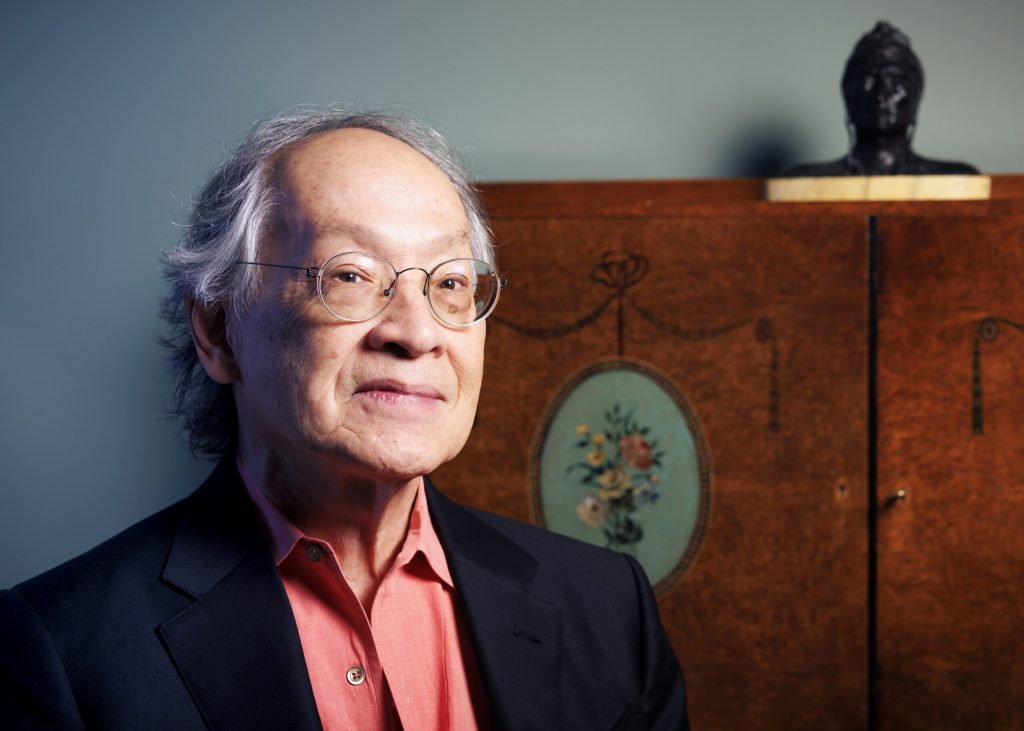
On Monday, September 15, the Library of Congress announced Arthur Sze as the 25th Poet Laureate of the United States. Sze succeeds Ada Limón in the position, and he is the first Asian American to receive the honor.
“As the son of Chinese immigrants, and as a sophomore who decided to leave MIT to pursue a dream of becoming a poet, I never would have guessed that so many decades later I would receive this recognition,” Sze said in a press release. “It’s a recognition that belongs to teachers, librarians, editors, poets, readers—everyone who works tirelessly on behalf of poetry.”
Sze wrote his first poem during a calculus class at MIT, when he suddenly stopped paying attention to the lecture and scribbled down a couple of phrases. The following year, he transferred to UC Berkeley, where he began studying poetry and honing his craft through translating ancient Chinese texts. In the decades since, he has published twelve books of poetry, as well as two books of translations, and his work has garnered significant attention—he is the recipient of the National Book Award, the Bollingen Prize for American Poetry for Lifetime Achievement, the Rebekah Johnson Bobbitt National Prize for Poetry, and a Guggenheim Fellowship, among many other accolades.
During his tenure as Poet Laureate, Sze plans to focus specifically on translating poetry originally written in other languages and bringing it to new audiences—a project he has already devoted significant attention to with The Silk Dragon II. “As Laureate I feel a great responsibility to promote the ways poetry, especially poetry in translation, can impact our daily lives,” he says. “We live in such a fast-paced world: Poetry helps us slow down, deepen our attention, and connect and live more fully.”
Read three of Sze’s translations below, and then listen to him read and discuss them on an episode of Tricycle Talks.
***
Drinking Wine (I)
By Tao Qian (365–427)
A green pine is in the east garden,
but the many grasses obscure it.
A frost wipes out all the other species,
and then I see its magnificent tall branches.
In a forest, men do not notice it,
but standing alone, it is a miracle.
I hang a jug of wine on a cold branch;
then stand back, and look again and again.
My life spins with dreams and illusions.
Why then be fastened to the world?
Autumn Comes
By Li He (790–816)
Wind in the plane tree startles the heart: a grown man’s grief.
By dying lamplight, crickets are weeping cold threads.
Who will ever read the green bamboo slips of this book?
Or stop the ornate worms from gnawing powdery holes?
Such thoughts tonight must disentangle in my gut.
In the humming rain, a fragrant spirit consoles this poet.
On an autumn grave, a ghost chants Bao Zhao’s poem,
and his spiteful blood, buried a thousand years, is now green jade.
Very White Moonlight
By Wang Xiaoni (b. 1955)
The moon in the deep night lights every sliver of bone.
I inhale blue-white air.
The world’s trifles and smatterings
turn into sinking fireflies.
The city’s a carcass.
No living thing
matches this pure nighttime color.
At the window, I open curtains:
before my eyes, heaven and earth merge in argentine white.
In moonlight, I forget I’m a human being.
The last scene of life
is quietly rehearsed in a shadow of plain color.
Moonlight reaches the floorboards:
my two feet have already whitened beforehand.
***
Tao Qian, or Tao Yuanming (365–427), was one of the great early Chinese poets. He was the first to celebrate the joys of drinking wine, and the illuminations that thereby came to him. He once worked as libationer for his district but soon resigned. He was then offered a job as keeper of records but also turned it down. Tao was always dissatisfied with official appointments and found, instead, contentment in his “fields and garden.”
Li He (790–816) wrote rich, complex poems that draw on Chinese shamanism and mythology. He was a child prodigy and, at age seven, stunned Han Yu when he wrote a poem for him, titled “A Tall Official Carriage Comes on a Visit.” Each morning, Li He rode on horseback, dashed off rough phrases of poems, and stuffed them in his saddlebag. Later in the day, he would lay out these phrases and incorporate them into poems.
Wang Xiaoni (b. 1955) was born in Changchun, Jilin, and worked as a laborer for seven years during the Cultural Revolution. She graduated from Jilin University in 1982 and has worked as a film script editor and also taught at Hainan University. She has published more than twenty-five books of poetry, essays, and fiction. Her work in English is available in Something Crosses My Mind, translated by Eleanor Goodman (Zephyr Press & The Chinese University of Hong Kong Press, 2014). She lives in Shenzhen.
⧫
“Drinking Wine (I)” by Tao Qian, “Autumn Comes” by Li He, and “Very White Moonlight” by Wang Xiaoni, all translated by Arthur Sze. From The Silk Dragon II, copyright 2024 by Arthur Sze, used by permission of Copper Canyon Press, www.coppercanyonpress.org.

Thank you for subscribing to Tricycle! As a nonprofit, we depend on readers like you to keep Buddhist teachings and practices widely available.