
“What happens when we die?” is a good question. A good answer should be based on evidence. It’s not a matter of belief or faith, but of looking deeply. Through the practice of mindfulness, concentration, and insight, we can see for ourselves the true nature of birth and death.
Many people misunderstand the word reincarnation, so I don’t like to use it. The word suggests that there is a soul, a spirit, that exists apart from the body. And when the body is destroyed or decomposed, the soul leaves and searches for another body to enter. I prefer the word continuation. There is nothing that leaves something and enters something else—continuation is constantly taking place.
At first, you may believe in a self or a soul that always remains the same. But in reality, there is nothing that can remain the same in two consecutive moments. “You” of this moment is no longer the “you” of the previous moment. We cannot see this if we have not gone deep enough and touched the true nature of no birth and no death, no self and no other, no being and no nonbeing.
Impermanence of Consciousness
Many philosophers and scientists alike have claimed that consciousness has a cinematographic nature. When we project a film, it appears to be something continuous and long-lasting. But we know that the film consists of separate pictures that last only a fraction of a second. Consciousness is like that; it’s only a flash, lasting just one millisecond. And because moments of consciousness succeed each other continuously, we have the impression that consciousness is something long-lasting. In fact, the permanent nature of consciousness is just an illusion.
It’s like a flame on the tip of a candle. You think that the flame is the same flame as a moment before, but that’s not true. There’s a succession of many flames, one after another, that give the impression of a fixed identity. The flame of this moment gives rise to the flame of the next moment. And the flame of the next moment gives rise to the flame of the following moment.
In Buddhism, there is another beautiful illustration of this. At night, someone holds a torch and draws a circle in the air with it in the dark. If they are doing the movement quickly and you are standing at a distance, you have the impression that there is a circle of fire. But, in fact, there is only a succession of points of flame. The circle of fire is only an optical illusion. Permanence is an illusion, and the basic mistake is to believe that we have a consciousness, or a soul, that is always the same. Everything is impermanent.
Mentally and physically, you are of a cinematographic nature; you are reborn in every instant. You are renewed in every instant to become a new person, a new being. And if you know how to do it, your renewal is beautiful. With karma, you can assure a better, more beautiful continuation. If you know how to handle your thinking, your speech, and your actions, you will become more beautiful. The fact is that you don’t need to wait until you die in order to see what happens to you. Look in the present moment and see that birth and death are going on in you at every moment, both in your body and in your consciousness.
Impermanence, Not Annihilation
When you look through a family album, you may see a picture of yourself as a 3-year-old child. Are you the same person as that little child? The answer is this: You are neither the same person nor a completely different one. You have grown up into an adult. Your form, feelings, mental formations, and perceptions are different. But you are not a completely different person either because you are a continuation of that child.
Many years ago during a retreat, I gave a kernel of corn to each child. I asked them to go home, plant it in a pot, and water it every day. Then, once the kernel had grown into a plant, the child could ask, “My dear plant of corn, do you remember when you were just a tiny little seed?” The plant of corn might respond, “Me? A little seed? I don’t believe it!” I told the children that, if they were eloquent enough, they could convince the plant of corn that she was once a tiny kernel.
Looking skillfully, we’d see the kernel of corn still there in the plant of corn. “Is the kernel still alive, or has it died?” is quite a deep question to ask a child. Yet it is possible even to teach children about no birth and no death, no being and no nonbeing.
In Buddhism, we talk about signlessness. Sign means form or appearance. Once a growing plant, the kernel of corn may no longer be recognizable as its sign, its original appearance, but that does not mean that it isn’t there anymore. When we were conceived, we were also a little seed—much smaller than the kernel of corn. That seed became a little child, but where is that little child now? Are they still alive? When those of us who practice meditation look at the plant of corn, we can still see the kernel. It is there, alive, although it doesn’t appear in its familiar form. Do you think that the little child in you has died, or do they continue in you? Do you talk to them, or are you too busy?
Birth and death are two sides of the same coin—you cannot pull them apart.
We may think that if the grain does not die, the birth of a plant is not possible. But is it true that something must die for something else to be born? When a cloud becomes rain, is something dying or not? Is something being born or not? The death of a cloud means the birth of the rain. If the birth of the rain is not there, the death of the cloud is not possible. Birth and death are two sides of the same coin—you cannot pull them apart.
In the word signlessness, sign means the appearance, the form, the object of our perception. A cloud has its own form or appearance. And thanks to that appearance, we recognize it as a cloud. The appearance of the rain is different from the appearance of the cloud. But, as the Buddha says, where there is perception, there is deception. If we are caught by the sign or the appearance of something, we are fooled; we cannot see the truth.
If a cloud cannot die, then our loved ones cannot die either. With our normal way of looking, we think that our grandmother, our grandfather, our ancestors have died. But when we look with the eyes of signlessness, we see that they are still alive in every cell of our body. We can talk to our grandfather, to our grandmother, right in this very moment—they will hear us.
Practicing signlessness is the way to touch reality. If you are not caught in the sign, you can have a correct perception of reality. If the child has the eyes of signlessness, they can see the kernel of corn in the plant of corn. Whether we succeed in our contemplation on birth and death depends on whether we can see things with the eyes of signlessness.
Transcending Notions, Touching Nirvana
Let us consider a flame. Before it manifests as a flame, you cannot say that it does not exist, or that it belongs to the realm of nonbeing. And when it manifests as a flame, you cannot say that it now belongs to the realm of being either. It cannot be described in terms of being or nonbeing.
Before we light the match, we can say to the flame, “My dear little flame, I know you are there somewhere. Manifest for us.” And the flame says, “Dear Thầy, I am ready to manifest for you. All conditions seem to be sufficient, except the last one.” The match is there, the matchbox is there, oxygen is there, and when we provide the flame with the final necessary condition—striking the match—she manifests beautifully. Now if I ask the flame, “My dear little flame, where have you come from?” The flame will respond: “Dear Thầy, I have not come from anywhere. My true nature is no coming. I have not come from the north, the south, the east, or the west. When conditions are sufficient, I manifest.” After blowing the flame out, we may ask, “Dear little flame, we miss you. Where have you gone?” And the flame will answer, “Dear Thầy, I have not gone anywhere. I do not go to the north, south, east, or west. When conditions are no longer sufficient, I stop manifesting in this form in order to manifest in other forms. Heat, smoke, and ash are my new manifestations.”
For a few seconds, the flame creates a beautiful image that penetrates into all of us. It creates heat that enters the cosmos. It creates some particulates and gas that go up to become a cloud of smoke. During her brief manifestation, we can say that the flame produces actions and continues in us and around us. Nothing is lost; the flame does not die. For those of us who know how to meditate, we see clearly that the flame always continues.
Our true nature is the same as that of the cloud and the flame: the nature of no birth and no death, no being and no nonbeing, no coming and no going. The ultimate truth transcends all kinds of notions, including notions of being and nonbeing, birth and death, coming and going. If you don’t let go of these notions, you can never touch the ultimate.
Nirvana in the Present Moment
The ultimate is nirvana. Nirvana is the extinction of suffering and afflictions, and this is possible only when we can extinguish notions like birth and death, being and nonbeing. We can define nirvana in very clear terms: It is the absence of all notions. Suffering is born from notions, and so nirvana is the absence of suffering.
Nirvana is available right in the here and now. Suppose you are walking barefoot, accidentally step on a briar, and get some thorns in your foot. Immediately you lose all peace and happiness. As soon as you remove one thorn, you get some relief. And the more thorns you remove, the greater the relief and peace. In the same way, the removal of our afflictions—our anger, fear, and despair—is the presence of nirvana. As soon as we begin to remove our afflictions, we start to experience nirvana.
Some people think that when you touch nirvana, you don’t have to be reborn anymore, that you are freed from the rounds of birth and death; you now belong to the realm of nonbeing. But that view is very misleading. Even some Western scholars of Buddhism hold this wrong view. They believe that the aim of Buddhism is to achieve a kind of eternal death, or eternal nonbeing. But our aim as practitioners is not to reach a state of annihilation. The Buddha’s view is a kind of insight that transcends both the notion of total annihilation and the notion of eternal life. Through meditation, we can remove these kinds of notions so that we have right view. Once you remove these and other pairs of notions—birth and death, being and nonbeing, self and other—you have peace, you have nirvana, and you don’t worry anymore.
♦
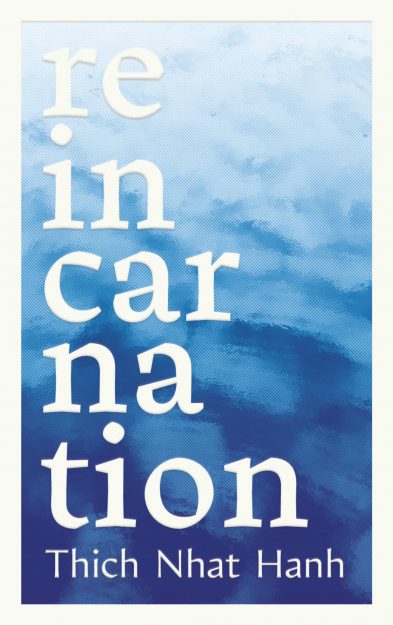
Reprinted from Reincarnation by Thich Nhat Hanh, 2025, with permission from Parallax Press.

Thank you for subscribing to Tricycle! As a nonprofit, we depend on readers like you to keep Buddhist teachings and practices widely available.