All spiritual traditions teach us to care for the vulnerable among us, children, the sick, the elderly, etc. Buddhism, Judaism, Islam, Christianity, you name it. It’s a universal code. In my heart, I’ve always felt this code as an “of course.” But in my day-to-day practice, it so often turns into a “right now there’s this other thing I have to do.” It’s astonishing how barricaded we can get against the world that needs us.
But there’s just too much suffering to process. We are bombarded with it 24/7. Even if we could shut our phones down, we would still see it on the streets—someone hunkered down on the sidewalk with a sign asking for spare change. Maybe we throw a dollar in, maybe we don’t. But, mostly, we just shield up and move on.
Wrestling with this recently, I came across a Mother Teresa quote: “We serve life, not because it is broken, but because it is holy.” This changes everything.
I was gifted with one of those holy moments a couple weeks ago. It was on Alaska Flight #23 from New York to Seattle, where a baby’s gut-wrenching wail came sailing through the cabin as we fumbled into our seats. We hoisted carry-ons into the overhead bins, and everyone looked vaguely the same—178 versions of gritted teeth and please make it stop on their faces.
As a mother, I remembered the sound of that crying from forty years ago, along with the embarrassment, guilt, and desperation that came with it. Only this time, I felt a strange joy, the joy that comes from knowing exactly what to do about it.
Decades ago, I was traveling home from New York to Rome on a transatlantic flight with my three children. We were accustomed to the look of masked dread in the flight attendants’ eyes when they saw us coming down the gangway. “Welcome to TWA,” they would say while simultaneously clocking how many small children were attached to me—one strapped to my belly, one on my back, and one in the stroller. I had this down to a science, and they were always surprised at how great my kids were (we traveled a lot); but on that one particular flight so long ago, they were right to be worried.
My 6-month-old daughter screamed for the whole first hour of that flight.
Was it her ears? Did she have a tummy ache? A temperature? Was she just overtired? Did she need changing? I tried everything. She was inconsolable. I did not know what to do. I was a very young mother heading into a seven-hour flight with my two sons, aged 4 and 2, fighting over a toy, and my daughter deep in distress.
The pilot had just turned off the Fasten Seatbelt sign when someone tapped me on my shoulder—a fellow passenger. She held out her arms and asked, “Do you think she’d come with me?” I handed her my baby, and the instant Chloe landed on the woman’s shoulder, she stopped crying. A wave of relief traveled through the entire airplane. When she came back about fifteen minutes later with my sleeping child, I wept with gratitude.
“How can I ever thank you?”
She smiled and said, “Do it for someone else.”
So here I was, forty years later. A baby, maybe 18 months old, was screaming bloody murder at the beginning of a five-and-a-half-hour flight. I wrote the baby’s mother a note, and passed it down to her through the flight attendant. I told her my story, and said, “When the seat belt light goes off, if you’re willing, I’d like to try.” But I added, “Even if you don’t want to give your child to a complete stranger, just know that there’s at least one person on this flight who knows exactly how you feel, and who is showering you and your baby with love and compassion, no matter what.”
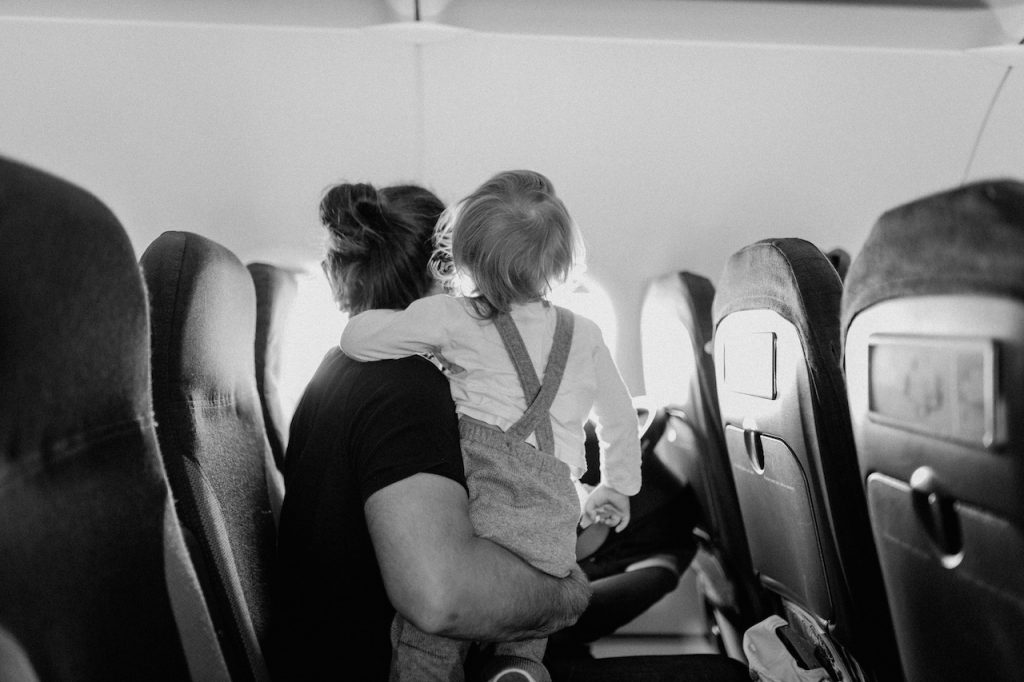
To my delight, the minute I held out my arms to that child a little later, she came to me without hesitation. Her name was Rory, and I whispered little stories to her as we went up and down the aisle. I told her all about what my babies were like when they were little. I held her close and activated all my grandmother molecules. It was heaven. Sometimes it just takes a different energy field to shift the mood. I almost didn’t want to give her back. That in itself would’ve been enough. I got to keep a promise I’d made forty years ago. I’d done it for someone else.
Her cries lanced the boil in my own heart. Her gutsy, belly-strong voice liberated my own grief, gave voice to the whole world’s grief.
But here’s the best part. Our first trip up and down the aisle, it was just Rory and I and our private little whispered conversation. As it turned out, my services were needed several more times during that same flight. By our third little airplane safari, there was a quiet tenderness growing in the rest of the passengers. Little by little, they lost their own shyness and engaged with us. One man, traveling with his grandchildren, held out a toy monkey with long arms to hug Rory with as we walked by. A young woman smiled and played peekaboo behind her scarf. There was a cohesive sense of love and protection in every one of those passengers. All of us became her uncles and aunties, her village, her sangha.
I have a daily meditation practice, and I regularly attend weekend retreats given by my longtime teacher, Anam Thubten. But I still struggle with anger, harshness, depression. He reminds us that sometimes the most important practice takes place once you get up from the cushion. You can memorize all the suttas you want, perform complicated rituals, receive empowerments from great teachers, but it doesn’t mean anything if you don’t find compassion in the heart of your daily life.
In his most recent book, Releasing the Knot of the Mind: Instructions on Resting in Stillness and Awareness, Thubten says, “When obstacles visit us, we should not always think they are a personal phenomenon. They are part of the spiritual journey shared by many people.” Maybe even shared by them on an Alaska flight from New York to Seattle.
Later in the book, he says:
“The mind has the capacity to break its falsely constructed boundaries and expand itself infinitely so that it can love everyone and experience equilibrium in all situations. Even in the midst of painful and sometimes challenging situations, our mind has the potential to experience stillness, peace, and pure unconditional joy.”
Unconditional joy. Which is, in reality, what I felt holding Rory in my arms and watching an entire sangha materialize out of a planeful of disgruntled strangers. I was so happy. There was no sense of duty or obligation. It was just joy and more joy.
This is what it can feel like, world peace. It’s not a grand, sweeping stoppage of war everywhere. It’s the immediate intimacy of holding our arms out to a crying baby, a desperate mother. It’s that sense of kinship with everyone on the plane—the business exec trying to ignore the annoyance, the teenager in headphones, the pilot, the flight attendants, the mothers on the plane, Rory’s mother, specifically, and Rory herself. The baby.
The baby! Her cries lanced the boil in my own heart. Her gutsy, belly-strong voice liberated my own grief, gave voice to the whole world’s grief. Let her rip, little one, I thought. Give that rage and suffering a way out of our hearts, let it climb into the arms of a stranger, into the arms of love itself. We resonate because we all know that pain. Somewhere in our depths, we all feel it. We are you. We get it.
This is the crux of compassion. This is what Anam Thubten is talking about when he mentions the “spiritual journey shared by many.”
“We serve the world, not because it is broken, but because it is holy.” Following the example of the woman who did it for me, I became a member of that baby’s sangha. We all did. Little by little, there was no more us and her, us and them.
There was only us.

Thank you for subscribing to Tricycle! As a nonprofit, we depend on readers like you to keep Buddhist teachings and practices widely available.