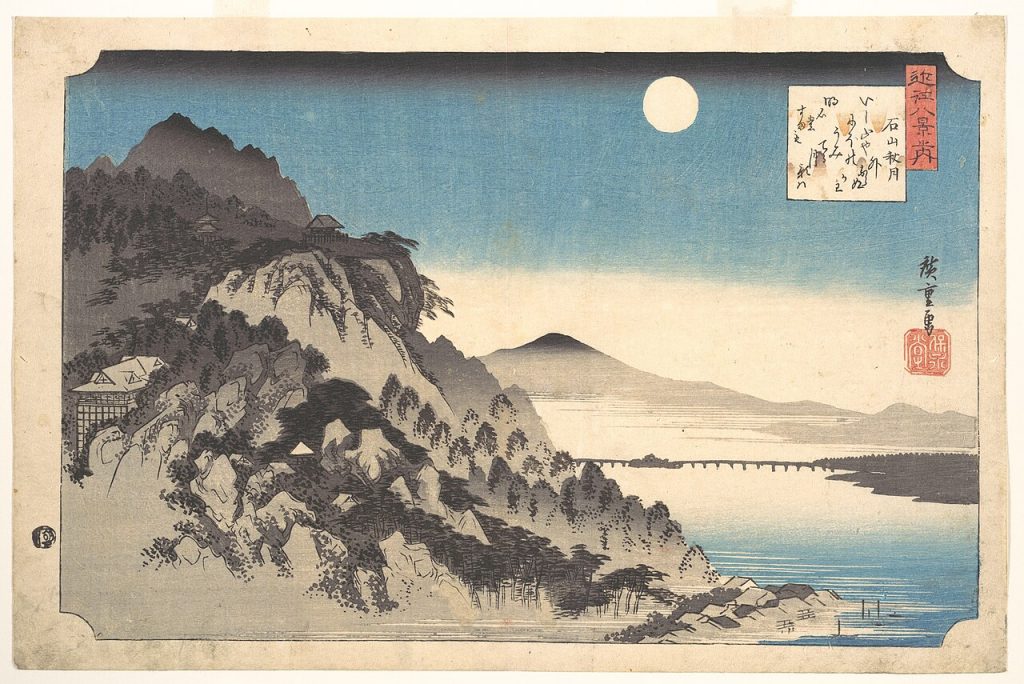
The following excerpts are from Essays in Idleness (Tsurezuregusa), a collection of essays by the Japanese monk and calligrapher Kenko (c. 1283–1350). Composed in the zuihitsu style (literally “follow the brush”), Essays in Idleness presents an eclectic assortment of 243 musings on impermanence, desire, delusion, and awakening.
***
20
A certain recluse monk once remarked, “I have relinquished all that ties me to the world, but the one thing that still haunts me is the beauty of the sky.” I can quite see why he would feel this.
25
This world is changeable as the deeps and shallows of Asuka River—time passes, what was here is gone, joy and grief visit by turns, once splendid places change to abandoned wastelands, and even the same house as of old is now home to different people. The peach and the plum tree utter nothing—with whom can we speak of past things? Still more moving in its transience is the ruin of some fine residence of former times, whose glory we never saw.
It is deeply poignant to see the Kyogoku-dono and Hojoji Temple and witness there the hopes of the man who built them, now so transfigured. The Midodono created these magnificent buildings and donated many of his estates to the temple, full of plans that his family would continue to act as regents for future emperors and retain its worldly power—could he have dreamed then that an age would come when all that he had set up would lie in such ruin? The temple gates and the Kondo were still standing until recently, but the south gate burned in the Showa era. The Kondo later collapsed, and no attempt has been made to rebuild it. Only the Muryoju Hall still stands in its former state, with inside it an awe-inspiring row of nine fifteen-foot-tall images of the Buddha. It is moving, too, to see the calligraphy by Grand Counsellor Kozei and the doors with Kaneyuki’s writing, still clearly visible. The Hokke-do is apparently still standing as well. For how much longer, l wonder?
In places where such remnants no longer exist, one can sometimes still see foundation stones in the ground, but none now know what buildings these once were.
And so we see how fickle is the world in all things, for those who would plan for a time they will not live to see.
59
Those who feel the impulse to pursue the path of enlightenment should immediately take the step, and not defer it while they attend to all the other things on their mind. If you say to yourself, “Let’s just wait until after this is over,” or “While I’m at it I’ll just see to that,” or “People will criticize me about such-and-such so I should make sure it’s all dealt with and causes no problem later,” or “There’s been time enough so far, after all, and it won’t take long just to a wait a little longer while I do this. Let’s not rush into things,” one imperative thing after another will occur to detain you. There will be no end to it all, and the day of decision will never come.
In general, I find that reasonably sensitive and intelligent people will pass their whole life without taking the step they know they should. Would anyone with a fire close behind him choose to pause before fleeing? In a matter of life and death, one casts aside shame, abandons riches, and runs. Does mortality wait on our choosing? Death comes upon us more swiftly than fire or flood. There is no escaping it. Who at that moment can refuse to part with all they love—aged parents, beloved children, lord and master, or the love of others?
74
We swarm like ants, scurrying to east and west, dashing to north and south, folk of high birth and of low, old and young, some going, others returning, sleeping at night, rising again next morning. . . . What is all this busyness? There is no end to our greed for life, our lust for gain.
We tend our bodies—to what end? Old age and death are the only sure things awaiting us. Swiftly they come, without an instant’s pause. What pleasure is to be found while we await them?
The deluded have no fear of this truth. In thrall to the lure of fame and fortune, they never pause to see what lies so close before them. Fools mourn it. In their longing for eternal lite, they have no understanding of the law of mutability.
157
To take up the brush is to write, to take up an instrument is to feel the urge to make it sing. A sake cup in the hand provokes the thought of sake, while a dice in your palm will prompt ideas of gambling. Contact will always trigger the associated urge. Never for a moment indulge in wrongful pastimes.
A passing glance at a phrase from the holy teachings will lead the eye on to read the words surrounding it, and before you know it you may have righted years of error. Had you not opened the text just then, you might never have had that realization. This is an example of the virtue of contact. Even if you lack all faith, simply to seat yourself before an image, hold a rosary, and take up a sutra book is to perform a virtuous act, however perfunctory; even seated on your meditation chair with distracted mind, you will sink into meditation before you know it.
Phenomena and their essence are intrinsically one. If outward actions conform, inner realization will naturally follow. Do not decry a lack of faith—such “empty gestures” in fact deserve our reverence.
241
The full moon’s perfect roundness lasts barely a moment, and in no time is lost. Those with no eye for such things, it seems, fail to see how it changes in the course of a night.
If you plan to turn your thoughts to the Buddhist Way after you have fulfilled all your desires, you will find that those desires are endless.
An illness will grow graver as each moment passes, and death is already close at hand, yet while the sickness is still mild and you are not yet confronting death, you are lulled by your accustomed assumptions of a normal life in an unchanging world, and choose to wait until you have accomplished all you want in life before calmly turning your thoughts to salvation and a Buddhist practice, with the result that when you fall ill and confront death, none of your dreams has been fulfilled. Now, too late, you repent of your long years of negligence, and swear that if only you were to recover you would dedicate yourself unstintingly day and night to this thing and that—but for all your prayers your illness grows graver, until you lose your senses and die a raving death. It happens to so many of us. We must fully grasp this, here and now.
If you plan to turn your thoughts to the Buddhist Way after you have fulfilled all your desires, you will find that those desires are endless. What could be achieved, in this illusory life of ours? All desire is delusion. If desires arise within you, realize that they spring from your lost and deluded mind, and ignore them all. Relinquish all today and turn to the Buddhist path, and you will be freed of all obstruction, released from the need for action, and lasting peace will be yours body and soul.
243
The year I turned 8, I asked my father, “What sort of thing is a buddha?”
“A buddha is what a human becomes,” he replied.
“How does a human become a buddha?” I asked.
“You become a buddha by following the Buddha’s teaching,” he answered.
“So who taught the Buddha?” I asked.
“He became a buddha by following the teaching of previous buddhas,” he said.
“So what sort of buddha was the first one who began the teaching?” I asked.
My father laughed and replied, “I suppose he just fell from the sky like rain or rose out of the earth like water.”
He used to enjoy recounting this story to others, adding, “He had me cornered. I couldn’t think what to reply.”
♦
From Essays in Idleness and Hojoki by Kenko and Chomei; translated by Meredith McKinney, introduction and notes by Meredith McKinney, published by Penguin Classics, an imprint of Penguin Publishing Group, a division of Penguin Random House, LLC. Translation and editorial materials copyright © 2013 by Meredith McKinney. First published in Great Britain by Penguin Classics 2013.

Thank you for subscribing to Tricycle! As a nonprofit, we depend on readers like you to keep Buddhist teachings and practices widely available.