
Spiritual practice is very important. However, it is not something we can force ourselves to do; our mind will generate aversion if we force it. Adoption of a practice has to be based on reasons, such as appreciation of the rarity of our precious human rebirth. When we understand the reasons for spiritual practice, the wish to engage in it will arise naturally.
Other forms of life, such as animals and even gods, are not really able to engage in spiritual practice, as animals lack the intelligence, and gods are too distracted to seek out practice. The best physical basis for dharma practice is certainly the human form. Since the precious human rebirth is difficult to attain, this one time we have attained it, we must ensure that it does not go to waste. Deciding to use this lifetime to engage in spiritual practice, we make it as meaningful as we can.
Understanding the twelve links of dependent arising leads us to realize the rarity and transitoriness of our precious human rebirth.
Life Is Short
It is truly praiseworthy that we are setting aside time to learn the dharma in spite of all the busyness in our lives. If we were to die tomorrow, everything we have done purely for the sake of this life would all be left behind. Activities centered solely on worldly concerns are often entangled with afflictive emotions and misdeeds. They will eventually become burdens we have to carry along with us. If we—who have attained a human body and intelligence—fail to create benefit for our future lives now, it would be really foolish of us! Behaving recklessly in this manner will also bring no benefit to others. It is thus wise for us to keep in mind our well-being in future lives.
When we are not mindful of death, it becomes difficult to sustain genuine spiritual practice. It is certain that we will die, but we cannot be sure when death will strike. And when it does, only our spiritual practice will be helpful. By reflecting on these points again and again, we will gradually develop a natural awareness of death. Once that occurs, our spiritual practice will arise spontaneously without any difficulty.
Our impending death is a stark reality; none of us can circumvent death. It is regrettable that our human existence lasts only a short period. That is why we must not postpone spiritual practice—we must begin now. Impermanence in the form of death is embedded in the twelve links of dependent arising. The links of birth and aging-and-death are taught at the end of the twelve links of dependent arising. The indication “in dependence on birth, aging-and-death arises” signifies that once birth has taken place, the possibility of avoiding death no longer exists. The conditions for our eventual passing are already present.
In addition, among the four characteristics of conditioned existence—birth, abidance, aging, and death—the twelve links mention only three, omitting abidance. This deliberate omission conveys a powerful truth: We will not remain for long. Thus, the twelve links of dependent arising indicate our impermanence in the form of death. We must therefore remain mindful of the fleeting nature of our lives.
Karmic Causality
Everyone seeks physical health and mental happiness; no one desires suffering in body or mind. Yet someone who is not spiritually inclined may believe that nonvirtuous actions, such as killing and stealing, can lead to happiness. This reflects a misunderstanding of cause and effect. If we truly wish to enjoy happiness, we have to create virtue—for virtue is the cause of happiness. If we do not want to experience suffering, we have to abandon nonvirtue—for nonvirtue is the cause of suffering. Once we understand how to cultivate virtue and abandon nonvirtue, we must apply ourselves to the task.
Through the explanation of inner dependent arising, we appreciate how causes and their results work. In dependence on ignorance, karmic formation will arise; once ignorance and karmic formation have arisen, progressively sensation will arise. Therefore, our sensations of pleasure and displeasure can be traced to the causes and conditions of karma and afflictions. The twelve links of dependent arising thus offer a detailed explanation of how karmic causality shapes our experiences.
The Buddha’s Final Intent
The Buddha gave a wide variety of teachings, but he did not deliver them all at once or for the benefit of a single person. Rather, he taught in stages, adapting his instruction to suit the needs, dispositions, and capacities of his trainees. As present-day practitioners, we must discern what is most essential among his teachings.
While the Buddha did teach methods for attaining happiness in the higher realms, a favorable rebirth is not the ultimate goal. His final intent was to guide sentient beings all the way to liberation and full enlightenment. Understanding this overarching purpose allows us to discern which teachings serve as preliminary steps and which point directly toward ultimate freedom.
The entrance to the path of liberation is the genuine aspiration for liberation. To enter the path of liberation, we must generate true renunciation—a deep recognition of samsara’s flaws and a heartfelt resolve to be free from it. With this mindset, our focus turns decisively toward liberation.
Our Present Predicament
Motivated by ignorance, we create karma and take rebirth in samsara. Generally speaking, our mindstream is not very virtuous. Under the influence of afflictions, we create karma, very little of which is virtuous. As our nonvirtues outweigh our virtues, it will be difficult for us to secure a good rebirth; it is likely that we will take a bad rebirth. Nonvirtues precipitate the links—of primary consciousness, name-and-form, and so on—that are associated with a bad rebirth.
Even though we may not directly see or hear those who have been reborn in the lower realms, it is a fact that they experience horrendous suffering. We get a glimpse of this by observing the visible sufferings of humans and animals. For example, we can witness humans undergoing the pain of aging, sickness, and death. The creation of nonvirtues leads to rebirth in the three lower realms— those of animals, hungry ghosts, and hell beings—not just once, but again and again, countlessly. There is no point being attached to such forms of existence characterized by manifold shortcomings.
Our teacher, Sakyamuni Buddha, was once a prince who enjoyed a life of luxury in Kapilavastu. One day he wandered out of the palace and witnessed the phenomena of sickness, aging, and death, realities that had been deliberately hidden from him. Realizing the futility of samsara, he renounced his royal trappings and sought the dharma. As an enlightened being, he displayed such life events so that others would also give up their attachment to contaminated pleasure.
Animals, finding the sensations of suffering disagreeable, reject suffering. Certain non-Buddhists also reject sensations of pleasure. It is the practice of Buddhists to turn away even from neutral sensations of samsara and abandon adherence to all the contaminated phenomena.
In brief, suffering is hard to bear, and contaminated pleasure is transitory and unstable. This reality of how the afflicted nature of our existence spells harm and trouble is revealed by the twelve links of dependent arising. The presentation of the twelve links demonstrates how we are trapped within the five types of rebirths in samsara, passing from one link to another like the spinning wheel of a potter. Resolving to escape, we must strive for liberation.
Can We Totally Eliminate Suffering?
In life, we encounter all kinds of problems and difficulties. Since we do not wish to suffer, we have to eliminate suffering. But what is the method that leads us to become free from suffering? Worldly beings don’t have the slightest clue. Whether we approach this question from the perspective of religion or philosophy, we need to analyze whether suffering has a cause. If it does, then we can eliminate suffering by eliminating its cause; but if it doesn’t, then there is no way to eliminate it.
There are religions in India that propound that suffering is causeless. If that is so, then there is absolutely nothing we can do about suffering. Certain religions assert the existence of a permanent primal substance—an unchanging essence underlying all phenomena—or a creator god who governs the world. If such an entity were to exist, verily there would be no way to eliminate suffering. For if such a god were a given and also a cause of suffering, then as long as that god existed, suffering would necessarily persist. It is similar for a permanent primal substance; if it were permanent and nothing could be done about this cause, then resultant suffering would be unavoidable.
Identifying the Cause of Suffering and the Antidote to It
The Buddha taught that the direct cause of suffering is karma. In turn, the cause of karma is afflictions, which are rooted in ignorance. This ignorance is a misconception of the self—an apprehension that, observing the five aggregates of a person, grasps to “I.” Can such an ignorance be abandoned? Upon investigation, we find that its antidote is the wisdom realizing selflessness, which apprehends those aggregates to be devoid of a self. By analyzing which of these two minds—self-grasping or wisdom—is mistaken, we discover that the mind believing there is no self is an unmistaken mind according with reality, whereas the mind believing there is a “real” self—when no such self exists in reality—is a mistaken mind. Through logic and reasoning, the wisdom realizing selflessness can refute our current mistaken conception of self.
Non-Buddhists believe in the existence of a self. They think that, without it, there is no karmic causality and no way to attain liberation. Madhyamaka proponents assert that a self exists conventionally. Even the path exists conventionally. The so-called Buddha also exists conventionally. There are also conventionally existent aggregates. For example, what we call a house is imputed in dependence on its door, windows, and so on. Similarly, what we call a person is imputed in dependence on its five aggregates. Such an imputed person exists, but a truly existent person does not. Even though a self does not exist, conventionally a self exists and is able to perform all functions. If the self as asserted by the non-Buddhists were to exist, then one would not be able to abandon the conception of self, in which case, one would not be able to abandon afflictions. Without abandoning the afflictions, one would not be able to abandon samsara. It is important for beginners like us to reflect on the grave drawbacks of the afflictions.
A self cannot withstand analysis by reasoning. If it were to exist, it would have to be identical to or different from the aggregates. In the former case, there would be many selves since there are many aggregates. The latter is infeasible since one would never associate the thought of “I” with anything other than the aggregates, say a house or a tree.
Madhyamaka propounds that the self is not truly existent; it is a falsity. The twelve links are also falsities. Even though they are falsities, they are able to perform their respective functions, like functions within a dream or an elephant conjured by an illusionist yet seen by an audience. Conversely, truly existent phenomena cannot perform functions. Consider a hand. Is it identical with its fingers, or different from them? The hand is imputed in dependence on its fingers. Likewise, a finger is imputed in dependence on its parts. Other than that, there is nothing real that one can pin down. Similarly, what we call self is imputed in dependence on its aggregates, such as form and consciousness.
The actual antidote to ignorance involves meditation on selflessness in which one meditates on selflessness of persons or selflessness of phenomena.
By abandoning the conception of self, we abandon the first link of ignorance. When ignorance has been completely abandoned, all the remaining eleven links of dependent arising will cease. Therefore, the philosophical traditions that assert dependent arising and selflessness know how to explain the path to liberation.
The way to abandon ignorance is illustrated by the meditations on the concordant and discordant, or forward and reverse, orders of dependent arising. Note that when dependent arising is taken simply as an object of observation in such meditations, the practice constitutes the cultivation of calm abiding. The actual antidote to ignorance involves meditation on selflessness in which one meditates on selflessness of persons or selflessness of phenomena. By engaging in repeated meditation on the aggregates as being devoid of true existence, one will come to see the truth and attain the first ground in the Mahayana or the state of a stream-enterer in the [Theravada]. When one directly sees the emptiness of true existence, one will be able to destroy the seeds of ignorance. When ignorance is destroyed, karma will be destroyed, and all resultant sufferings will come to an end. Leaving samsara behind in this manner, we will achieve liberation.
♦
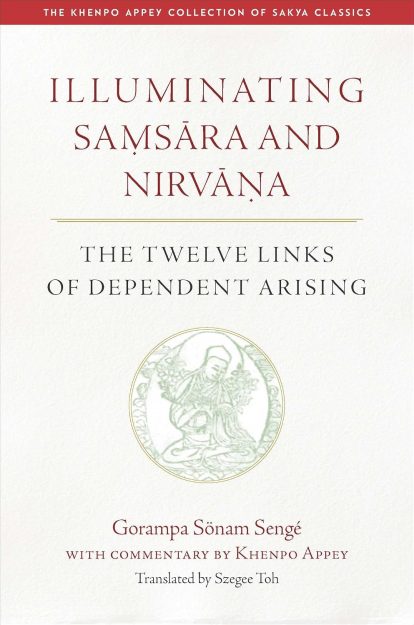
From Illuminating Saṃsāra and Nirvāṇa: The Twelve Links of Dependent Arising by Gorampa Sönam Sengé, © 2026 Khenpo Appey Foundation. Reprinted by arrangement with Wisdom Publications.

Thank you for subscribing to Tricycle! As a nonprofit, we depend on readers like you to keep Buddhist teachings and practices widely available.