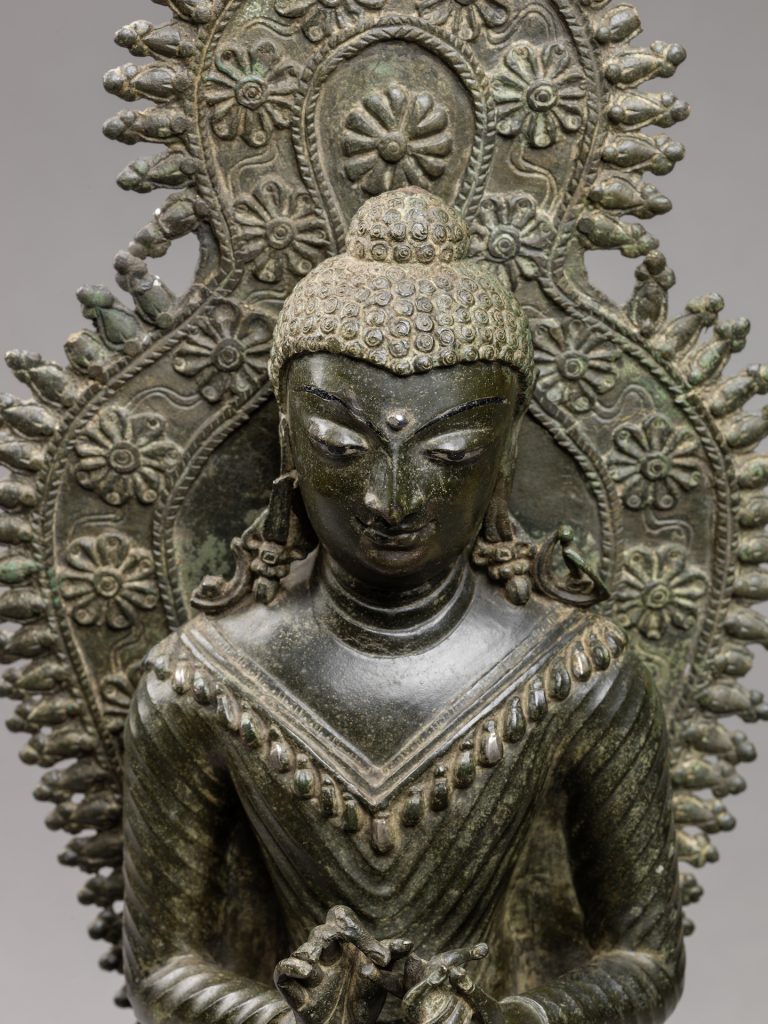
Buddhist scriptures speak of the Buddhas of the past, the present, and the future. The Buddha of the Future will appear in our world when the teachings of the previous Buddha, our Buddha, Shakyamuni Buddha, have disappeared into oblivion. Although his advent is millions of years away, we know his name and location. The image above, likely produced in the 8th or 9th century in the Swat Valley, now part of Pakistan, is said to represent him. His name is Maitreya (“kindness” in Sanskrit). Here, he is seated on a throne, already with the crown protrusion atop his head, one of the thirty-two “marks of a great being” that adorn the body of a Buddha. He resides in a heaven called Tushita (Joyous) located in the skies above Mount Meru, the center of the Buddhist cosmos.
Maitreya is mentioned only once in the Pali canon, the scriptures of the Theravada, the Buddhist tradition of Sri Lanka and Southeast Asia. However, he descends to earth in a number of important sutras of the Mahayana tradition of Tibet and East Asia, sometimes as a member of the Buddha’s audience, other times as an important interlocutor, as in the Lotus Sutra, the Vimalakirti Sutra, and the Gandavyuha Sutra. As the Buddha of the present moved further and further into the past, the Buddha of the Future became more and more important.
As the Buddha of the present moved further and further into the past, the Buddha of the Future became more and more important.
The Buddha is said to have set forth forty different topics of meditation from which monks and nuns could choose. One of the most popular is called “recollection of the Buddha” (buddhanusmrti), in which one calls to mind the magnificence of the Buddha by contemplating this sentence: “The Blessed One is accomplished, fully enlightened, endowed with clear vision and virtuous conduct, sublime, the knower of worlds, the incomparable leader of humans to be tamed, the teacher of gods and humans, enlightened and blessed.”
It is important to recall that images of the Buddha in the form that he is known today did not begin to appear in India until the early second century of the Common Era, some five centuries after he passed into nirvana. With the creation of those images, the practice of “recollection of the Buddha” would come to include visualization of the Buddha. Texts instruct meditators to sit before an image of the Buddha, staring at it until they are able to visualize the Buddha in perfect detail in their mind. Also in the 2nd century of the Common Era, monks in what is today Kashmir began to make Maitreya the focus of their practice of “recollection of the Buddha.” Some sought to receive his teachings; others sought to be reborn in Tushita and to join his retinue when he descends to restore Buddhism to our world. The statue pictured above, produced centuries later, may have been used for that purpose.
The most famous story of meeting Maitreya involves the 4th-century Indian monk Asanga; indeed, the story is so famous that it is often told in the presence of an image of Maitreya, like this one. Asanga was one of the most important figures in the history of Buddhism. He was the founding philosopher of the Mind Only School and the author of an important text on meditation, in which he set forth the practice of visualizing the Buddha. He was born in the city of Purushapura in Gandhara, today the city of Peshawar in Pakistan. Because Asanga knew so much, when he had a question, no one could give him the answer. Therefore, he decided to take his questions to the future Buddha.
In order to meet him, Asanga left his monastery and went to meditate in a cave, where he prayed for Maitreya to appear. After three years, he still had no success. About to give up, he saw a man rubbing an iron spike with a piece of cloth. When Asanga asked him what he was doing, the man said that he was a tailor and made his own sewing needles. Asanga was incredulous until the man opened a small box and showed him the needles he had already made. Inspired by the tailor’s persistence, Asanga returned to the cave to entreat Maitreya once again. Another three years passed without success. He gave up, but was then inspired to try again. Then another three years passed; despair was followed by recommitment. Ultimately, he spent twelve years meditating in the cave, with no sign of Maitreya. As Asanga gathered his robes and begging bowl to return to his monastery, he saw a dog lying outside the cave. She had a gaping wound that was filled with maggots.
Asanga took pity on the dog and knelt down to clean the wound. Picking up a stick, he was about to scrape the maggots away when he remembered that the maggots were sentient beings as well, equally deserving of his pity. If he removed them, he would deprive them of their food. Yet he had to save the dog. When a passerby approached, Asanga traded his monk’s staff for the man’s knife and cut a piece of flesh from his own thigh. He placed it next to the dog and was about to transfer the maggots when he realized that if he used the stick, or even his own fingers, he would kill some of the maggots. The only safe means of transfer was his own tongue. To avoid becoming nauseous, he covered his eyes with his hand, stuck out his tongue, and lowered his head to begin moving the maggots. Yet instead of touching the warm flesh of the infected wound, his tongue touched the cold stone of the cave floor. Uncovering his eyes, he raised his head to see that the dog was gone. Maitreya was standing before him in all his glory.
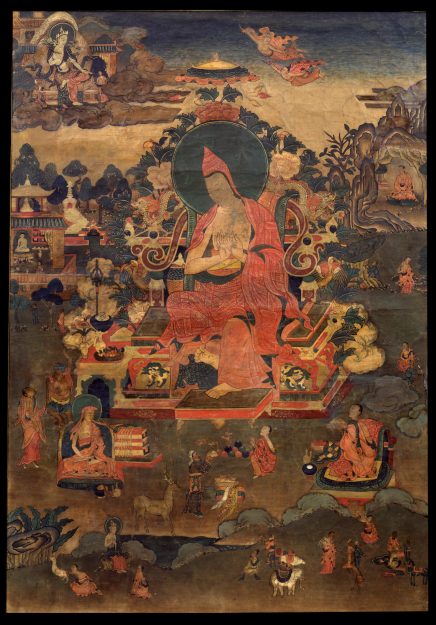
Understandably confused and somewhat disgruntled, he told the future Buddha that he had been praying to him for twelve years. Maitreya explained that he had been with Asanga all that time, he just could not see him. When Asanga doubted him, Maitreya pointed to the crumbs of food and dried saliva encrusted on his resplendent raiment; he had been so close to Asanga each day that his robes had become soiled when the monk ate his daily meal. Asanga had been unable to see Maitreya because of obstacles in own mind, obstacles that were not removed by twelve years of prayer and meditation; they were removed by a moment of kindness. Asanga still did not believe him, and so, in one of the stranger scenes in Buddhist literature, Maitreya instructed Asanga to pick him up and carry him into town. No one saw Maitreya. An old woman saw a monk carrying a dog. Maitreya told Asanga to put him down and grab hold of his robe. He then flew up to Tushita heaven, where Asanga spent one celestial morning, the equivalent of fifty human years, returning to earth with what are called the “five books of Maitreya,” some of the most influential treatises of Mahayana Buddhism.
Eventually, Maitreya will appear in our world for a longer stay. In Buddhism, the world—a world that is the product of our collective karma—passes through various cosmic stages. The current stage, called the Stage of Abiding, also passes through cycles, in which the lifespan of humans rises and falls. At present, the cycle is on a downward slope, with the human lifespan decreasing, eventually dropping to ten years, after which it will rise again until it reaches eighty thousand years. During this period of decline, not only will the conditions of the world deteriorate, but also the dharma will disappear.
This decline is attributed to what are called the “five degradations”: the degradation of the lifespan, because the human lifespan decreases; the degradation of views, because wrong views become rampant; the degradation of afflictions, because negative emotions like desire and hatred become stronger; the degradation of sentient beings, because both their physical and mental powers weaken; and the degradation of the eon, because the physical environment deteriorates over time. As these degradations grow, the ability to follow the path to enlightenment declines to the point that enlightenment becomes impossible. But when does that period begin? And, more importantly, has it already begun? Various calculations have been made over the centuries. In Japan, it was concluded that the period of the decline of the dharma began in 1052. Especially in East Asia, the faithful have therefore decided not to wait for Maitreya but to seek to be reborn in a different universe, the western paradise called Sukhavati, the Land of Bliss, the abode of the Buddha of infinite light and infinite life called Amitabha. Its happy denizens need never be reborn in our world again. All are destined to achieve Buddhahood from his pure land.
The future Buddha will decide the appropriate period in the fluctuating human lifespan to enter the world. In the Theravada account of the birth of the Buddha of our age, he fears that if the lifespan was thousands of years, it would take too long for the sufferings of aging and death to become apparent. If the lifespan was under one hundred years, it would be too short for his disciples to progress on the path. He therefore concluded that a Buddha should appear in the world when the lifespan was one hundred years.
Maitreya is not in a pure land; he remains in samsara, in our realm, called the Realm of Desire, because we are so attached to the pleasures of the senses. He is now in a heaven above Mount Meru, a place where we can be reborn. It is not so far away.
Maitreya must have come to a different conclusion, because it is said that he will not descend from his heaven until the human lifespan has reached its maximum length of eighty thousand years, something that will not occur for almost six billion years. Thus, the leaders of millenarian movements who have declared themselves to be Maitreya over the past centuries have been pretenders. Still, the long wait for Maitreya should not be a reason for despair; the long temporal distance from his advent is mitigated by his physical proximity. Maitreya is not in a pure land; he remains in samsara, in our realm, called the Realm of Desire, because we are so attached to the pleasures of the senses. He is now in a heaven above Mount Meru, a place where we can be reborn. It is not so far away.
In this beautiful piece, Maitreya’s hands show that he is teaching the dharma, perhaps to Asanga. But his seat is also significant. It is said that he sits on a throne instead of in the lotus posture so that he can quickly rise when it is time for him to enter our world to bring back Buddhism. Yet, as the story of Asanga suggests, until that day, whenever we practice kindness, Maitreya stands before us. This is how to see a Buddha.
♦
This essay originally appeared in Approaching the Buddha: Transmission and Transformation, by Hao Sheng (The Museum of Fine Arts, Houston, 2026), which highlights works from the Xuzhou Collection of Buddhist Art, a private collection of masterpieces from Buddhist cultures across Asia. Reprinted with permission from the author and publisher.

Thank you for subscribing to Tricycle! As a nonprofit, we depend on readers like you to keep Buddhist teachings and practices widely available.