
While Halloween has all but come and gone, that doesn’t mean the time of horror movie bingeing has gone away with it. If you are looking to squeeze in a few more fall fright nights while the leaves are still emblazoned with bright yellows and crimson reds, now could be an opportune time to catch the latest zombie blockbuster: 28 Years Later (2025). Reunited with longtime collaborator and writer Alex Garland, 28 Years Later sees veteran English director Danny Boyle returning to his much beloved postapocalyptic horror universe. As a lover of zombie films, I was pleased with the emphasis on human nature in this one—physical human nature, that is. It’s comparatively less jumpy and horrific than it is contemplative and reflective.
The third film follows its predecessors with an incremental nod to the amount of time that has passed since a devastating virus known as Rage swept across the United Kingdom: 28 Days Later, 28 Weeks Later, and now, almost three decades since the initial outbreak. As can be surmised, the zombies in this franchise aren’t your typical brain-seeking, staggering undead monsters, though they are comparatively dead in the sense that their former selves are forever gone following infection—their minds overtaken by an unrelenting, vicious impulse to continue the virus’s spread above all else. But they aren’t walking corpses. They’re still technically living humans, suffering from something horrible that amplifies their anger, aggression, and ill will as it eclipses all other emotions, trapping them in the clutches of an immense and highly contagious disease—or, dis-ease (another possible way to define dukkha).
The Rage-infected are generally depicted as fast and ravenous—gruesome in their unquenching appetite to spread the infection as aggressively as possible, never becoming fully sated. Such an incessant need to feed offers a potent analogue to a concept like tanha (craving): Desires and hindered states of mind are equally unsatisfactory and touch those around us in interrelated ways. But the foul, ghastly bodies of the infected and their victims are also ripe candidates (pun intended!) to consider as meditations on death.
Remembering that we must die probably isn’t the first thing that comes up in the Western imaginations when most people think about Buddhist teachings, but it’s actually quite common across Buddhist traditions and arguably one of Buddhist philosophy’s most central considerations. Beginning with the pivotal corpse that the young Siddhartha first encountered outside his palace walls, and including Tibetan bardo teachings and charnel ground practices, skeletal remains and bloated bodies—much like the ones seen throughout the film—occupy an important thread of contemplative practice throughout varying Buddhist schools. Meditation on such foulness (asubha practices) encapsulates the fact that we, just like all else, are subject to impermanence. Our bodies are subject to decay and decomposition—just like those leaves we welcome in admiration each autumn season. And as the Buddha taught, we shouldn’t shy away from this fact. Rather, it should be held in intimate recognition throughout our lives.
The third film of the series, 28 Years Later follows a young boy named Spike as he travels with his ailing mother, Isla, to a former medical doctor, Ian Kelson, now living a mysterious, solitary existence away from others and the safety of Spike and Isla’s nearby community safehold. Isla has been suffering from some sort of illness, and even though Spike has been warned that Kelson is no longer sane, he sees no other way to help his mother than by seeking him out. Along the way, they encounter a newborn baby, who they end up taking in and caring for. Shortly after, they are attacked by an “alpha”—a newly evolved Rage-infected host with superhuman strength and more advanced cognitive control. Kelson makes a startling appearance, rescuing the trio by shooting a sedative dart at “Samson” (Kelson’s name for the alpha). As they travel back with Kelson to his home, towering pillars of bones covering the hill on their immediate horizon start to come into view.
“What’s that?” Spike asks as they approach Kelson’s macabre sanctuary. “Do you know the words memento mori?” he asks in response. “It means ‘remember death.’ Remember you must die.” And as the camera pans out, it’s pretty difficult not to remember that amid the thousands of bones Kelson has acquired, cleaned, and placed in such mesmerizing formations. “Every skull is a set of thoughts,” he continues. “These sockets saw. And these jaws spoke and swallowed. This is a monument to them. A temple. . . . The memento mori is actualized.”
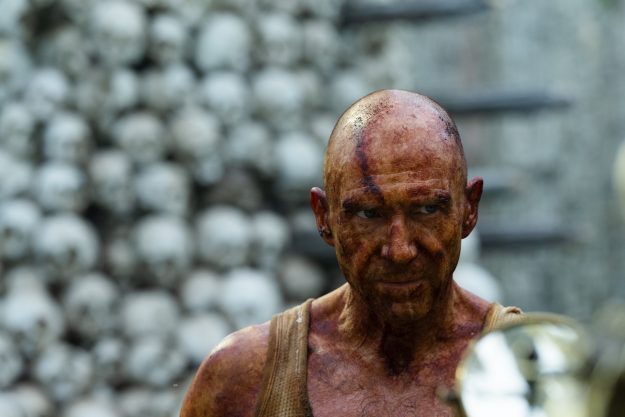
Taking in the sheer number of dead bodies that Kelson has arranged, we are pushed to recall our own nature, much like the Upajjhatthana Sutta’s “Five Remembrances”: We are going to age; we are going to get sick; we are going to die; we won’t remain close to what we hold dear; and we are always subject to our actions. Keeping these at the forefront of our lives and practice allows us to better see into the nature of our interactions and perspectives—of the world around us and our place in it.
Kelson maintains a markedly detached perspective that seems to demonstrate these as well. As they approach his monument to death, he nonchalantly carries the skull of a recent victim in his arms, half its spine dangling below. “There were so many dead,” he reflects out loud. “Infected and noninfected alike . . . because they are alike.” Kelson doesn’t explicitly elaborate much on this point, but we can infer his position by the way he treats Samson, whom he stunned rather than killed, and by his lack of affect in the presence of the newborn baby Isla and Spike carry with them: Life, death, and mindless infection are all simply states of being stemming from the same conditioned factors of existence.
It’s a message also found in the Satipatthana Sutta: Reflect upon “the soles of the feet on up, from the crown of the head on down, surrounded by skin and full of various kinds of unclean things,” it tells us—including bile, feces, phlegm, blood, pus, sweat, mucus, saliva, urine. And all of this becomes more grotesque after death, within the festering remains of a decaying corpse. “This body, too,” the sutta tells us, “such is its nature, such is its future, such its unavoidable fate.” Kelson and the Buddha are noticeably aligned in this as well. Keeping it in mind can help assuage our attachments and cravings toward our own bodies and those of others, and it can help us awaken to that fundamental principle of change—and decay.
The Satipatthana Sutta presses us to reflect on what happens to the body after it’s had time to wither and rot, and how it might appear in its ghastly postmortem state: as a skeleton with bits of flesh and blood smeared all over it, tendons perhaps still attached and keeping the remaining pieces dangling in place. Fans of zombie narratives know that image well. The sutta starts to sound a lot like Kelson’s temple: “here a hand bone, there a foot bone, here a shin bone, there a thigh bone, here a hip bone, there a back bone, here a rib, there a chest bone, here a shoulder bone, there a neck bone, here a jaw bone, there a tooth, here a skull . . . the bones whitened, somewhat like the color of shells . . . the bones piled up, more than a year old.”
We are going to age; we are going to get sick; we are going to die; we won’t remain close to what we hold dear; and we are always subject to our actions. Keeping these at the forefront of our lives and practice allows us to better see into the nature of our interactions and perspectives.
Kelson’s display also recalls Tibetan sky burials, wherein the body of the recently deceased is laid in a dedicated space, with him serving as a rogyapa (a ritual body cutter/funeral butcher) of sorts every time he fires up his bone kettle and prepares his latest human remains. Granted, Kelson might not be offering these bodies to nearby hungry vultures (the traditional climax of the ritual), but his practice shares in the relevance it has for contemplating impermanence, the reality of death, the reminder that death is inevitable, the connection between remembrance and memorializing, and the fact that we are all part of very clear and certain natural cycles.
Remembering death under the shadows of Kelson’s sanctuary also invites us to keep in mind that it is ultimately unpredictable; it often occurs unannounced and might arrive at any moment. And that’s certainly been the case for the past thirty years in the ravaged United Kingdom we see throughout the series. Mindfulness of death (maranasati) encourages us to recognize this imminence and not push it away—to not ignorantly cling to the temporality of life.
But mindfulness of death can also help prepare us for the type of death we might experience. “There are many kinds of death, and some are better than others,” Kelson tells an emotional Spike and Isla after determining she is in an advanced stage of cancer and that death is approaching soon. “The best are peaceful,” he adds. “Where we leave each other in love,” is one of those kinds of death he tells Spike. “You love your mother.” “I love her,” Spike responds. “And Isla, you love Spike.” “So much,” she says. “Memento amoris,” Kelson tells them. “Remember you must love.”
The climactic scene ends with Kelson assisting Isla in ending her life that evening, while she is still relatively pain-free and lucid, sharing her final moments with her loving son. We watch her approach this death without attachment; she realizes it is simply part of our existence and concomitant with the impermanence that characterizes it. And the compassion (karuna) Kelson demonstrates in assisting her casts him differently from that of just a funerary butcher and collector of bones: one who has attained an uninhibited understanding of the world, hoping to help others achieve a similar perspective—a bodhisattva of sorts in a place filled with Rage.
Kelson cleans Isla’s bones just like the others and hands her skull to an accepting Spike, instructing him to find a place for her among the central tower of skulls. We watch Spike climb to the very top and position it to face the rising sun. In these final moments of 28 Years Later, we witness what it means to contemplate death, how it can inform the way we live, and how interconnected the cycles of life and death truly are: As Isla’s life is ending, a baby’s life is just beginning. As Spike cradles the newborn in his arms, those final moments offer him further insight into what else we remember when we remember death: As much as it is a part of life, so, too, is life a part of death.

Thank you for subscribing to Tricycle! As a nonprofit, we depend on readers like you to keep Buddhist teachings and practices widely available.