A generation ago, maybe two, hundreds of millions seemed to be behind the Tibetan cause. Two major Hollywood movies came out about the Dalai Lama’s story, and he was regularly featured on magazine covers worldwide, often voted the most respected figure on the planet. Washington’s political leaders seemed to be waking up to the atrocities that continued to take place in Tibet, though always sensitive to how protecting that endangered culture could complicate their relations with Beijing. Tibet concerts and bumper stickers were the staple of college campuses, and whenever I went to see the Dalai Lama, he was encircled by movie stars, billionaires, and lawmakers who longed for all his presence could offer them.
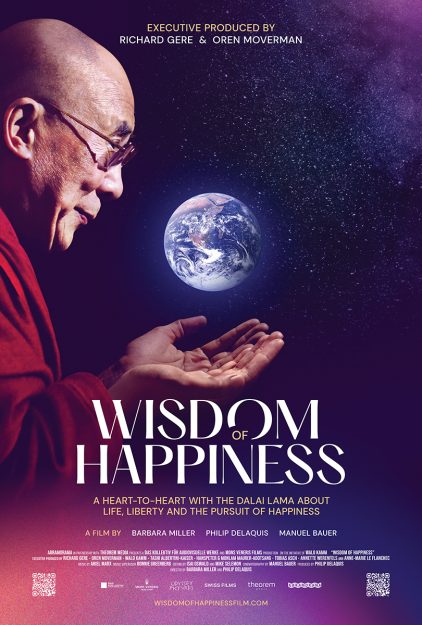
Wisdom of Happiness: A Heart-to-Heart with the Dalai Lama about Life, Liberty, and the Pursuit of Happiness
Directed by Barbara Miller and Philip Delaquis
Produced by Philip Delaquis, 90 min., 2025, film
For better and worse, the clear-sighted and radiant leader was Tibet’s best asset. But now, in his 90s, he lives quietly, entirely in India. The cause of Tibet has, understandably, been eclipsed by more recent dramas in Ukraine, Gaza, and elsewhere. Buddhism is less of a novelty now and more easily taken for granted. Even as the gradual, systematic eradication of Tibet intensifies on many fronts, we hear more about Taiwan and the Uyghurs.
This ebbing away of attention is a rending sorrow insofar as the Buddha’s teachings never grow old. Worse still, Tibet is ever more imperiled, and the Dalai Lama’s message of interconnectedness and tolerance seems more important than ever in an increasingly divided world. To see the so-called enemy as one’s teacher, to appreciate that the destiny of any one of us depends on the destiny of all, and to recognize that violence wins victories only in the short term, are exactly what we need today, and what our accelerating, short attention span world too often obscures. For fifty years now, the Dalai Lama has been spreading a vision of foresight and responsibility toward the environment, and now it appears to be almost too late to undo our heedlessness.
His Holiness begins by telling listeners to get rid of all expectations: There will be no miracles or blessings in this film.
I was jolted back into an awareness of all this as soon as I watched Wisdom of Happiness, a stirring and uncluttered new transmission of the Dalai Lama’s teachings put together by an ace team behind the camera—including Manuel Bauer, a longtime personal photographer of the Dalai Lama—and Tibet’s decades-old friend Richard Gere as an executive producer. The ninety-minute documentary has the feel of a master class delivered by a physician of the mind, recalling to us all that everyone has the capacity to develop clear-sightedness and, with it, hope. You won’t see the familiar images from the 1990s and 2000s, when the Tibetan leader was constantly traveling the world, magnetizing people with his kindness and laughter. Instead, we see rare footage of the man in his earliest years, complemented by current close-ups, as he looks us in the eye so we can bring full attention to everything he’s saying.
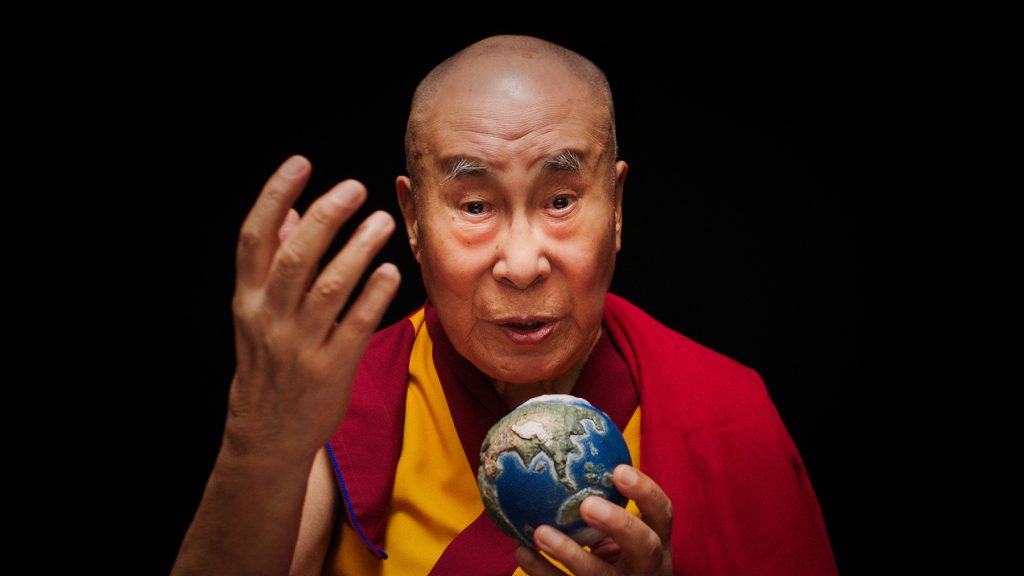
As ever, the message is universal and liberated from any talk of religion or a single doctrine. Characteristically, His Holiness begins by telling listeners to get rid of all expectations: There will be no miracles or blessings in this film. Instead, there will be the example of one human being prey to all the same impulses and concerns as the rest of us, showing, with crystalline logic, how any of us can get the better of them. Speaking entirely in lucid (though subtitled) English, without his glasses, set against a black background, he might be offering a one-on-one audience with each of us, about how we can cultivate both warmheartedness and “inner disarmament.” Since so many of our problems are caused by ourselves, they can be cured by nobody but ourselves.
The Dalai Lama delivers all this with an unaffected humility that I’ve seen melt the hearts of the most cynical journalists and wary heads of state. When placed on the Lion Throne in Lhasa as a 4-year-old, he had little interest in Buddhism. He admits that he just wanted to play. At times, he lost his temper, just as his father did, though he soon realized that the main victim of such anger was himself; when upset, he could no longer see things as they are. True to the Buddha’s example, he reminds us that if he, a fellow human, can use his mind (which is something more, as he explains, than the brain) to dismantle his afflictive emotions, so can we.

It’s powerful to see images of His Holiness in meditation, deeply serious, reciting in a nearly silent voice with eyes closed. In one striking image, we even see him as he might look when angry. Yet set against exquisite images of blue sky emerging from behind clouds, and with the Dalai Lama at two points leading us through an exercise in deep breathing, it becomes an almost visible lesson in how to find clarity and peace of mind in a world ever more on fire.
The Dalai Lama was, famously, a globalist and an environmentalist long before most of us had ever heard such terms. He rejoices in the fact that new technologies have both highlighted and extended the ways in which we’re all connected, and borders and denominations matter less and less. But what we do with those connections—in a world ever more cut into binaries—depends on our ability to see beyond the short term and the needs of our tiny selves and immediate neighborhood.
Over the years, the Dalai Lama has shared many of these principles before. Yet what is startling in this film—free of digressions and with nothing to show but images of our globe and the face of His Holiness—is how passionately and forcefully he conveys his message, aware of its mounting urgency. Set to lyrical music and drawing on images that Bauer has collected over thirty-five years, the result is a distillation of a lifetime’s teachings into a single, pointed summary.
We see many scenes that I’ve never witnessed in more than forty years of watching documentaries about the Dalai Lama. Images of him with his family when he was young, in Lhasa, and shots of him going on hikes and picnics in the hills after he first arrived in India. There are, as there have to be, harrowing images of both natural disasters across the planet and the violence that has been inflicted on Tibet over the last seventy-five years—temples reduced to rubble, people broken down in tears. Yet what is new, at least to me, is scene after scene of the very young Dalai Lama sitting among circles of Tibetan children in exile. This might almost be an image of what he is doing in this film, as he tries to offer us the practices that can guide us toward a better future.
Interspersed with these new scenes are magical images of our natural world and of practices that can stitch us together, bringing home all the beauty that surrounds us. Watching some of the shots—from our lives of rush and agitation—I recalled a Japanese friend recently telling me that the character for “busy” in her language means “losing your heart.” This film shows us, in practical, rigorous ways, how not to lose our hearts but instead to awaken them.
The mark of a visionary leader’s life is that his or her example keeps guiding us toward fresh possibilities for generations to come.
Near the end, the Dalai Lama shares a story that cuts to the heart of his purpose: A monk, worried that his teacher might not be around forever, is reminded that the lama is inside himself. You don’t need an external guide if you can genuinely recollect the capacity for transformation within. “Our strength is truth,” His Holiness declares, aware that the world is changing at every moment, which means that there’s no reason—ever—to give up on hope.
The mark of a visionary leader’s life is that his or her example keeps guiding us toward fresh possibilities for generations to come. Chuckling at times but more often looking at us directly and spelling out points with a full-throated immediacy, the Dalai Lama is telling us never to lose confidence in ourselves and never to get distracted from what he engagingly calls the “Big We.”
I truly hope everyone will see and benefit from this film, especially the young, who may feel overwhelmed by the issues of the day, and who will be reminded that everything depends not on what happens to us but on how we respond. All that many of us are crying out for, these days, so poignantly, is a sense of wider possibility.

Thank you for subscribing to Tricycle! As a nonprofit, we depend on readers like you to keep Buddhist teachings and practices widely available.