Growing up in rural Nepal, Samyak Shertok never thought he would become a poet. In his childhood village where he says the only sign of technology was his father’s transistor radio, Shertok encountered poetry solely through textbooks, and he assumed that in order to become a writer one had to have a PhD—or a long, white beard like Rabindranath Tagore.
After moving to the US to study psychology, Shertok came to understand the healing power of poetry by chance when he enrolled in a program at the Mayo Clinic. There, he worked with cancer patients to transform their stories into personalized poems. Upon seeing the impact the finished poems had on the patients, he learned the value of honoring people’s stories and came to recognize how “poetry can keep people alive in a certain way.”
This lesson hit home in April 2015, when a major earthquake struck Nepal, injuring thousands and leaving millions displaced. In the earthquake’s aftermath, Shertok launched Healing Through Poetry: Nepal Earthquake Relief Project, an initiative where he developed writing workshops to help survivors share their stories of grief and uncertainty—and voice their frustrations with the Nepalese government for the lack of support they received.
With his debut collection, No Rhododendron, Shertok brings a similar blend of elegy and political commentary, turning his attention to the aftermath of the Nepalese Civil War (1996–2006) that devastated his native country. In his careful excavation of grief and mourning, Shertok iterates on received poetic forms to develop a “new ghost language” that speaks to the ways that political violence continues to fracture and haunt survivors and their descendants.
For Shertok, this is one of the functions of poetry: to better understand these forms of haunting and, ultimately, through giving them language, to let them go. “Each poem is a being,” Shertok told the Nepali Times. “A poem begins with a haunting, and ends when you are able to release the haunt.”
–Sarah Fleming, senior editor
A Blessing
after Li-Young Lee
Twice a year Apa cooked his “monk’s half-moon” dish:
pumpkin blossom lamb curry—crackle the fenugreek seeds
in ghee, stir the thinly sliced baby pumpkins translucent,
add a concocted paste of wild herbs steeped in buttermilk overnight,
drop the smoked fatted lamb pieces, pour bone broth,
let the fat begin to melt, then spread the flowers whole on the top
until they’re dreaming—but before offering it to us over steamed rice,
even before his gods, he’d serve those who were not home,
place the filled clay bowls on the edge of the smoldering hearth
in a half-ring, always bigger portions than for those politely waiting
around him with clean wet hands, which made me wish
I were not there but forgot all about it as bite after bite
dissolved in my mouth, each mouthful lusher than the last, more
ravenous for the next: cliff-forged flesh, aged smoke,
foraged fragrance, rain-honeyed dark, earthed moonmilk,
petrichor pistils, salt, butter gossip of the butterflies, fire
of the fireflies, summer, sweet summer, sweet impossible summer—
How to Sky-Bury Your Father Tongue
July, Vermont Studio Center
One of the rooms is haunted the Resident Poet tells me,
handing the key. From my studio, the Gihon is green and barely
a creek. Yet this town with one bar and no coffee shop summons up
my birth village: the two-storied stone house, the water mill,
the suspension bridge, the Mikli-Phoom that spat out Jyojyo
still breathing . . . (I never went back after we moved to Kathmandu:
What was I so afraid of finding, of not finding?) And why am I,
who have always been afraid of the dark, disappointed
when she says Yours is not the one. While I was asleep an ocean away,
the Himalayas shook, everyone fled, the stone house collapsed,
then they remembered—the baby asleep in the cot
in the prayer room. My niece who was yet to be named. I wake up
to animal sounds coming from under my bed a week later at lunch,
the fiction writer from Alabama says in a calm voice.
Maybe a child was buried there says the multimedia artist. I say
nothing. The door-obsessed painter says I bet someone upstairs
is having sex. We laugh. A surrealist, the writer doesn’t request
a room-change. I think they’re trying to tell me something . . . If we haunted
a house without us ever knowing it. If the house mistook it
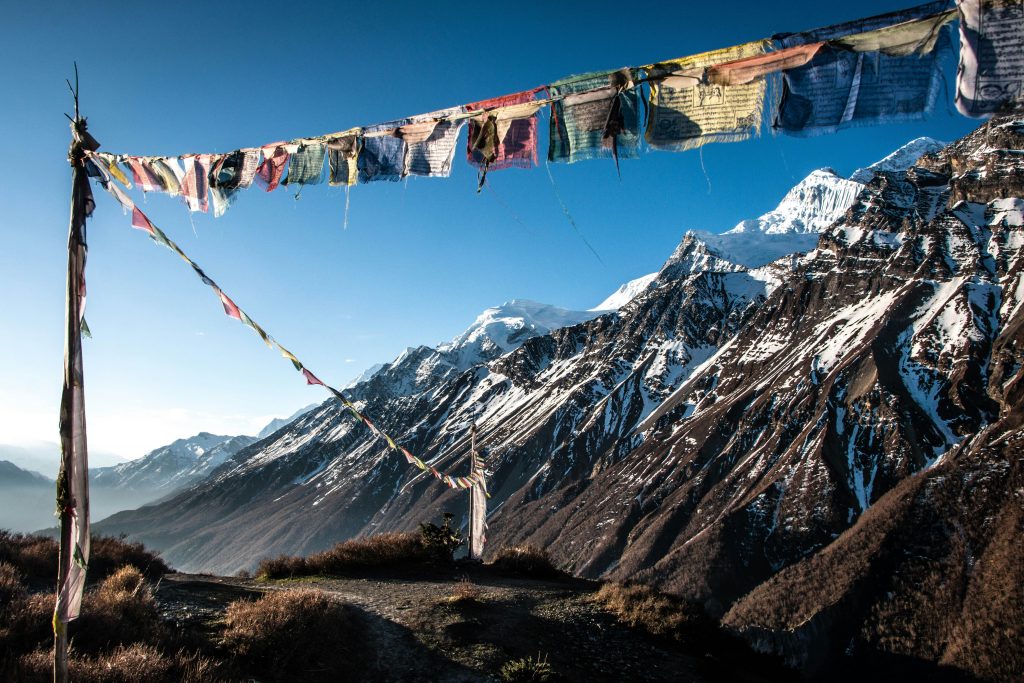
for a type of love. Beside Red Mill, the Buddhist prayer flags
whip in the rain: Wind Horse carrying the three jewels of the Buddha,
dharma, and sangha. Dragon, tiger, snow lion, and garuda guard
the four corners. The wind touches the mantra—and the sky
is purified. What do they say, these mantras? My father tongue
that I did not inherit. Apa tried, but before I could say water
in Lama, we both realized we’d rather go drown ourselves
in the Mikli-Phoom. The only Lama word I still remember:
Sertok. Golden steeple. The name he gave me. Always broke and
acrophobic: the irony is neither of us got irony. At the primary,
the Hindu Sirs who spoke only Devanagari heard Sher: Lion.
For once my classmates were creative: Sher-Tok. Lion, Bite!
Somewhere above the Atlantic, I settled on Samyak. Buddha’s Middle Way.
In honor of my devout Buddhist parents, I convinced myself,
looking at the whitest clouds. Messenger pigeons weave
and unweave a prayer shawl from the Red Mill roof to the Gihon
and back. Beneath the buckthorns on the bank, Houdini,
the Resident Cat, lurks . . . On the bridge, the Asian American artist
from New York calls me Sam again. I don’t tell her
what I said to the sophomore who did the same. Instead,
I think Gilded father tongue. I listen to the river reverie—the house
in Kathmandu waking to Apa’s foreign chants and later riding the currents
of his incantation coming through the brick wall, I’d begin
my own mantra of malleus, incus, stapes . . . Do things become
ghosts once we stop calling them by their names? And what
of the disappearing tongue, the one we never learnt?
In my studio, I sit cross-legged on the cushion by the window.
The wind fills the sky with pine needles, dead catalpa leaves . . .
When Houdini makes a pigeon disappear
inside his mouth and spits out the feathers, how much sky does he swallow?
When his prana wouldn’t release him days after he had stopped
speaking and I finally wanted to embrace him, Apa, go in peace,
why did I think, Do I have his permission? He held on to his breath
for nine nights—to say water? To whisper a name
I had long sloughed off? When he was finally freed of maya,
I was asleep in our second house to ward off the burglars. But what house
isn’t already broken into. Loss is a horse I carry on my back
strapped with burning prayer flags. I write these lines—and my niece
is still nameless. Outside the Meditation House, a robin thrashes
the window again and again, its claws scratching an illegible note
on the glass . . . If I carried the subterranean animals inside
my mouth against their will. If I haunted them every time I spoke.
The Last Himalayan Beekeeper
Let it be said Ama was the last
Himalayan beekeeper.
When she harvested honey barehanded
in the stone house we lived in, she took not juniper
smoke but song to the hive.
A home is one blossom
and a thousand stings.
The bees flew into her oiled black hair
and when she combed it, down
fell rhododendrons.
Let it be said not a single
bee stung her. The summer before I left
home, she fed me raw
honey from her palm every night.
In the dark I learned to hold
bees in my throat, one
for every ancestor. Let it be said
not a single bee died.
Now
every time I misremember the word
of the Horse-Ghost, I get stung
in the windpipe. With each perished
bee, Ama becomes
more smoke. Let it be said
if you plunge your hand into an abandoned
hive, you will still get stung. At night
Ama plucks stingers from my tongue
with her nails. Each barb she binds
to her lock, and her crown grows
more thorn than rhododendron.
Let me sky-bury them, Ama,
while they are still alive. No,
Tamang she opens
the wounds with crushed hooves
your mouth is our last hive.
♦
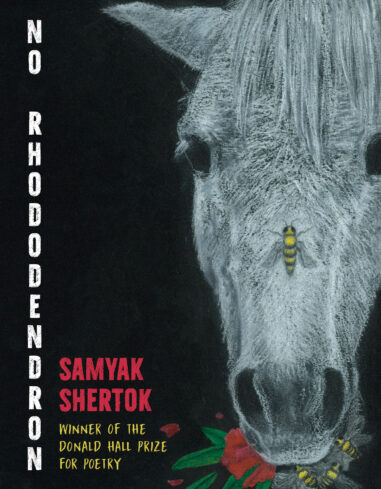
“A Blessing,” “How to Sky-Bury Your Father Tongue,” and “The Last Himalayan Beekeeper” from No Rhododendron by Samyak Shertok, © 2025. Reprinted by permission of the University of Pittsburgh Press.

Thank you for subscribing to Tricycle! As a nonprofit, we depend on readers like you to keep Buddhist teachings and practices widely available.