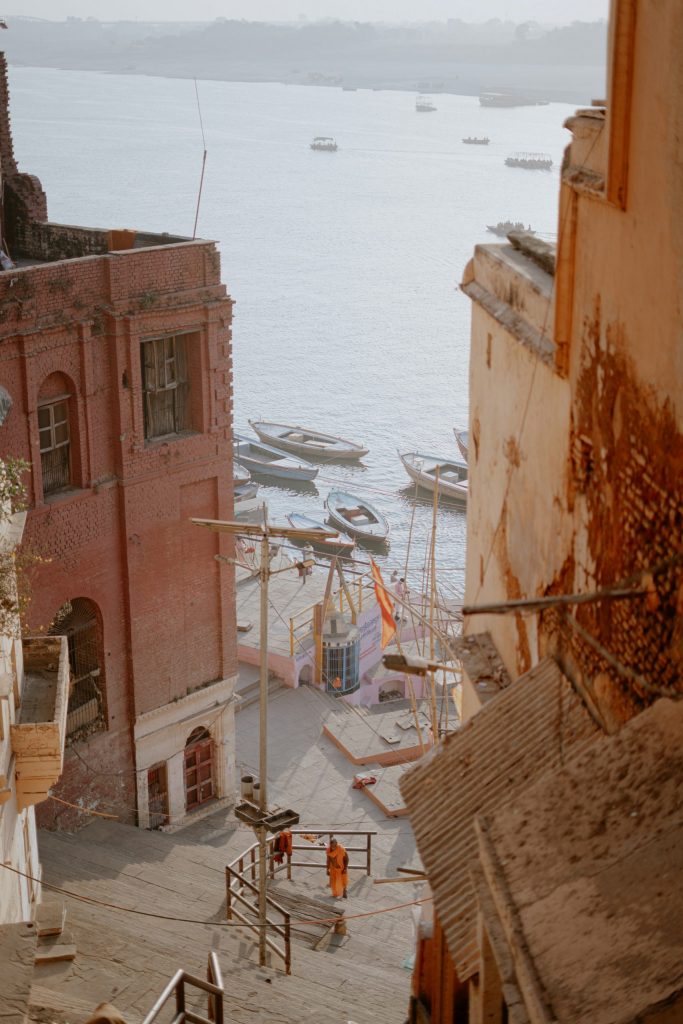
The gray-bearded holy man of Varanasi beckoned me over when we made eye contact. I’d been in this ancient, sacred city in northern India for a week and I’d walked past him several times, always sitting on a perch at the intersection of two narrow pedestrian lanes. Did he know I’d been having an existential crisis? Could he see it on my face? I took a seat next to Baba Mehdar Giri, who said he had come to Varanasi to die—ensuring that, as a Hindu, his death, cremation, and ashes thrown in the Ganges River would ensure he would go straight to nirvana, or moksha, as Hindus call it—and until that happens, he’ll remain on this perch, reading and meditating. As a white cow sauntered past, he said: “God is not looking at you. Ever.” He paused and looked at me. I felt a jolt of nervousness. “God is not a statue. You have to find god in you.”
He then added, “You have to know yourself, and then you will never be born again.”
“Easier said than done,” I told him.
He put his hand up, his index finger pointing heavenward, and said, “The key, my friend, is to. . . .” And just then I heard a cell phone ring. Baba pulled out a flip phone and spent the next sixty seconds talking in Hindi as I waited for his wisdom. “OK,” he said, snapping his phone shut. “The key is this: Impermanence,” he continued, pausing and staring deep into my eyes for a long three seconds. “Impermanence isn’t the source of suffering. It is your inability to recognize that wanting things to be permanent—when nothing in the universe is—is the true cause of suffering.” I felt my mouth drop, and before I could say anything, he said: “Truly embrace impermanence, and it will shape your life and change the way you live and love.”
And with that wise advice, I said thank you, steepling my hands at my chest, and then walked off toward the holy Ganges River. The next day, I was on a homeward-bound flight, thinking a lot about this conversation, realizing that whatever problems I had at that moment would no longer be problems in a week, in a month, in a year—or however long they would take to resolve. It took this simple piece of advice from an unexpected encounter with a sadhu, or holy man, to offer a rope ladder out of that pit I’d been trying to claw my way out of. This moment in Varanasi was a decade ago, and I’ve never lived or traveled the same since.
Travel changes you in the way that spirituality does too. They are companions.
And so went one giant epiphany in my life—one in which travel was a catalyst. Even if you don’t realize it, traveling is a spiritual experience. When you travel, you not only leave your family, friends, and possessions behind, you also leave yourself behind—your home self—and a different you emerges, perhaps one that is fresher, more vulnerable, more open to new ideas and things. You’ve put yourself in the hands of the world, and you’re hoping, wishing, they will take care of you. Travel changes you in the way that spirituality does too. They are companions.
It was fitting to have an epiphany about impermanence in Varanasi, as it is just five miles northeast from Sarnath, where the Buddha first introduced the world to the four noble truths. And since travel can be difficult at times, why not marry our spiritual and physical journeys, the four noble truths of travel.
The First Noble Truth of Travel: Travel Is Dukkha
The word “travel” is derived from the Middle English word travailen (to labor, toil, or journey) and the Old French word travailler, “to suffer.” That word comes from the Latin word, tripalium, an old Roman instrument of torture.
Travel, therefore, is rooted in suffering. Of course, no one needs to tell you that. You’ve likely experienced it. The delayed flights. The missed trains. The lost passports.
At 29 years of age, Siddhartha Guatama set out into the world to see the adinava—a Pali word that doesn’t have an exact translation but can mean drawback, defect, danger, hindrances—seeking to see the impermanence of life that is bound up with dukkha and eventually find a path to enlightenment.
As a career food and travel writer, I’ve experienced plenty sukha and dukkha—ease and dis-ease—while on the road, but it’s often the displeasing and difficult experiences that have stuck with me: food poisoning from a bad bowl of pho in Hanoi that caused a particularly potent E. coli infection and sent me to the hospital and left me bedbound for ten days; lost and, therefore, canceled credit cards that left me with little available cash while in Ethiopia; a bicycle accident in Berlin that won me a ride in an ambulance; street scammers in Mexico City. You get the idea. We have to accept that dukkha, or an unsatisfactory thing, is going to happen when we travel. The best advice is that we listen to Baba Mehdar Giri, the sadhu, in Varanasi, and “truly embrace impermanence.” Life might seem difficult the moment bad things happen on the road, but the feeling and situation is not permanent.
The Second Noble Truth of Travel: We Suffer When We Travel Because We Grasp
At Sarnath, the Buddha said that the reason we suffer is that we hold on to things when those things are impermanent. Attachment is the biggest obstacle to inner peace. And travel has a distinct way of causing dukkha.
I used to live in Rome, and was accustomed to strolling into my favorite restaurants and getting a table or exercising one of my “travel hacks” by going to the Vatican Museums after lunch when, as a sort of local, I knew there would be no line. I went back to Rome a couple of years ago, and I experienced some serious dukkha when I learned that nearly every restaurant I wanted to revisit was now booked for the entirety of my stay. There were lines around the corner at the Vatican at all hours of the day. Even the Pantheon, which was never crowded, now had a 500-person line to get in.
If we’re not mindful of attachment, it can add a destructive element to our trips. Instead of coming home and telling loved ones about how great your trip is, you might end up just complaining about all the things that didn’t go your way. The Buddhist idea of nonattachment in terms of travel isn’t about trying to have the perfect trip; it’s about not being restricted by your attachments.
When things don’t go my way on a trip, I try to remind myself of a favorite quote by Pema Chödrön: “When there is a great disappointment, we don’t know if that’s the end of the story. It may be just the beginning of a great adventure.”
The Third Noble Truth of Travel: The Path to Having a Better Travel Experience
“Let go or be dragged.” The well-known Zen proverb floats through my head a lot when I’m traveling. In the Buddha’s third noble truth, he says the cessation of dukkha can be resolved when we eliminate attachment, craving, and ignorance.
When I was first beginning as a travel writer, I went to Zagreb, the capital of Croatia, hoping to write about it. I didn’t know much about the city then, but it sounded exotic and interesting to me. After one day of exploring the town, I had a meltdown. I didn’t like Zagreb. The town wasn’t as aesthetically pleasing as, say, Venice, Prague, or Amsterdam; I hated the food; the locals weren’t particularly friendly. I wanted to leave, but I had just paid for five nights in a hotel in a city. But now, when I look back, I realized the true origin of my anger: I wanted so desperately to kickstart my writing career, and Zagreb was not going to be a catalyst for that. It also brought up lots of buried feelings of unworthiness. I wasn’t enraged at Zagreb and its denizens; the anger I was feeling came from within me. It was my own attachments that were dragging me.
Bad experiences and unexpected twists in my itinerary and expectations still occur when I am traveling, but these days I deal with them much differently. I excavate my feelings of anger as close to the origin as possible, reminding myself that I’m grasping, and then, like a palimpsest, uncovering the emotional layers to get to the seed of my displeasure. The Buddha said it more distinctly, “The moment you know how your suffering came to be, you are already on the path of release from it.” After all, pain does not decompose when you bury it.
The Fourth Noble Truth of Travel: The Right Way to Travel
In the last of Buddha’s noble truths, he lays out a path to living ethically and developing wisdom. In the case of travel, this means being a better, more respectful visitor to other people’s countries, regions, and towns; being mindful of our own biases and judgments; being aware of the types of businesses we’re giving our money to (like trying to support small independent businesses in order to create a more sustainable local economy). We should also consider having the right mindset for having conversations with other people when we’re traveling.
For example, in Rome in 2002, I went into a butcher shop. After I placed my order, the Filipino butcher asked where I was from. When he heard I was from the United States, he asked what I thought of the recent US-military invasion of Iraq. “I think we should definitely be dropping bombs on them,” I said. He looked surprised. And then I added, “But the type of ‘bombs’ that I’m talking about are washing machines, flat-screen TVs, stereos, and other things that will make their lives better, not worse.” The butcher looked astounded, his mouth agape. And then he said, “Are you sure you’re American?” I nodded affirmatively. “I’ve never heard an American who thought this way.”
Clearly, he hadn’t met enough Americans in his lifetime. But the point was: I managed to transcend what he thought was a stereotype of Americans: that we all have the exact same views as our government and are perfectly fine with war. Some Americans affix Canadian flags to their backpacks when they’re traveling abroad. My feeling about this has always been: Just don’t be a jerk; be a responsible, open-minded traveler and you will not have to pretend to be Canadian, but also you might help change some opinions—in a positive way—about Americans. This goes for any nationality, as no country’s citizens on earth are immune to being ugly travelers.
The artist, performer, musician Prince once crooned, “The only love there is, is the love we make.” This is true. But in terms of travel, “The only path there is, is the path we make.”
That path may or may not lead you to a holy man in Varanasi, but it may inspire you to be a wiser, more mindful traveler in the future.

Thank you for subscribing to Tricycle! As a nonprofit, we depend on readers like you to keep Buddhist teachings and practices widely available.