Flowers are the prayers of the vegetal world. The plants offer their beauty to the Supreme.
—The Mother, Flowers and Their Messages
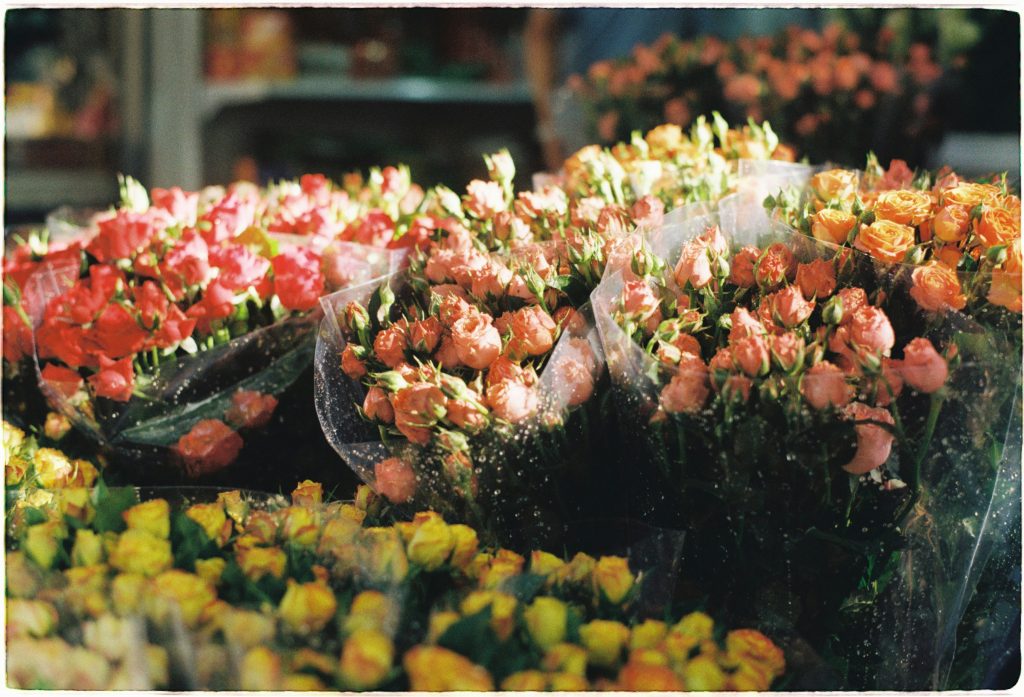
All my life I’ve been a sucker for beauty, especially beauty in the form of flowers, plants, and the natural world. I would rather go without food than without flowers. It sounds dramatic—and that’s real for me. I recall a time years ago when I was desperate to touch the natural world. I was living in a third-floor walk-up hall room in Queens, working at Burger King, and going to City University of New York in Manhattan at night. On my way to school one day, I passed a street vendor selling roses by the bundle in colors of peach, scarlet, and magenta. Time stopped as I stared at them. I heard them whisper two words to every part of my body: “Take me.”
In those days I had a skin-tight budget and lived mostly on chicken livers at less than one dollar for a small container, which I could buy at a cut-rate grocery store down the street. I looked at the flowers. They looked at me. I calculated the cost in my head. Twenty bucks. TWENTY BUCKS. I looked at the vendor, a savvy, street-smart Latinx man with a baby face and hefty hands. He saw my dilemma; he had seen this before. The flowers would cost my entire food budget for the week. I knew (and he knew) the flowers were outside my budget, but that was alright because I wasn’t buying roses. I was buying the luxurious, overabundant desire to touch and smell something beautiful, like spring wind in a turquoise sky, warm rain pooling in the moonlight, or a slow lifting fog, and that was priceless, so the roses were a bargain.
Roses remind me of the importance of beauty for beauty’s sake. Beauty is complete and gives generously. It is a homecoming that excavates an inner sensitivity and sureness that is present, waiting, and expectant. Growing up in Brooklyn, I knew the natural world was there, generous and beautiful, of course, but at that time it seemed distant, rough, and inaccessible. The gentle sun came up and set over the parched terrain of Bushwick’s row homes, concrete sidewalks, and chain-link fences. To see and feel grass, my brothers Alex and Robert and I would run through Evergreens Cemetery on Bushwick Avenue, one of the great urban forests of New York City, paying little or no mind to the lives marked by tombstones. We were there to smell the green, green grass and feel it squishy under our sneakers and get close to muscular trees like a hundred-year-old sweet gum, black oaks, and white ash trees. We were chasing an emerging feeling, a fleeting sense of the timeless present, moments that glow in their luminosity and cannot be possessed but are lived with a slower presence of the immediate now.
For me, this time spent at Evergreens was more than dodging city streets. I was safe among the trees and flowers emerging in the spring, and the leaves falling in autumn. They wanted nothing from me and gave me beauty not as a luxury concept but as a birthright to be known, felt, and lived. My mother, a single parent working two jobs to support four kids, took in boarders in our sturdy brick house with oak doors and beveled glass. She filled every room, including the tiny hall room, little more than a closet, with older alcoholic Black men who had seen better times. Innocent and available, I was left in the house and subjected to sexual abuse by these tenants until they left or ran out of money to pay rent. The terror of the abuse in this strange place was adjacent to the beauty of Evergreens, the daffodils and cherry blossoms in spring, the autumn leaves in full glorious color. Even with the terror, or perhaps because of it, I held on to the beauty of Evergreens that could not be damaged, destroyed, or diminished, that was beyond the physical landscape and pointed instead to a horizon within me, tranquil and unstained.
I was safe among the trees and flowers emerging in the spring, and the leaves falling in autumn. They wanted nothing from me and gave me beauty not as a luxury concept but as a birthright to be known, felt, and lived.
That moment with the street vendor years ago led me to a lifelong love of not just roses but also flower gardening. When I moved from Brooklyn into my barn-like home outside Philadelphia, and after my husband left and we divorced, I set out to create something beautiful from the death of the marriage, to transform the “mud” of the marriage into a “lotus” garden. To paraphrase Wendy Johnson, one of the founders of the Garden Program at Green Gulch Zen Center in California, there are three good reasons to grow flowers: for beauty, for the coming apart of beauty, and to begin again. This wisdom aligns with many Buddhist teachings and, for me, especially the teachings on impermanence (anitya). The beauty of growing flowers is a living lesson on impermanence.
The Buddha asked all practitioners to manifest, moment-to-moment, the insight of impermanence. As a Dharmacharya, a dharma teacher in the Plum Village tradition, I feel especially drawn to learn the inescapable reality of impermanence not as a theory but as an ongoing realization and practice I can share with others. Ultimately, everything and everyone changes despite sometimes resisting change. Flowers decompose; a child becomes an adult; day becomes night. This calls for practice with the shifting nature of reality: to love, to care, to accept, to occupy space and time, to release, to let go.
This loving and letting go is the essence of gardening, and it was a lesson I relearned in my garden through an old flowering Wisteria sinensis. When I moved into my home, the wisteria grew over the cottage roof and threatened to rip off the shingles with its branching, leafless, wooden tentacles. Slowly, little by little, I cut back the vine and trained it over a substantial wooden pergola. In late spring, the plant bloomed a voluptuous cascade of blue to purple flowers, perfuming the air. Impermanence teaches that things ripen, flower in their time, and fade away in a continuous cycle of beauty, being, becoming, and nonbeing. It teaches gratitude and appreciation for the unrepeating wonder of each day, each moment.
Impermanence teaches that things ripen, flower in their time, and fade away in a continuous cycle of beauty, being, becoming, and nonbeing. It teaches gratitude and appreciation for the unrepeating wonder of each day, each moment.
What have I learned from this experience? Because of impermanence, I have learned that I can change my relationship to the abuse that happened to me. I acknowledge the beauty and violence inherent in life. I am aware that the people who abused me were abused themselves and were caught in a system and structure that perpetuated their despair and depredation. I’m aware of both the violence I experienced and the beauty of the Evergreens. Today, both the beauty and the violence are available to support me in transforming my life to be of service to others, to grow compassion not only for myself but also for victims and perpetrators of violence and abuse.
♦

From Love Is Liberation: Five Contemplations for Daily Ethical Living (2026), courtesy of Parallax Press, parallax.org.

Thank you for subscribing to Tricycle! As a nonprofit, we depend on readers like you to keep Buddhist teachings and practices widely available.