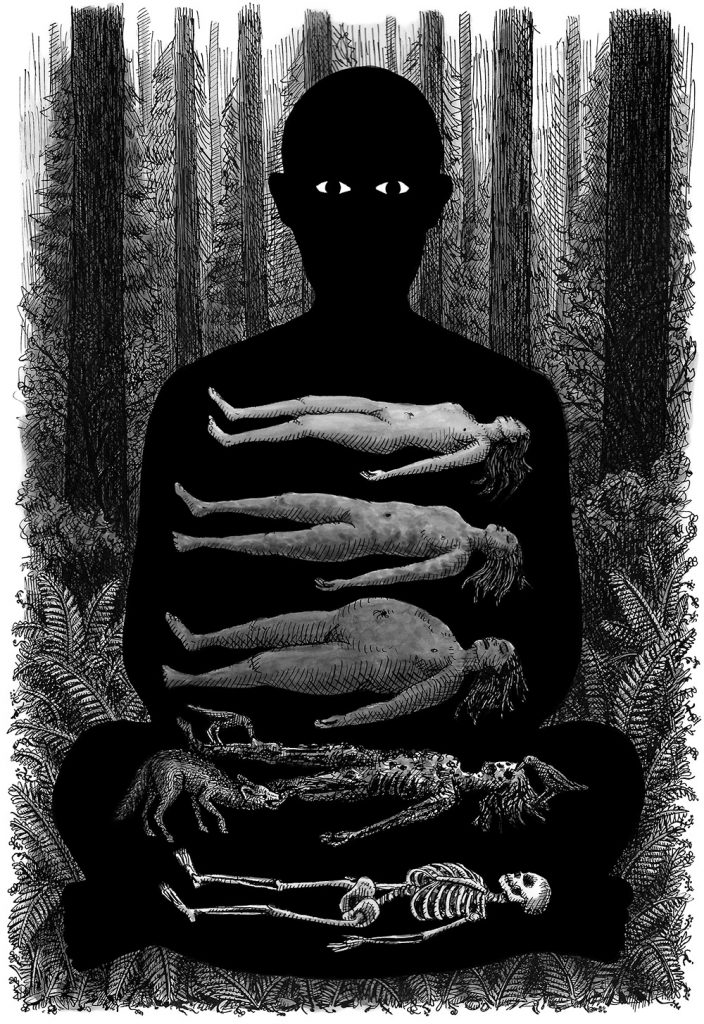
The nature of all good things is that they come from things that aren’t good, just as lotuses that are fair and lovely are born from mud that is filthy and repulsive; yet once they rise clear of the mud, they are clean and pure, becoming a fitting headdress for a king, a viceroy, or a courtier, never again returning to the mud. In this they are like the earnest meditator, one engaged in a persistent effort. Such a person must investigate a thing that is filthy and repulsive if the mind is to gain release from all filthy and repulsive things. The “thing that is filthy and repulsive” here is the body. The body is an assemblage of filth, urine, and excrement. The things that are exuded from the hair of the head, the hair of the body, nails, teeth, skin, and so on are all forms of excrement. When they fall into food, people take offense at it. The food has to be thrown out, for no one can stomach it. Moreover, the body has to be constantly washed and scrubbed if it is to look presentable. If we don’t clean it, it will smell rank and no one will let us come near. Clothing and other accessories, when they are apart from the body, are clean and attractive, but as soon as they come into contact with the body they become dirty. If we let them go without washing for a long time, no one will let us come near, because of the smell.
From this we can see that the body is a house of urine and excrement, asubha—unattractive; patikkula—repulsive. When still alive, it’s bad enough; when there is no more life to it, it’s even more disgusting, to the point where nothing else can compare. So from the very beginning, all earnest meditators investigate the body methodically until they have it mastered. Before the body becomes clear, they investigate whichever part or aspect of the body is agreeable to their temperament until a particular aspect of the body appears as an uggaha nimitta. Then they focus on that aspect, working at it and developing it repeatedly.
“Working at it and developing it repeatedly” should be understood as follows: When rice farmers grow rice, they work in the soil, plowing the soil and planting rice in the soil. The following year they grow rice in the soil again. They don’t grow their rice in the air or in the middle of the sky. They grow it only in the soil, and the rice then fills their granaries of its own accord. When they work repeatedly in the soil, they don’t have to plead, “Rice, O rice, please come and fill our granaries.” The rice pours in of its own accord. And even if they forbid it, saying, “Rice, O rice, don’t come and fill our granaries,” if they have completed their work in the soil, there’s no doubt but that the rice will still come and keep their granaries full.
In the same way, we as earnest meditators should keep investigating the body at the point that is agreeable to our temperaments or first appears for us to see. No matter what, we should not neglect or abandon that point. Working at it repeatedly doesn’t refer only to the practice of walking meditation. We should be mindful, continuing our investigation in all places and at all times. Sitting, standing, walking, and lying down; eating, drinking, working, speaking, and thinking, we should always have all-round mindfulness of the present: This is what is meant by “working at it repeatedly.”
Once you have investigated the body until it is clear, you should then consider dividing it up into its various parts, using your own way of being methodical. Separate the body into the elements of earth, water, fire, and wind, examining it until you really see it in those terms. At this stage, you may use any strategies of your own devising that are agreeable to your temperament, but you must not in any event abandon the original reference point that first appeared to you. Don’t investigate once and then let it go for half a month or a month. Investigate in and out, back and forth, again and again. In other words, withdraw inward to quiet the mind and then come out again to investigate the body. Don’t exclusively investigate the body or exclusively quiet the mind.
A person who wants release but who practices wrongly or doesn’t practice—and wastes his time being lazy until the day he dies—won’t meet with release at all.
When you have investigated in this way until you have it thoroughly mastered, what happens next is what comes of its own accord. The [six senses of the] mind are bound to converge in a big way; and the instant it converges, everything will appear to converge, being one and the same. The entire world will be nothing but elements. At the same time, an image will appear of the world as being level as a drum head, because the entire world is of one and the same inherent nature. Forests, mountains, people, animals—even you yourself—will all ultimately have to be leveled down in one and the same way. Together with this vision, knowledge arises, cutting off all doubts in the heart. This is called yatha-bhuta-nana-dassana vipassana: the clear insight that both knows and sees things for what they actually are.
This step is not the end point. It is the beginning of the next stage we have to practice, which we as earnest meditators are to work at and develop repeatedly in order for heightened awareness to be mastered and complete. Then we will see that the mental fashionings that suppose, “This is mine. . . . That is me,” are inconstancy; and that because of attachment they are suffering—for all elements have been the way they are all along: arising, aging, growing ill, and dying, arising and deteriorating since before we were born. From time immemorial, this is the way they have been. But because the conditions of the mind and the five khandhas have fashioned and labeled throughout every existence up to the present, through lives too numerous to number, the mind has been deluded into following its supposings. It’s not the case that our supposings have attached themselves to us. When you come right down to it, there’s no doubt that all phenomena in the world, whether endowed with consciousness or not, have been the way they are—arising and deteriorating on their own—in just this way.
Thus the earnest meditator comes to analyze things down in line with their inherent nature, seeing that sabbe sankhara anicca, sabbe sankhara dukkha: Acts of mental fashioning—the conditions of the mind—are what is inconstant. The world of living beings is constant: It is simply the way it is. Analyze these things in terms of the four noble truths as a way of rectifying the conditions of the mind, so that you can see for certain, in your own right, that these conditions of the mind are inconstant and stressful. And the fact that you haven’t seen in your own right that they are inconstant and stressful is why you have fallen for mental fashionings. When you truly see this, it will rectify the conditions of the mind. The realization will come to you: sankhara sassata natthi. “There are no mental fashionings that are constant and lasting.”
Mental fashionings are simply conditions of the mind, like mirages. As for living beings, they have been a constant feature of the world all along. When you know both sides—i.e., that living beings are simply the way they are, and that mental fashionings are simply a condition of the mind that supposes them—then thitibhutam, the primal mind that has no conditions, can gain release. As for the teaching that all phenomena or regularities of behavior are not-self: How could they be the self? Their business is simply to arise the way they do. Thus the Buddha taught: sabbe dhamma anatta. “All phenomena are not-self.”
We as earnest meditators should investigate things to see them clearly in this way, until the mind is made to converge, enabling us to see truly and vividly along these lines in our own right, at the same time giving rise to the knowledge that accompanies this vision. This is what is meant by vutthana-gamini vipassana (clear insight leading to emergence). We should work at this stage until it is mastered, until we see truly and clearly, along with the full convergence of the mind and its concurrent knowledge, converging against the current, curing the latent tendencies, turning supposing into release; or until we converge on the primal mind that is simply the way it is, to the point where it is absolutely clear, with the concurrent knowledge: khina jati nanam hoti. “There is the knowledge of no more birth.”
This stage is not an assumption or a supposition. It isn’t anything fashioned or conjectured into being, nor is it anything that can be obtained by wanting. It is something that arises, is, and knows entirely of its own accord. Intense, relentless practice in which we analyze things shrewdly on our own is what will cause it to arise of its own accord.
Don’t investigate once and then let it go for half a month or a month. Investigate in and out, back and forth, again and again.
This has been compared to rice plants. Once we have properly nourished and cared for the rice plant, the results—the grains of rice—are not something that can be obtained by wanting. They will appear of their own accord. If a person who wants to get rice is lazy and doesn’t care for the rice plant, he can keep wanting until the day he dies, but no rice grains will appear for him. The same holds true with the reality of release: It isn’t something that can be obtained by wanting. A person who wants release but who practices wrongly or doesn’t practice—and wastes his time being lazy until the day he dies—won’t meet with release at all.
♦
From A Heart Released: The Teachings of Phra Ajaan Mun Bhuridatta Thera by Phra Ajaan Suwat Suvaco, translated from the Thai by Thānissaro Bhikkhu.

Thank you for subscribing to Tricycle! As a nonprofit, we depend on readers like you to keep Buddhist teachings and practices widely available.