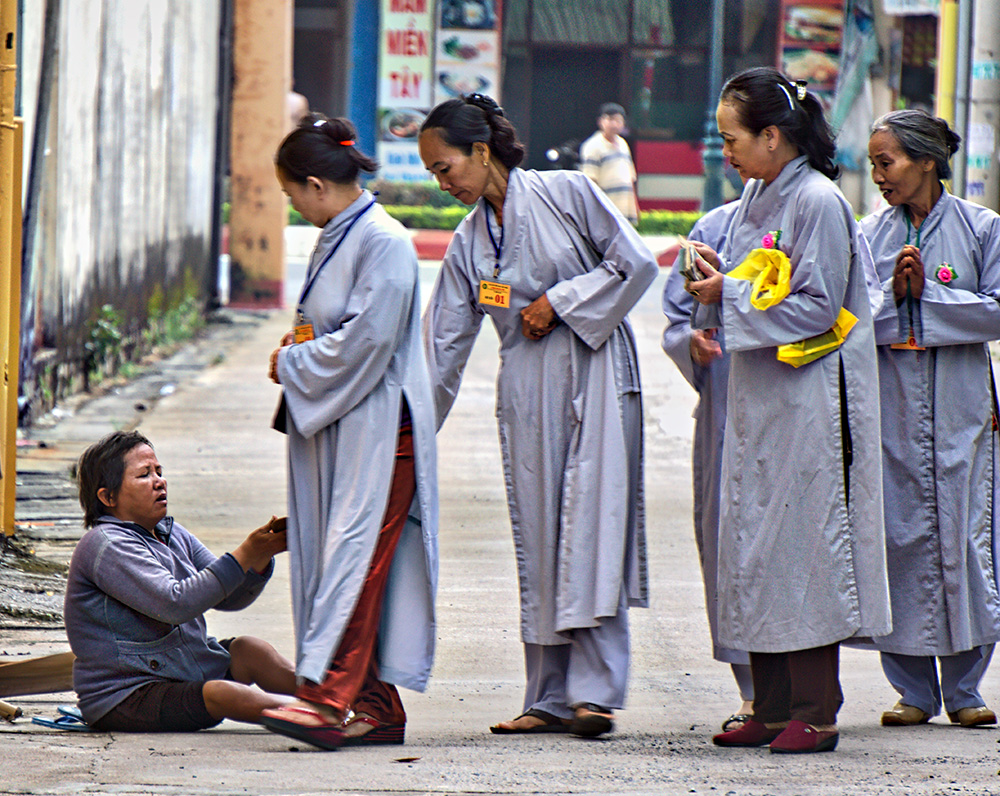
When I was growing up, the youth group at my Pure Land temple in Raleigh, North Carolina, held a yearly charity fundraiser. Dozens of us gathered in my family’s home, making thousands of spring rolls by hand, fulfilling hundreds of orders. We sent the proceeds to Buddhist temples in central Vietnam that distributed aid to impoverished families. As a teenager, I saw this annual ritual as simply part of being Vietnamese and Buddhist. We were a community whose care extended to people suffering on the other side of the world, in the homeland we had fled.
Sara Ann Swenson’s Near Light We Shine: Buddhist Charity in Urban Vietnam gave me a new understanding of the practices that I grew up with. Swenson, an assistant professor of religion at Dartmouth College, spent four years conducting fieldwork in Ho Chi Minh City, interviewing more than 400 charity volunteers across twenty-five groups. Her resulting ethnography examines Buddhist charity not just as a transfer of resources from donors to recipients but as an intricate web of emotion, morality, politics, and spiritual aspiration. In a country where political organizing and public protest are restricted, Swenson argues, the act of giving becomes a subtle yet powerful form of agency through which ordinary people assert their values and their visions for what society should be.
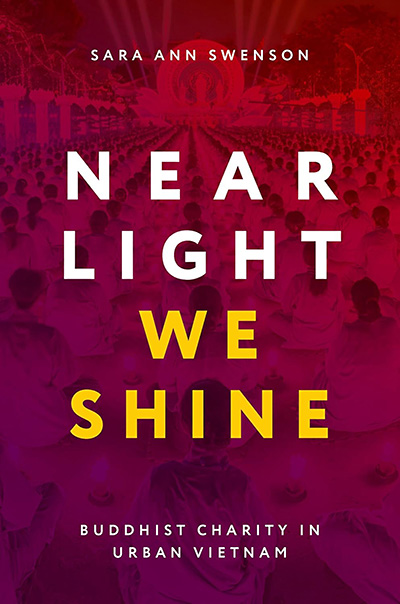
Near Light We Shine: Buddhist Charity in Urban Vietnam
by Sara Ann Swenson
Oxford University Press, 2025, 238 pp., $99.00, hardcover.
Near Light We Shine opens memorably with Swenson stranded at a stoplight in downtown Saigon. She and her companion, a 24-year-old volunteer named Truc, have just watched their moped die in traffic. Rather than abandoning the meals they had been delivering to unhoused residents, Truc decides they will continue on foot. Over the next several hours, the two women carry boxes of food and milk pouches more than six miles through the sleeping city. As they leave their last package near an elderly man asleep on a rickshaw, Truc muses that he will wake up and be moved that someone noticed and wanted to care for him. Although the meal will no longer be warm, its purpose was never just nutritional. In Truc’s view, the most important aspect of charity is the expression of love. When love spreads, karma shifts—and when karma shifts, society improves.
This scene highlights Swenson’s central insight that Vietnamese Buddhists understand charitable giving as much more than material exchange. Genuine feelings of comfort, love, and happiness are core to the act of giving because these emotions ripple outward through karmic networks spanning this life and countless others. This belief is expressed in the Vietnamese axiom from which the book draws its title: “Near ink, we darken; near light, we shine” [Gan muc thi den, gan den thi sang]. Swenson describes this kind of charity as an “affective politics” of care that demands social change by resisting trends toward isolation and individualism. Across seven richly narrated chapters, she shows how a fundamental belief in karmic transformation unites her diverse cast of volunteers, even when they disagree about nearly everything else.
One of the book’s greatest strengths is its refusal to flatten the world of Vietnamese Buddhist charity into a single narrative. Swenson moves between dramatically different groups—from queer tattoo artists and gig workers who use charity events as a form of alternative youth culture, to retired female government employees and veterans who channel their Communist ideals into infrastructure projects, to trained social workers who provide long-term care for children with HIV/AIDS. This range of characters illustrates Swenson’s insight that Buddhist charity consists of many overlapping social and moral worlds, held together by a shared orientation toward karma.
Each group defines “true charity” differently. Some believe the donor’s emotional intention matters most, while others insist on lasting structural change. Some practice “compassion with responsibility” by excluding those they see as perpetuating bad behaviors, while others embrace mutual culpability and vulnerability across all parts of society. Some fear the karmic bonds that form between giver and recipient, while others embrace them as the very foundation of generosity. These tensions are never resolved. Instead, Swenson lets the disagreements reveal what is at stake for the volunteers as they seek to embody what it means to give well.
The act of giving becomes a subtle yet powerful form of agency through which ordinary people assert their values and their visions for what society should be.
Swenson writes with a vulnerability that is rare in academic texts, and this openness deepens her analysis rather than distracting from it. At one point, a volunteer corrects her Vietnamese, saying that one cannot “research” people but only “seek to understand” them. It’s a moment that highlights the personal stakes of her work, which grows out of genuine connections with the people she studies. She describes being brought to tears alongside volunteers, sleeping beside them on overnight buses, babysitting their children, attending weddings and funerals, and accepting a haircut in one of their kitchens. These personal moments mirror the care that her subjects practice, and by including them, she infuses her scholarship with the warmth and narrative drive of a memoir.
Swenson observes how volunteers’ socioeconomic backgrounds, life experiences, and political ideals shape their approaches to giving, and some of the book’s most touching passages emerge from their contrasting stories. In one chapter, we meet Hong, a widowed single mother in her 40s who cooks and distributes meals to people asleep on the sidewalks on her commute to work. While facing her own grief and financial hardships, Hong gives out of solidarity with those around her and reminds Swenson that “what is given does not matter so much as the way it is given.” In another chapter, members of the Bridge of Love Foundation, mostly women veterans over age 60, sing revolutionary songs on their way to the Mekong Delta to commemorate new bridges funded by wealthy donors. A Vietnamese American sponsor who fought on the opposite side of the war joins them, and the women joke about poisoning him over lunch. These moments of quiet self-awareness and dark humor show how wounds can be healed and commonalities found through the practice of charity. Volunteers are not just giving to help others, they are transforming their own lives.
Reading her descriptions of these charity organizers, I saw my own family reflected in Swenson’s subjects. I recalled how my aunt, who hosted me during my research trips to Ho Chi Minh City, packed hundreds of bags of dry goods at her house, led charity trips to orphanages and hospitals, and proudly posted photos on Facebook documenting each visit. Through her charity work, my aunt found purpose in retirement and formed a community full of laughter, friendship, and its fair share of interpersonal drama. Swenson captures this world of Vietnamese charity with an intimacy that rings true to me, as someone who has witnessed this culture both in my family and through fieldwork as a historian in the same city.
Near Light We Shine raises a provocative question about the relationship between Buddhist identity and Buddhist practice. Although her subject is Buddhist charity, many of Swenson’s interviewees do not formally identify as Buddhist. Some distrust the state-controlled Buddhist institution yet hold Buddhist beliefs about karma, merit, and reincarnation. Others come to charity through secular motivations like social networking, patriotic duty, or professional training, only to find themselves working within a fundamentally Buddhist ethical framework. In Swenson’s analysis, what makes all these different people and organizations Buddhist is their shared orientation toward karma. This broad understanding of what counts as Buddhist practice will resonate with readers who have witnessed a similar evolution of Buddhism across North America and Europe, among practitioners who may never call themselves Buddhist yet organize their spiritual and moral lives around Buddhist principles.
The question at the heart of this book extends well beyond Vietnam and beyond Buddhist communities: Whose responsibility is it to care for people? Swenson shows how charity in a socialist state can function as both a fulfillment of state ideology and a critique of the government’s shortcomings. The volunteers in this book use charitable giving to assert their own moral authority, to build community in the wake of retirement or migration, and to express agency when formal political channels are closed. As one volunteer said, “You don’t have to wait until you’re a billionaire—just do anything you can do.”
When love spreads, karma shifts—and when karma shifts, society improves.
The only limitation I noted is that readers may wish for more sustained engagement with the perspectives of charity recipients themselves, whose voices appear only briefly. Swenson acknowledges this, and her focus on volunteers is deliberate and methodologically sound. But given her core claim that charity is a relational, karmic exchange affecting all parties, this asymmetry leaves room for future study.
Near Light We Shine arrives at a moment when conversations about engaged Buddhism often center on institutional programs or high-profile teachers. Swenson redirects our attention to something subtler: the volunteers who cook and pack meals at midnight, who play with orphaned children, who hold the hands of the sick and elderly sleeping in shacks on the streets. Their work may not register as political advocacy or a social movement. But as Swenson writes in her closing pages, giving is an act of hope, and perhaps these efforts will shape the future of Vietnam, and of our world, in time. For those of us who grew up volunteering and fundraising, or who have wondered whether small acts of compassion really make a difference in a suffering world, this book offers both recognition and a deeply affirming answer.

Thank you for subscribing to Tricycle! As a nonprofit, we depend on readers like you to keep Buddhist teachings and practices widely available.