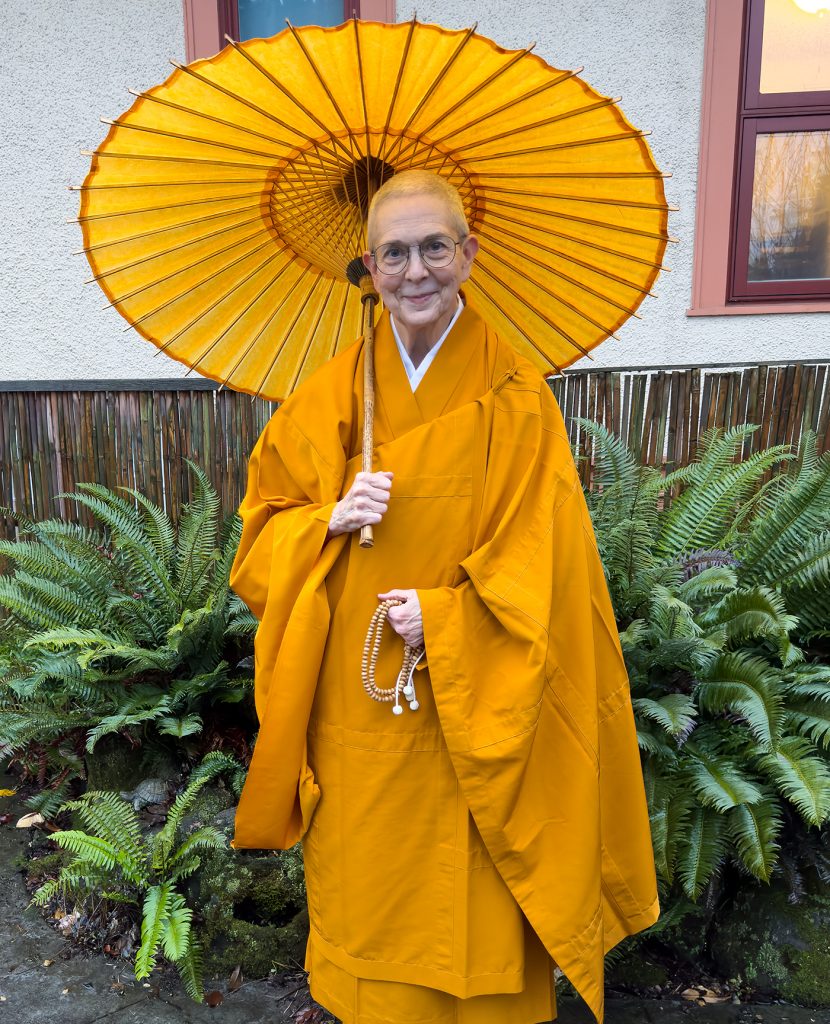
While attending an art history class at a Japanese university during her senior year abroad in 1980, Rev. Eko Noble—then Susan Noble—was very taken with mandala images of Shingon Buddhism, a Japanese Vajrayana school founded by Kukai, posthumously known as Kobo Daishi (774–835 CE). She asked her professor how to study Shingon more closely. He told her, “They’ll never let you in. You have to go study Zen.” She went to a Soto Zen temple and learned to sit zazen but didn’t give up on Shingon. On returning to New York, she learned of a Shingon priest teaching quite openly—surprising, given Shingon’s secretive reputation. “I thought, this is a rather extraordinary opportunity I couldn’t have in Japan. So I began to study, and the nature of the practice was compelling: visualizations, mudras, mantras. It was clear that this was a very good path for me. So I dove in.”
Shingon’s esoteric practice is not generally well understood in the West, but according to Noble, there is some overlap with Tibetan Vajrayana: “It is remarkably similar in terms of formal initiation, recitation of mantra, mudra, and visualization. Shingon meditation uses breathing, images of a full moon, and the Sanskrit seed syllable A as anchors.” Periods of meditation are perhaps longer than in Tibetan Buddhism, depending on the lineage—more like thirty or forty minutes, as one might see in Zen. “Scholars point out that there is no direct lineage connection between Shingon and Tibetan Buddhism,” Noble said. Both share roots in Indian Esoteric Buddhism but from different periods of development. “Shingon is a very well preserved form of 6th- and 7th-century Indian Esoteric Buddhist practice, transmitted through China and maintained uniquely in Japan for over 1,200 years.”
Noble’s initial pull toward Shingon was very much self-directed. Shingon did no proselytizing at that time and doesn’t do much now. In 1987, she headed to Mount Koya, Japan’s Shingon hub. “There was a lot of complexity around getting permission to even take the entrance exam,” she said, adding that Mount Koya “is famous because for over 1,000 years women were never allowed to set foot there.” But persistence paid off: “I ended up being the first non- Japanese, male or female, to go through their main monastic training system.”
“It was clear that this was a very good path for me. So I dove in.”
Her root teacher at Mount Koya was Zengan Kogi Aratano. “He was born in 1904 and had a traditional but liberal education for his time,” Noble said. “He spent six years in Hawaii as a missionary in 1931, returning to Japan before the war. He was not an aristocrat but had a university degree, was very well educated, and found himself ministering to faithful Japanese laborers in the pineapple fields. He came to love the culture of Hawaii. He was open to disciples from other cultures, and very supportive.”
When asked why contemporary practitioners might study an ancient esoteric school like Shingon, Noble answered, “In Shingon, sadhana (practices) frame and guide your spiritual development in much the same way that’s been done for centuries. That’s amazing, to literally feel that historicity. As modern Americans, I think we may long for that sense of continuity. And it offers both focus and expansiveness of view, philosophically, pointing to timeless enlightenment.”
Noble’s center, the Radiant Light Sangha, is in Portland, Oregon, but her students are far-flung. Noble has not been offering public teachings for a few years now, supporting students online due to her medical challenges. During a three-year residency at an old temple in Nara, Japan, Noble became ill, and it took many years of sleuthing to discover both the cause and effective treatment. “The main hall of that temple, unbeknownst to me, had been treated with mercury-containing insecticides,” she said, and this exposure dealt lasting damage to her health. The yearslong healing journey has led her to the discovery of nontoxic ways of living and environmental health advocacy for others. Her current passion project is nontoxic tiny homes. She lives in one herself, a prototype that resulted from years of research and experimentation.
“Japanese Buddhism has substantially changed in modern times, and now it’s experiencing a decline, though younger clergy work hard to both maintain traditions and address changing needs,” Noble said. “I’m looking at the lesson of Buddhism’s relevance for truly benefiting others, how to skillfully bring this dharma home to postmodern democratic Western culture. It’s a big theme in my work.”

Thank you for subscribing to Tricycle! As a nonprofit, we depend on readers like you to keep Buddhist teachings and practices widely available.