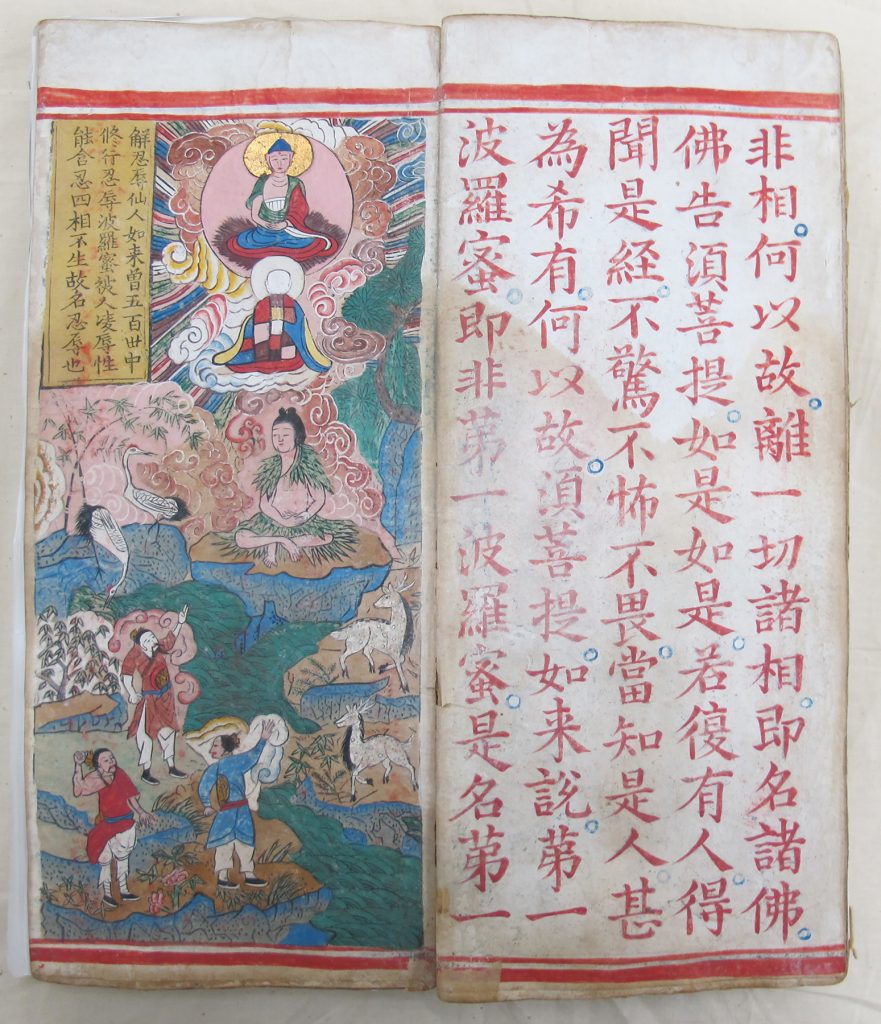
My hope for these notes is that they inspire you, the reader, to take up the practice of sutra reading—in this case, reading sutras aloud while standing. This practice engages your whole being, body, speech, and mind. Sutra reading goes back hundreds, if not thousands, of years, but it has fallen out of fashion, especially here in the West. That is regrettable, because to stand and read aloud a sutra or any other text is one of the best ways to form a relationship with that text. It is also the best way to create the conditions in which you absorb directly what a text has to offer without depending on conceptual understanding.
As in formal meditation practice, choose a well-lit place where you are free from disturbances during your reading session and the sound of your voice does not disturb others. For the Diamond Sutra, it is best to read the whole sutra in one reading—about forty minutes in all. If that is not possible for you, then read a portion of it every day. When you have completed the sutra, then start from the beginning again.
Body
Stand with your feet about shoulder-width apart, your weight evenly distributed, with a little more than half your weight on the balls of your feet. Let your body straighten, as if you are being pulled up slightly by a thread connected to the very crown of your head. When you do that, your body straightens naturally, your head is level, your chin comes in slightly, and your spine and pelvis support your whole body. During the reading session, you may find it helpful to change the way you are holding the book or to shift your weight a little from one foot to another, but, for the most part, keep your weight evenly distributed and your body straight but relaxed. Initially, you may feel some discomfort, but after a few days, your body adjusts to standing, your legs and other muscles become stronger, and the small secondary muscles that keep you in balance naturally come into play.
If, for whatever reason, you are unable to stand, then read it in a sitting position. This is not an endurance practice. The aim is to build a relationship with the sutra in body, speech, and mind. Strain in the body is neither necessary nor helpful.
Position the sutra in front of you in a way that makes it easy to read. This edition of the sutra is probably light enough to hold in your hands. With other editions or other sutras, you may prefer to use a music stand to hold the text.
Speech
Stand quietly for a few minutes to let body, breath, and mind settle. When you are ready, start reading the sutra aloud. Read it in a natural voice, as if you were speaking to someone standing in front of you. Read it at a natural pace, not so quickly that you slur words or elide syllables, not so slowly that reading feels forced or contrived. As you read, listen to the sound of your own voice as if you were listening to someone else reading. When you do this, you naturally hear whether you are reading it too quickly or too slowly, whether there is any tension or strain in your voice, or whether you are reading in your own voice or someone else’s.
Mind
As you read the sutra, let your mind rest. At first, let your mind rest on the sound of your voice as you read the sutra. Thoughts may come and go. If you are distracted and lose your place, take a breath, feel your feet on the ground and the presence of your whole body, and start again at the point you last remember reading. If, at any point, you find yourself thinking about the meaning of the sutra, regard that as you would any other thought and bring your attention back to the sound of your voice.
When you can read with relatively few distractions, then rest attention not only on the sound of your voice but also in your body. When you do so, you may find that your body naturally makes small adjustments to your posture. Usually, the result is that your body feels more in balance, and standing is easier and requires less energy. Again, if you find yourself thinking about the meaning of the sutra (or anything else, for that matter), come back to the sound of your voice and the presence of your body and continue reading.
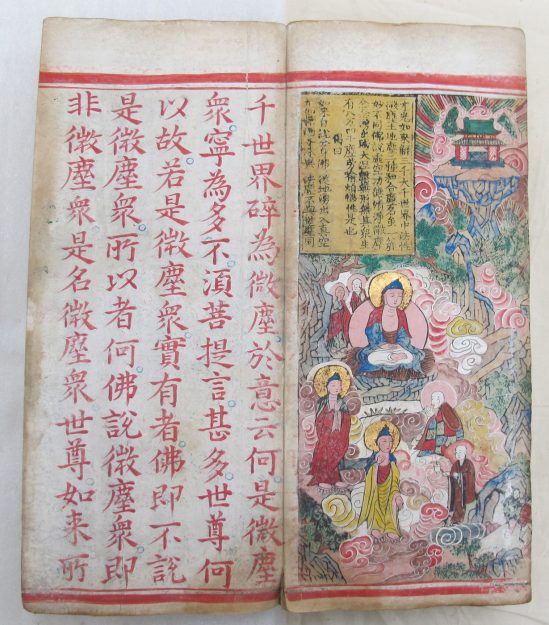
Reading Without Thinking
While you are doing all this, your body and mind are actually taking in the words and meaning of the sutra, even though you are not making any explicit effort to understand it. When read this way, the words of the sutra bypass the conceptual mind and engage body, speech, and mind directly. It often takes a while to become used to this way of reading because most of us are used to thinking about and arriving at a conceptual understanding of what we read. The purpose of this practice is quite different. It is to let the sutra speak directly to you. For that, you must listen, and to listen, you must learn how to be quiet inside as you engage the sutra.
At some point, you may notice little shifts taking place as you read certain passages. Include the sensations of those shifts in your attention and rest there as you read. Some of those shifts may be emotional reactions that seem to come out of nowhere and take you right out of what you are doing. As before, as soon as you notice you have been distracted, take a breath, reconnect with your body, and return to the reading again. Other shifts include moments of clarity or understanding, the warmth of faith or devotion, heartfelt compassion or gratitude, or the cessation of conceptual thinking of any kind. When such positive shifts arise, you may try to hold on to them, extend them, or replicate them. The shifts themselves are in no way a problem, but as soon as you try to do anything with them, you have fallen into distraction. Again, when you notice that, take a breath, reconnect with your body, and return to reading.
As you learn to rest in these shifts, you may discover an ineffable clarity that is nothing other than your own mind shorn of confusion and reactivity. It may arise while you are reading, while you are meditating, or while you are going about your day. That clarity is what the Diamond Sutra teaches. In doing so, it opens the possibility of experiencing life in a completely different way.
♦
Adapted from This Unexpected Jewel: Reading the Diamond Sutra by Ken McLeod © 2025. Reprinted with permission.
Listen to Ken McLeod talk about his translation of the Diamond Sutra in this episode of Tricycle Talks.

Thank you for subscribing to Tricycle! As a nonprofit, we depend on readers like you to keep Buddhist teachings and practices widely available.