Tricycle is pleased to offer the Life As It Is podcast for free. If you would like to support this offering, please consider donating. Thank you!
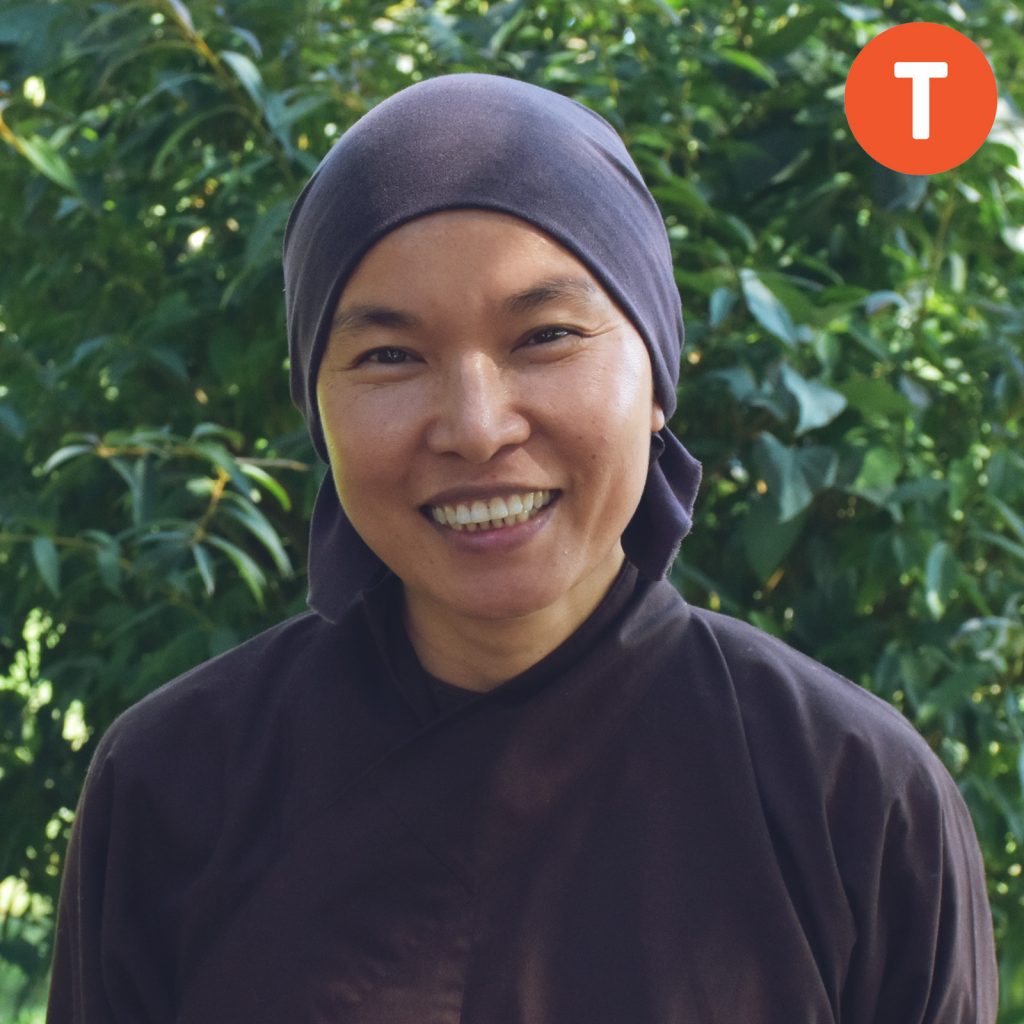
Sister Tue Nghiem is a dharma teacher in the Plum Village tradition. She is currently based in Australia. In her new book, Caregiving and the Art of Presence: A Zen Nun’s Journey of Love and Letting Go, she reflects on the challenges and unexpected gifts of caring for her mother in the final seven years of her life.
In this episode of Life As It Is, Tricycle’s editor-in-chief, James Shaheen, and meditation teacher Sharon Salzberg sit down with Nghiem to discuss how she came to be her mother’s caregiver, what caring for her mother taught her about the importance of letting go, how suffering can be a catalyst for compassion, and what it means to cultivate the gift of non-fear. Plus, she leads a guided meditation.
Life As It Is is a podcast series that features Buddhist practitioners speaking about their everyday lives. You can listen to more of Life As It Is on Spotify, Apple Podcasts, and iHeartRadio.
♦
We’d love to hear your thoughts about our podcast. Write us at feedback@tricycle.org.
Sister Tue Nghiem: For me, touching the earth is really coming in touch with this energy of stability, the energy of love. The Earth is in me, and all the ancestors are in me. I just really need to have trust and confidence in them, in me. And with this confidence, I can touch qualities, their qualities, their wholesome qualities as a way to energize me, as a way to empower me, to give me the strength and the clarity to face and to deal with all the challenges that I was going through and difficulties that I was going through. James Shaheen: Hello, I’m James Shaheen, and this is Life As It Is. I’m here with my cohost Sharon Salzberg, and you just heard Sister Tue Nghiem. Sister Tue is a dharma teacher in the Plum Village tradition currently based in Australia. In her new book, Caregiving and the Art of Presence: A Zen Nun’s Journey of Love and Letting Go, she reflects on the challenges and unexpected gifts of caring for her mother in the final seven years of her life. In our conversation with Sister Tue, we talk about how she came to be her mother’s caregiver, what caring for her mother taught her about the importance of letting go, how suffering can be a catalyst for compassion, and what it means to cultivate the gift of non-fear. Plus, Sister Tue leads us in a guided meditation. So here’s my conversation with Sister Tue Nghiem. James Shaheen: Okay, so I’m here with Sister Tue Nghiem and my cohost Sharon Salzberg. Hi, Sister Tue. Hi, Sharon. It’s great to be with you both. Sister Tue Nghiem: Hello. Happy to be here also. James Shaheen: Okay, so Sister Tue, we’re here to talk about your new book, Caregiving and the Art of Presence: A Zen Nun’s Journey of Love and Letting Go. So to start, can you tell us a bit about the book and how you came to write it? Sister Tue Nghiem: Well, the book was really coming out of my journal, writing to really understand what was really happening with the effect of my mom’s health, and aging on me and also her death. So it was really for me to reflect on myself and the impact of her life on me, really. That’s what it was. And when I shared my stories with friends who came to Plum Village, they encouraged me to write about it because they went through something similar with having to take care of someone, dealing with their aging parents. Sharon Salzberg: So to step back, I’d like to start by asking about your mother and her background. So could you tell us a bit about your mother’s own biography? Sister Tue Nghiem: Yeah, as I share a bit in the book, she was brought up in the midst of the war between the French and the Vietnamese. The French had occupied Vietnam for about 100 years, and during World War II, they left Vietnam and they went back to Europe, to France, because the Germans were fighting with the French. After World War II, they came back, and that was when my mom was a child. So she grew up in that context, with a lot of poverty happening around her, you know, the usual things that happen during the war. And so because of the poverty, their family left the village to look for a better place to find food, and she was given to a young couple. And so you can imagine at about 6 years old, she was given away, because her parents, her dad could not raise the six kids that he had in the midst of this war. But eventually, he came back, and he brought her home. And I share a little bit more in the book, but I don’t want to go into the details. So that impacted her life a lot as a young person but also a grown up. Sharon Salzberg: You say that in Vietnam you lived close to the possibility of death, and you grew up surrounded by ghost stories but also stories of real loss and catastrophe. So could you talk about what you learned about grief and loss from growing up in this environment? Sister Tue Nghiem: Well, I was born at the end of the war with the Americans. The Americans call it the Vietnam War, but we call it the American War. You know, toward the end, before the ending of the war, we had to evacuate because the war was coming to our village, and we were on this boat in the middle of the river, and I remember seeing a lot of fire exploding all around me, and I heard people screaming all around, shooting guns, and all that. And I was just 5, and I have these flashes of memories of that incident. And so in that kind of situation, we don’t know whether we can really make it through the night. So even though as a child, I didn’t really understand what was happening, I didn’t understand the suffering that was happening, but I knew that had become a part of me, that had somehow entered me and influenced me. And I think it was because of that that I have so much love for my mom because I knew she had to put up through a lot to raise us, five children alone, in the midst of the violence of the war and the uncertainty of the war. Sharon Salzberg: And then you moved from Vietnam to the US, and eventually both you and your brother came to ordain in the Plum Village tradition. So I wonder if you could say something about what led you both to ordain. Sister Tue Nghiem: Well, we left Vietnam when I was about 10 or 9 on a boat. We were boat people escaping the country. Mind you, we’re not flying over. We were escaping in this very small flimsy fish boat. And then we grew up in California. So we came to the States in about 1980. In 1985, we met Thay. We met Thay. Thay, our teacher, the Zen teacher Thich Nhat Hanh, came to the United States and was teaching to the Vietnamese community, and that’s how I first encountered Thay and the teaching. And that’s when I also attended the Buddhist youth as well. And that was when I was 15. And so I was in college when my brother went to Plum Village and he decided to ordain. So after my graduation, it was him who invited me to come over to Plum Village in France. So I did. I came over. And I think the impact of just being in this surrounding—Plum Village back then was really simple. Most of the people that came thirty-three years ago were mainly Vietnamese from different countries, from European countries, from the United States, even from Australia. And it was like coming home for me, meeting a lot of young people my age from all over the world, learning Vietnamese culture as well. We were wearing these traditional Vietnamese dresses, and that felt really like being at home, back in the country where I was brought up and raised. And that had touched something really deeply in me because that was the first time I felt I was at home. I was accepted for who I am, for my color, for my hair color. Because living in the United States, growing up in the United States, I didn’t feel accepted, because I was just different from other kids because of my skin color and my hair color. And so being in Plum Village, I really felt accepted. I felt at home. And so that’s what brought us to Plum Village. That’s what brought me to Plum Village. So I decided to stay for a year, because it was right after my graduation. I decided to stay to learn. I studied psychology when I was at the university, and so that winter when I was there, the first winter when I was in Plum Village, Thay, our teacher, was teaching on Buddhist psychology. And it was just really an eye-opening experience for me because I studied psychology for four years at the university, and I felt like I was looking through what I learned through a looking glass. You know, I couldn’t relate to a lot of what I learned. But the Buddhist psychology was so deep, so profound, and yet I could relate to a lot of what I learned, and there were practices that I could do. Because one of the things that motivated me to go into psychology was wanting to understand why I was the way I was, why I suffered the way I did. Because I received a lot of you could say traumas from my mom, from the society that I was born into during the war, and things that I didn’t really understand that was happening in me, such as deep sadness, for instance. And I wanted to go into psychology as a way to understand what was happening in me and why I was feeling what I was feeling, and after four years I didn’t really get to a deeper understanding why I was the way I was, because, like I said, everything was like through a looking glass for me, and it was through the Buddhist psychology that Thay was teaching that helped me to understand. And that’s the biggest factor for me to stay on in Plum Village and eventually to ordain. James Shaheen: Sister Tue, you talk about how through sharing our stories, we can come to understand a central Zen teaching, and that is that there’s a way to embrace our suffering so that we can suffer less. So can you talk about the role of storytelling in shifting our relationship to suffering? Sister Tue Nghiem: Sure. We all have suffering, and for me, and for many of us, I see that the suffering that we experience is really coming from the stories we tell ourselves and being able to recognize these stories, being able to really listen to these stories that we’re telling ourselves, we’re telling other people, it’s a way to really understand the roots of our suffering, the causes of our suffering. And that’s really the way. It’s the understanding that helps us to go through our suffering and to transform our suffering. And for me, telling my stories, these stories, was to really have a deeper understanding of what I was going through, shining light, shedding light on my own stories so that I can understand deeper into the impact of what was happening on me, in me, and also on the suffering that I was experiencing while taking care of my mom. James Shaheen: Mmhmm. Well, how is it that you came to be her caregiver? Sister Tue Nghiem: Well, first of all, it’s very normal for Vietnamese children to take care of their parents. Let me just start with that. But also as a monastic, I’m free. I don’t have the responsibilities of a family. I don’t have a job like my sisters and my older siblings had. So I was more available to be the main caregiver to my mom. And also I wanted to do it. I wanted to do it because it was really a way for me to avoid feeling regrets later on. I knew that would happen. You know, if I don’t take care of her, the regrets will just eat my inside, and that’s going to be much more suffering than caring for her. So that was another factor. But the one big factor was I knew it was a really good opportunity for me to really understand my mom. Because in understanding her, I understand myself, because I left home at 18 to go to college, and then at 22, I came over to Plum Village right after my graduation. And then I stayed in Plum Village for a year and ordained at age 23. And after I ordained, I only got to visit home once every four years. And so you could imagine the time I spent with my mom was very little in my young adult life. So spending time with her and taking care of her was a really good opportunity for me to understand her, and especially understanding her from the lens of a practitioner so that I can understand myself and why I am the way I am when I can understand who she is and how she is. Sharon Salzberg: One of the themes that comes up again and again in the book is the importance and the difficulty of learning to let go. So could you talk about your experiences of letting go, especially as it relates to caring for your mother, and what space did it open up? Sister Tue Nghiem: Yeah, that was a really important lesson for me, learning how to let go, because I noticed there was a lot of attachment between me with my mom. And even though when I was living in Plum Village as a monastic, that was not very obvious, the attachment. And it was only when she got sick that I realized that there’s this very really strong string attached between me and her, because the impact of her illness on me was so powerful. You know, I shared about going through depression. I shared about going through this panic attack that I had. Not so much about caring for her, but it was more the anxiety that I had, the fears that I had of seeing her suffering, and also at the end of her life letting go of her physical body. You know, the thought that I will never get to see her anymore, ever, I will never get to hear her, I will never touch her. That was really difficult. It was a really good opportunity for me to contemplate on letting go, because I know eventually she will go, and actually it was really good for her to go, and yet it was really hard. It was really hard to let go. But I’ve reminded myself that it was good for her to let go. To go on, I need to let her go. But also it was an opportunity for me to look inside myself so that I can touch her inside myself here and now, that she’s not just in that physical body that was no longer functioning and serving her, and that for me to be able to let go, I need to really touch her in me. And that has helped me a lot in the practice of letting go. James Shahaeen: You know, letting go is a lesson well taken. I get that. When caring for people myself, I had to learn the very same thing because so much is just not in our control. But something that we do find ourselves doing in caring for others is learning how to give. And you point out that the Buddha identified three types of giving: material giving, the gift of the dharma, and the gift of non-fear. So can you talk about these three forms of generosity and how caring for your mother shifted your relationship to them or made them more apparent to you? Sister Tue Nghiem: The material giving, I talked about my mom being a really generous person. The gift of the dharma, in the book I talked about, and especially with her, it was really sharing the teachings with her, reminding her about the impermanence of this physical existence, and also it’s about sharing the teachings and practices so that she can also learn to accept her physical condition and also her mental state. But the gift of non-fear, I found that for me to be able to offer the gift of non-fear to my mother, I really need to understand my own fears because I was going through a lot of fears myself. One of those fears was really obvious was the fear of her dying. And for me to offer that non-fear, I needed to work with my own fears. And in the book, I mentioned how I contemplated fears and how I faced my fear. And what I learned was that a lot of my fears were coming out of these stories that I made, that I have in my head. You know, I mentioned the stories about ghosts, that it was all really mind-made, my own stories that had triggered the fears, not necessarily what’s actually happening. And so it was really working with my own fears that I was able to be present for her and really to help her to experience the non-fear of dying. I shared with her a lot about that she’s not dying, that she continues in me, she continues in my siblings, she continues in her grandchildren. And I think that helped her to let go of her body. So it was in this process of her own health issues that I faced my fears and that I was able to be present and support her to be non-fear of her own physical body that was getting worse every day, that was declining, her health that was declining, her physical functions were declining every day. But eventually her own passing. James Shaheen: You know, you also talk about the practice of offering peace in this context. Can you tell me what that means? Sister Tue Nghiem: Yeah. There were times when I just paused because I felt this deep peace inside me. You know, I would think that in this situation of caring for my mom, that I would be so exhausted, or I would have a lot of anxiety and worries, but there were times when I just had this deep peace. I think that comes from just being able to do something for her, to be present for her, to be able to care for her when she needed me most, that had brought a lot of peace for me. Of course, that didn’t come easy. That came because I had practiced before that. I had done the practice of embracing my own emotions and taking care of my body and mind. And because I knew how to take care of myself, I knew how to cultivate peace in myself, I was able to be there with her in a more peaceful way, not expecting things to be otherwise, not expecting anything from her, but just simply being present for her. And that for me had given me a lot of peace because I can be there in that way for her, in a peaceful way for her, but also the opportunity for me to be there for her had given me a lot of peace. Sharon Salzberg: Something related and that is also, I think, pretty difficult for many people is giving and receiving love, and you talk about this in the context of your own family. So I’m wondering if you can tell us what caring for your mother taught you about expressing appreciation and love. Sister Tue Nghiem: Yeah, thank you for that. I did have a problem receiving, actually. But also I noticed that as well while living with my monastic sisters, that it is really difficult for me to receive their support. When someone did something for me, I didn’t like that. I didn’t want to bother them. I wanted to be independent. And I knew it was during caring for my mom that I realized that it wasn’t because I was independent but because I wasn’t able to receive. And it has its roots, as I shared in the story, in my relationship with my mom. I grew up as a young person, and I didn’t really want to bother her. I didn’t want her to sit there watching me eat before going to school. I didn’t want her to cook for me. I didn’t want her to do laundry for me. And it was really coming from that. And so learning how to receive didn’t come easy for me. It was really a practice. And it started with my mom when she came to the monastery, because I realized that I didn’t want to hurt her when she was offering this love, and I was feeling a bit irritated about it, the kind of gesture that she had given me since I was a kid. And so I didn’t feel comfortable about that, and I didn’t want to hurt her. So I looked into myself to understand why I was triggered by all these really kind gestures of love. And I realized that I wasn’t able to receive. I have all these ideas of how love should be offered, given to me, you know? And it was because of all these ideas of how love should be expressed that I didn’t appreciate the expressions of love that she was offering, and so I couldn’t receive them even though I needed love. And that helped me to practice allowing myself to be cared for, because I know it gives her joy. It gives my sisters joy to be able to do something for me. And so in learning how to receive, I’m also learning how to love. It’s really a practice of loving for me as well, because I know I needed it, that love, but also I’m offering love to my mother. It makes her happy, and I know that’s the case with my monastic sisters too. So it’s really a practice of love as well. James Shaheen: Sister Tue, you talk about giving and receiving love, and you also talk about, on the other hand, the challenges of regret and remorse in caring for your mom, which can be common emotions, the endless what-ifs and the questions about if things had gone differently. So could you talk about working with remorse, since we all feel it, especially in a situation where caring for someone at the end of their life and the decisions are not always ones that come easily. What are some of the practices that helped you here? Sister Tue Nghiem: Well first of all, I knew what it would be like if I had this remorse in me because I experienced it before. It’s very painful to experience remorse for things that I did or didn’t do that could create suffering for other people. And in my relationship with my mother, especially during the time that she was sick, that had become the biggest bell of mindfulness for me: not to do anything that I would regret later on. And with that awareness, first of all, I learned to just accept so that I don’t react. I don’t react in ways that could create suffering for her. And that requires me to really create space in myself. And I create space in myself by being with whatever is unfolding inside and just accepting what’s unfolding inside. That’s how I create inner space. It’s only when I have enough space in here that I can accept and embrace her without reacting in ways that could hurt her and could hurt me later on with the regrets and the remorse. And so that was the awareness of creating space. So taking care of myself was really creating this space within. Of course, it was inevitable not to create hurt. And there were some stories that I shared in the book about the remorse that I had. So I also shared about coming back to the present moment because what had happened had happened. And a lot of times, it’s really my thinking about it. Sometimes it can be blown out of proportion. And these stories, these thoughts and thinking, was really what was eating my inside. And so when I am in the present moment, I can embrace that feeling, you know, the regrets, the remorse, the bad that I had created and caused. It’s like accepting the mud in me, accepting the mud in me. We all have mud. We all have lotuses too. And the regrets are definitely the mud inside me, and being in the present moment helps me to embrace that part in me and just accept it. You know, sometimes I think the situation, it was the way it was, and that had brought up this reaction, and yeah, I wasn’t at my best, and so I just have to accept that. I just have to accept myself for that. And it’s the acceptance that helped me to really release the remorse and the regrets, because I know it’s by accepting that I can transform it. It’s by accepting that I learn to be more skillful. James Shaheen: Well, as you’re pointing out, I think no matter how mindful we try to be and how careful, we still do or say things that hurt others, and it’s very painful thinking back on it. But we’re under such duress in these sorts of situations with others at the end of their lives, so we will make mistakes, and so acceptance, yes, but you also mention the practice of walking meditation as an offering for others and a way of healing regrets. So how can walking meditation facilitate or make possible this sense of healing? Sister Tue Nghiem: So I talked about embracing our mud, and we can only embrace our mud when we are really there, present. And the practice of walking for me is one of those practices for me to be present for whatever it is in me. Because I notice that there’s a mechanism in my mind of not wanting to face the suffering that was surfacing in me. I share a story about wanting to look at my fears, and I couldn’t. The fear eluded me. Not that the fear eluded me, but my mind refused to stay with the discomfort of the fears. And so the practice of either walking meditation, of body awareness, being with the breath are all ways to help me be present, to recognize the discomfort that I was having inside, so that I can really be with it and take care of it. If I am not present, then obviously I am in my head, I am busy with something else, and I’m not there. I’m not there to recognize what’s happening inside. I’m not there to really recognize and embrace the mud that’s unfolding in me. Sister Tue Nghiem: The practice of walking meditation is one of the practices that I do because it’s easier for me to be present than just sitting still. Because sometimes sitting still, facing my thoughts and thinking, could be more challenging. So walking helps me, especially if I walk out in nature. Nature, the trees, the sky, the sun are all helping me to be present. It’s easier for me to be present when I’m in nature. Sharon Salzberg: Well, it seems that there’s a common component of caregiving. You know, something that seems to figure into caregiving is grief. And one of the components of grief is really powerlessness or despair and also disconnection. So I wonder if what happens for you when you’re walking in nature, for example, is you feel so deeply connected perhaps to the world, to the universe, and not so alone. You know, it seems in my mind when I think about it, that it’s also a way of working with feeling helpless and overwhelmed. Sister Tue Nghiem: Well, for me, when I practice walking meditation and coming in touch with nature, one of the things that I noticed was that these beauties around me really, it takes my mind off the issues that I was experiencing, you know? It takes my mind off from dwelling too much in the issues and the problems that I was having, you know? The anxiety, the stress, the fears. The biggest support for me was to come in touch with nature in dealing with the difficulties I have because it takes my mind off from these things. Like I share sitting for me would mean facing these problems, and at times like that, it’s just so overwhelming that I need to step away from these stories and from these… and so the nature really helps with that a lot so that I can have enough calm, enough clarity to look inside, to feel what was there. James Shaheen: You know, aside from nature, which is always great, when we face overwhelm and helplessness and all of these heavy things, sometimes humor can in and break that heaviness. So could you talk about finding humor? It’s something you mention. Sister Tue Nghiem: Definitely. I think that’s really important too. You know, for me, turning everything into something to laugh about was really helpful in releasing the stress that I was experiencing, and especially right after my mom had a stroke. In other words, not to define who she was with her actions, with her ways, with her behavior, was so helpful in finding the humor in everything that was unfolding. And me and my brother had to really do that as a way to accept the way she was, just finding humor in it, and also not to have to create any conflict between my mom and I or between us and her. It was the humor that helped us accept so that we would not be overwhelmed by the stress and the tension. I mean, if we can approach the situation with a sense of humor, there are so many things that could be really humorous, many things that could make us laugh, many things that we could find joy in even though we’re in the midst of stress and pain seeing the way she was. I don’t know if that helps, but for me, that was definitely how it helped me. And I was really aware also, like I shared, that everything happened at the right time for me because it was happening during the time when I knew how to take care of my emotions. I knew how to take care of myself. I knew how to cultivate joy in daily life for me. So when it happened, it was so much easier for me to really find the joy and the humor in what was happening. So that’s why I talked a lot about self-care, taking care of our emotions, taking care of whatever that’s unfolding in us. And so that goes back to what I just shared earlier about the practice of being present because that’s self-caregiving. And that’s really important before we can really offer our presence in caring for other people. Sharon Salzberg: Well, I really appreciate the tools that you’re offering because, as you say, so many people are actually in this situation of caregiving for someone in their life, and it’s so helpful to have some sense of actual tools one might try to use. And so one is also that you say that letting go and not believing all our thoughts can empower us to actually experience reality, and I wonder if you can say something about that. And another practice that you mention is the very classical death contemplations, including the five remembrances. So I wonder how these practices can help us recognize the emotional situation that we’re in and feel more tolerant of that whole range of emotions. Sister Tue Nghiem: It’s going back to what I share about taking care of myself, like being able to listen to what’s unfolding in me, my thoughts, my emotions, my suffering. It was really my daily practice. It was really listening to what was unfolding inside, learning how to accept what I was seeing and hearing coming from within. And for me, that’s the practice of self-love. I need to be able to offer love for myself before I can offer love to my mother. So it was really important for me with the practice of listening to myself. It was what we call a practice of deep listening: listening without judging, without beating myself down, but just simply with a curiosity of what was unfolding inside, you know, in regard to the situation of taking care of her at a very challenging time in her life. And that had helped me to confront the emotions and confront the pain, because it was only with total acceptance that these emotions can release themselves. And that was really important as part of caregiving to my mom. And so every day, I really needed to have some space and time to be alone because toward the end, especially when I was taking care of her in Deer Park Monastery, as well as when we brought her back to Vietnam, I spent twenty-four hours with her, and so I needed space and time away so that I can take care of that part in me. The practice that I share about creating space inside by listening to my emotions and listening to my pain was already creating the space inside. But I’m not caught in my own emotions. I am not caught in my ideas about how things should be because I have confronted it. I have listened to it. And just by confronting and listening with acceptance and with love, that’s a way for them to pass through me so that they don’t get stuck in me. And that’s a process that helps these emotions to move on so that there’s space in here for me to be more available. And so the time that I take away, even if it may be just half an hour, even if it’s just time for me to write in my journal, were all times for me to listen to myself, listen to the emotions and the stress and the suffering that I was having inside. It’s a practice that I do on a daily basis, really. That’s what I do when I go into sitting meditation. I was just really listening to what was unfolding and accepting whatever it is that I was hearing and seeing and witnessing unfolding in myself. James Shaheen: Sister Tue, one last question before we close. At the end of the book, you include a number of practices geared toward caregivers. You just mentioned a few. And you note that two that you found particularly helpful were touching the earth and calling on your ancestors. So could you walk us through these practices? Sister Tue Nghiem: You know, traditionally we have the practice of touching the earth, you know, the prostrations. I think you probably know that. But not everyone feels comfortable about this practice with the prostrations. But for me, touching the earth is about connecting with Mother Earth underneath us. So walking meditation for me is also a practice of touching the earth, being aware that the earth is there, and I am receiving her stability, and I’m receiving the love that’s there in Mother Earth, the love that’s there imprinted by all these, all these ancestors, all these awakened beings that have tread on the earth. And so for me, touching the earth is really coming in touch with this energy of stability, the energy of love. My mom practiced it by doing prostrations. And that had helped her a lot during the time that she was living in Deer Park to give her some calm and some peace. Because at that time when I came to take care of her in Deer Park, she had a lot of agitation, and that was really a practice that helped her. And it’s also a practice of helping me to come in touch with this healing, this positive energy that’s there in Mother Earth. You know, something that’s much bigger than us, something that is solid, always present, which is really right underneath us. And also coming in touch with the ancestors. You know, I share a story that I experienced in dealing with the difficulty I had by coming in touch with one of the teachers that I had heard of but never experienced, which was the Venerable Sariputra. And that was a powerful experience for me to really see that they are not really outside of me. Even the Earth is not outside of me. The Earth is in me, and all the ancestors are in me. I just really need to have trust and confidence in them, in me. And with this confidence, I can touch qualities, their qualities, their wholesome qualities as a way to energize me, as a way to empower me, to give me the strength and the clarity to face and to deal with all the challenges that I was going through and difficulties that I was going through. And so coming in touch with the ancestors are not really coming in touch with dead people outside of me or people outside of me but really coming in touch with the stability inside, coming in touch with them inside me. And so I think of all my genetic ancestors, for example. They probably had a lot of suffering in their life. They probably had a lot of unskillfulness in their life, just like we all do. But one thing I know for sure is that they want the best for their children. They want their children to be happy, peaceful. And so I come with those qualities of them in me. Because coming in touch with these positive and wholesome qualities, either in the Earth or in these ancestors, I am really watering, allowing these qualities to grow in me. James Shaheen: Sister Tue, anything else before we close? Sister Tue Nghiem: I am really grateful for the opportunity to be with you all. So when I got invited, I was so thrilled because I thought, “Well, this is a really great opportunity for me to meet you all.” But also I was really amazed and humbled because, you know, these stories that I was sharing in the book, I felt a bit self-conscious about them because they show my true colors, like aspects of myself that made me vulnerable. And yet you found them helpful. Sharon Salzberg: Yeah, well thank you so much for saying all that. I mean, it’s really beautiful. But I think, you know, I have a special place in my heart for caregivers and people who I think are really on the front lines of suffering, and I think you did a beautiful job in your book and in your teaching to talk about all aspects of it. And truly, as you know, I’m sure, it’s our vulnerability that helps people feel close to us, you know? Like, “Oh, yeah, I went through that too,” or, “I understand that,” or, “Yeah, I know it’s hard. It’s hard for me too.” And so I think you did a really wonderful thing. Sister Tue Nghiem: Thank you so much. I feel supported when I received the invitation and I feel supported just by being able to share with you. I’m hoping that this book or just the practice of taking care of ourselves so that we can take care of other people can reach out to many people so that we don’t have to create unnecessary suffering toward ourself and our beloved ones that we would regret later on when they’re no longer there. James Shaheen: Thank you. Sister Tue Nghiem. It’s been a pleasure. Thanks so much for joining us. For our listeners, please be sure to pick up a copy of Caregiving and the Art of Presence, available now. We like to close these podcasts with a short guided meditation, so I’ll hand it over to you, Sister Tue. Sister Tue Nghiem: Thank you. So let us sit comfortably. Let us come back to our body, feeling the vibration, the circulation that’s happening in our body. Feeling our body expanding and contracting with an in-breath, with an out-breath. Feeling our belly rising and falling. Let us just relax our shoulders, relax our face with a smile, a gentle smile. Feeling the air coming through our nostrils, air coming out of our nostrils. Breathing in, I’m aware that my body exists, is expanding. Breathing out, I’m aware that my body’s contracting. Breathing in, I’m aware of my whole body. Breathing out, I’m aware of my whole body. I smile to my body, aware of my whole body smiling. Breathing in, I’m aware that my mother is in me. Breathing out, I smile to my mother in me. Breathing in, I’m aware of the difficulties and the suffering that may be there in me. I’m also aware of the joy and the well-being that’s also present in me. And with an out-breath, I am smiling with love and acceptance to the suffering that’s in me, but also to the joy and the well-being that’s there in me. Breathing in, I’m aware that this suffering and this joy are my parents, are my mother, are my ancestors in me. Breathing out, I embrace this suffering and this joy with love and acceptance. Breathing in, I smile to myself. Breathing out, I smile to my mother, to my ancestors. Thank you for practicing with me. James Shaheen: Thank you so much. Sharon Salzberg: Thank you. James Shaheen: You’ve been listening to Life As It Is with Sister Tue Nghiem. Tricycle is a nonprofit educational organization dedicated to making Buddhist teachings and practices broadly available. We are pleased to offer our podcasts freely. If you would like to support the podcast, please consider subscribing to Tricycle or making a donation at tricycle.org/donate. We’d love to hear your thoughts about the podcast, so write us at feedback@tricycle.org to let us know what you think. If you enjoyed this episode, please consider leaving a review on Apple Podcasts. To keep up with the show, you can follow Tricycle Talks wherever you listen to podcasts. Tricycle Talks and Life As It Is are produced by Sarah Fleming and the Podglomerate. I’m James Shaheen, editor-in-chief of Tricycle: The Buddhist Review. Thanks for listening!

Thank you for subscribing to Tricycle! As a nonprofit, we depend on readers like you to keep Buddhist teachings and practices widely available.