Tricycle is pleased to offer the Life As It Is podcast for free. If you would like to support this offering, please consider donating. Thank you!
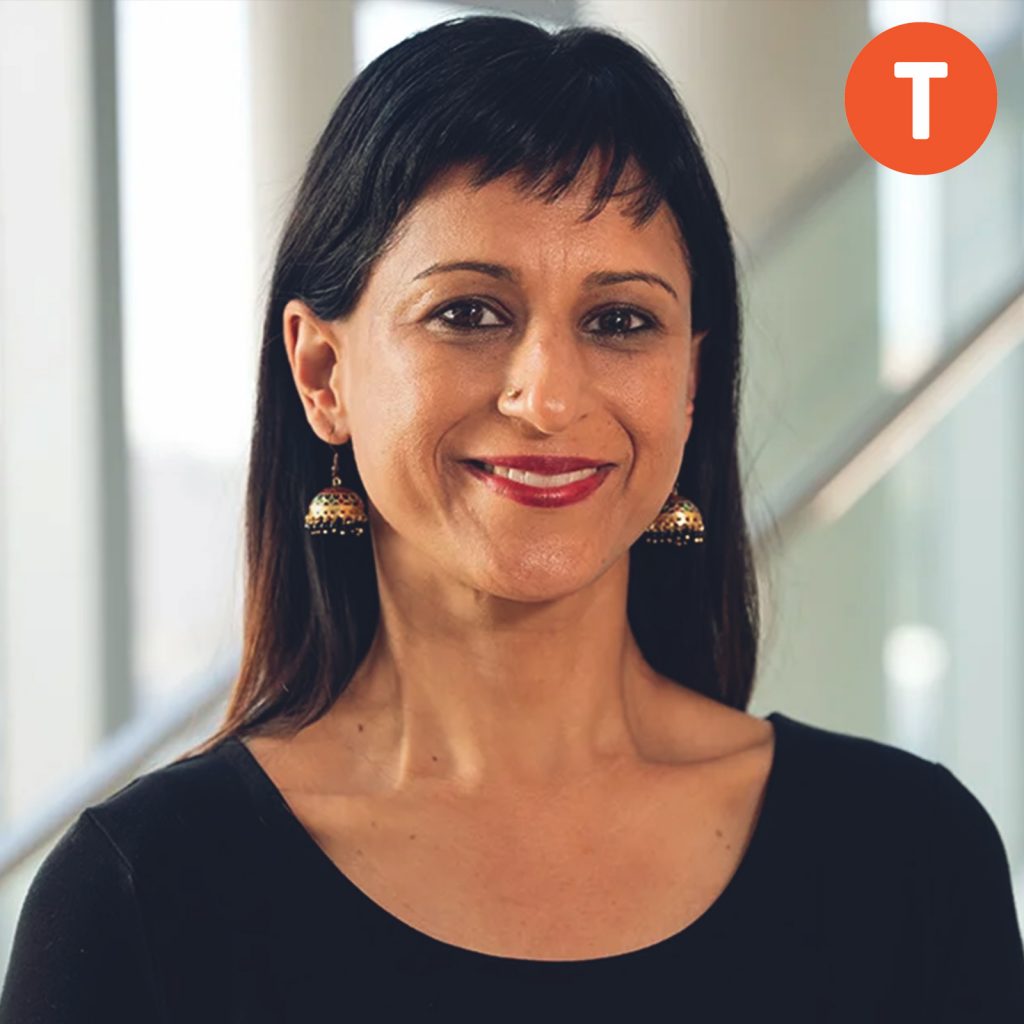
Sunita Puri is a writer, a palliative medicine physician, and an associate professor of medicine at the University of California, Irvine School of Medicine. She is the author of That Good Night: Life and Medicine in the Eleventh Hour. She recently wrote an article for the Spring issue of Tricycle called “Seeking Refuge,” where she discusses how she has found refuge in nature in the face of burnout.
In this episode of Life As It Is, Tricycle’s editor-in-chief, James Shaheen, and meditation teacher Sharon Salzberg sit down with Puri to discuss what first led her to turn to nature as a way to hold her grief, how her relationship to the concept of refuge has evolved over time, why she views refuge as a practice rather than a place, and how Buddhist teachings on impermanence have shaped her life and her practice.
Life As It Is is a podcast series that features Buddhist practitioners speaking about their everyday lives. You can listen to more of Life As It Is on Spotify, Apple Podcasts, and iHeartRadio.
♦
We’d love to hear your thoughts about our podcast. Write us at feedback@tricycle.org.
Read transcript
Sunita Puri: Through the practice of refuge, I have come to see that I am no different from the moon or a beetle or the vastness of the sky. I am a doctor, but I may not be tomorrow, should an accident befall me. I search for comets in the winter sky, knowing they will blaze and vanish. I love my family and my pets in ways that words cannot capture, but I know that one day I will lose them all and live alongside grief that transcends language. But beyond love and sadness and worldly identities there is something magnificent, something that exists at the coordinates of absolute stillness. When I feel it, I imagine that it fills the great hollow of my thorax, transforming it into a place filled with stars. James Shaheen: Hello, I’m James Shaheen, and this is Life As It Is. I’m here with my co-host Sharon Salzberg, and you just heard Sunita Puri. Sunita is a writer, a palliative medicine physician, and an associate professor at the University of California, Irvine’s School of Medicine. She recently wrote an article for the February issue of Tricycle called “Seeking Refuge,” where she discusses how she has found refuge in nature in the face of burnout. In our conversation with Sunita, we talk about what first led her to turn to nature as a way to hold her grief, why she views refuge as a practice rather than a place, and how Buddhist teachings on impermanence have shaped her life and her practice. So here’s our conversation with Sunita Puri. James Shaheen: OK, so I’m here with Sunita Puri and my co-host Sharon Salzberg. Hi Sunita. Hi Sharon. It’s great to be with you both. Sunita Puri: Hi, it’s great to be back. Thank you for having me. Sharon Salzberg: Hi there. James Shaheen: Yeah, it’s the second time. So Sunita, you’ve moved back to California since the last time we recorded the podcast, is that right? Sunita Puri: Yes. Yep, indeed. James Shaheen: And where are you exactly? Sunita Puri: So I live in Long Beach, but I work at the University of California Irvine. So it’s about thirty-five to forty minutes away. James Shaheen: Ah, that’s a drive. Sunita Puri: Yeah, I enjoy driving, actually. I listen to podcasts like the Tricycle one and catch up with friends and family by phone. So even though at times the traffic can be maddening, I try to find a little peace in the car. James Shaheen: Yeah, I used to live in Long Beach for a bit in Belmont Shore. Sunita Puri: Yeah, it’s a lovely city. James Shaheen: Yeah, it’s very nice. So can you tell us about your current role, your current work? Sunita Puri: Yeah. So I am a palliative care physician, and I direct the inpatient palliative care program at the University of California Irvine, which means that I see patients in the hospital who are sick enough to come into the hospital, and when teams need my help, it’s usually because patients with a serious illness are suffering from some type of physical or emotional or spiritual discomfort. And that is really the domain of palliative medicine is addressing what we call multimodal or different shades of suffering that come with being sick, both for the patient and their family. So I see people in the hospital, I teach residents and medical students and our palliative care trainees, and then I also have time to write. James Shaheen: Well, we’re grateful for the time to write, because you have an article in Tricycle’s Spring issue, on your work as a palliative care doctor. So can you tell us a bit about the article and how you came to write it? Sunita Puri: Certainly. So it’s now been eleven, almost twelve years since I finished my training, which is kind of hard to believe. And yet, even though my mind has a hard time believing it, I think my body very much understands the weight of the work in a way that I don’t think I was open to when I was going through my training or even the first years out of practice. What I mean by that is that I think I have moved at this point in my life into a greater sense of what my body is trying to tell me or what shows up and lodges itself in my body. There were times where I would come home from work feeling, like I wrote in the piece, as though I were swollen or had gained a bunch of weight, which was obviously not possible in the span of a few hours at work, but it was really just understanding that I was carrying the grief and the emotions of so many people around me, not just the patients and the families, but the people I train, the other doctors I work with who ask for my help, even just the people walking around the hospital witnessing what we witness on a daily basis. And I think I started to feel very much like my world was shrinking, that, like I wrote in the piece, I almost would leave my days feeling as though I was in the confines of an MRI machine, but of course I wasn’t. It was just that I was carrying so much and being exposed to so much that I didn’t let myself realize before. So I started to really crave being in the opposite of a confined, constrained experience, and that’s when I really started to ask myself the question of where do I find refuge? What does refuge mean? And I couldn’t get that word out of my head, this concept of refuge, which has resonance, I think, in all spiritual traditions. But I wrote this piece to try to assemble together my thoughts about what it has meant to find refuge not just in wide open spaces, which are of course the opposite of the constrained world of the hospital, but also within the great expanse that lives within each of us, that is our soul, that is something bigger than our bodies, but is contained within our bodies. James Shaheen: You know, it’s easy to forget the level of commitment required when you give your life to medicine, and you say that for most of your life, during that period, hospitals had been your second home from the time you were a child, really. Why was that, and when did that begin to shift for you? Sunita Puri: So I grew up the daughter of a physician. My mother is an anesthesiologist, and when we were growing up, my brother and I, she would bring us with her to work instead of having us with babysitters, especially on our days off. And so I grew up really familiar with the smells and the rhythms of a hospital, and there’s times even now where I might be walking in a space that isn’t a healthcare facility, but I’ll smell something that will take me right back to the cleaning supplies of that time, and this was the late eighties, early nineties when I was growing up. And so the hospital, the people there, the way it looked and felt to me, was no different in a lot of ways than the familiarity of my home where I grew up, and so that was almost sacred as well to me because I associated it with my mother, who I wanted to emulate, and I wanted to be exactly like her. And so I think for a long time the familiarity of medicine and the familiarity of my mother kind of collapsed into the same thing that I was chasing, wanting to be like her, wanting to inhabit the spaces she inhabited, but in my own distinct way. Through residency, through my training, again, there were familiar smells, cadences, rhythms, but I think I would say probably within the last five years I’ve started to feel more profoundly what I had hints of feeling during my training, the hints during my training were that this space is familiar, but what takes place within these spaces is now mine to bear in a way that I didn’t bear when I was a child following my mom around and watching her bear it. It was now mine. I had stepped into this role, and that role and the space coexist, but they’re not the same thing. And so there would be times like the scenes I wrote about during the piece where I would come off of a very tough night set of nights in residency in the ICU, and I would feel consumed by what I had seen and without the vocabulary or way of wrapping my mind around what I had seen and how it had affected me. And I think I couldn’t almost allow myself to go there emotionally or otherwise or even spiritually because it would mean that I couldn’t necessarily, that I didn’t necessarily have the reserve to put myself together and go back and continue to do the work, whether it was minutes later if I was taking a brief break from patient care or for a stretch of time to come if I was covering the ICU for a while. Those glimpses that I started to feel but couldn’t allow myself to move into, suddenly those feelings became somewhat inescapable over the past few years, and I would say really within the last year, maybe last two years is when I have been acutely aware that what I need for myself is something that is the opposite physical space-wise, in terms of the wide open emotional field. I kind of need that in opposition to what my day-to-day existence is like in the hospital. James Shaheen: You know, initially, Sunita, you say that your role in the hospital gave you a sense of meaning and identity, a structure, a hierarchy, a place you knew where you belonged, but over time it came to feel like a performance and even a bit of a prison. I think we all experienced this to some degree, how something that used to be meaningful and offered us a home or structure, perhaps even a kind of refuge, can become rote or even hollow. So can you say more about that? Sunita Puri: Certainly. I think for so long I had thought of myself as existing to do rather than to be. And of course those two things, doing and being, have to coexist in some sort of harmony. It’s not that we are all doing or all being, especially in our modern world, but I think that my identity had become so much, so very enslaved to the idea of what I could do for other people, or that my education was meant to serve everybody else, and I and my education kind of collapsed together that I lost sight of who I was at my core. Who I would be, who would I allow myself to be if I couldn’t do these things anymore? I think some of this comes into sharp focus in my day-to-day. I hear stories of people who tell me, “I used to be able to run a company, and now I can’t remember my daughter’s dog’s name because the chemotherapy has devastated my brain.” And I started to ask myself more profoundly with real intention, Who would I be if I couldn’t do these things anymore? And so I think there were two things that were happening. One, the story I told myself about my purpose, the meaning I was getting from it seemed to be diminishing. And secondly, I started to ask myself, What if I no longer find meaning in this work? Who would I be then? Or what if I couldn’t physically do the work because of something that happened to me? Who would I be then? What would my life mean? What would my purpose be? And that’s really when I started to kind of ask myself with intention and purpose, Why are you doing the things you’re doing? Who are they for? What does service mean to you? And can you separate who you are as a servant to humanity, which is the role you’ve always wanted to be in, to what it would mean to be in service of understanding who you are apart from that identity, because it’s very easy to disappear into that identity and to tell yourself, This is all I am, and to tell yourself, Because this is all I am, I’m going to stay at work and work really late so that I can avoid the other parts of my life where I don’t know who I am or I don’t know how to relate to the person in front of me. But I do know who I am in the hospital. I do know who I am at work, and I’m just going to stay in this safety until that no longer is safe. James Shaheen: Yeah, you know, work as identity is an easy trap, and it’s one that almost all of us fall into, like, who will I be when I retire as an example. And yet after a certain point you said that you had the feeling that the walls were closing in, it wasn’t working anymore, and the sense of burnout led you to start spending more time in nature, a different kind of refuge. So can you say more about this? What is it that you were seeking? Sunita Puri: So I think, you know, the feeling that things were becoming claustrophobic at work came from a couple different sources. One certainly is some of the ways that people are suffering now being very different. I see a lot of young people in their 20s, 30s, and 40s dying of very aggressive cancers, just as one example. So there was the type of suffering I was engaging with. There was this, as you mentioned in your prior question, which I forgot to get to, this performative sense of being a doctor and having a relationship with your patients that’s not so much a performance, but you can feel like a performer in front of the people you’re training, that you’re not allowed to slip into any sort of humanity of your own that might be picked up on by someone else and emulated, and you may not want that to be a part of you to be emulated. So there’s a lot of pressure of feeling like you’re under a spotlight and eyes are on you at all times. And I had never been somebody who kind of found refuge in the outdoors, to use kind of a hackneyed phrase. I loved being outside, but I didn’t have a relationship to the outdoors. And I started to do more walking when I got my dog, and being outside walking him was both an obligation that turned into a pleasure once I could actually see it as something different than a task. And it was really around the time that I started to feel acutely that I was leaving work feeling like I was wearing a tire on my neck when there was no tie that I started to ask myself, What are the other things you can do to just release and find more expansiveness when you’re feeling so much like the walls are closing in on you? And so I started simply to just try to notice what was around me in my neighborhood when I was walking my dog. So things like plants that were in the median of the street that I’d never noticed before, or the fact that a neighbor’s house had a really bright blue door that I’d never noticed before, or the fact that there was a guy that was sitting on his porch almost every day when I walked by him in the morning, and I kind of said rote hellos, but I didn’t know his name even though I’d been walking by him by that point for a couple of years. And I think it was just the slowing down and noticing what was around me that started to help me physically understand that I was not trapped, that there was an expansiveness and a set of spaces or a space around me that was physical but that was also emotional if I just allowed myself to know that and to step into it, to step off the treadmill of work and step out of my sense of myself as only existing to work and allowing myself the peace and the treat at that point of existing in the world as something other than a person who’s just in service to others. And that was when things started to really shift for me, that I really enjoyed being outside, that I looked forward to it, and that I found a sense of calm and peace in just stopping. And I know this sounds really cheesy, but even now I will stop and I will literally smell roses my neighbors have planted, because where I live now, people have beautiful rose bushes and other flowers in their yards, and I’ll stop and smell, or I’ll take a photo or I’ll just observe how I’m feeling as I walk around, and that return to the body as opposed to studying the body has been a profound shift for me, and it’s where I’ve found expansiveness and freedom. Sharon Salzberg: I’m really fascinated by this relationship with nature and how it seems to offer a profound sense of connection, and you also say that spending time in nature softened your resistance to stillness and you began to feel again. So I wonder if you can say some more about that. Sunita Puri: Yes, so I think it’s a lot easier to be a roadrunner and stay in motion than it is to stay still, and I think for me, that shows up most acutely because when I am in motion or doing things for other people or just doing, doing, doing, I don’t have a sense of connection of what’s going on within me. And a lot of times that sort of do, do, do, achieve, achieve, achieve is the ultimate distraction. You think that it’s giving you meaning and an identity and a purpose, but sometimes it actually is doing the opposite, which is only giving you some sort of meaning or identity and purpose in relation to something external or somebody else, and it’s not about you, and it’s in stillness that you can actually start to observe that. Because that was such a frightening realization for me. It was much easier for me to stay in motion than to be still and actually examine who I am or how I felt, or my relationship to the world, or what the answers to some of these really tough questions would be. And I think this is part of the challenge of living is learning that there can be meaning and purpose and beauty in being in motion, but that there can be an equal amount, but an overwhelming experience of being still. Sharon Salzberg: You mentioned a pivotal moment earlier in your career when you went to a temple and watched Buddhist monks sweep away a sand mandala. So this is a very intricate artistic process, which takes many days to construct on the ground, and then at the end of it, it’s swept away. It kind of disappears. And so can you tell us about that experience and what you felt it offered you? Sunita Puri: Certainly. So when I was in my palliative care training after I finished my residency, I thought that I was the type of person who’d come from this background of a very spiritual home, and I understood that death was not the end of things. It was just the end of the body. I really tried to bring this awareness of what death was and wasn’t to my patients. And at the same time, I was struggling losing them. And I thought that I wasn’t supposed to struggle because here I was in this role where I was supposed to bring comfort to people who were going through loss, both death and the many losses that come with just being sick. And when it started to get overwhelming, I started to go to a Buddhist temple that was not far from the hospital where I was working at the time, and I found tremendous comfort in the temple, in the sangha, and even in the times where I was just by myself on a lunch break. I saw over a period of days as the monks made this incredibly beautiful mandala, and I’d never seen one made before in the process of being made, and I would just go and I would watch them and my mouth was like on the floor in the way of those cartoons from the eighties where the character’s mouth has dropped. One day when I went, I did not know that part of the ceremonial process of making a mandala was also destroying it, and I remember watching and thinking, “Oh no, stop, it’s so beautiful. Don’t you want to keep it exactly as it is?” And watching it being swept away created this swell of emotion in me in which I both grieved the loss of the mandala and understood exactly why it was necessary for me to watch what was happening. It was a physical enactment of this idea of impermanence that is so fundamental to Buddhism, to Hinduism, but also just fundamental to life, spirituality and philosophy aside, that nothing will ever remain as it is ever in any given moment. What we have right now is not what we are going to have in the next, and being able to see that gave me an example of something, again, grounded externally, grounded in something outside of my experience of the hospital that was both a physical experience and an emotional experience, watching this being swept away, being given a baggie of the sand that I still have as a reminder that everything contains within it the seed of its own destruction. How will I move forward with that knowledge that was given to me in a new way? It wasn’t coming from the Sanskrit mantras that I used to recite as a child with my parents. It wasn’t coming from what my parents taught me. It wasn’t coming from being at a deathbed and performing a peace I assumed I needed to have with death in the end of life. This was coming from a different set of teachers, something external, and it came at exactly the right time. I think the other lesson in that experience was that this is a continual relearning of this lesson. Nobody is perfectly at peace with the concept of impermanence, that gaining more peace around that and applying its lessons to one’s life is an iterative process, and I think it gave me permission to remind myself, I don’t need to be a master of anything right now. I’m learning my role as a doctor, but I am learning how to be as a human being in a complex world where nothing stays the same. Sharon Salzberg: And you then began to incorporate teachings on impermanence into your work as a physician, is that right? Sunita Puri: Yes. So I started to kind of try to help my patients consider this concept in a more intentional way. And I would really often take examples from nature, and this was before I was spending a lot of time intentionally in nature, feeling its expanse, feeling myself expand when I was in the wide open. This was more asking people things like, “Tell me about a time when things changed very suddenly for you. What was that like for you? How did you cope? What was your life raft? What was challenging about it, and how did you make it through?” And then asking people more intentionally, like, Do you have a garden? Do you have objects outside of yourself that you’ve observed changing? And what has that been like for you? What is it like for you to consider the ways that joy and sorrow are two sides of the same coin, that joy might be the green leaves on a tree in the summer, and sorrow might be the burgundy blaze in the fall? And of course, I’m giving examples here, and not all of this is what I say in one encounter, but these are the sorts of things that I started to find useful in my toolkit because maybe somebody couldn’t talk about what it felt like to no longer be able to remember their daughter’s dog’s name, but maybe a swell of emotion would come forth when they would talk about the way that their garden changed or the way that they observed more gray hair coming around the muzzle of their dog, or the ways that the cards that they hung on their wall that used to be perfectly white were now yellowing over the years and what that brought up for them. So sometimes just talking about nature, talking about other things that change, could help me have a conversation with people about what it meant to experience their bodies changing, their lives shortening, their relationship shifting as the person they were becoming while sick was changing, and I found that very profound. I still find this to be the most profound part of my work, is to help people cultivate an understanding of what will change and what never changes, what’s eternal and what is of this world. Sharon Salzberg: Listening to you, I’m remembering a conversation I had with someone who’d undergone a really significant and pretty terrible loss, and she tried many things to help her get through, and she said the only thing that actually helped her was gardening. Sunita Puri: Yeah. Yeah, it’s a profound thing to put one’s hands in the earth, to try to give something life using the tools that you have, but also surrendering to the elements that you have no control over, like the pH of the soil, or whether the shade is enough for that particular plant. It’s a very humbling experience. Sharon Salzberg: At a certain point though, you say that that kind of incorporation of teachings on impermanence became somewhat rote as well, and that these ideas became more a part of your practice than your life. So I’m wondering how your relationship to impermanence has shifted since you started spending more time in nature. Sunita Puri: So I think it’s still evolving. I think in a lot of ways I’ve put pressure on myself throughout my life to have achieved mastery of things that one can never really fully master, and I’m seeing that more now, that a mastery of the knowledge of the body is different than being able to take that knowledge and apply it to a patient because every human body is different. Or mastery of this idea of writing, which is a practice just like medicine is a medical practice, moving away from the idea of mastery and moving toward the idea that things are constantly evolving and shifting is I think a deeper form of understanding and embracing impermanence. And I see that when I’m out in nature more because I can look at roses that have fallen off a bush and say they are just as beautiful in death as they are in life. I can see for the first time that some of the most beautiful sites I have encountered in nature are of things dying, of things as they die, and you see that in the fall when the trees are changing, and that’s my favorite season. When the trees are golden and red and burgundy, it looks like they’re on fire, but they look like that because they’re dying. And I think that what I am moving more deeply toward is this idea that impermanence gives you a sense that even in death there are so many beautiful things, and death and dying themselves are these expansive containers of change and transformation. I don’t know that I really understood that in the same way when I was a fellow in my training watching a mandala being swept away. I think I knew it intellectually, but I think things have gone from me feeling like I master and understand something to me being more open to everything that I don’t know and understand. And I think that in and of itself has been a huge shift spiritually, and it’s opened up space for uncertainty in a new way, for impermanence, in a new way, a loosening, if you will, where there had once been rigidity and constraints. Sharon Salzberg: And you’ve also said that you’ve come to see that refuge isn’t a place; it’s a practice, which is a very beautiful way of saying that. And I’m wondering what the practice of refuge looks like for you. Sunita Puri: Yeah, I think it would’ve been really easy for me to kind of come to the conclusion that my refuge is the outdoors, which is where I think a lot of people find refuge and peace. But I think the more complicated realization is that if I tie refuge or this sense of peace and expansiveness to a physical place I may not be able to access all the time, then I am limiting my understanding of the peace and freedom and expansiveness that’s always available to me. And I think something that I started to realize was that expansiveness when I was outside—for example, even this morning, I took a walk, and there’s this estuary not far from me, and there are cranes and pelicans, all sorts of birds that are just there. And the way I felt inside as I looked at this pelican and his huge wingspan and the way he could just pull currents of air with his wings was the same feeling I could feel within myself, the depths of that expansiveness, the power of what is within. And I could see it externally in him, but I could feel it within me. And I think this is what being in the outdoors or wherever we find peace and stillness, I think this is the gift, that we go there to find what has been within us the whole time. And I think that was ultimately the great gift of feeling like I had a necktie around my neck or feeling like I was leaving work in an MRI machine. Something told me that there is something within you that you’re not accessing that can help you bear this. And for me, the process was going outside to know that I didn’t need to go anywhere else but within. But I needed to be outside to understand that expansiveness in a new way. Sharon Salzberg: I’m so curious because you’ve talked a little bit about training others, and I’m just wondering, are there ways you can bring this or do bring this into that training? Sunita Puri: Well, one thing that my students and residents know is that I always try when we’re going between different buildings in the hospital to have them walk with me outside to the next building. There’s a way to get from one building to another that you don’t need to leave the hospital, but I always want to get outside, even if it’s just for a few minutes of getting fresh air and sunshine. And I tell them that, and they know this from rotating with me. A lot of people will say, “Oh yeah, Dr. Puri likes to go outside.” Or I will point out to them that when I am outside, I just feel a breath of fresh air, both literally and physically. I have talked to some of them about that feeling of constraint, that we have this necessary hierarchy in medicine, that we have to remain a certain way in order to get through the days, but asking them, What do you think that’s cutting you off from? Have you ever been curious about that? Or what do you do when you start to feel overwhelmed and you can’t go to the thing that comforts you? Have you thought about where that exists? Apart from whatever it is, whether it’s watching TV or eating a certain food or being outside, what can you do within you when you don’t have access physically or otherwise to that particular tool? I also tell them that 95 percent of doctoring is an inside job, which I firmly believe, and I can talk about that in two ways. Sometimes it’s our own fear of whatever it is, other people’s strong emotions, fear of death, fear of being wrong, that influences what we say and what we do not say to patients, and that can influence outcomes in their care in profound ways. But the other piece of it is a huge part of doctoring is how we hold our own discomfort. There’s the way the discomfort affects the patient, and then there’s the way the discomfort affects who we are in our interactions with ourselves and others, whether they’re family, loved ones, or patients. And so really starting to cultivate an awareness of where is my internal world off-kilter, and how is it influencing how I treat myself and others? The silences that I allow myself to maintain when I know that I shouldn’t, the things I say when I feel like I shouldn’t have said, the avoidance and the joy alike. Sharon Salzberg: And as you write, “I needed to understand in an embodied way that there’s nothing fixed about my identity as a doctor, nothing within a hospital that could ever be a reliable home.” Sunita Puri: I think this goes back to the idea that all things are subject to the law of change and that there’s a difference between what is worldly and what will always be in flux versus what is eternal and will never be in flux. So this idea of who we actually are beyond the body, who we actually are beyond how we identify ourselves on our CV, that expansiveness, which cannot be written down on the CV, that sense of wonder and awe that comes with really connecting with the love and the essence of who we always are, we always were, and we always will be. That is, I think, the fixed home that I have come to see. The hospital might be familiar to me, but it will never be my shelter. It will never be my refuge. It’s a place I go to try to help other people to find a little bit of solace and refuge as they face their own storm. But that which never changes, that which is eternal, is beyond all the laws of the physical world. And I think understanding that in a way that I can access through my body and not just through my mind was the big shifting, turning point for me, that it was no longer just about telling myself that all things are impermanent and things will change and I can’t rely on my profession as the entirety of who I am. It was actually feeling it within, which to me feels, as I wrote in the piece, like my thorax is a universe full of stars, and I can feel that light in a very intentional way. I can allow myself to picture what’s within as the darkest sky with the brightest stars that I’ve ever seen. And there’s something about the physicality of that, about transposing what I have observed with wonder in the outside world and seeing it within. To me, that imagery and that expansiveness is what has allowed me to mature, I think, as a person, as a spiritual seeker, and as a doctor. James Shaheen: Sunita, you mentioned or quoted the last line of your essay, so I was wondering if you could read the last paragraph of that essay. Sunita Puri: Yes. “Through the practice of refuge, I have come to see that I am no different from the moon or a beetle or the vastness of the sky. I am a doctor, but I may not be tomorrow, should an accident befall me. I search for comets in the winter sky, knowing they will blaze and vanish. I love my family and my pets in ways that words cannot capture, but I know that one day I will lose them all and live alongside grief that transcends language. But beyond love and sadness and worldly identities there is something magnificent, something that exists at the coordinates of absolute stillness. When I feel it, I imagine that it fills the great hollow of my thorax, transforming it into a place filled with stars.” James Shaheen: Thank you, Sunita. That’s so lovely. I love the way that essay closes. Sharon Salzberg: So you were recently interviewed by Oncology News Central, and you talked about how you’ve come to adopt an approach of radical honesty in your work. I wonder if you can tell us what you mean by radical honesty. What does this look like in real practice? Sunita Puri: Absolutely. So I think that in medicine, in my training especially, there was kind of a sense that if we were honest with people, especially about hard things, that we would upset them, and that if we were not upsetting somebody in any sort of strong emotion, but especially anger, sorrow, things that we labeled as how we don’t want our patients to feel, that we would avoid those conversations that could trigger those things. When we avoid things, avoidance has its own force field that distorts a conversation or a relationship that you have between yourself and a patient. And so part of my move into palliative care was finding ways to be honest and also to understand that honesty was compassion, maybe. I used to think compassion was protecting people from the strong emotion or the emotion that would arise from understanding something really difficult. And so I tried very much, and something I was very drawn to is how do we tell people honest things truthfully in ways that honor their reactions and don’t spare them the reactions that they have every right to have. But I think that the part that was always hard for me with the radical honesty piece of this was admitting when I didn’t know something either. So I had learned to become OK with being honest with people about hard things, whether it was that several organs are failing and time is short and they are dying and allowing space for the strong emotions, but it was harder for me to say, “I don’t know what comes next for you.” I consider myself an expert in this land of uncertainty that we’re both in, but I, in truth, was a lot more uncomfortable with the uncertainty I felt as the doctor than the uncertainty that I welcomed them to have as the patient. Now that people are living longer with certain cancer therapies, they’re facing new types of uncertainty, and in that conversation, Dr. Figlin, who had interviewed me about this idea, was wondering, how do we help people who are living with this new type of uncertainty? And the thing I encouraged him to think about that has been my newer practice is not to be afraid to say, “I don’t know.” And to some extent, I’ve always been OK saying I’m not sure or I don’t know. But the radical part of it to me is that I am now trying to say to people, “I don’t know, and I’m not sure how I’m going to find out how to guide you, but I am committed to guiding you. And it’s not just that I know that there’s uncertainty here about how you are going to face life. It’s more I am also uncertain how to guide you in this new world of you living longer with cancer therapies that you didn’t think were going to work.” I think that when we can be honest with our patients, number one, they trust us more, even if what we have to tell them is not what they’re hoping we would tell them. Number two, we can be more honest about the nature of medicine, which is that we don’t have all the answers all the time. It is an imperfect science because my body of knowledge doesn’t always translate perfectly into the way your human body is acting. And I think in general, the more we are able to name the difficulty and say, even sometimes I will say to people, “It’s hard for me to say this to you, but . . . ” or “I want to tell you something that I am worried you might hear in a way I don’t intend, so I’m going to tell you this and I’d like to have a conversation about it afterwards.” Just being very transparent and honest brings the humanity of both doctor and patient into very sharp focus, and you still have your expert and your professional obligations to somebody, but you also have your humanity standing right there with you, which I think we can leverage in powerful, authentic ways, in ways that heal, that don’t just cure, because medicine will always be relational primarily. James Shaheen: You know, Sunita, not everyone welcomes your radical honesty. You describe in the essay a run-in you had with an oncologist after you had answered this young woman’s questions about her husband’s condition and the possibility of hospice. So has that changed a lot, or is there still that tension in your role as the person who often has to deliver honest news? Sunita Puri: I will say that one of the hardest things about practicing palliative care is that the fear other doctors have that you are going to upset their patient or tell them something that that doctor feels is not theirs to know is a really ongoing, huge cultural challenge in the practice of medicine, the practice of palliative care. And so I practice my role sometimes with a constraint that I know will always be a part of what I have signed up for because I can’t see patients unless other doctors refer them, so I am bound to the sensitivities and the expectations of some of the other doctors. Now, that said, sometimes patients ask me questions that I have to answer. If they ask me, “What can hospice do for my loved one?” I can answer that in a very generic way that I have learned to do in a way that describes the facts without veering into the territory of saying, “I think you should consider hospice,” because that might upset the oncologist. But it is a highwire act at times, and I don’t think that we talk about this openly enough in our field that being beholden to other specialists can, depending on the culture that you’re practicing in, take an enormous toll because you are asked to keep silences that can feel dishonest. And so for me, the hardest part of my job is not actually with my patients and families. It’s operating in the culture of medicine writ large that still polices what we say and what we shouldn’t say to upset somebody or not upset somebody, and the person we might upset the most is not the patient. James Shaheen: You know, also, not answering would also deprive them of the opportunity to know what they’re facing, and you recently wrote an opinion piece for the New York Times called “Living to Die Well,” where you say that many of us don’t ask ourselves what it means to live fully and authentically until we’re confronted with death, which is potentially the opportunity you would deny them if you were not honest, but we needn’t wait until that point. Can you tell us about that piece? Sunita Puri: Absolutely. So there was a show on I believe it was Hulu called Dying for Sex that I had watched with great interest, and it was about this young woman in her 40s who had been diagnosed with breast cancer that had returned and was now stage four and incurable. She had been in a marriage that had been unfulfilling in many ways and sexually in particular, and so once she knew that she was going to die from her disease, she decided to leave her husband in pursuit of sexual fulfillment, in particularly looking to have an orgasm, which she had not had with another person for complicated reasons that had to do with things that befell her in childhood. I watched this series with great interest because she began to pursue what was important to her the minute she knew that she was going to die of her disease, and I think that many of us do this. We tell ourselves things, and it doesn’t even need to be death, like “When I retire, I’m gonna travel the world,” or “When something happens in time, I will finally find freedom.” Because that’s what this is really about, right, is finding freedom. Sometimes when we are facing no way out in one way or another, that’s when we can locate freedom most acutely. When we face death, I think a lot of us tell ourselves stories, like “That’ll be the time where I do something I haven’t allowed myself to do,” like a radical shift in the way I live. And the truth of it, and what I tried to communicate in the piece, is we don’t know not only when that time is coming for us, but we don’t know that we will have the body that we have right now that allows us to do certain things. So you could be dying, let’s say somebody got a diagnosis of colon cancer. That might be the moment where that person decides, “I’m gonna quit my job and travel the world.” You don’t know how the colon cancer is going to affect your body, so you don’t know what traveling the world is actually going to be like, or whether it’s a possibility, because you might be too sick, just as one example. We don’t know that we’re even going to have the luxury of a process of dying or whether we’ll get into a car accident and that’ll be it. So there’s so much we don’t know. And when we tell ourselves these stories, like “When X happens, I’ll do Y,” we’re denying ourselves freedom in the moment, freedom to ask ourselves, What is it that I actually want? How is it that I have been living in the last six months? If I could do things differently, would I have? In the six months to come, how do I really want to be living my life?” And that’s why I wrote the piece is really to help people to go from the traditional questions we ask, like, “When I retire, I’m going to do this. When I get this divorce, I’m going to do this. When I am dying, I will finally give myself permission to do whatever,” and give yourself permission now, if not to do it, then at least to have that authentic conversation with yourself about the difference between how you’re living and how you might wanna live. James Shaheen: OK, Sunita, anything else before we close? Sunita Puri: No, this has just been such a wonderful conversation, and I’m so grateful for the opportunity to talk about the piece and the various things that it brings up, and I just hope that this has brought something to think about for listeners as gratifying as it’s been to talk about it. James Shaheen: Great. So Sunita, it’s been a great pleasure. Thanks so much for joining us. For our listeners, be sure to check out Sunita’s piece in the spring issue of Tricycle. We like to close these podcasts with a short guided meditation, so I’ll hand it over to Sharon. Sharon? Sharon Salzberg: Great. Thank you. And thank you so much, Sunita, for all of your work, really. So why don’t we sit together for just a few minutes. I like to think of the breath as a refuge. It’s a home base. It’s a landing place. We don’t have to fix it or make it better. So see if you can find the place in your body where the breath is strongest for you or clearest for you, and just rest your attention. Here it is. Images may come and go. Thoughts may come and go. Certainly feelings may come and go. Listening to this conversation, maybe you feel determination, maybe you feel unease, whatever it might be. Let the feelings just flow through you as you settle your attention on the feeling of the breath. And if you go far, far away or you fall asleep, something like that, really don’t worry about it. You can realize you’ve been gone, gently let go, and just come back to resting your attention on the feeling of the breath. So thank you so much. James Shaheen: Thank you, Sharon. Thank you, Sunita. Sunita Puri: Thank you. James Shaheen: You’ve been listening to Life As It Is with Sunita Puri. Tricycle is a nonprofit educational organization dedicated to making Buddhist teachings and practices broadly available. We are pleased to offer our podcasts freely. If you would like to support the podcast, please consider subscribing to Tricycle or making a donation at tricycle.org/donate. We’d love to hear your thoughts about the podcast, so write us at feedback@tricycle.org to let us know what you think. If you enjoyed this episode, please consider leaving a review on Apple Podcasts. To keep up with the show, you can follow Tricycle Talks wherever you listen to podcasts. Tricycle Talks and Life As It Is are produced by Sarah Fleming and the Podglomerate. I’m James Shaheen, editor-in-chief of Tricycle: The Buddhist Review. Thanks for listening!

Thank you for subscribing to Tricycle! As a nonprofit, we depend on readers like you to keep Buddhist teachings and practices widely available.