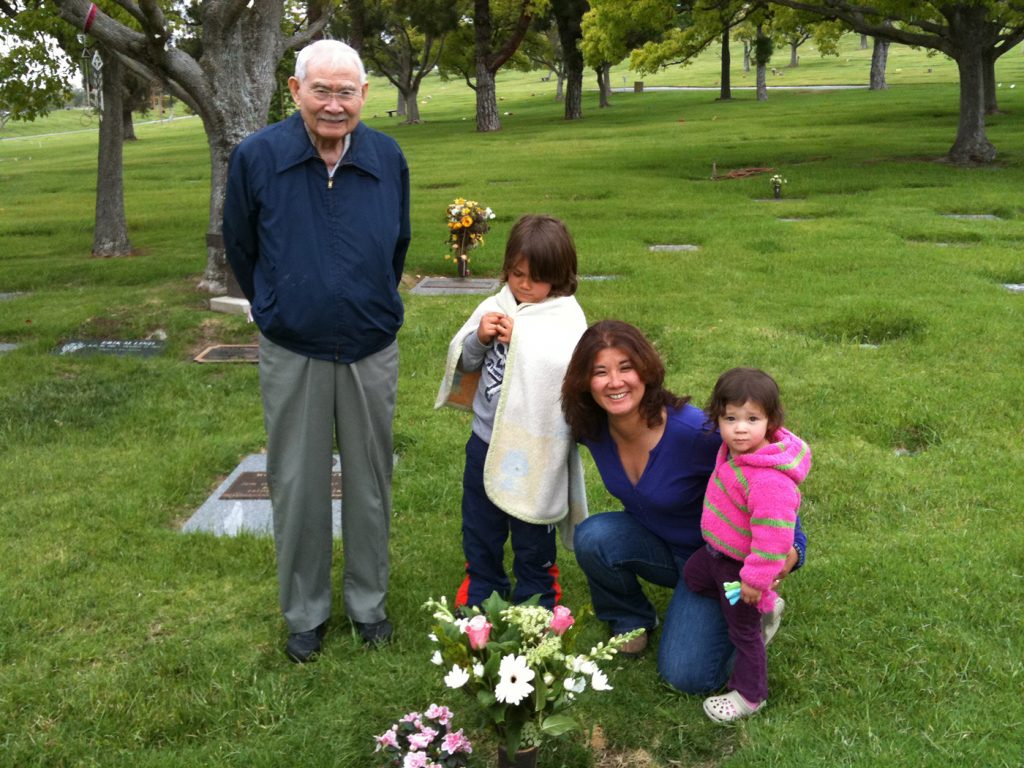
“It’s time to visit the cemetery. How about this Sunday?” I say. My teenage children and husband agree, and we set the date. Sunday, we hop into the car. We pick up flowers on the way and make the hour-long journey to Pacific View Memorial Park. My daughter reads, and my son and husband nap in the car.
Twice each year, my family and I visit the cemetery where my parents are buried. This is not unique or unusual; visiting the grave is a common practice among many Buddhists. Thich Nhat Hanh notes that “the most precious gift we can offer anyone is our attention. When mindfulness embraces those we love, they will bloom like flowers.” Such attention takes many forms and is built into the rituals we enact for the living and the dead. Beyond simply honoring my deceased parents, these visits have become occasions for a radical caregiving that forges bonds among my parents, myself, my children, and the larger chain of being—between the human realm (saha, world of suffering) and the Western Pure Land. The ritual has become a way to share and pass on to my biracial children a legacy that is life-enhancing and part of their spiritual inheritance.
Connection
My parents’ grave is a short distance from where we park. As we walk up the hill, we pass from the mundane to the sacred—a time and space full of special meaning and connection. We take a look at the grave marker, which has weathered since our last visit. It is right that we are here at this moment.
When my father was alive, we would visit my mother. And when he passed, we would visit him. My mother and father enjoy seeing their grandchildren. Over the years and through our visits, they have seen my children grow and flourish. I know they are pleased and look forward to our visits.
Our family’s story is a typical Japanese American one. As a Sansei (third-generation Japanese American), I was raised as a Buddhist. I attended a small rural temple that was part of the Buddhist Churches of America from an early age and fell in love with the sutra chanting performed each Sunday. Growing up in the “church,” I also took part in dharma school, danced at Obon festivals, frequented dances that were part of the Junior Young Buddhist Association (Jr. YBA), and played the piano for memorial services. While attending a Mennonite high school, I moved away from the temple and came to adopt a Christian identity. In college I briefly joined an evangelical Christian church and later studied Christian theology in graduate school. During my studies, my deep affinity with a Buddhist perspective became apparent, and I came to embrace my Japanese American Buddhist roots in my late 20s.
My grandparents, Jodo Shin Buddhists, migrated from the southern Kyushu region of Japan. They were part of a large wave of Japanese who immigrated in the late 19th to early 20th century—the majority of whom were Buddhists. As they settled, these Issei (first-generation) established temples and sponsored ministers from Japan. My parents, Nisei (second-generation), were raised in the temple and within a thriving Japanese American Buddhist community. As my parents grew into adulthood, Buddhism was simply a given. Beyond sending their only child to dharma school, their connection with the temple centered on weddings and funerals.
My grandmothers were a different story. Although they did not go to temple, they maintained home altars (butsudan) and chanted the nembutsu at home. Their Buddhist faith was key to their survival. The Buddhist worldview that my grandmothers embraced provided an anchor in a sea of suffering that they experienced as Japanese immigrants in a new and often hostile world, and the Japanese American Buddhist community served as a means of sustenance and support. Buddhism also allowed immigrant Japanese Americans such as my grandparents to maintain their connection with their spiritual and cultural heritage and shore up a positive sense of self—deep and meaningful—that resisted the tides of oppression. My father’s mother, Natsuye, was especially devout, and her devotion was built into the care she took with her family, and especially my grandfather. When my grandfather was alive, my grandmother would shred carrots, bundle these shreds into a cheesecloth, and painstakingly squeeze a cup of carrot juice to nourish her ailing husband. When he died, she took care in arranging his memorial service and maintaining his memory at her butsudan.
In addition to these practices, her day included setting a place at the table for my deceased grandfather and having conversations with him. This seemed odd to me at first. But as I grew accustomed to this ritual, I would come to appreciate my grandfather’s continuing presence and my grandmother’s love for him through this gesture. The daily place settings and conversations were my grandmother’s way of taking care of my grandfather even as he had passed on to the Pure Land. Through my grandmother’s actions, I learned that death does not mean the end of our relationships with one another. I also came to realize that she was modeling an ethics of care that extended beyond the loss of my grandfather’s human existence and physical presence and served as an expression of deep compassion and enduring obligation to the Buddha realm. It is this model of care that I carry forward in our visits to the cemetery.
In her study of Zen Buddhist women practitioners in Japan, Paula Arai recognizes how the dead are transformed into “personal Buddhas,” who play an important role in the process of healing and spiritual cultivation of the living. She notes in Bringing Zen Home:
Recognizing the deceased as personal Buddhas means the living and dead are not separated. The concept of personal Buddha takes the teaching of interrelatedness and stretches it across the illusory boundaries of life and death. Intimate relations people have with their personal Buddhas function to dissolve the delusion of separate entities.
Setting a place at the table, reciting the nembutsu at the butsudan, and visiting the cemetery are ways of interacting with our personal Buddhas. As Arai notes, this relationship is intimate and ongoing and connects the living and dead across time and space. Beyond the significant function it plays for the living, these acts of remembrance and loving-kindness pay homage to the dead and let them know that they dwell among us.
Caregiving
My son fetches water to clean the grave and for the flowers. My daughter cuts and arranges the flowers. I wash the grave and cut away the grass. We stand to look at the grave—fresh and beflowered. It’s time for pictures. My children stand next to my parents. Click. We stand in various configurations and take pictures. Click, click, click.
When my children were young, they would roam the cemetery while I prepared the flowers. They would often gather fallen pine cones and fir branches during their exploration and arrange these treasures around the grave. Their beautiful display was my children’s way of interacting with and caring for their grandpa and grandma.
Our cemetery visits can be viewed as a practice grounded in an ethics of care. The feminist theorist Carol Gilligan articulates such an ethic as one . . .
grounded in voice and relationships, in the importance of everyone having a voice, being listened to carefully (in their own right and on their own terms) and heard with respect. An ethics of care directs our attention to the need for responsiveness in relationships (paying attention, listening, responding) and to the costs of losing connection with oneself or with others. Its logic is inductive, contextual, psychological, rather than deductive or mathematical.
In contrast to theories of moral action guided solely by universal principles and rational thought, an ethics of care places emphasis on emotion and relationality. Gilligan further notes that “the ethics of care starts from the premise that as humans we are inherently relational, responsive beings and the human condition is one of connectedness or interdependence.”
Here I find strong parallels between Gilligan’s conception and Buddhist thought. Jodo Shin Buddhists, who recognize a radical interdependence, view being inherently interrelational and intercausal on a most personal level. It is not only I, as a human being, who is coming into relation with Amida Buddha, a transcendent figure; I exist within buddha-fields that are constituted by all living beings and the myriad of Buddhas. Recognition of this interdependence compels one to act ethically. It is also an acknowledgment of the causes and conditions and beings to whom we are indebted for our existence. Beyond these connections, we are nothing. In terms of our visits, framing the ritual within this web of ongoing connection highlights the emotional dimension of the practice and the role that empathy and compassion play in our lives. Understanding Buddhist death practices within an ethics of care and a Buddhist sense of interrelatedness highlights the significance of an enduring connection and ongoing moral obligation to the living and the dead.
The living and the dead are interconnected and forever bound within a continuous chain of being.
Framed in this way, our visits constitute a type of caregiving. Caregiving is conventionally seen as an activity of regularly looking after someone who is unable to fully care for themselves, such as a child, the elderly, or a disabled person. A caregiver also provides emotional and personal support. Caregiving stands in contrast to the function played by caretakers, who primarily attend to physical, material needs—usually in a professional or formal capacity. When we go to the cemetery, we certainly perform caretaking duties: clearing the weeds and washing the marker. I increasingly served as a caregiver as my parents aged: overseeing my mother’s care when she was ill and attending to my father’s everyday needs. After they both had passed, I looked after my parents in a different but no less significant way. I assure them that they are loved and not forgotten and that they are still very much a part of our lives. I bring their grandchildren to come visit. We are not simply caretakers of the grave but caregivers of the spirit.
According to the Shin Buddhist tradition, the dead who believe in Amida Buddha’s compassionate vow attain rebirth in the Pure Land. Shinran, the founder of the Jodo Shinshu sect of Buddhism, to which my family belongs, radically rejected previous conceptions of death rituals by presenting salvation as instantaneous and assured at the time of one’s death. In Shinran’s words: “Individuals in whom faith has arisen dwell at the stage of those whose birth in the Pure Land is certain; thus they are in effect ‘equal to buddhas.’ ” Unlike other Buddhists, Shin Buddhists hold that the deceased do not dwell in an intermediate state but are reborn in the Pure Land. Intercessions by the living on behalf of the dead (deathbed and death rituals, merit making) are not necessary. Upon their passing, they become a nondifferentiated part of the Buddha realm—a state through which we, the living, come to realize our commitment to the buddhadharma and to all sentient beings.
Put another way, death rituals become ways for the living to “understand dharma, great truth, and to encourage us to appreciate this life and our connection to everything and everyone around us,” as Ken Yamada writes. According to Shin Buddhism, our ritual acts are built around this concept and viewed as ones whose focus and benefit are turned back onto the living. Hence, care for the dead essentially represents care for the living. While philosophically, and perhaps even ontologically, this may be the case, this articulation glosses over an important step that a feminist ethics of care helps to highlight: that our ritual visits to the cemetery play a key role in our own healing and rededication to the dharma.

Remembrance serves as the lynchpin of this dynamic of care. Congruent with a Buddhist view, our existence is lived out over many lifetimes and across many realms. Passage to the Pure Land represents the ultimate stage of this existence. However, I not only honor my parents in their perfected state but also remember them as they were and continue to be for us. For me and my children, they remain the parents and grandparents who love us and whom we love. My parents’ wish that I visit them after their death and remember their human existence remains present and real, and I carefully and joyously heed it. I hear and attend to their voices.
Death does not sever our connections with the deceased. The living and the dead are interconnected and forever bound within a continuous chain of being. While caring for my mother and father does not entail any direct interventions, such as the transfer of merit or the offering of food and other items to sustain them in the afterlife, we continue to sustain and nurture the bonds that connect us. Within a web of care and devotion, we acknowledge the continued existence of the deceased, give thanks for what they have given and who they continue to be for us, and communicate our enduring love. Honoring the deceased is not simply for the sake of the living but for the dead as well.
Western psychology frames religious and spiritual rituals around the dead in terms of processes of mourning and healing. However, by focusing on how these rituals operate for the living, they do not (directly) speak of the needs of the dead. Such needs are recognized only through a practitioner’s viewpoint and practice. As is made manifest in death rituals, many Buddhist adherents acknowledge a person’s existence beyond death. The meaning of death is not final but a passage into another form of being. The dead and the living are linked to one another in a web of being, highlighting their interconnectedness. To ontologically realize such radical interconnectedness between all sentient beings, beings along the path, and the myriad of Buddhas is a hallmark of Buddhism. Interbeing makes possible the interpersonal relationships across this web. Death rituals, therefore, do not negate the existence of the deceased but affirm their being and significance—albeit on another plane. The care of the dead becomes an affirmation of their continued existence throughout the web.
John Traphagan sums this up well. In his examination of death rituals in Japan in The Practice of Concern: Ritual, Well-Being, and Aging in Rural Japan, he writes:
The living and the ancestors depend upon each other for continued well-being and, ultimately, for their existence—the living would not exist without the ancestors, and the ancestors depend upon the living to keep them involved, as memories, in the world of the living and to provide the basic love and attention that all humans require. In other words, living and dead are mutually involved in enacting and maintaining each other’s well-being.
As we continue to care for my parents, we do so for the mutual well-being of the living and the dead. Through remembrance as care and attending the grave, we give thanks for my parents’ lives and recognize how they still care for us.
Legacy
We take one final look at my parents’ grave and head back down the hill to the car. I say a few quiet words to my parents—wishing them well and saying how good it is to see them; I end in gassho. We discard the clippings, tumble into the car, wave goodbye to my parents—and make our way home.
In the present day, we continue our ritual of visiting the cemetery. Now that my children have grown, our visits are brief and more somber. We do not speak much but attend to our ritual. My children recognize that our visits are important to me, and they do not question, fuss, or complain. Like holidays, our visits are built into the year and something that we simply do. While the meaning of our visits will continue to evolve, I feel I have instilled in them a Buddhist sense of connection, caring, and hope.
I hope that one day, after I have passed, my children will continue to visit me—with their families and those close to them. I hope my children remember that they are not alone but are part of a great chain of being. That they have responsibilities to the living and the dead and an obligation to care. After I pass, I look forward to seeing them and hope these times will give them comfort, joy, and connection that such visits have given me. Namu Amida Butsu.
♦
Adapted from Emergent Dharma: Asian American Feminist Buddhists on Practice, Identity, and Resistance by Sharon A. Suh, published by North Atlantic Books, copyright © 2025 by Sharon A. Suh. Reprinted by permission of North Atlantic Books.

Thank you for subscribing to Tricycle! As a nonprofit, we depend on readers like you to keep Buddhist teachings and practices widely available.