
We think the Buddha entered final nirvana long ago. But in truth the one who sees the dharma sees the Buddha. It’s difficult to get this point. When you see Buddha, you see dharma. When you see Buddha and dharma, you see Sangha. They exist in the mind. But see them clearly; don’t merely pick up the words to play with. Otherwise people will say things like, “Buddha is in my mind,” but their behavior doesn’t match, and they never practice or realize anything according to the Buddha’s intention.
The mind is the one that knows the dharma. The one who knows is Buddha. The Buddha taught dharma. He was enlightened to dharma, but he did not take the enlightenment away with him. For example, you might be a teacher. You weren’t born as a teacher; you studied to accumulate knowledge and got experience at teaching people. You work at it for a number of years, and someday you will retire and then pass away. But we can say the teacher doesn’t die, because the virtues that make you a teacher have not disappeared. The dharma of ultimate reality, the truth that makes one a Buddha, does not disappear. So we can say there are two Buddhas, that of his physical form and that of his mind. The Buddha said, “Ananda, practice well, develop yourself well. You will blossom in the sasana. Whoever sees dharma sees me, and the one who sees me sees dharma.”
We hear the words and don’t really know what they are about. It gets confusing—dharma is Buddha, Buddha is dharma. But the truth is like this. At first, there was no Buddha. When he realized dharma, he was given the title Buddha. Before that, he was Prince Siddhattha Gotama. We are the same. We are called Joe or Alice or perhaps Prince so-and-so, but if we realize the dharma then we too are Buddha, no different from him. So understand that the Buddha is still living.
Where is the Buddha? Whatever we do, truth is there. We think we can do evil and it doesn’t matter, no one sees. Watch out! The Buddha sees. The Buddha still exists to support us to walk the path properly and continuously, but we don’t see, we don’t know it. Those who practice won’t doubt good and evil; they are their own witness. But we think we can act in unwholesome ways and no one sees. There is no such thing. We see. Wherever we are, whatever we do for good or bad, we don’t go beyond it. That is called karma. Truth in actions exists. The Buddha taught according to that principle. If everyone in the world were to practice and realize truth, they would all be transformed and become Buddha, the one who teaches the path of virtue. So the Buddha still exists. You should be happy about this. It’s not something to feel sad about. But some people feel frustrated and say, “Oh man, if the Buddha were still here, I would have made it by now. I would be enlightened.” But in truth he is really here, in the path of practice, the standard of right and wrong.
“Whoever sees dharma sees me, and the one who sees me sees dharma.”
The Buddha called humans “special beings,” those able to realize dharma. Unlike animals, for example, we can understand concepts. When trained by a qualified teacher, we can practice and realize the truth. It is much easier for us than for other beings.
The teachings say that human birth is hard to attain. This is difficult to understand. We think, How can that be? People are being born constantly. Sometimes they are even born two together. We don’t quite get it because we don’t know what a real human is. We look around and see plenty of people. A person without virtue is one type of human, just barely human. He or she is another kind of animal, only having the name human.
We come into this world and as children don’t know what this is all about. We don’t know what to practice, don’t know what is the true wealth and virtue of human existence. As we grow up, we learn from parents and teachers, gradually developing virtues, and become complete humans. Then we can say that a human is born.
As humans we have greater potential than animals. I’ve sometimes given the example of a dog sleeping on a pile of unthreshed rice. When he gets hungry, he has to go looking for food. No matter how big the pile of rice, he can’t make use of it, because a dog can’t thresh rice and cook it. He might go wandering all around and find nothing, only to return to the heap of rice. He will be lying there, his empty stomach growling. He is right at the source of food but could die of starvation.
So humans have this greater potential. It can be used for good or evil. An evil person, the type we can call a human animal, may even destroy a whole nation, but we never hear of a dog destroying a country. On the other hand, if a human being takes an interest in dharma and practices sincerely, he or she can accomplish things that are impossible for an animal.
In truth, to practice virtuous dharma is not easy. It is correct, but difficult to do. Consider an easy example: the five precepts. We observe them all the time.They are the measure of worth for a real human. Refraining from killing or harming any living thing, as well as spreading goodwill to all; not stealing, respecting the rights of others; knowing restraint and moderation and what is proper in sexual relations; truthful speech; and refraining from intoxicants. If everyone observed them, there wouldn’t be much trouble in the world. Even without realizing dharma, there would be little conflict, and we would really have a human world. There’s not a lot to it, but those who keep the five precepts will have well-being. Recollecting the past, we will be OK because we have done no harm, and when death comes, there will be no regret. So we are studying for the purpose of becoming real humans.
♦
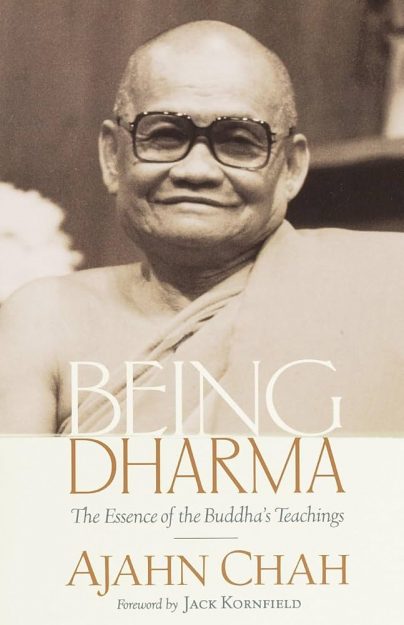
Excerpted from Being Dharma ©2001 by Ajahn Chah. Reprinted in arrangement with Shambhala Publications, Inc. Boulder, CO. www.shambhala.com

Thank you for subscribing to Tricycle! As a nonprofit, we depend on readers like you to keep Buddhist teachings and practices widely available.