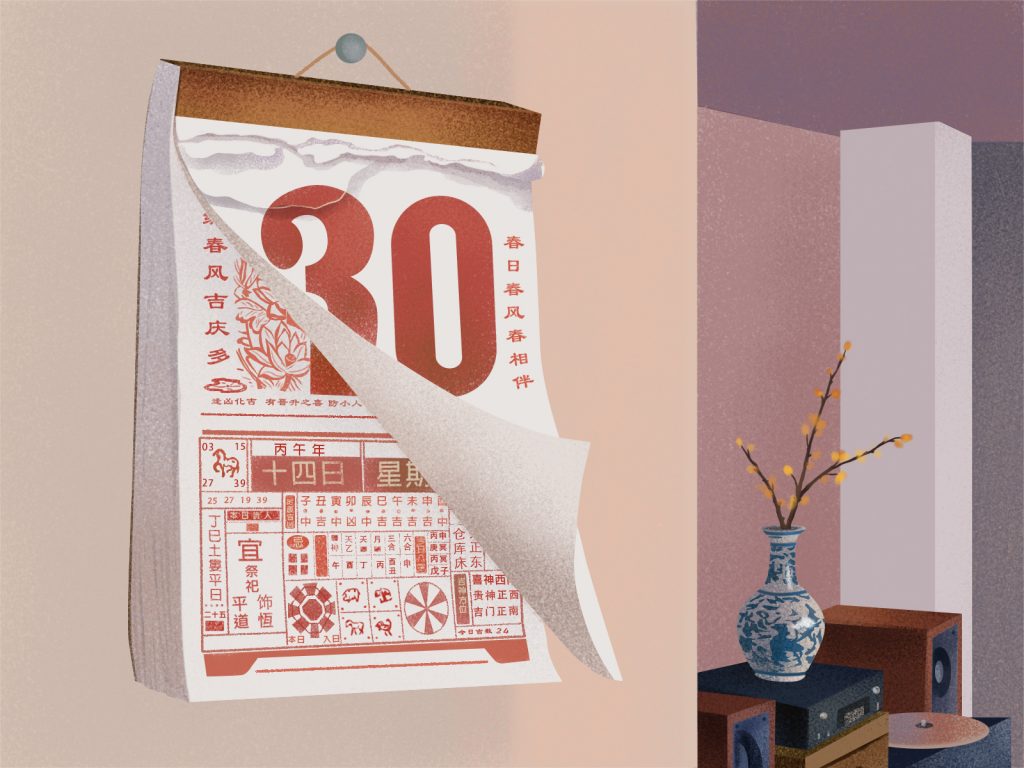
Poems on the season word “old year” are invariably characterized by a thoughtful mood. The theme is unique in haiku literature for its focus on the past. But there are many flavors of retrospection. Poets may cast a wistful eye at the year as it passes . . . or they may welcome the opportunity to put it behind them. They may even feel caught between the old year and the new—not quite willing to let go of the past, but nervous about the future. Last month’s winning and honorable mention haiku explored the range of these sometimes-contradictory feelings, setting a new standard for year-end haiku in English.
- Margaret Stawowy finds herself at a loss when she discovers that the old year has been replaced “with a replica.”
- Noga Shemer watches the old year pass like a night train leaving a station until its “lights and people” are all gone.
- Nancy Winkler wonders if the latest year added to her “growing pile” of old ones will cause it to teeter and fall.
Congratulations to all! To read additional poems of merit from recent months, visit our Tricycle Haiku Challenge group on Facebook.
You can submit a haiku for the current challenge here.
Winter Season Word: The Old Year
WINNER:
I was sound asleep
when the old year was replaced
with a replica
— Margaret Stawowy
Our January 2026 winning haiku records a kind of heist. While the poet slept, the minute hand passed twelve and “the old year was replaced with a replica.” One thinks of a jewel thief making off with a priceless diamond in the dead of night, leaving a cleverly fashioned substitute in its place. Only in this case the thing stolen is not an object, but a year.
Who stole it? The answer can only be Time. Time picks our pockets so skillfully that we usually don’t notice it. There are no “old minutes,” “old days,” or “old months.” It is only with the theft of a year that we are likely to feel the loss—on a birthday or anniversary, or with the turn of a new calendar year.
The poem makes sense on an emotional level because of this, even if the idea of the new year as a replica remains somewhat elusive. A year is a unit of measurement after all—a pair of parentheses set 365 days apart with nothing but time and life to fill them. One year might as well be a replica of another. Isn’t that the point?
The poet seems to resent Time’s theft, nevertheless, as it reduces her future years by one. But the resentment is held lightly. Perhaps even comically. She wakes on New Year’s morning to discover that the old year has vanished like a dream, leaving a new year in its place. If she is fortunate, she will see that year through to the end. But then it, too, will vanish into the past. What can she do but laugh?
Though soft and tinged with sadness, that laughter lies at the heart of the poem. The years move on, replicating one another like mirrors reflecting endlessly through time. The poet dances on a knife edge between wonder and sorrow in the meantime—wonder at the progression of years moving forward, and sorrow for the regression of years falling behind.
To balance the possibilities for infinite gain and infinite loss in a single poem of 17 syllables isn’t an easy thing to do. But sometimes a poet gets it just right.
HONORABLE MENTIONS:
the old year passes
the train slips from the station
lights and people — gone
— Noga Shemer
starting to teeter
another old year added
to the growing pile
— Nancy Winkler
◆
You can find more on January’s season word, as well as relevant haiku tips, in last month’s challenge below:
Winter season word: “The Old Year”
nothing we can do
to help it now the old year
is beyond our grasp
Submit as many haiku as you please on the season word “The Old Year.” Your poems must be written in three lines of 5, 7, and 5 syllables, respectively, and should focus on a single moment of time happening now.
Be straightforward in your description and try to limit your subject matter. Haiku are nearly always better when they don’t have too many ideas or images. So make your focus the season word* and try to stay close to that.
*REMEMBER: To qualify for the challenge, your haiku must be written in 5-7-5 syllables and include the words “The Old Year.”
Haiku Tip: Celebrate the Fifth Season!
The Japanese haiku tradition includes five seasons instead of the usual four. To spring, summer, autumn, and winter, Japanese poets add a category called “The New Year.”
Because it is so heavily weighted toward human affairs, the list of traditional season words for the New Year doesn’t include many plants, animals, or meteorological phenomena. Most New Year’s topics concern foods, customs, clothing, or rituals.
Many of these words don’t translate well into English, where native speakers have no cultural context for them. The list of “firsts,” for instance: “first calligraphy,” “first smile,” “first laughter,” “first dream.” The last, in particular, has a long tradition. The first dream was thought to contain prophecies for the coming year. The most auspicious dreams would feature Mount Fuji, a hawk, or an eggplant.
The New Year has its own two-week holiday in Japan with lots of associated activities—especially around the home. In Basho’s day, it was celebrated at the beginning of spring but shifted to earlier in the year when Japan adopted the Gregorian calendar in 1873.
In the English-speaking world there are New Year’s season words as well. Examples would be “countdown,” “popping the cork,” “watching the ball drop,” “new diary/calendar,” “(making) resolutions,” or singing “Auld Lang Syne.” But the most popular words are just what you would expect: “Old Year,” “New Year,” and “New Year’s Eve.”
This month’s season word is unique in that it refers to something that cannot be experienced in the present. We can experience New Year’s Eve and New Year’s Day in real time. The Old Year is different: it refers to the previous calendar year once the new calendar has been flipped to its first page. The experience is therefore retrospective and usually somewhat reflective. In short, this is a backwards-glancing word.
In art and literature, the old year has often been personified as an old man, whereas the new year is seen as an infant. This echoes one of the most ancient ideas in Western culture, sometimes called “The Allegory of the Seasons.”
In the Allegory of the Seasons, spring is birth and childhood, while summer is adolescence, autumn is maturity, and winter is old age and death. The old year departs into the past in order to make way for the future. After which the cycle begins again.
A poem by the English poet John Clare (1793-1864) begins as follows:
The Old Year’s gone away
To nothingness and night:
We cannot find him all the day
Nor hear him in the night:
He left no footstep, mark or place
In either shade or sun:
The last year he’d a neighbour’s face,
In this he’s known by none.
There is a lot to play with here in crafting that little pivot of thought that makes for a good haiku. There is, after all, something mysterious about the old year. We remember it, sometimes vividly, even though it is forever over and done with now. It’s heavy, but also weightless. Gone, but somehow still present to the mind.

Thank you for subscribing to Tricycle! As a nonprofit, we depend on readers like you to keep Buddhist teachings and practices widely available.