“This is not some exalted, abstract idea of emptiness, of the absolute. It is enlightenment in everyday life.”
—Roshi Pat Enkyo O’Hara, A Little Bit of Zen
“I invite you to bear witness, and in your mind, to ask, ‘What will I do?’ You have many options. Choose one.”
—Bernie Glassman
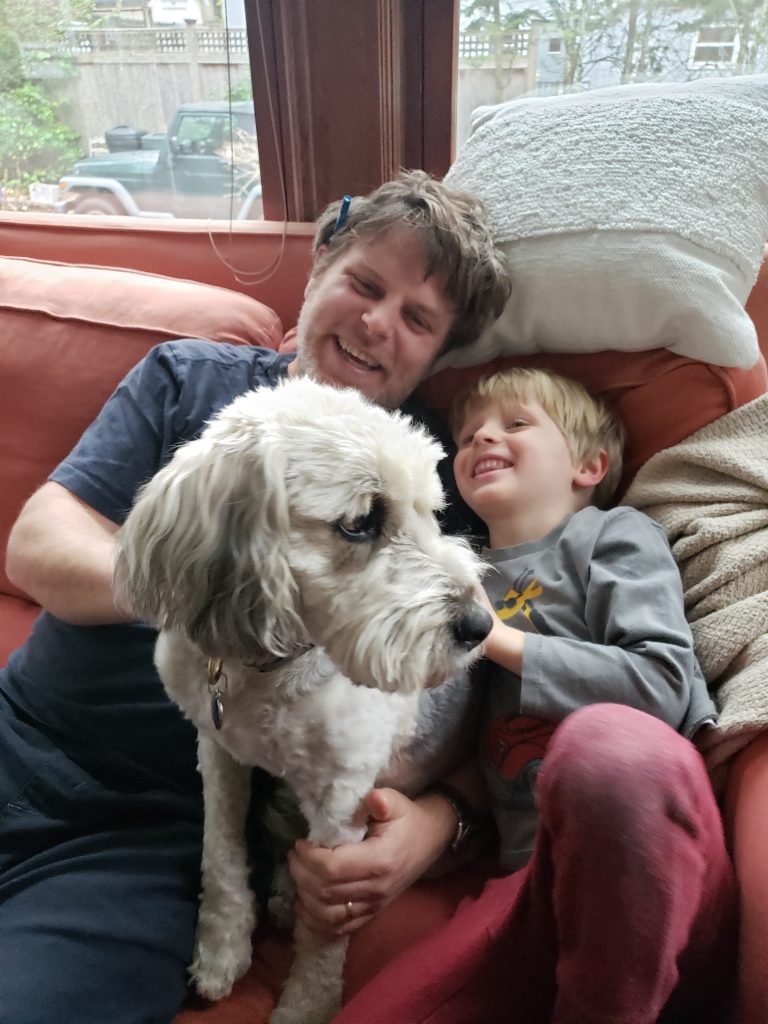
Every now and then, I notice an expression of deep concern on my dog’s face. This is, perhaps, surprising, considering that for the most part, Brooklyn is a happy and reasonably well-adjusted pup. She has herself a pretty good life too: She gets fed, walked, loved. I mean, what, exactly, does she need to be worried about, anyway? Whether or not we will soon present her with a morsel of chicken?
And, yet, that look. Her eyes set and serious, her head pivoting, her body alert and on the lookout for threats on the horizon. If she had a brow beneath all that fur, I have no doubt there are times it would be furrowed.
I imagine that, if you’re anything like me (or my dog), you, too, have found yourself beset with anxiety as of late. There are concerns, no doubt—we each have our list, a seemingly endless one of things that aren’t right in the world, and in us. Matters that weigh on us, that sit in the crease of our foreheads and dig.
As a practicing Buddhist, I wonder sometimes: Am I even allowed to feel this way? Isn’t my existence supposed to be one of resounding inner peace and equanimity? After all, at the heart of the teachings is an ultimate (and ultimately reassuring) truth—that we are all Buddhas at heart, and that the Great Buddha Way is all around us and within us. Where in this grand, immaculate vision of Oneness is there room for concern, worry, doubt? Indeed, to allow ourselves to feel these things almost seems like a betrayal of our faith, and of its deepest Truth: that everything is perfect just as it is.
Despite her occasional expressions of concern, I should make it clear that Brooklyn herself seems well-attuned to this more “enlightened” absolute perspective too—as are dogs in general. Most of her furry existence is spent content, at ease, lazing about, nothing to do, nowhere to go, everything just fine, just as it is. Oh, and it’s an enviable existence, to live this way, with not a seeming care in the world—her muscles soft, her heart open, her mind calm and present and anxiety-free. Nothing weighs on her. She drifts off easily, guiltlessly, into a midday nap.
Is this how we should be living too—so rooted in the truth at the heart of reality that we drift along through life, imperturbable? Yes, one might assume that this is the highest Buddhist ideal—maybe even the ideal no matter your faith—to be so at One with everything, so flush with inner peace, that nothing bothers you at all, but I’m not so sure that’s the deal. That’s not enlightenment. If anything, that’s just being checked out.
So let me just go ahead and reassure you: It’s OK to be concerned. With everything that’s going on in the world right now, you should be concerned. (Indeed, if you aren’t, something might be a little wrong with you.)
Of course, concern on its own is not enough. To sit around all day worrying is precisely as useful as sitting around all day basking in Oneness: not very. Indeed, much like that root recognition of our interconnectedness, it’s really valuable only insofar as it urges us to action. Thus the question becomes: So, you’re concerned. What are you going to do about it?
As Zen Peacemakers founder, Bernie Glassman, makes clear, we have many options for direct engagement. We can volunteer, we can protest, we can sign petitions, we can donate money or resources to a reputable cause or organization, we can call our representatives. Most immediately, on Tuesday, November 3, here in the United States, we can also vote—a great privilege and honor. The point is, one way or the next, we can make ourselves heard, express ourselves and our concerns, get out of our heads and into the world, where a change, a difference, can be made.
Of course, it’s fine to have concerns—but we must not allow them to drive us to despair. Interestingly, actually engaging with the world’s problems may be part of what keeps us from becoming debilitated by them and succumbing to bitterness and gloom. After all, anxiety that doesn’t lead to action—the kind that circles endlessly through the mind like a snaggle-toothed shark in an aquarium—that kind of worrying is not only unhealthy but also pointless. There’s little use in doomscrolling all day and losing yourself in one horror after the next.
Here, too, Brooklyn acts as a kind of model. Sure, she recognizes potential threats—dogs walking down the street (who the hell do they think they are?), mailmen approaching the front door (what the hell does he think he’s doing?)—and she barks like a maniac to express her apprehension, but when these perils have passed, she returns to a state of relative calm. Or, to put it most plainly: Things concern her, she responds to them, she barks herself clean, she moves on.
It seems my dog knows better than to drape herself in unending anguish. Her worries do not haunt her the way they so often do for us—for the rest of the day, into the night, and on into the following morning, ad infinitum. And part of her secret, I think, is the simple fact that because she acts on her concerns so wholeheartedly, she is then able to release them fully too.
The other part of Brooklyn’s secret? She knows the benefit of rest, and of play, and of love. It is OK to be concerned, she knows, but it is also OK to not be concerned sometimes. To set all that aside for a moment. Lie about in the sun. Wrestle with her stuffed toy flamingo. Wag her tail. (And, oh, as many reasons as there are to be concerned, there are even more reasons to wag your tail.)
Point is, Brooklyn finds a balance with it all, somehow: Out the window, she barks viciously at the crumbling world, deeply concerned for her family and all living things. Later, she takes a nap, or has a cuddle. Sometimes she even makes a purring sound that expresses a deep and unwavering faith: All is well in the world.
How are both those realities possible? How can everything be perfect exactly as it is when at the same time there is such immense and obvious suffering in the world? And how can Brooklyn somehow attend to both those perspectives so fully, and with such conviction?
Perhaps most importantly, is it possible for us humans to do the same?
I realize this might appear contrary to what I was originally saying—that we must guard against getting swept away by that absolute perspective, the one that can too easily veer into escapism, nihilism, and a belief that nothing need ever be done. In fact, I was even going to mention an alternate Buddhist ideal, that of the bodhisattva, who makes the decision to turn their back on the bliss of heaven and nirvana and come back down to earth, vowing to remain here in this realm of infinite concerns until all sentient beings have been saved, an impossible task of endless trial and tribulation.
But I’m not so sure being a bodhisattva means you have to completely reject that vision of Oneness, either. It is, after all, at least half the truth, and well worth keeping in your heart. In fact, to truly act on this earth, you might need to hold heaven in your heart. For then, you can return to it, to that refreshing well of the Tao at the root of it all, so that, replenished by the great One, you can once again emerge into this fractured, divided world and do what you can.
Perhaps this is the real Buddhist ideal, to simultaneously hold both those aspects of reality, samsara and nirvana, and to hold them lightly too. Then we can sit, and we can stand up. We can rest, and we can awaken.
And why can’t we tend to it all, anyway? As Brooklyn reminds us, both these perspectives are not only true but also necessary. Or, to misquote Suzuki Roshi, the world is perfect just as it is, and there is work to be done.

Thank you for subscribing to Tricycle! As a nonprofit, we depend on readers like you to keep Buddhist teachings and practices widely available.