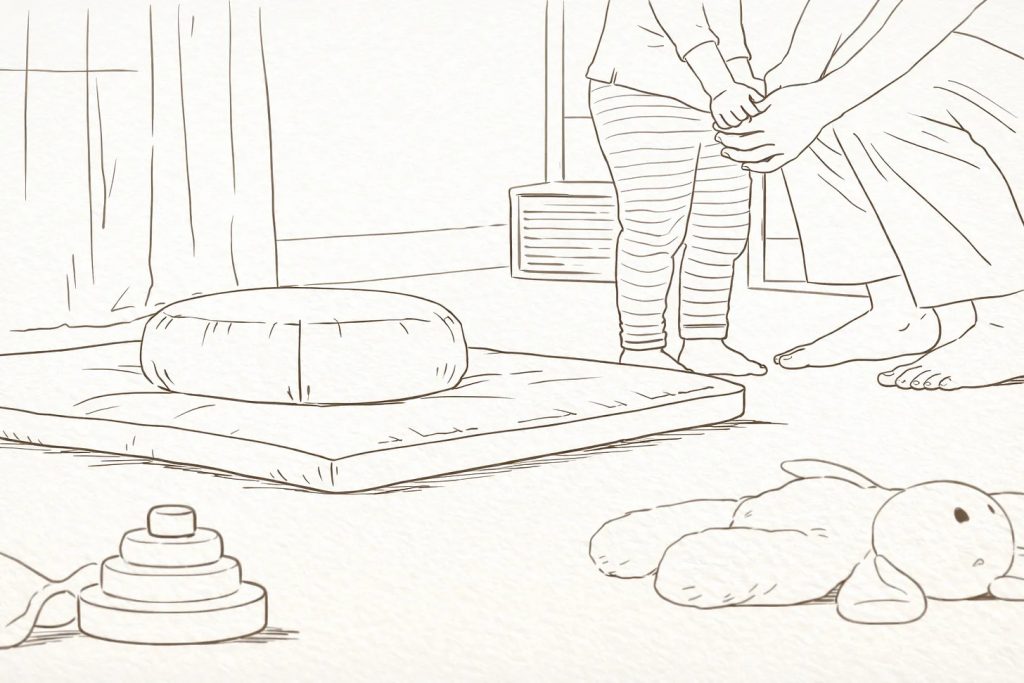
I recently had a birthday, and I really wanted to meditate that morning. Nothing elaborate. Just zazen at sunrise, on my zabuton, marking another year alive.
My son woke up right before I sat down.
I brought him into the living room with me. Within seconds, he started trying to haul me up to standing and rip my rakusu off. For the next forty-five minutes, he oscillated between furious protest and groggy confusion. He whined relentlessly but couldn’t say what he needed. It wasn’t hunger. It wasn’t thirst. I gave him water; he knocked it onto the floor. I pointed to every breakfast option we had. All rejected. Toys were a hard no.
I even tried to include him in my practice, bringing him onto my cushion to sit in my lap.
What he seemed to want, very clearly, was for me not to meditate. I kept trying anyway.
Every time I sat back down, he escalated. Every time I stood up to meet him, the need shifted or disappeared. Sunrise came and went. My perfect birthday zazen dissolved into mutual frustration.
This was not a failed practice. This was the only practice available to me.
A Quiet Flaw
Most of my frustration with practice since I became a mother has come from a mismatch between how I internalized practice—quiet, monastic, protected—and how my life actually requires me to practice.
I inherited an image of awakening that looks like ascent. Progress. Levels. Breakthroughs. Clean insight followed by stability.
That image didn’t come out of nowhere.
The dharma as I received it has been shaped, preserved, and transmitted largely by people whose lives were structured around renunciation rather than ongoing responsibility. Monastics. Institutions. Lineages. Mostly men living in social systems where the daily labor of care was carried by someone else.
This isn’t a moral judgment. It’s a structural condition.
But when you are not designated as anyone’s primary caregiver, certain insights never make it into the record. Not because you lack compassion, but because your nervous system is not trained by interruption, dependency, and repetition.
It makes me wonder whether some of the exclusions in our traditions are less about who can awaken, and more about who society can afford to lose to cloistered practice.
What This Is Not About
This is not about masculine versus feminine energies. This is about labor. Specifically: who is responsible for keeping other bodies alive, day after day, without pause.
Primary caretaking generates a form of knowledge that is not peak-based, not calculable, and not resolvable. You don’t arrive. You repeat. You practice messily today, then again tomorrow, under different conditions, but with the same high stakes of life and death.
In my view, the Buddha’s wealth was a problem for awakening. Extreme insulation distorts perception. But I do not believe the Buddha’s family was a problem.
I resist that conclusion because, as a householder and a mother, it would banish liberation from my own life. It would push awakening elsewhere. Later. Purer.
I need to believe that my practice will continue to be confirmed along this path. Otherwise, the dharma would not only be inaccessible to me; it would collapse under the weight of life.
In my desire for confirmation, I turn to the sutra that centers awakening in a lay householder who never leaves. The text says:
“Though he lives in the household, he is not attached to the household.
Though he wears ordinary clothes, he lives without defilement.
Though he appears to enjoy sense pleasures, he is always in meditative absorption.”
— Vimalakirti Sutra, Chapter 3
For the householder, liberation cannot be proven by departure, only by how one remains.
But I still can’t help wondering who was doing the labor that requires attachment and defilement—who was keeping bodies alive so that this freedom could be named at all.
“As a mother would risk her life to protect her only child, even so should one cultivate a boundless heart toward all beings.”
Not a mother once the child is calm. Not a mother after rest. A mother. Which means strain. Fragmentation. A heart asked to widen while already stretched thin.
The Metta Sutta does not describe ideal conditions.
A Doctrinal Gap We Don’t Name
Zen does not simply lack mothers in its lineage stories. It lacks a theology forged in the fires of their care.
When pregnancy, postpartum, nursing, vigilance, exhaustion, and long-term dependency are treated as spiritually secondary, the Mahasangha loses access to the embodied insights that arise when dharma practice is braided with breast milk, womb blood, and tears.
Zen developed refined teachings on impermanence, no-self, and non-attachment. What it did not develop as fully was an account of awakening that remains credible when you cannot set the object down without causing harm.
“That which is dependently arisen
we call emptiness.
That which is a dependent designation
is itself the middle way.”
— Nagarjuna, The Root Verses on the Middle Way
Dependence is not a spiritual problem to be overcome. It is the very condition of reality. If caregiving is radical dependence, then it is not outside the dharma. It is śūnyatā lived under pressure.
The absence of Zen mothers is not a historical oversight. It marks the limit of what our ancestors were able—or willing—to imagine as the ground upon which we awaken.
When mothers are left out of our stories, it is not only our paths that remain unsupported by example. The tradition itself loses access to the forms of wisdom that arise only under sustained care, interrupted attention, and long-term responsibility. Everyone’s practice is thinner for it.
I sometimes wonder whether the Buddha’s hesitation to admit women into the sangha reflected an unspoken recognition of how much the world depends on us.
Not because women are less capable of liberation, nor because men are less capable of care. But because society is structured so that it would collapse without women’s labor holding it up.
Through, Not Up
Experiential evidence for the horizontal potential of my practice predates the plot twist of motherhood, because practice has never moved me upward. It has always moved me through.
Through the same terrain. Through the same constellations of grief. Through anger again and again without burning me to ash. Through care without uninterrupted zazen.
I meet the same material at deeper levels of responsibility. I don’t take this as evidence of awakening, only as evidence of being practiced by my life.
The test has never been transcendence. It has always been whether I can stay in relationship without collapsing or hardening.
No insight has exempted me from showing up. Motherhood makes this unavoidable.
What continues to soften is my expectation. I look to practice less and less to save me from life and instead let it train me to remain present inside it.
What continues to soften is my expectation. I look to practice less and less to save me from life and instead let it train me to remain present inside it.
On my birthday morning, I didn’t get the meditation I wanted. I got the one my life offered. No perfect stillness. No full-body sigh. Just frustration, presence, and relationship.
So I remind myself, again and again, that if boundless love is modeled on maternal care, then care is not adjacent to awakening. It is the discipline. It is the pressure. It is a legitimate path.
Because, if awakening depends on leaving care behind and mothers are not able to leave, then awakening has always rested on someone else’s labor. And that is not liberation. It is a debt we have failed to name.
Post Script
On New Year’s Day my son woke right before zazen again. This time, I didn’t have the courage to try with him.
So we stayed in bed while he nursed from my left breast and held my right thumb in his small hand. I felt his breathing soften into the steady rhythm of sleep, still rough with the cold we’ve all been carrying for weeks. I felt his warm body curled into the C of mine.
I noticed the familiar craving to get up, to show up as the good Zen student, to sit.
And instead, I stayed.
I let myself rest inside this fleeting, ordinary act of care—knowing that even when attended to fully, it is still impermanent.
I fell back asleep.
♦
The article was adapted from a piece originally published on Alexandra Cain, M.Div’s Substack. Reprinted with permission.

Thank you for subscribing to Tricycle! As a nonprofit, we depend on readers like you to keep Buddhist teachings and practices widely available.