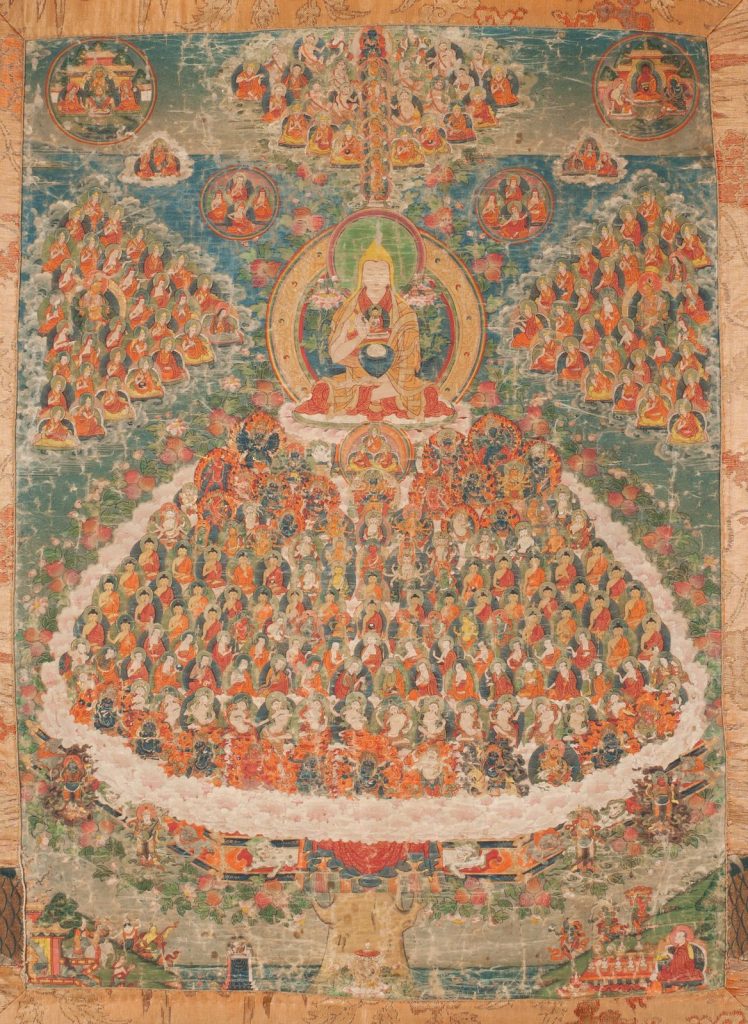
Geshe Chekawa’s (1102–1176) Seven-Point Mind Training starts right at the beginning, with the preliminaries. These preliminaries are: the precious human life, karma and rebirth, impermanence and death, and the unsatisfactory nature of samsara (the cycle of birth and death) as we experience it with our ordinary, conceptual minds. Everyone who has done the tantric preliminaries, or ngondro, knows that we first have to contemplate all these reflections in order to acknowledge our good circumstances and to get us motivated. They are commonly known as “the four thoughts that turn the mind to dharma.”
First, Train in the Preliminaries
The slogan for this point is simple: First, train in the preliminaries. These preliminaries are so important because they encourage us. So often, as we are going along our path, a problem comes up or something more exciting comes along, and then our path and practice get diluted. We lose interest; we lose inspiration. This means we need to develop a strong sense of purpose. Why are we bothering to practice? We have to remind ourselves again and again what it’s all about, because whatever tradition we belong to, there is always the understanding that this is samsara: It is like a prison, and we are all trapped. We have to escape from the prison of samsara, either by leaving samsara behind or by transforming it: By recognizing that, from the very beginning, samsara and nirvana both refer to the mind, and if we understand things as they truly are, samsara transforms into nirvana. So there is actually nothing to escape from. However, as long as we are caught up in the prison house, simply saying that is just empty words. These preliminaries are to remind us that we are both imprisoned and that we have the opportunity to escape.
There are various ways one can practice with the four thoughts that turn the mind. It is possible to integrate the contemplations as part of a broader practice. For example, our nuns at Dongyu Gatsal Ling Nunnery recite some verses related to the preliminaries every morning before meditation, which helps them set a virtuous motivation for the practice. One can also sit with these contemplations individually and dive deeply into each of them, one by one. Again, the point of all of them is to remind us that our circumstances are incredibly unique and precious, so we must make good use of them while we can.
The Preciousness of Human Life
The first of the preliminaries is generating gratitude for having attained a precious human body and mind. Most readers probably know this already, but it is useful to be reminded. We need to start our dharma practice immediately thinking, “Well, aren’t we lucky we have this opportunity!” Even in the world today, we see so clearly that most people have no dharma path. They may be very affluent and outwardly have everything, and yet inwardly they feel so empty because their life has no meaning beyond acquiring more and more. We all know this. Or perhaps they are born into a situation where they do not have the opportunity to practice dharma. In many countries even today, there is no opportunity to study dharma. Especially for women, the educational and the societal opportunities are not there, even in India.
Being educated means that we can pick up a book, read it, and understand it. I think many people don’t recognize how rare that is. Even among our nuns, some may be able to read the words, but don’t understand the meaning. This is why it is so important for nuns to get an education, because traditionally they did not receive one. With education we can pick up a book and, provided it is not about some arcane subject like quantum physics, have a good go at understanding what it is saying. That is an enormous advantage.
We can learn, and then we can think. We can hold two or three different views in our mind and think through them. The Buddha said that, first, we hear or read, then we go away and think about it. Do the things we learned make sense? What is the real meaning of it? What is the point? Then, if we agree, we can practice and incorporate it into our life.
A precious human birth basically means to have all the advantages and so forth, but the real point is that we have the freedom to find a spiritual path and practice it. Essentially, we must have a desire for the dharma, because we can be in a Buddhist country, and have teachers who are talking in our language, and yet we have no interest. This is very common nowadays, as you know. Instead, there is an outer faith based on culture. People will say “om mani padme hung” and do circumambulations, but any real interest in practicing and using the dharma in daily life is simply not there. Nowadays genuine faith is quite rare.
So, when all these causes and conditions come together, don’t waste your chance. These causes and conditions for meeting with the dharma are something we ourselves created, in this and previous lifetimes. It is not an accident; the situation didn’t arise out of nowhere. However, if in this lifetime we don’t make good use of the opportunity to develop ourselves to the best of our abilities, next time around who knows where we will go? The chance to practice the dharma may not come again. This is why the preciousness of human birth is the first and most important point. We mustn’t waste this life and die with regrets.
Death and Impermanence
The second preliminary is contemplating on death and impermanence. Everything is changing from moment to moment, and we don’t know how long we have left in this life. Just because we are young doesn’t mean we aren’t going to be dead tomorrow—especially on Indian roads. People who are still young and healthy and fit can have heart attacks; they can have accidents. Anything can happen—we just don’t know. We cannot confidently say how long we’re going to live. Maybe we will, maybe we won’t. Everything is impermanent, but the one thing certain about life is death. That’s the one thing we all have in common: Absolutely 100 percent of us are going to die.
Buddha said that, if we could do only one meditation, the meditation on impermanence and death should be it. This is not to make us miserable, but again to help us recognize how precious this human life is while we’ve got it. It is to remind us we are not going to live forever, so we better practice now.
Karma and Rebirth
The third preliminary is karma and rebirth. You are, at this moment, about to read this text on lojong, and you are part of a minute section of society, out of all the beings in the world, who will read this. Somehow you have made the causes and conditions to read this dharma text. This is considered to be the result of your past actions, or karma. You may think that you made the decision, but you were actually propelled by your own actions from past lives and also during this lifetime. All of it came together so that, at this particular point, you had the interest and opportunity to pick up this book and start reading.
So much of what happens to us, especially seminal things that happen to us, are the result of causes and conditions that we ourselves have created. How we respond to those situations creates more causes and conditions, as we constantly make our future. Moment to moment, we are eating up the past and creating the future. It is all unfolding continuously.
Moment to moment, we are eating up the past and creating the future. It is all unfolding continuously.
Much of what happens in our lives is not arbitrary, not just coincidence, but a part of our individual patterning that we are experiencing at this time. Therefore, it is very important that whatever happens to us—this again is part of the lojong—we don’t judge it as good or bad. What we need to think is this: “How can I respond to this situation with compassion and intelligence, in a way that opens up future opportunities?” Much of what happens to us is good or bad only according to our narrow, egoic ideas. So often, things that we think are unfortunate turn out to be the best thing that could happen. Likewise, things that we think are great don’t necessarily lead to much. Therefore, we shouldn’t judge things by whether they are comfortable or uncomfortable for our ego; instead, we should ask ourselves: “What can I learn from this? What is this going to teach me?”
The Suffering of Samsara
The fourth of the preliminaries is the difficult state of samsara. No matter whether it looks like a god realm or a hell realm that we are living in, it is still part of the prison. We are still entrapped. We are entrapped not by our external circumstances but by our own internal delusion and ego grasping. And, as long as we retain this fundamental ignorance of the way things really are, we are going to suffer. We suffer because everything is impermanent, yet we want it to be secure and stable. We just don’t know what is going to happen, when it is going to happen, how it is going to happen, and yet our ego wants everything to be safe and settled and going the way the ego thinks things should be going. The ego equals ignorance, so why are we endlessly following ignorance?
Again and again, the dharma is trying to help us to break out, even for an instant, to see things as they really are, and not as our ordinary, deluded, conceptual mind thinks they are.
♦
From Change Your Mind, Change Your Life © 2026 by Jetsunma Tenzin Palmo. Reprinted in arrangement with Shambhala Publications, Inc. Boulder, CO. www.shambhala.com

Thank you for subscribing to Tricycle! As a nonprofit, we depend on readers like you to keep Buddhist teachings and practices widely available.