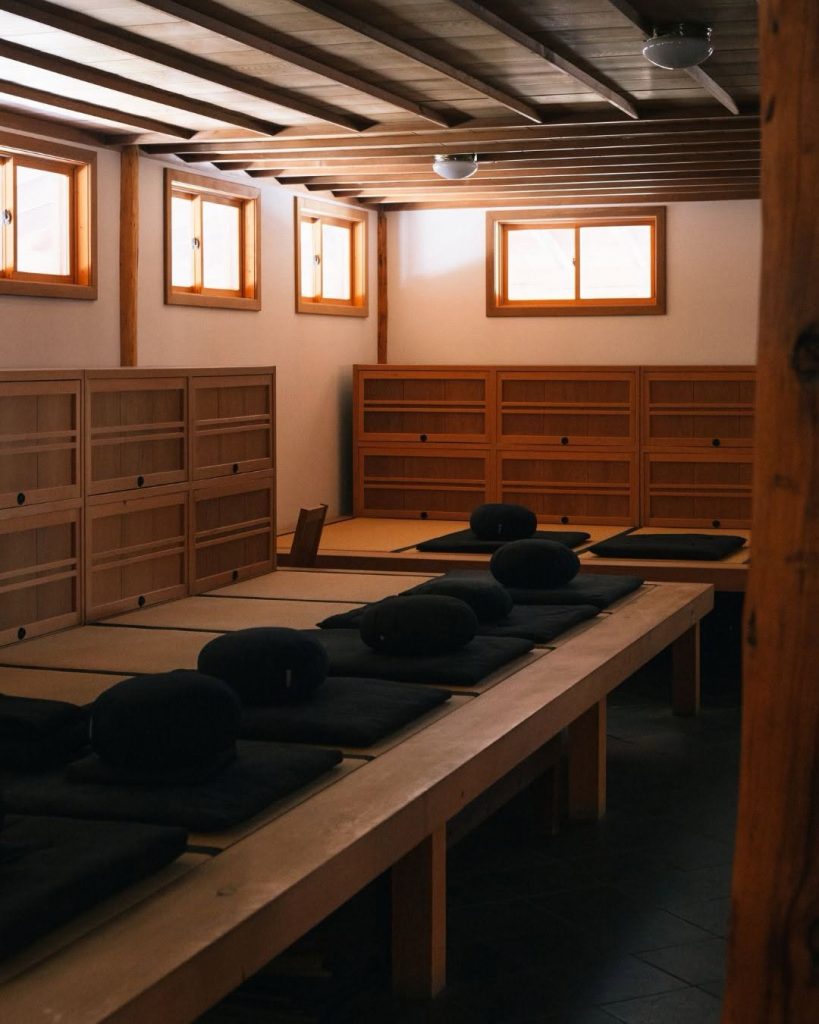
I moved into a Zen monastery when I was 24 years old.
I hadn’t set out to become a renunciant. I had spent the previous seven years practicing in the insight meditation tradition, going in and out of retreat. The practice had become the organizing force in my life, but my life itself was fragmented. I would go on retreat, come home, find whatever work I could—waiting tables, painting houses—and save enough money to go back on retreat again.
Then I found Crestone Mountain Zen Center, a monastery high in the mountains of southern Colorado. Fourteen-thousand-foot peaks rose above us, an enormous desert valley opened below, and a creek ran through the property. The monastery itself was beautiful. Every room contained a statue that seemed to be teaching you how to hold yourself, how to be. And the community was small and serious, full of people who had been practicing for years and decades. It felt like a place where I could mature. We woke at 3:30 in the morning, dressed in our robes in the dark, and went to the meditation hall, where we sat facing the wall in glacial stillness. The forms of the monastery extended far beyond the meditation hall. We bowed when we entered a room. We bowed when we met one another on the path. We ate together, worked together, studied together. Nearly every part of the day was gathered into the same intention.
My practice deepened and, for the first time, I began to see a path where I could give my life wholly to the dharma.
My teacher there, Zentatsu Richard Baker Roshi, once described renunciation as the power that comes from limitation: “When we limit ourselves, when we really choose one thing, it empowers that thing and shapes our lives around that thing. We give something up to empower our lives.”
***
In college, I had a close friend who was also a writer. We read each other’s work, talked endlessly about novels and essays and poems, and took seriously our shared ambition to become writers.
After graduation, she moved to New York to become a publicist at Vintage, and I moved into the monastery. I thought she was selling out. She thought I was ridiculous.
A year later, she sent a group email to a bunch of us about the absurdity of moving in Manhattan. She had managed to lock herself out three times in a single day, calling the same increasingly exasperated locksmith each time. Another friend on the email was an editor at the Village Voice. He edited the email into a piece and published it. Then a Riverhead editor saw the piece and asked her to write a book.
The book became a New York Times best seller. Suddenly she was a literary celebrity, sipping martinis with the authors we’d been obsessing over together in the college coffee shop. She stopped returning my calls.
It burned.
Another friend, who’d secured equity in a giant tech company, got married in Napa. I couldn’t afford the hotel, couldn’t afford the flight, and the friendship fizzled.
I can still feel the pain of those losses, that separation. The stories of my friends’ lives arrived in emails and phone calls and occasional visits: jobs, marriages, apartments, books, money. Meanwhile, my own life was becoming narrower and deeper. I owned very little. I had almost no money. My days were largely prescribed. Month after month, I got up before dawn, put on robes, sat facing a wall, worked, studied, sat some more.
There was deep pleasure in that life. I loved the seriousness of it, the beauty of the forms, the intimacy of practicing with the same people day after day. I loved having so much of my life gathered around a single point.
But then somebody else’s life would appear beside mine. And my simple life, in relief, would look temporarily shabby. I would wonder why I had stopped writing. Or what else I was missing. Or who I could be spending my time with if I wasn’t spending my time in flowing black robes.
Six years is a long time in your 20s. By the time I left Crestone, some of the lives I had imagined for myself at 24 were no longer waiting around as possibilities.
***
The Dhammapada says, “If by renouncing a lesser happiness one may realize a greater happiness, let the wise one renounce the lesser, having regard for the greater.”
On the page, the arithmetic is simple. The harder thing to understand in an actual life is that the lesser happiness is still happiness.
When I was 24, I knew quite well what I was giving up. I knew what it was like to stay up late talking with friends, to write, to travel, to fall in love, to have an unscheduled afternoon. I could imagine a career because I had friends beginning their careers. I could imagine marriage, money, cities, books. These weren’t temptations in the sense of things I secretly believed were bad for me. They were just things I wanted.
What I knew much less about was the other side of the equation. I had been practicing meditation for years, and I knew that I wanted to give myself to it. But I couldn’t know what six years of monastic practice would do to me. I couldn’t know what would happen from thousands of hours of sitting still, or from living inside a community organized around realization, or from making the same choice again each morning for years.
This is part of what makes renunciation difficult to talk about. We can make it sound as though the things we relinquish have been exposed as counterfeit pleasures. But the verse doesn’t say that. It calls the thing being abandoned a happiness.
The lost friendships were a lost happiness. Not writing was a lost happiness. I could imagine another life full of art and music, of love, curiosity, and play. That life would have contained happiness, and I felt the pain of giving it up.
***
You don’t have to move into a monastery to encounter this arithmetic. A meditation practice takes time, and the time has to come from somewhere. You sit for forty-five minutes instead of scrolling through your phone, reading a novel, or sleeping for another forty-five minutes. You spend a week on retreat instead of taking a weeklong vacation with your family.
Some of those choices are easy. Others aren’t. A vacation with people you love can be wonderful. So can sleeping in late, making money, watching television, going out to dinner. Practice doesn’t require us to pretend otherwise.
But if practice becomes important enough, we begin choosing it anyway. An hour becomes a morning, a morning becomes a day, a day becomes a week. Over decades these choices can take up a measurable portion of one’s life.
***
After six years, though, the monastery had begun to feel too small.
I was falling asleep in zazen. My practice, which had deepened so much in the first five years, seemed to have plateaued. I was also having increasing difficulty with my teacher. I couldn’t stop seeing inconsistencies in him, and I couldn’t find a way to live with what I saw.
And there were parts of me that had nowhere to go. I wanted to have a voice in the culture. I wanted to write books, talk to people, be in the mess and fuss of things. I wanted complication and energy and bigness. The very limitation that had shaped me so powerfully was now constraining something that wanted to develop.
And so I left. I had no idea what I was going to do.
For almost a year, I spun. I was frightened. I had spent most of my 20s in a monastery and had almost no marketable skills. I didn’t know how I was going to support myself. I applied to business school, then realized I couldn’t imagine spending my life in business. I almost applied to law school and recoiled even more strongly at that.
Eventually, I decided to get a PhD in psychology. It was the closest thing I could think of to what I had already been doing: People had come to the monastery and talked with me about their lives. I had learned to sit with them, listen, and try to help.
When I moved into Crestone at 24, I had given up one possible life without knowing what the monastery would give me. Six years later, I did it again. I left a life I loved before I knew what would replace it.
***
I spent my 20s learning how to trim the wax from altar candles. I learned how to arrange the ashes, dust the Buddha, and place the flowers. I had no thought that any of this was preparing me for something else. Sometimes I wondered what possible use it would be. Who needs to know how to tend an altar in this life?
The same was true of living in the monastery itself. There was almost no privacy and very little relief from other people. I used to joke that monastic life was like being married to a dozen people I hadn’t chosen, some of whom I didn’t even like. There was nowhere to go when somebody irritated me. We still had to sit together, eat together, work together, and get up the next morning and do it again.
Years later, I got married, and I began to understand what those years had taught me. Marriage is difficult. Relationships are rough. Yet living in community had given me six years of practice with staying close to other people when I was uncomfortable, irritated, hurt, or simply wanted to be left alone.
Other things returned in forms I couldn’t have anticipated. I thought I had given up being a writer when I went to Crestone. In a sense, I had: The literary life I imagined in college never happened. But I did become an author. Instead of writing literary novels, I began to write about the dharma.
My life now contains almost everything I wanted when I was 24, though very little of it looks the way I would have imagined then. I have a happy marriage. I have friends, including many from the monastery, some from college, and others I have met along the way. I teach the dharma. I have enough money.
I wake up most mornings stunned by my good fortune.
And when I see people living the kinds of successful lives that once made my own look shabby, I don’t feel the old comparison. I can see that their lives contain things worth wanting without wanting those lives for myself. Mostly I think: Good for them.
***
Sometimes I think about the 24-year-old version of me sitting in the meditation hall at Crestone, facing the wall while news of other lives reached him from far away. I don’t want to tell him that none of it matters. It mattered to him, and some of it still matters to me. He was giving up things worth having, and he had taken a risk not knowing what those years in the monastery would give him in return.
Maybe that is the difficult thing about the Dhammapada verse. We usually have to relinquish the lesser happiness before we know the greater one well enough to compare them. We choose with incomplete information.
At 24, I could see the lives I wasn’t living much more clearly than I could see the life I was making. I could not have imagined this life. I only knew which way I wanted to go.

Thank you for subscribing to Tricycle! As a nonprofit, we depend on readers like you to keep Buddhist teachings and practices widely available.