“Just yesterday while walking alone,
I saw the old path strewn with Autumn leaves,
and the brilliant moon, hanging over the gate,
suddenly appeared like the image of an old friend.”
–Thich Nhat Hanh
Every time I saw my father he was a different person. He lived just three hours away in a small house near the beach, but I hadn’t seen him since May, so at the end of the summer I took my two sons to visit him. He had received an official dementia diagnosis the previous year, but his illness had been apparent for some time before that. I didn’t know what to expect on this visit, but what I’d heard over the summer wasn’t promising.
His new caregiver was Celly, a quiet South African woman of unguessable age, anywhere between 30 and 60. We fumbled through the pleasantries, then she said, “I understand he was a very brilliant man? And his work mattered a great deal to him?” The past tense was painful but accurate. I found myself saying, “His work was his life.”
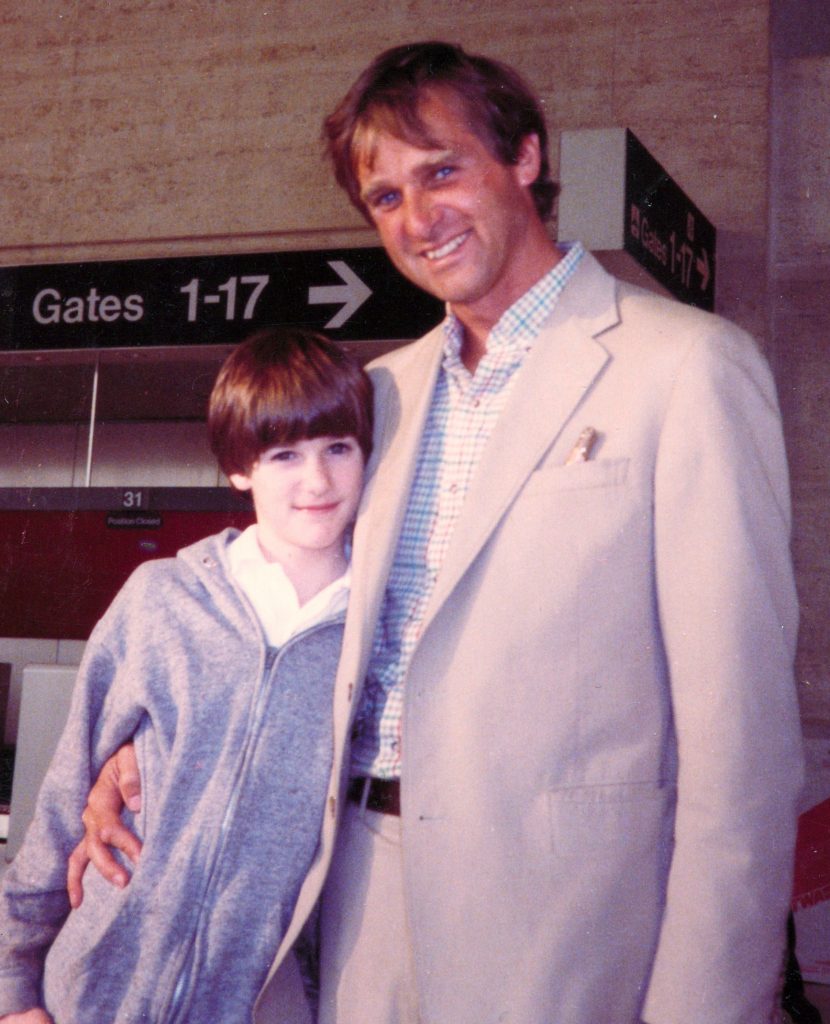
As a clinical researcher in a university lab and later a pharmaceutical executive, he traveled widely, seemingly incessantly, delighting in the fastest route to this airport or that, carefully weighing the merits of the hotels in Helsinki or San Francisco. My mother, from whom he separated when I was 9, said that even when he was home, which wasn’t often, his mind was still at work. After the divorce I saw him mainly on trips, to Minneapolis, Los Angeles, even Barbados, where he spoke at a conference while I went to the beach and got stung by a Portuguese Man o’ War and was sunburned so badly my eyelids peeled. He was generous, optimistic, a loud talker, sure of himself in all scientific matters. As a doctor studying infectious diseases he was certain he was doing the most important work in the world.
But now he had no contact with the former colleagues who never seemed to leave him alone back when the two of us went out to dinner, and sat silently on the couch watching one of an endless series of barely distinguishable Hallmark movies. He enjoyed their familiar motifs: “That guy is not a good guy.” “They’re going to kiss now.” The Hallmark phase came about because Little House on the Prairie, his previous standby, proved too exciting. In one episode, Mr. Ingalls, played by Michael Landon, was accidentally shot by his daughter Laura, played by my childhood crush Melissa Gilbert. My father got up and went to the next room (at 82 he can hardly be said to “hurry” anymore) to announce: “A man has been shot! We have to help him!” And once, watching a war documentary, now strictly off-limits, he warned someone headed outside, “Be careful, there’s a lot of shooting out there!”
Dementia is the perfect illustration of the stark truths of impermanence, suffering, and nonself, or it’s the mockery of those truths.
Confusing television and reality may seem frightening, but this is the lighter fare. The new development was that he didn’t recognize us. He couldn’t say who anyone was or what they meant to him. He didn’t remember what he did five years ago or five minutes ago. Asking him the simplest question, as Emperor Wu asked Bodhidharma, “Who are you?” would be cruel and pointless. He could no longer operate his phone (he had been an ardent early adopter of cell phones) or the remote control. His cares were immediate and did not extend far beyond his person. He was a prisoner of the present moment, unable to plan ahead or look back. There was nothing for us to do but be attentive to his moods and wants, keeping our griefs hidden. Displays of emotion upset him.
“Past mind cannot be found, present mind cannot be found, future mind cannot be found,” the Buddha tells Subhuti in the Diamond Sutra. I wondered, was my father watching his thoughts flow past like a movie he couldn’t follow? Could his discerning mind find no purchase in the rushing stream of thoughts, or was the stream itself dammed? Was there a luminous mind in him still, obscured by the disease?
His diagnosis is frontotemporal lobar degeneration, or FTLD, which may sound specific but is an umbrella term covering a wide range of progressive dementias. The temporal lobes are damaged or shrunken. Auditory processing, memory retrieval, visual perception, emotional regulation, language comprehension all suffer. The ability to maintain attention, as well as a sense of self, is reduced.
We were told his dementia results from a mutation of the gene designated C9orf72, which causes excess “abnormal proteins” to accumulate in the brain, and over time these proteins obstruct signals between neurons and generally muck everything up. One result is ALS, which causes a progressive lack of muscle control, and killed my uncle, my father’s younger brother, at 72. The other common result is frontal lobe dementia. Many people in my family probably carry this mutation. Most of us don’t know one way or the other, and we don’t know what to say to our kids about it.
My father sat surrounded by photos meant to prompt his memory: black-and-white photos of his parents, color photos of his children. He briefly showed interest, understanding that this was expected of him, but they couldn’t hold his attention. What could the photos mean, now that he had forgotten? The photographer Sally Mann said that photographs, far from preserving memories, destroy and replace them. Memories, according to Mann, are delicate things, to be handled lightly:
I tend to agree with the theory that if you want to keep a memory pristine, you must not call upon it too often, for each time it is revisited, you alter it irrevocably, remembering not the original impression left by experience but the last time you recalled it. With tiny differences creeping in at each cycle, the exercise of our memory does not bring us closer to the past but draws us further away.
Mann’s pessimism about memory is shared by the novelist Harold Brodkey, who minutely examined and recreated his childhood over a literary career spanning five decades. Brodkey commented:
It’s often an absurdity in terms of time and will to try to remember one’s real history. While we are growing up, we are forced to learn to hide things—from ourselves and from others. . . . We learn to do things indirectly and in steps, to be discreet—buttoned up—as part of manners and taste and part of our moral judgment and tactics of survival.
This self-protective deception may be why we so easily forget. We’ve all forgotten more than we remember, and the imbalance grows daily. What we remember, even if it’s not perfectly true, shapes us into who we are.
In the absence of memories or new information, my father turned to trust as his measure of people, a kind of intuition. Everything is tinged with suspicion, which seems natural for those with dementia. The world is unstable, and the people around you are mysterious. How can you trust someone you don’t understand?
I took a brief phone call while I was with him. He watched me reproachfully, asking, “Who are you talking to?” with rising annoyance.
When I hung up and explained, he said, “I know you’re lying. What I can’t figure out is why.”
“Why would I lie to you, Dad?”
“That’s what I’m trying to figure out. But I can tell you’re lying. And now I will never, ever trust you again! So you’ve made a big mistake.”
Ominous, but not long after, I was readmitted to his circle of trust with little fanfare. We sat in mostly amiable silence on the front porch. He asked me, dozens of times, whose white car was parked out front. (It was mine, every time, though I was tempted to get creative.) Celly came out to give him his pills, which he accepted without protest. She pointed at me and asked him brightly, “Who is this? He has your eyes. Look at his face. Who is he?” He looked from her to me and back again, expressionless and serious. (Humor had been beyond his reach for some time already.) He placed a trembling hand on my shoulder and announced, in the same rough voice that frightened me as a child, “This is my old friend! And I trust him completely!”
I was clinging to a relational identity that was no longer reciprocated. We are told not to “insist on reality” with people with dementia, to play along, to let go of our own narratives. The teacher and activist Sean Feit Oakes, speaking about impermanence, put it baldly: “The only thing lost when we understand that nothing can be held on to is the suffering we experience by grasping.” Yes, but don’t be fooled. Letting go hurts too.
Where does the mind go as the neurons are occluded and the brain tissue withers? We may as well ask where the mind emerges from in childhood. It arises and passes away, ungraspable, in constant flux. Dementia is the perfect illustration of the stark truths of impermanence, suffering, and nonself, or it’s the mockery of those truths. The curtain falls prematurely on the performance of personality. The continuity and solidity we cling to is revealed as a farce.
About ten years ago my uncle felt a tingling in his feet that soon spread to his hands. Two years later he was largely immobile and had lost half his weight. Shortly before his death I lifted him up and carried him to his bed. In my arms he lay fetal as an infant, this man who always met me at the train station when I came home from college with a $20 bill in his hand. He took me to Yankees games and once caught a foul ball hit by Frank White of the Kansas City Royals, which still sits on my shelf.
My father’s decline took place offstage. During Covid he was isolated with my stepmother (his third wife) and my younger brother. On FaceTime calls he seemed confused and distant, but he was going deaf, and we were all a little crazy then. Did he know something was wrong, even if he would never say? As vocal and articulate as he seemed to be in his work, the part of his life we barely touched, he shared little of himself outside it, and asked few questions. He emerged from lockdown much diminished from the colossus of my childhood.
“The Buddha’s primary insight was that everything of importance happens in the mind,” writes the scholar Richard Gombrich. We are told to rely on our minds alone, as in the Dhammapada:
Whatever a mother, father
or other kinsman
might do for you,
the well-directed mind
can do for you
even better. (trans. Thānissaro Bhikkhu)
But it is difficult to trust our minds, knowing how easily they forget and deceive us and will eventually cast us adrift. We have only this body to practice with, and only this mind too. We must embrace and accept our vile bodies, but the mind—when it’s a healthy mind—can be trained and strengthened.
The 4th-century philosopher monk Vasubandhu commented, “Awareness of other minds is illusory. How? Just like one’s awareness of one’s own mind.” The mind cannot perceive itself just as the eye cannot see itself and the fingertip cannot touch itself, much as we try to watch our minds in meditation. We see fragments, catch brief glimpses. This may mean we can’t be aware of our own mental failings until we’re unable to recall the word for this thing with a handle that holds our coffee. It is delusion to think we can watch the mind as it decays. Or can meditation shine a light on the creeping approach of dementia? This is not an idle question.
“Bring me your mind, and I will pacify it for you,” Bodhidharma told his disciple Huike, who presented his severed arm to his teacher but couldn’t produce his mind. Much of my time here is spent pacifying my father. He is hungry, he is tired. The mind doesn’t enter the discussion.
In college I wrote my senior thesis on materialist or physicalist philosophies of mind, the idea that consciousness is a creation, or illusion, in Daniel Dennett’s phrasing, of the brain, a sort of movie emerging from a projector. I wrote about Buddhism’s very different picture of the mind, as a process, not even a thing, and defended my thesis in front of a committee of three professors. My advisor told me to stick to Berkeley and Hume and Wittgenstein but to lay off the Buddha and Vasubandhu in my verbal arguments—it was too late to change the written ones—but I don’t remember if I listened. Today I can see just a frozen image of the sunlit room, a snapshot taken from the doorway of three waiting faces. The words we spoke are gone, but I’m sure dementia didn’t come up. Though it would seem to lend support to materialist arguments, dementia is not of great interest to philosophers of mind, who also start with the assumption, the luxury, of a healthy brain.
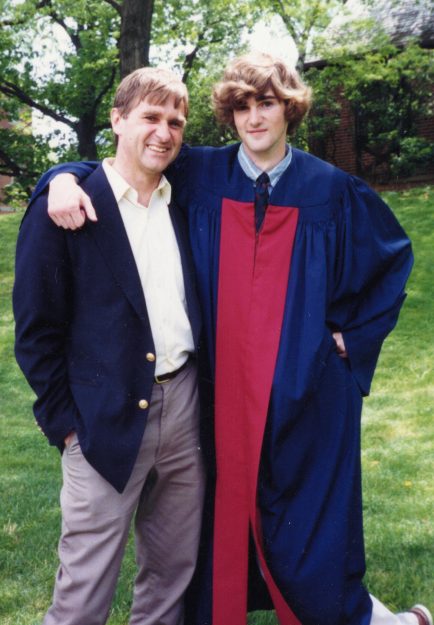
In my college years my father had two small children—my younger sisters—with his second wife. This was, I think, the happiest period of his life. He was the fullest expression of himself, at large and unhindered in the world. He lived near my school (which he paid for), and I was able to see him often. My best memories of him are from this time, when I was no longer a child but not yet an adult.
My father had escaped forever the conversation I always wanted, the one where he would say, “How are you? Tell me how things are going.” I had imagined that as an older man, content and resting from his labors, he might arrive at this at last. I recognized this as my childhood perspective on our relationship, with him always going away and me in hopeless pursuit. I would never catch him, but there would have been no satisfaction even if I had. His outward personality, his enormous confidence, must have cost him, and must have hidden a yawning uncertainty empty as the interior of an atom. But I shouldn’t pretend to know. Why would I understand him better than I understand myself, just because he now fits in the palm of my hand? He is unknowable as ever, a black box sealed and submerged in utter darkness on the ocean floor.
As we were leaving he shook my hand from the couch. I told him I loved him, and he warmly repeated his highest praise, that he trusted me, his old friend. Then he pointed imperiously at my sons, who are identical twins, and shouted, “But I don’t trust you, and I don’t trust the other one! It doesn’t matter what shirt you wear or what you say! And that’s the way it’s gonna be!”
They were taken aback in the moment, but driving home they cheerfully replayed the scene, pointing at each other, “It doesn’t matter what shirt you wear or what you say!” “And that’s the way it’s gonna be!”
I may be the way he is one day, but I promise to offer myself as fully as I can before it’s all taken away.
I told them, “Someday I may not trust you, and I may forget your names. But right now I trust you—and the other one!”
And we laughed. What else could we do?

Thank you for subscribing to Tricycle! As a nonprofit, we depend on readers like you to keep Buddhist teachings and practices widely available.