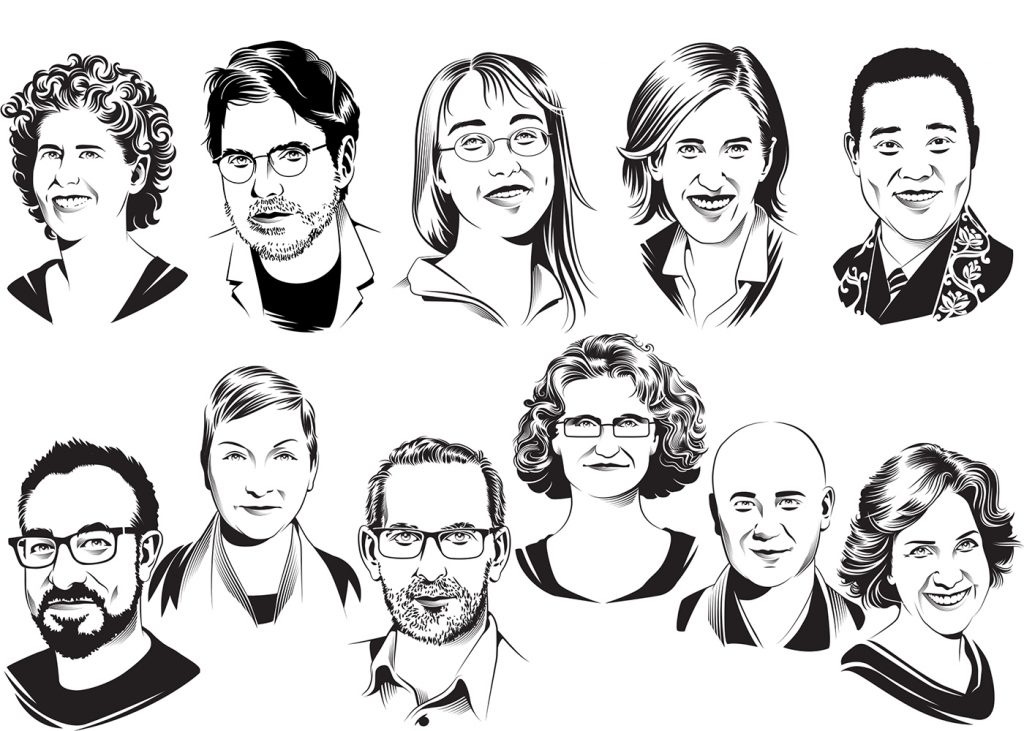
In 2008, Tricycle asked a group of “old Buddhist hands,” including teachers, writers, and longtime practitioners, “What in Buddhism have you changed your mind about, and why?” We got delightful, unexpected answers from the generation that founded a host of dharma centers and gave us many of the institutions that still define the Buddhist world. Today, there’s a new group of old hands settling into positions of leadership around the Buddhist world—or is there? After all, we’re talking about Generation X, the forgotten generation, familiar with being overlooked and bypassed, standing quietly by while others take the limelight, whose cultural ascendancy was over before it began.
We asked this group what they had changed their minds about, and this is what they said. Please join them and let us know what you’ve changed your mind about!
–Philip Ryan, executive editor
Justin Whitaker
When I first encountered Buddhism twenty-five years ago, I was struck by its apparent clarity. Here was a tradition that spoke directly to suffering, offering an almost scientific guide to ethics, meditation, and insight without rigid dogma. Compared with the religious traditions I had known growing up—many of them steeped in authoritarian rules and outdated rituals—Buddhism felt rational, psychological, and rooted in a deep concern for human well-being. I saw it as the most refined expression of human wisdom.
But time, and study, have eroded that rosy-eyed view. I’ve seen the ways Buddhist history is shaped by many of the same forces as other traditions: politics, patriarchy, violence, and cultural blind spots. I saw how some teachings could be used to promote passivity, and how others were used to defend or deflect attention from outright harm and abuse.
I’ve come to admire deeply the depth and beauty of other traditions—the moral rigor and poetic beauty of Christian mysticism, the community bonding and deep melting away of ego in a Native American sweat lodge, the generosity and humility of the Muslim holy month of Ramadan. My admiration for Buddhism remains, but it no longer sits on a pedestal. Instead, it lives alongside other traditions in a more humble, comparative light.
I still find immense value in Buddhism—its silence, its questions, its invitation to wake up. I still practice. But now I do so with more curiosity and less certainty. Buddhism is not the apex of religion. It is one thread in the great tapestry of human attempts to wake up, to live well, and to ease suffering—sometimes failing, and sometimes, brilliantly, succeeding.
Justin Whitaker is a senior correspondent at Buddhistdoor Global and a core faculty member of the Humanistic Buddhist Monastic Life Program at the Woodenfish Foundation
Vanessa R. Sasson
Life is suffering.
When I first encountered the tradition, this lesson spoke to me. I saw evidence of it in my own life, in the news, in the world I watched with young eyes. But I don’t think I really understood suffering (maybe I still don’t). I was young and idealistic. I firmly believed the world, and everyone in it, would get better with time. The arc is long, but it is supposed to bend toward justice.
Twenty, thirty years later . . . my idealism has taken a hit. I watch the world with older eyes. Some people seem to go out of their way to create suffering. Some might even enjoy watching others squirm under their thumbs. I see goodness, too, of course, but the suffering is loud.
I know I should be wiser by now. I should be able to look at cruelty with wizened eyes. But some days, I just can’t get there. Cruelty is strangely prevalent and terribly ordinary. Desire turns some of us into monsters who grab at everything with both hands. So perhaps my answer is this: I know less than I used to know. I feel less safe. And I am sadder than I think I was before. A real Buddhist teacher would probably jump in at this point and say, “This is the very definition of samsara. This is as it has always been.” I’m sure that’s true.
But my idealism still begs me for a better world. Perhaps, if you ask me this question again in another twenty, thirty years, my idealism will have finally dissipated. I will have let go. And then I will have something better to say.
Vanessa R. Sasson is a professor of Buddhist Studies and the author of Yasodhara and the Buddha and The Gathering.
I know I should be wiser by now. I should be able to look at cruelty with wizened eyes. But some days, I just can’t get there.
Cator Shachoy
I thought I would cry less. Whoops! It turns out there’s no Off button for feeling. Planning or controlling tears is ridiculous. They just come and go, the same way the ants move around the garden, then into the house, then back out again, doing their own thing. Have you ever seen toddlers lining up for snack time? What might at first appear to be a modicum of order quickly reveals itself as a complex improvisational choreography. Who’s in charge here, anyway? Tears flow every day for the beautiful and terrible things of this world. My heart quivers of its own accord, with no regard for my schedule or plans. This can be very inconvenient. Expanding, contracting, expanding like the flickering lights of the Bay Bridge toll plaza. Twinkling red and green, a magical living artwork whose mundane purpose is to avoid a traffic jam as we commute into the City. And then a traffic jam happens anyway, just a half mile down the road. Once again, I am arguing with my mother.
Cator Shachoy is a craniosacral practitioner, yoga therapist, and meditation instructor.
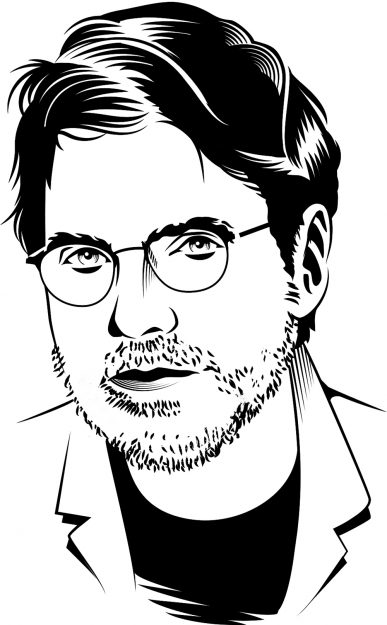 Brad Warner
Did I, in the past, have any definite ideas about Buddhism? And have those ideas changed? When I first began to study and practice Buddhism, I didn’t have any idea what it was other than the idea that it was an Indian religion related to Hinduism. I went into it blind. I was looking for a class about Hinduism when I was at Kent State University in the early ’80s. They didn’t offer any, but they did offer a not-for-credit class called Zen Buddhism. I figured that might be interesting.
As time has gone on, I have mysteriously come to be regarded by some as an “expert” on Zen Buddhism. But I’m not. I just found the practice to be extremely valuable and the philosophy to be deeply profound. It continues to interest me. I don’t know if I’ll ever understand it. I sometimes wonder if anyone understands it. Also, I seem to be an entertaining speaker when I speak about Buddhism.
But when it comes to any aspect of it that I’ve changed my mind about, I just can’t come up with anything. I’m still trying to figure out what it is.
Brad Warner is a dharma heir of Gudo Nishijima Roshi. He wrote The Other Side of Nothing, Hardcore Zen, and other books.
Some have become disillusioned and left the dharma. Others have persevered. What has changed? We have.
Holly Gayley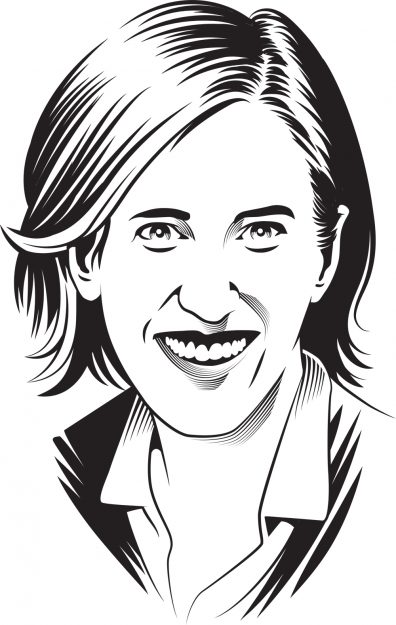
Once, long ago, I caught myself looking at the guru the way my dog looks at me. It was some combination of loyalty and longing toward what seemed like the source of everything good. Given the legacy of Orientalism, it was easy to slip into an idealization of all things Buddhist and Tibetan.
More recently, an abuse crisis in my sangha forced me to rethink the teacher-student relationship. The path had become rote, ticking off mantra recitations on a mala, or rosary, to progress to the next esoteric teaching. My practice had plateaued, like skating on a frozen pond. This is an image that collective trauma expert Thomas Hübl uses to describe when spiritual practice doesn’t penetrate the depths of our being due to unresolved trauma.
As I grappled with the crisis, and my own experience of guru misconduct in my 20s, I made two choices: to dive into a trauma training and to circle back to foundational Mahayana teachings. The trauma training helped me to heal—melting the ice, relating to the murky waters underneath, and processing fear, resentment, and shame. Along the way, I refocused my practice on tonglen and taking adversity as a path, part of the Tibetan “mind training” teachings called lojong. It took me two years before I could pick up a sadhana, or liturgy, again.
For me, losing the teacher has been a teaching. It has forced me to take responsibility for my own path. Following the trajectory of my academic research, I’ve turned to the female side of the tradition, Yeshe Tsogyal and Machig Labdrön, for inspiration in liturgy.
Some have become disillusioned and left the dharma. Others have persevered.
What has changed? We have.
Holly Gayley is an associate professor in religious studies at the University of Colorado Boulder.
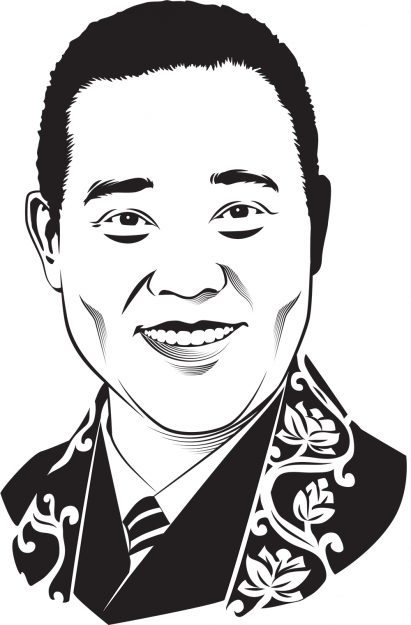 Rev. Blayne Higa
The traditional roles of a Buddhist priest are to serve as a dharma teacher and ritualist. However, in my years serving a sangha, I have come to realize even more intimately how in the Shin Buddhist tradition we are all just “fellow travelers” along the Buddha’s path. We live, work, play, and cry together as a community of dharma friends encountering the joys and sorrows of life from birth to our birth in the Pure Land. To be a fellow traveler means to come alongside each other as imperfect companions who struggle and strive to embody the dharma in all that we do while awakening to the dynamic working of all-inclusive wisdom and all-embracing compassion that is Amida Buddha.
Our ordinary everyday life is the proper place of practice, where we learn to transform our intellectual knowledge of the teachings into a heart-
centered understanding of the living dharma. Only in community do we truly learn and grow together on the life-giving and life-transforming path the Buddha shared. I’ve come to realize that institutions are not necessarily sangha. Being a priest is more than our traditional roles and serving an institution. It is about caring for people and nurturing a dharma-centered community. Sangha is where the Buddha continues to live through the practice of the dharma. In a world marked by isolation and division, it is unsurprising to realize there is nothing more radical and yet traditional than community.
Rev. Blayne Higa is the resident minister of the Kona Hongwanji Buddhist Temple in Kealakekua, Hawaii.
Sangha is where the Buddha continues to live through the practice of the dharma.
Satya Robyn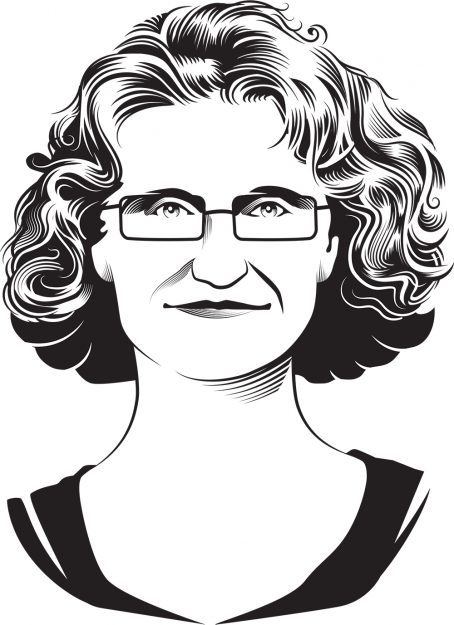
This morning, I was incandescent. After a UK Supreme Court ruling that put rights for trans folk back decades, I was encountering many friends who had “different views” on my social media stream. I was caught in a doomscroll, feeling worse and worse about humanity, and utterly unable to engage in calm, sensible debate. I was unfriending people left, right, and center. I was out of control.
According to the great Pure Land teachers, we are all bombu—foolish beings of wayward passions. I began studying Buddhism with the hope that I might extinguish my greed, hate, and delusion, or at least pour some water on them. Decades on, I can see more clearly than ever how deeply flawed I am. I see the limits of my patience, compassion, and wisdom. I see the harm I (mostly unwittingly) cause others. I see the shadows in my practice and in my teaching.
Alas. Buddhism hasn’t fixed me. It has reminded me, over and over, of a source of unlimited wisdom and compassion in the universe. Sometimes this compassion is gentle, and sometimes it has the fierce confidence of Manjushri’s sword. THWOCK!
Maybe a more enlightened Buddhist teacher would have handled this morning quite differently. Even so, I feel confident that Amitabha Buddha accepts me, just as I am. This is what I lean into, and what keeps me sane. This is the gift I want to pass on to others. How lucky I am!
Satya Robyn is a writer, psychotherapist, and environmental activist. She is the co-founder of the Bright Earth Buddhist Order, a Pure Land community in Malvern in the UK. Visit her at satyarobyn,com.
 Koshin Paley Ellison
For a long time, I believed Zen practice was about getting it right—sitting still, being composed, not needing anything. I wanted to be a good monk, a good student, a good teacher. I thought if I followed the forms precisely, I’d find freedom. I put all my chips on that.
Some years ago, I was rushing out the hospice doors to lead a meditation group when a hospice resident named Moishe called out, “Hey! Sit down for a second. I don’t want to die alone today.” I paused—torn between the idea of lateness and this cry. Then something softened. I sat down beside him. We held each other’s hands in silence.
After a few minutes, Moishe looked at me and said, “You are a monk and yet rushing around to be quiet. Sometimes stillness is just not leaving.”
That moment broke something open in me. I began to see that the practice isn’t about embodying ideas of perfection. It’s about being touched—and staying in relationship. Real freedom doesn’t come from escape but from intimacy.
Now, when someone interrupts my day with their pain or their joy, I try to remember Moishe. I try to remember that the true heart of practice is not elsewhere. It’s always right here—in the person before me, in the moment, asking for presence.
Yes, I was late to lead the sit that day. But I arrived changed. A bit less polished. More loving. And, somehow, more free.
Koshin Paley Ellison is cofounder of the New York Zen Center for Contemplative Care.
Even my own relationship to the nature of changing views is changing. Sometimes I think, “Why so timid, why so uncertain?

Sumi Loundon Kim
I wrote at least three responses in my head about how my understanding of Buddhism had changed from age 20 to 50. Then I considered how much my point of view might change from age 50 to 80. Whatever I submit to Tricycle, would I, thirty years from now, find it to be underinformed or even, horrors, incorrect? From time to time, I’ve gone back to what I wrote in my earlier decades. I often thought, “Ah, I didn’t write anything wrong per se, but if I were to write this again now, there would be more complexity, qualifications, and subtlety.”
Given that my understanding has changed, and is likely to continue to evolve, what grounds do I have to teach and write from? I’m actually not sure! For this reason, I tend to teach by sharing some ideas, frame thoughts with “in my experience,” ask listeners what they think, and recommend they look at their own experience.
But even my own relationship to the nature of changing views is changing. Sometimes I think, “Why so timid, why so uncertain? I have some hard-earned wisdom and depth of experience that, in combination with a 2,600-year-old tradition, can be helpful to share.” I can see myself looking back at this submission and thinking, “You were ridiculous.” Recently, on this very question, a fellow chaplain here at Yale shared what a dear friend had said: She will be comforted when future generations correct her, because that will be a sign that people are continuing to evolve.
Sumi Loundon Kim is the Buddhist chaplain at Yale University.
 Nagapriya
At the risk of sounding anti-Buddhist, I used to believe I could become Enlightened—but now I know I can’t. Let me explain.
I first encountered Buddhism as a teenager. Drunk on enthusiasm, I embraced the ideal of Enlightenment as a heroic, personal quest. I imagined it as an extension—perhaps even an inflation—of myself: I would still be me, only vastly improved. I saw it as a goal within reach, a personal achievement that could be commemorated with a proudly worn pin. People might look at me with awe, and perhaps even a little envy. I would live in glory.
Years later, that hubris collapsed—along with my sense of self. I came to see that my self-willed striving wasn’t lifting me out of ignorance but dragging me deeper into it. The more I struggled to break free, the more tightly the fetters bound me. But in that despair, I discovered I wasn’t alone. Centuries earlier, the Japanese master Shinran had confronted the same disillusionment: a painful recognition of his inability to overcome his deep-rooted failings. Through Shinran, I encountered the teaching of Other Power, embodied in the cosmic Buddha Amitabha (Amida).
Enlightenment ceased to be a destination to reach and became, instead, a sacred horizon—something that lends meaning to my everyday efforts. Dharma practice is no longer a means to an end but a continuous act of entrusting: a surrender to the impulse to go for refuge, and an opening to a wise, compassionate, supra-intentionality that is always seeking to reveal itself.
Nagapriya is a long-standing member of the Triratna Buddhist Order, currently based in Mexico.
I came to see that my self-willed striving wasn’t lifting me out of ignorance but dragging me deeper into it.
Dhara Kowal
I came of age in NYC in the early ’80s. There were about 1,000 students in my high school, and word spread fast about plans for a fight in the courtyard, a battle between two factions: rock versus disco. I chose rock, of course, and punk rock, in particular. I wore the requisite miniskirt with fishnet stockings, studded leather wristbands, heavy eyeliner, and gel-spiked hair for the occasion. There was a lot of shouting and blaring of boom boxes involved, and the security guards were on edge. Now, what does this have to do with your question, “What in Buddhism have you changed your mind about, and why?” I don’t know.
Sensei Dhara Kowal is codirector of Rochester Zen Center.
Vanessa Zuisei Goddard
I’m still turning the question in my mind—or rather, I’m still letting the question turn me, but on instinct, I’d have to say I have a fresh view of effort.
In a nutshell, right effort, as it’s defined in the noble rightfold path, is doing what’s good and keeping it going; and not doing what’s bad and, if it’s begun, to drop it. I used to think that to do anything truly good—attain enlightenment, for example—I had to work long and hard, and that if I hadn’t gotten to where I thought I needed to be, the thing to do was simply to try harder. Now, after many years of dedicated practice, I understand it’s all that to-doing that gets in the way, and that this is particularly true of liberation.
The problem isn’t hard work itself. When the Buddha found his Magadhan grove—the place where he’d settle for the next six years to engage in a grueling series of ascetic practices—the first thing he said was, “This [place] is good for striving.” He knew that what he wanted to achieve would require effort, and lots of it. But after pushing himself past the very edge of striving, he saw he wasn’t any closer to the peace he’d been seeking. Then he settled down to not do for a while, and everything changed.
What I’ve come to understand is that the shift is not one of energy or will but of perspective. Once you realize that both doer and doing are convenient fictions (thank you, Ajahn Amaro), that they’re empty of inherent substance, then you can let effort happen of itself. Like farmers operating a diverter valve, our job is simply to pick the right channel for liberation to flow freely through us and into the world. It’s not about working hard, then, but smart. It’s not about getting anywhere other than out of our own way so we can do this one thing well: choose wisely.
Vanessa Zuisei Goddard is a writer and the guiding teacher of the Ocean Mind Sangha, a virtual community of Zen practitioners. She is the author of Still Running: The Art of Meditation in Motion and the children’s book Weather Any Storm.
Shozan Jack Haubner
When I left the Zen monastery, I had nothing. After thirteen years as the model monk, I was suddenly living out of my car and catching up on bad habits. Edibles were eaten. Cigarettes were smoked. Who was I now? That’s what the Starbucks barista wanted to know, black marker poised over paper cup.
He had blue hair. Easter egg blue. And a lot of metal in his face. Whatever I was going through, he did not have time for it. But I told him anyway. I have three names, I explained. I was born Steve. When I ordained, my Zen teacher dubbed me Gento. Then I took on the pseudonym Shozan Jack Haubner after I started publishing personal stories about my life as a monk.
Buddhism, I told him, was the practice of anatta/not-self, but now I had three selves!
“Pick one,” he said, unsympathetic to my plight.
Names are a big deal in Rinzai Zen. You get one when you become an unsui/monk. You get another one when you become an osho/priest. You get a few more en route to becoming a Zen master/roshi. Zen, I had come to believe, was a serious practice, and names denoted your seriousness as a practitioner. They conferred status. I had no idea what my status was now. I had no job, no home, no community, no role in society, and, it seemed, no name.
Who was I?
“OK, let’s go with Dave,” I told the barista.
He got the joke, and this was the first time he’d smiled. It was a start. I was a clown.
Shozan Jack Haubner is the pen name of a Zen Buddhist priest and writer. His essays have won a Pushcart Prize, and he has been published in the New York Times, The Sun, Lion’s Roar, and the Best Buddhist Writing series. His latest book is Single White Monk: Tales of Death, Failure, and Bad Sex. He also has a YouTube channel, Zen Confidential.
Wangmo Dixey
I used to believe that preserving Buddhism meant safeguarding texts, maintaining temples, and teaching in classrooms. That the survival of the dharma rested on intellectual understanding, institutional protection, and academic continuity.
But after walking across India for sixty-four days—organizing sixty-five sacred programs in places where monks and nuns had not been seen in centuries—my view has changed completely.
I’ve come to realize that we cannot preserve the dharma solely through books or ideas. We have to walk. We have to return to the holy sites—not just the famous ones but the forgotten ones, where ancient stupas still rise from the earth in silence. We have to make these places living again, not museum pieces or tourist stops but vibrant centers of spiritual renewal, or what we call Buddha Carika.
In village after village, I witnessed the power of presence. The moment monks chanted in Pali—the moment villagers saw yellow robes walking their roads—something awakened. Tears flowed. People offered food they could barely spare. And in that offering, the dharma came alive again.
I now believe that one of the greatest responsibilities of our generation is to embody the dharma by taking it back to the land it came from. To make it a living heritage—not just preserved but practiced. Not hidden away but walked into the world with sincerity and service.
Wangmo Dixey is the executive director of the Light of Buddhadharma Foundation International (LBDFI) and president of the International Buddhist Association of America (IBAA).
Mindy Newman
When I was 23, I went to a talk by H.H. the Dalai Lama at Harvard, where I was a graduate student of world religion. His opening words were, “It’s important to cultivate your mind, but it’s also very important to cultivate your heart.” It’s hard to describe the degree to which that simple statement somehow blew my mind open. I realized I had been so focused on building my ego through academic achievement that I had never stopped to wonder if what I was doing was actually going to benefit others at all. I finished my degree, but I left the path of academia and intentionally dedicated my life to practicing the dharma and helping others as a psychotherapist.
But I was young, and I misunderstood many teachings of Buddhism, especially the purpose and methods of working with emotions. Without meaning to, for a long time, I unconsciously used the teachings to reinforce my perfectionism and to suppress any emotional reactions that I considered “bad.” What was the result of that? A highly rigid practitioner trying to do everything right and contorting herself emotionally to try to become “good,” meaning never missing a day of meditation, never getting angry or jealous, never being selfish even for a minute, etc. But of course those things happened anyway, so then I would criticize and judge myself horribly. It was a vicious cycle, and I wasn’t experiencing the joy of the dharma at all.
So what’s changed, now that I’m in my 40s? I’ve learned that trying to be a good Buddhist is not the same as allowing the teachings to deeply move and transform your heart. As it turns out, transformation is a messy process. My greatest spiritual growth spurts have repeatedly come on the heels of intense suffering in my life, when I’ve been too stripped down to my core to try to be “good.” That’s when I’ve tasted the greatest joy on my cushion and in my life. I’ve realized the only way to enlightenment is through the messiness of our reactivity and fears and mistakes. Ultimately, we have very little control over the arising of our feelings, but we definitely have control over how we respond to them and use them. We can actually take them and transform them into the fuel of enlightenment. So while I’m a much less perfect Buddhist now, I’m also a much more joyful one.
Mindy Newman is a psychotherapist and hypnotherapist in private practice and a meditation teacher at the Nalanda Institute for Contemplative Science.
Kimberly Brown
Since becoming a student, my perspective on many aspects of Buddhism has shifted— including beliefs I once held firmly: that a guru is essential, that a formal lineage is required, and that reincarnation is purely metaphorical. But the most significant change in my thinking has been around one long-held belief: that through meditation and dedicated practice, I would eventually transform into a perfect being of love and light.
What I really meant by that, I see now, was that I wanted to escape—from difficult emotions, ingrained habits, and even physical pain. It took me a long time to recognize that this aspiration was itself a form of confusion, and that clinging to it was only deepening my suffering.
Coming to terms with the fact that I can’t transcend the basic causes and conditions of being human was, at first, a real disappointment. But letting go of that constant striving—and the fantasy of becoming perfect—brought an immense sense of relief. It allowed me to stop struggling to be someone other than who I am in this moment. And it’s deepened my compassion for both myself and my students, many of whom carry the same poignant, though mistaken, hope that I once did.
Kimberly Brown is a meditation teacher and author based in New York City. Her teaching methods integrate depth psychology, compassion training, and traditional Buddhist techniques as a means to help everyone reconnect to their inherent clarity and openness. Her latest book is Happy Relationships: 25 Buddhist Practices to Transform Your Connections with Your Partner, Family, and Friends.
Justin von Bujdoss
Rather than a change in mindset, I think more in terms of how much better I know myself from three decades of practice. What I see at this point is someone who has gotten to know themselves in an intimate way—being aware of the nature of my conditioning, and understanding where work and support need to happen, while appreciating when wisdom and clarity arise.
Initially, my teachers were much more able to see me for who I was than I was when I looked in the mirror or thought of myself as a practitioner. Now, I feel that I understand my teachers’ perspectives. I’ve learned through good experiences and bad experiences what style of practice suits me best.
When I first encountered Buddhism, like many before me and many now, I made the initial assumption that somehow an interest in Buddhism had to intersect with a relationship to the Academy. My root teacher seemed to understand that this was not a good fit for me, even when I couldn’t see that. Alternatively, focus on pastoral forms of Buddhist practice—chaplaincy, dharma teaching, and being engaged in the world— has been rich. Likewise, decentering the primacy of monasticism led me to connect formally with both Repa and Ngakpa practice lineages.
As a result, my practice has become much simpler, more relaxed, and authentically situated in my life. This feels very good. It makes me feel that I don’t have many regrets, and that up to this point, life has been well-lived.
Justin von Bujdoss (Repa Dorje Odzer) is an American Buddhist teacher and spiritual director of the Yangti Yoga Retreat Center. He previously served as Chief Staff Chaplain for the New York City Department of Correction and was recognized as a repa (lay tantric practitioner) in the Karma Kamtsang tradition by Goshir Gyaltsab Rinpoche. Learn more at www.yangtiyoga.com.
Rebecca Li
Over the years, my belief that cultivating wisdom, meditative practice, and upholding precepts are equally important in dharma practice and that they support each other has not changed. I have, however, changed my mind about how best to support practitioners on their path as I learn from their experiences and reflect on how to adapt dharma teaching to our changing world. I would like to share an example from this reflection.
I used to think that dharma study and retreat practice would work only in person. As I tried to find a way to support practitioners who live in different time zones after they attended retreats with me, I started to experiment with building a sangha and holding dharma study via videoconferencing apps like Zoom. Over time, a group of sincere practitioners cocreated a sangha built on trust and mutual respect even when we could not be in the same physical space. Technological advances and changed attitudes about engaging in practice activities virtually helped to make this work, and I am happy to let this development change my mind. I am pleased to see the online format working, as it makes staying connected with dharma practice more accessible, especially for practitioners who do not live in metropolitan areas with a high concentration of dharma centers and for practitioners who have care-giving responsibilities or mobility issues that make leaving their home challenging.
Rebecca Li is the founder and guiding teacher of Chan Dharma Community and a Dharma heir in the lineage of Chan Master Sheng Yen. Her recent book is llumination: A Guide to the Buddhist Method of No-Method (Shambhala Publications).
Martha Henry
I’ve changed my mind about the Buddhist concept of purification. Though getting rid of greed, hatred, and delusion seemed like a worthy project, the word purity made me uncomfortable. I associated it with Puritans, Nazis, and eugenicists.
What got me interested in Buddhism in my late teens was the prospect of enlightenment, something I assumed I’d obtain quickly. I didn’t. But I kept reading Buddhist books. The year I turned 30, after emerging from a monthsong depression, I started to meditate. I was looking for a way to control what was going on in my mind. I wanted to purge (OK, purify) my head of harmful thoughts. The Buddha had prescribed a series of exercises to cleanse the mind of defilements. Brainwashing, more or less. I continued to sit.
Meditation enabled me to observe my thoughts, most of which were disappointingly mundane and repetitive. What surprised me was how much anger I found in the mix. Though easily annoyed, I’d never considered myself an angry person. A teacher pointed out that irritation was a mild form of anger. There was more to purify than I’d imagined.
Observing my thoughts didn’t necessarily end the suffering, but it helped. Now, years later, I continue to meditate, not with the expectation of an immaculate mind but because the ability to calm my mind keeps me out of all sorts of trouble.
Martha Henry is a freelance writer who lives in Cambridge, Massachusetts. Previously, she was the executive director of the Harvard School of Public Health AIDS Initiative.
Aaron Proffitt
I have a few things I could talk about here. The big thing for me as a Zen old-head is that when I moved to Japan for the first time, back in 2005, I ended up in Kumamoto prefecture, where the population is mostly Shin Buddhist. Apparently, eastern Japan is more Zen than Shin, but western Japan is more Shin than Zen? The joke I heard is that in eastern Japan you can throw a rock in any direction and hit a Soto Zen temple, but in western Japan it’s Shin temples. So what surprised me was just how prevalent and vibrant Shin Buddhist culture is, and how little I had learned about Shin/Pure Land, despite reading tons of books on Buddhism. So in my academic work I’ve tried to focus on important traditions that the modernist Anglophone lens sometimes misses.
As much as I enjoy the modernist (and postmodernist) approach to practice, ethics, egalitarianism, etc., there’s a lot that gets left out: like how cosmology, ritual, and life-cycle rituals (baby blessings to funerals) give life to the philosophy and practice so often emphasized in Anglophone literature on Buddhism, the importance of community life and creating space for children, elderly members, people with disabilities. Or perhaps the pervasive influence of tantra and esoteric Buddhism throughout the Mahayana world, the way different traditions overlap, function together, etc.: esoteric pure land, esoteric Zen, Zen Pure Land, Madhyamaka/Tendai/Pure Land, Yogacara/Kegon/Tantra/Zen, and so on and so forth. Add to that the shamanistic traditions across Asia, or the ways Buddhism, Daoism, Confucianism, Shinto, Bon, or whatever else all work together. . . . The compartmentalization of Buddhism into discrete schools or sects seems like a major stumbling block for a lot of people trying to make sense of how textbook Buddhism differs so much from lived Buddhism.
Aaron Proffitt is an associate professor of Japanese studies at SUNY Albany and cofounder of the Albany Buddhist Sangha.
Lama Karma Yeshe Chödrön
Today, my pick for Things I Most Changed My Mind About in Buddhism are the realms of samsara. Hells, hungry ghosts, devas and asuras—not knowing what to make of them at first, I shelved the whole topic.
Over time, I considered interpretations of Buddha’s teachings on the six realms that viewed them as psychological metaphors, pedagogic tools, or sheer myth. While useful, none resonated with my practice of embracing the teachings as they are, letting dharma refine my understanding in the crucible of listening, contemplating, and meditating. Gradually, meditation practice, teachings on emptiness, and intimate experience of my own mind invited me to contemplate whether heavens and hells might exist in a manner not reducible merely to time and place. So I turned inward.
Buddhadharma transforms my life by altering my subjective experience of objective conditions. My signature mishmash of kleshas condenses into an atmosphere that sustains my idiosyncratic way of experiencing life. Within that sphere, I respond, sowing seeds for what follows.
Thus, mind curates my own personal samsara from the stuff of attachment, aversion, and delusion. Mind alone fashions my present existence, in its intricate human immediacy. Always mind. And yet it feels as real to me as any realm, celestial or infernal, that might coalesce from its own source material. As real as enlightenment will be, when dharma so suffuses my mind that I embody its true nature fully. Thus, how I cultivate mind radically shapes my experience—now, and as mind’s continuum evolves, moment by moment.
Lama Karma Yeshe Chödrön is a scholar, teacher, and translator in the Kagyu lineage of Tibetan Buddhism. She divides her time between the Rigpe Dorje Institute of Pullahari Monastery in Kathmandu, Nepal, and Santa Fe, New Mexico. With Lama Karma Zopa Jigme, she cofounded Prajna Fire and the Prajna Sparks podcast.
Sean Feit Oakes
Like many American convert Buddhists, I came into practice interested in teachings from across the Asian spiritual landscape. I lived at a severe Zen monastery, received Dzogchen Pointing Out instructions, sat long vipassana retreats, chanted to Kuan Yin in Chinese, and was briefly a monk in Burma, all alongside teaching yoga, reading Sufi and Bhakti poetry, and studying Advaita, Vajrayana and SŚaiva texts. When I settled in insight meditation, my peripatetic style was affirmed, with teachings from a wide range of Buddhist and non-Buddhist traditions woven together, suggesting that the differences between the various dharma cultures were more aesthetic than substantive. While this felt natural to me then, I now disagree with this approach both pedagogically and politically.
As a teacher, I see that mixing instructions often doesn’t work. The practices of the various schools cultivate different meditative states and lead to different insights. For example, the common instruction in the Pali discourses to “try, make an effort, exert the mind, and strive so that bad, unskillful qualities don’t arise” (and so that skillful qualities do arise) sits in awkward tension with the attitude of “nonstriving” central to contemporary mindfulness and Zen koans like “Ordinary mind is the Way.” I regularly see students struggling to integrate nondual teachings like this into their practice, not knowing how or even whether to make effort in meditation, and unclear about what the goal of practice should be.
Politically, it’s clear that the spiritual buffet not only isn’t skillful teaching but is also a form of appropriation and continued colonization. As a teacher of a faith from the Global South, I’m acutely aware of my positionality within a colonial power. Our lineages have already evolved dramatically from their precolonial roots, so it’s not about returning to an imagined precolonial purity but about recognizing that everything we do in the dharma either furthers colonialism and injustice or helps heal it. From this basic deconstruction, I hope we are responding humbly and wisely to the choices of our teachers, and setting our students up for a more grounded and just life in the dharma.
Sean Feit Oakes, PhD, E-RYT, SEP, teaches Buddhism and somatic practice focusing on the integration of meditation, trauma resolution, and social justice.
Noa Jones
Working at the intersection of children’s education and Buddhism has made me realize the importance, even urgency, of cultivating pathways for children to encounter the dharma. According to Pew Research, the number of practicing Buddhists is decreasing faster than in any other religion. This is perhaps because Buddhists don’t typically proselytize and, importantly, because there’s no comprehensive Buddhist education for children outside of the monastic environment (which is also rapidly shrinking). I worked for quite a few years on a project called (Middle Way Education) to help remedy this and went to graduate school to study trends in education, learn how to develop models that can be scaled, and analyze the market for this “product.” Our professors fed us large amounts of DEI content that I appreciated and found entirely necessary. I also felt that focusing on making American Buddhism more diverse, while important, is not the imperative. First, we need to work on eliminating the misperceptions of Buddhists (a few of us have been building a list of instances of Buddhism in popular culture, and it’s nearly always associated with wayward, fluff-spewing potheads or austere, lifeless mendicants) as well as creating opportunities for people, especially young people, to encounter the authentic dharma, regardless of skin color. Supporting heritage Buddhists, those living in the West and those living in their native countries, is also essential. I hope we don’t get too distracted by current trends at the expense of the vitality of the timeless trend of the dharma.
Noa Jones is a writer and editor of creative fiction and nonfiction. She is the founding director of Middle Way Education (MWE).

Thank you for subscribing to Tricycle! As a nonprofit, we depend on readers like you to keep Buddhist teachings and practices widely available.