In the winter 2021 issue, I reported a feature story on meditation sickness for Tricycle, inspired by two recent mainstream publications: Harper’s Magazine, a David Kortava feature on the psychological risks of meditation, and Astray, a podcast series hosted by Caroline Slaughter that looked at cases of “India Syndrome”—culture shock, dissociation, delusions of enlightenment, and other mental health difficulties that can occur in Westerners visiting India. My angle was to explore how modern research, Buddhist texts, and a Buddhist publication could contribute to the conversation.
I spoke with meditation teachers, institutions, dharma students, and former meditators. Many people returned emails and graciously agreed to interviews. But many messages, some to people who always wrote me back, went unanswered. Of course, no one is obligated to talk to me, although I can’t say for certain why they wouldn’t. But when I think back on this article, I always recall the crickets more so than the actual content. And I now know it probably wasn’t a coincidence that more messages than usual went unanswered.
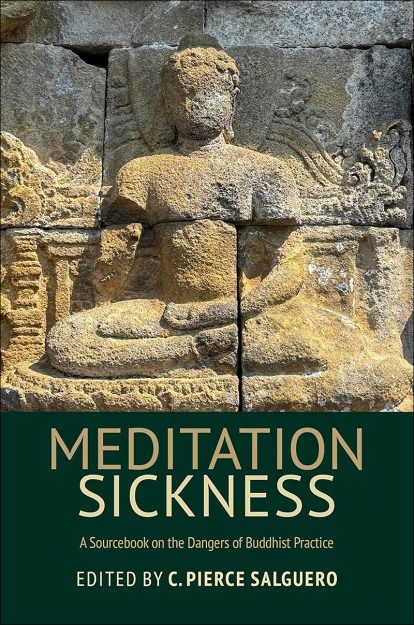
Meditation Sickness: A Sourcebook on the Dangers of Buddhist Practice, edited by C. Pierce Salguero. University of Hawai‘i Press, 2026, 338 pp., $80.00, hardcover.
Meditation sickness, or adverse effects experienced during meditation, is the subject of a new collection edited by C. Pierce Salguero. With nearly thirty authors, Meditation Sickness: A Sourcebook on the Dangers of Buddhist Practice offers much-needed illumination on the spectrum of negative things that might arise as we practice meditation and on our modern reluctance to discuss the negative side effects that have been documented since the time of the Buddha.
Salguero is a scholar and professor at Penn State Abington, where he chairs the Multidisciplinary Studies and Health Humanities programs, and is editor of Asian Medicine: Journal of the International Association for the Study of Traditional Asian Medicine. His previous books include A Global History of Buddhism and Medicine, and several popular introductions to Buddhism and spirituality for non-academics. Salguero describes himself as both a fan and critic of Buddhism, and notes in the introduction that he is “in no way arguing that people should stop meditating,” rather that we should move beyond the all-or-nothing thinking that frames meditation as inherently good or curative, or bad and psychosis-inducing.
Though meditation sickness has been documented for millennia, there is still no concrete criterion for negative outcomes. Meditation-related distress is also subjective: A similar event might be considered either spiritual progress or mental illness, depending on context. In the West, the beneficial effects of meditation have been enthusiastically studied and disseminated for decades, while the shadowy counterpart has received much less attention. This sourcebook is divided into three sections—scriptures, historical texts, and contemporary accounts presented as interview transcripts—that make a wide range of historical and traditional materials newly accessible.
In the scriptures section, we learn that meditation sickness encompasses not only tragic and extreme cases—mass monk suicides in Buddhist scriptures or contemporary accounts of practitioners harming themselves—but also a much wider range of experiences: anxiety, spiritual pride, visions of colors during meditation or dreams, false beliefs about having attained enlightenment, and physical symptoms such as joint pain, digestive problems, or itchy palms. Buddhist traditions also describe threats from Mara and other harmful spirits or demonic forces.
Among the most striking of these examples, the scholar-monk Bhikkhu Anālayo writes about a shocking episode that appears in both Pali and Chinese texts. Newly ordained monks are instructed by the Buddha to meditate on the “lack of attractiveness of the human body” and its impurities, perhaps as a way to reinforce celibacy, according to Anālayo. They take this too far, generating disgust so strong that a number of monks either kill themselves or ask a layman named Migalandika to kill them. In his introduction, Salguero calls this episode of mass suicide from the earliest layers of the scriptures—the Samyukta Agama (Pali: Samyutta Nikaya)—“one of the most famous accounts of meditation gone wrong.” When the Buddha learns of the monks, he gives a sixteen-part instruction on the mindfulness of breathing (anapanasati) that includes “experiences of joy, happiness, and gladness, counterbalancing any negativity toward the body.”
We should move beyond the all-or-nothing thinking that frames meditation as inherently good or curative, or bad and psychosis-inducing.
Anālayo concludes that the monks’ deaths highlight the dangers of generalized instructions to unseasoned and unsupervised meditators: “This makes this tale remarkably relevant to contemporary times, where, especially in the Western setting, those who are fairly new to meditation and have little knowledge of Buddhism can occasionally experience destabilizing consequences when undertaking intensive and prolonged silent meditation retreats.”
The historical texts section warns against pride in practice, as outlined in the Perfection of Wisdom in 8,000 Lines, a foundational Mahayana sutra known as the Astasahasrika Prajna-paramita. Other notable content includes the Surangama Sutra’s explanation of deceptive and demonic states that can occur during meditation, and the hopeful “illness memoirs” from Kurata Hyakuzo, who interprets his obsessive thinking, insomnia, and confusion as blessings on the way to enlightenment.
A chapter by Paul L. Swanson, a professor and Permanent Research Fellow at the Nanzan Institute for Religion and Culture, details the Tiantai master Zhiyi’s (538–597) explanations of how disease can arise during meditation practice—imbalance of the four elements, a bad diet or overeating, incorrect meditation practice, the presence of demons or spirits, Mara’s influence, and karma—and the practices that can cure them, including Buddhist doctrine, breathing practices, and Chinese medicine. Hakuin’s (1686–1769) “enveloping butter contemplation,” also in this section, offers a complementary approach: a visualization practice he believed effective at removing the defilements that stand in the way of enlightenment.
The final section shifts to contemporary voices. Alongside interviews from the ongoing Brown University study Varieties of Contemplative Experience, it includes a chapter by Kin Cheung profiling Cheung Seng Kan, a healer based in New York City; conversations with leading Tibetan medical doctor and lineage holder Nida Chenagtsang; and first-person accounts of “practice-caused madness” among Tibetan Buddhists in Amdo Province. It also includes an ethnographic account of a case of meditation madness in Myanmar, where local Buddhist cosmology, gender dynamics, and traditional biomedical understanding shape how communities respond to adverse meditation experiences.
One of the beautiful reminders of Buddhism is that we are among a group of people coming together to practice the 2,500-year-old teachings of the Buddha.
One chapter directly challenges the notion that meditation sickness is primarily a Western problem. Ira Helderman, a professor, psychotherapist, and author of Prescribing the Dharma: Psychotherapists, Buddhist Traditions, and Defining Religion, interviews Pawan Sharma, a medical doctor born in Nepal, who asserts that “delusion is delusion” no matter where you are in the world. While noting that some things are socially normative in one culture and not another—temporary demon possession, for instance—Sharma believes meditation-related psychosis is only about the brain’s chemicals. Sharma says that in Nepal, someone being temporarily possessed by a demon in a temple isn’t outside the realm of societal norms and therefore wouldn’t be treated as a mental health episode. He tells Helderman that he yearly treats about two to four patients who could be described as meditators-in-distress and supports the use of antipsychotic medication as well as family support. When asked about the idea that meditation sickness specifically arises in Western practitioners of European descent, Sharma says that the adverse effects of meditation today are the same adverse effects experienced across generations and cultures.
Also worth noting is Buddhist scholar Daphne Weber’s interview with Thai bhikkhuni Luang Pi on the “Netflix Dilemma.” Pi likens engaging with visual images of past experiences that arise during meditation to binge-watching Netflix. Practitioners deviate from practice when they engage with these images instead of noting that they arise. She stresses the importance of learning with a teacher to stay connected to reality and not alter their daily life or practice.
The importance of a guiding teacher ties together the different traditions and time periods detailed in Meditation Sickness. Going back to my reporting five years ago, and the reluctance of some teachers to talk about adverse effects, I thought that in the early days of Buddhism in the West, we could excuse this silence and overlook the tendency to highlight only the positive aspects. But the dharma is now officially mainstream and scalable, and as meditation continues to expand into fields like recovery, health care, and psychology, now is the time to turn toward—not away from—the less frequent but very real negative side effects.
This is what makes Meditation Sickness such an important contribution. Meditation teachers and students now have a collection of problems and solutions, and don’t need to search for original source texts in a library across the world. One of the beautiful reminders of Buddhism is that we are among a group of people coming together to practice the 2,500-year-old teachings of the Buddha. That community includes meditators who have experienced itchy palms, vertigo, dissociation, distress, and psychosis too.
For those who teach the dharma but haven’t had students share their difficulties, consider these words from an interview with Asahi Seicho, a Shingon Buddhist priest and abbot: “As a teacher, you should understand how your students are doing. You should even understand what kind of dreams your students are having. What kind of problems are your students feeling within? Without understanding that, it is impossible to guide them to success.”

Thank you for subscribing to Tricycle! As a nonprofit, we depend on readers like you to keep Buddhist teachings and practices widely available.