
If you can express yourself fully while sitting in zazen without dreaming of anything, that is the actual practice that includes everything. If you have that practice, Buddha is with you, Bodhidharma is with you, and every sage is with you.
—Shunryu Suzuki
When Shunryu Suzuki Roshi (1904–1971) arrived in San Francisco in 1959, few could have anticipated how lasting his influence would be. Teachers die, and it isn’t often that we have the chance to reencounter their voice in an intimate, dynamic way. Now, we have a new collection of Suzuki’s talks, Becoming Yourself: Teachings on the Zen Way of Life, edited by Jiryu Rutschman-Byler and the late Sojun Mel Weitsman.
Suzuki came to the United States to lead a community of Japanese Americans at Soko-ji. He was 55 years old, a shaved-head Soto Zen monk in black robes who had grown up in his father’s temple south of Tokyo. His Japanese congregation wasn’t so interested in zazen meditation, but early each morning, people from outside the congregation began to sit with him. In 1962, this group was incorporated as San Francisco Zen Center.
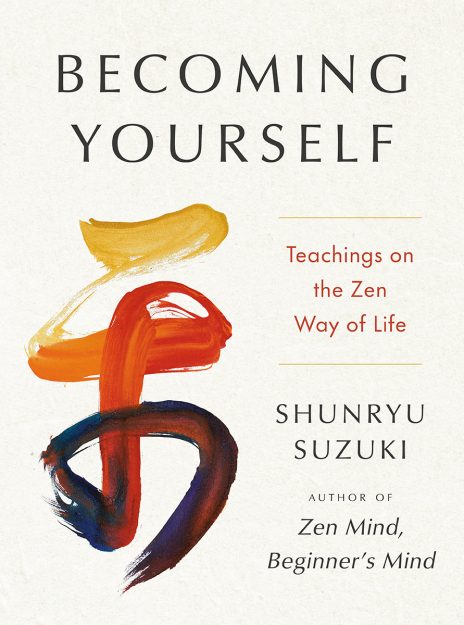
Becoming Yourself: Teachings on the Zen Way of Life
By Shunryu Suzuki, edited by Jiryu Rutschman-Byler and Sojun Mel Weitsman
Tarcher, 2025, 208 pp., $28.00, hardcover
Until then, Zen in the United States was a philosophy found in books, but Suzuki wanted to introduce Americans to the practice of Zen. He was moved by the fresh curiosity and sincerity of his young students—what he called their “beginner’s mind.” He eventually left the Soko-ji community and devoted his energy to establishing Zen in the West.
In 1967, Suzuki founded Tassajara Zen Mountain Center, the first Zen Buddhist monastery in the United States, deep in the wilderness, east of Big Sur. Contrary to the Zen tradition in Japan, women and men practice together at Tassajara. In 1969, Zen Center opened a temple in a stately Julia Morgan building on Page Street, near downtown San Francisco. Green Gulch Farm in Marin, the third Zen Center site, was purchased in 1972 and became an organic farm, conference center, and residential practice community.
Suzuki died at the San Francisco Zen Center on December 4, 1971, during Rohatsu sesshin, the annual seven-day intensive meditation retreat held in honor of Buddha’s enlightenment. In his twelve short years on the West Coast, this slight humble priest left a lasting mark. His lineage now includes Zen groups throughout the United States and beyond.

The first collection of Suzuki’s teachings, Zen Mind, Beginner’s Mind, skillfully edited by Trudy Dixon and published in 1970, introduced Suzuki’s voice to the world. Over the years, other books have followed, and Becoming Yourself joins a growing collection of posthumous teachings that extend his legacy.
Sojun Weitsman, an early student of Suzuki’s and the abbot of Berkeley Zen Center, worked with Jiryu Rutschman-Byler, now abbot at Green Gulch Farm, to shape this latest volume. They spent several years sorting through a trove of old recordings and rough transcripts. After Sojun died, in 2021, Jiryu brought the project to completion. The first part of the book focuses on sitting practice; the second explores how to bring that spirit into our daily life. The third centers on the Buddhist precepts—guidelines for living with integrity.
Suzuki wanted to introduce Americans to the practice of Zen.
Jiryu spoke about the book with Shoren Heather Iarusso, head of practice at Tassajara, on her podcast Spark Zen. He explained that he and Sojun wanted readers to feel as if Suzuki were speaking directly to them: “Even though he gave these talks long ago, they still feel fresh and immediate to practitioners today.”
The editorial road wasn’t easy. Alongside the poor sound quality of the original tapes, Suzuki’s idiosyncratic English was often fractured and difficult to follow. Jiryu and Sojun would debate over a single sentence—reading aloud, rewriting, turning the words over again and again. In reflecting on Dixon’s achievement on the podcast, Jiryu said that she was able to express “kind of what he said and exactly what he meant.” He described the editing process as mining and polishing the jewels Suzuki left behind.
Though Jiryu arrived at Zen Center long after Suzuki was gone, he came to deeply appreciate the voice that emerges in these teachings: simple, lighthearted, warm, and true. “The most difficult thing in editing Suzuki Roshi’s talks,” he said to Shoren, “is to fully convey the depth of his joy—the buoyancy, warmth, and laughter that is palpable when one hears recordings of his voice but which can be missed when one just reads his words. His laughter is everywhere.” Shoren recalls a moment when a student asked Suzuki, “Why is there so much suffering in the world?” Suzuki replied, “No reason,” and then laughed.
“When you practice Zen,” Suzuki said, “there is no problem, and you have a bright light within yourself, a bright light within and without. When the light comes, there is no problem.”
Suzuki honored tradition even as he gently poked fun at it—and at himself. “I have a sense that the limitation or seeming rigidity of practice is about finding our freedom and ease within ourselves,” Jiryu observes. “We are always in some form of limitation, and the way to be fully alive is to find yourself within the freedom of limitation.” As Suzuki noted, “To find true joy under some limitation is the way to realize the whole universe.”
The talks in Becoming Yourself gently explore the most basic questions that arise in practice: Who am I? What does it mean to “become me”? When Shoren asks Jiryu about the title, he explains that we become ourselves through zazen, through taking care of our everyday life, through having compassion for others. “Forgetting everything you think you are,” he says. “Suzuki teaches us not to try to figure out who we are from the outside looking in, as others see us. Instead, we can ask ourselves, ‘What is this being on the cushion?’ Sitting zazen helps us feel our aliveness, the ungraspable nature of being.” He goes on, “Being yourself is the same thing as including everything, the same thing as being intimate. To be myself as completely as a stone is a stone.”
Icame to Zen Center a few years after Suzuki died. In the last year of his life, I was traveling slowly overland from Europe to India, stopping off in Afghanistan to explore the opium dens of Herat. My definition of freedom then was doing pretty much whatever I felt like doing, with little thought for the consequences. When that way of living began to unravel, I started looking for another way and found myself at San Francisco Zen Center.
I was thirsty for rigorous practice and soon became a student at Tassajara. I learned how to sit still and be with my breath. I learned what my teacher, Eijun Linda Cutts, calls “the freedom of restraint.” My definition of freedom slowly began to change. I found that becoming myself didn’t mean becoming a different person—or even a better version of myself. It meant becoming who I truly am when the distractions of the small self recede and big mind becomes visible.
Becoming Yourself is a book to be savored. One way to read it might be to incorporate it into your morning practice—reading one chapter each day, letting it settle into your body and mind, and carrying it gently into the day. I found that when I approached the book this way, the subtle, lingering resonance of Suzuki’s teachings stayed with me.
Zen practice isn’t found between the covers of a book; it’s alive in our sitting and in how we live each day. Jiryu and Sojun have gracefully transmitted Suzuki’s simple words and profound teachings. Their collaboration with Suzuki will encourage, inspire, and stay with you, helping carry you along on the path. The Lotus Sutra teaches us that “only a Buddha together with a Buddha can penetrate the nature of ultimate reality.” Three Buddhas are even better.
A student entered Suzuki’s room at Zen Center not long before he died, and they bowed to each other. Suzuki was very weak, but he looked into his student’s eyes and said firmly, “Don’t grieve for me. Don’t worry. I know who I am.” If we practice diligently, one moment at a time, perhaps at the end of our lives we, too, can say, “Don’t worry, I know who I am.”

Thank you for subscribing to Tricycle! As a nonprofit, we depend on readers like you to keep Buddhist teachings and practices widely available.