Tricycle is pleased to offer the Life As It Is podcast for free. If you would like to support this offering, please consider donating. Thank you!
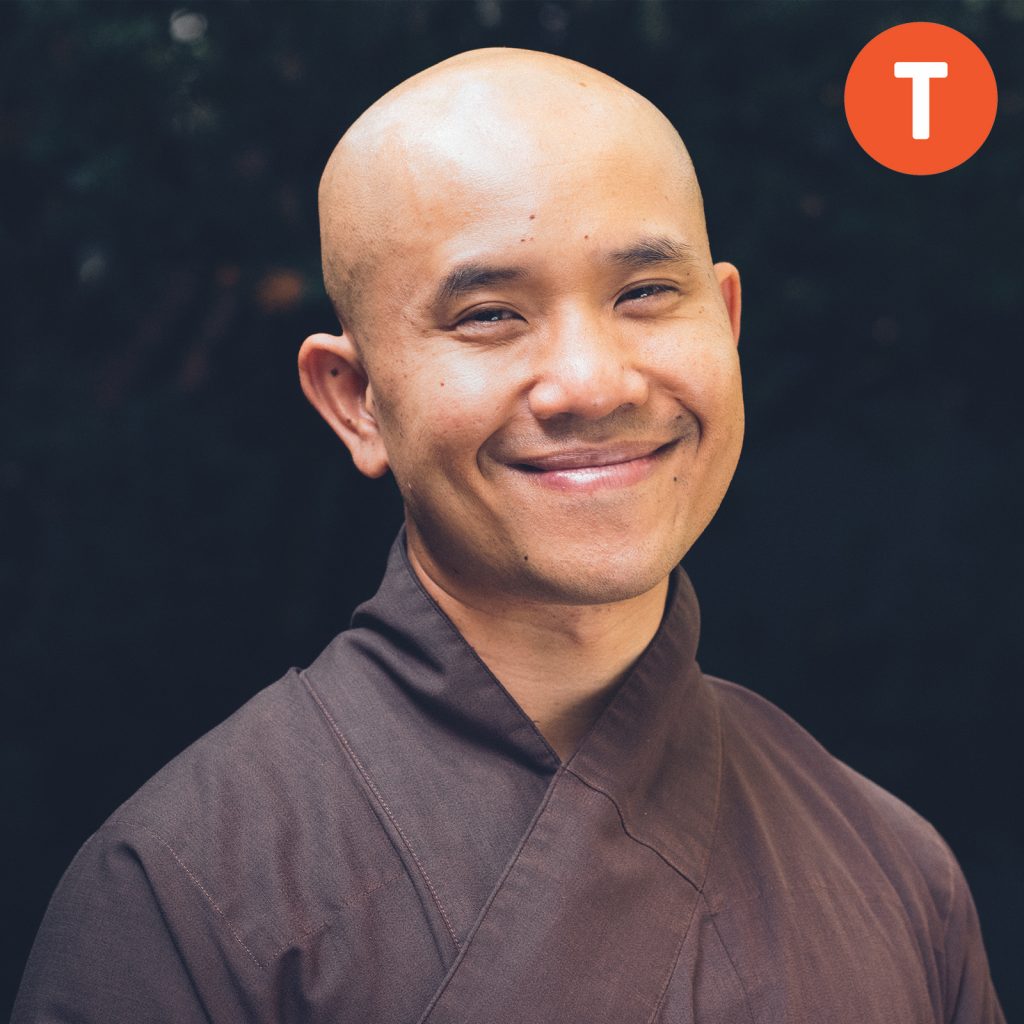
Brother Pháp Hữu is a senior teacher in Thich Nhat Hanh’s international community and the abbot of Plum Village in southwest France. In his new book, Calm in the Storm: Zen Ways to Cultivate Stability in an Anxious World, which he co-wrote with Jo Confino, he lays out a compassionate guide for coming home to ourselves and meeting the challenges of our time with greater presence and resilience.
In this episode of Life As It Is, Tricycle’s editor-in-chief, James Shaheen, and meditation teacher Sharon Salzberg sit down with Brother Pháp Hữu to discuss what it means to come home to the present moment, the forces that take us away from a sense of home, how we can let go of stories that no longer serve us, and how we can tap into a deeper sense of community and belonging. Plus, Brother Pháp Hữu leads a guided meditation.
Life As It Is is a podcast series that features Buddhist practitioners speaking about their everyday lives. You can listen to more of Life As It Is on Spotify, Apple Podcasts, and iHeartRadio.
♦
We’d love to hear your thoughts about our podcast. Write us at feedback@tricycle.org.
Brother Pháp Hữu: The journey of coming home is already love, is already healing. When I can accept my own body, that is love. When I can accept my suffering, that is love. When I can accept that I’m not perfect, that is love. And loving oneself is to love others. When I am understanding of my suffering, then I can have so much more space to expand my love to others. James Shaheen: Hello, I’m James Shaheen, and this is Life As It Is. I’m here with my cohost Sharon Salzberg, and you just heard Brother Pháp Hữu. Brother Pháp Hữu is a senior teacher in Thich Nhat Hanh’s international community and the abbot of Plum Village in southwest France. In his new book, Calm in the Storm: Zen Ways to Cultivate Stability in an Anxious World, which he co-wrote with Jo Confino, he lays out a compassionate guide for coming home to ourselves and meeting the challenges of our time with greater presence and resilience. In our conversation with Brother Pháp Hữu, we talk about what it means to come home to the present moment, the forces that take us away from a sense of home, how we can let go of stories that no longer serve us, and how we can tap into a deeper sense of community and belonging. Plus, Brother Pháp Hữu leads us in a guided meditation. So here’s our conversation with Brother Pháp Hữu. James Shaheen: So I’m here with Brother Pháp Hữu and my cohost Sharon Salzberg. Hi Brother Pháp Hữu. Hi Sharon. It’s great to be with both of you. Sharon Salzberg: Hi. Brother Pháp Hữu: Hello, James. Hello, Sharon. Thank you for inviting me. James Shaheen: Ah, you’re very welcome. And you’re calling us from Plum Village in France, is that correct? Brother Pháp Hữu: That is correct. James Shaheen: Well, welcome. So Brother Pháp Hữu, we’re here to talk about your new book, Calm in the Storm: Zen Ways to Cultivate Stability in an Anxious World, which you co-wrote with Jo Confino. So to start, can you tell us a bit about the book and what inspired you to write it? Brother Pháp Hữu: So the book is inspired by a few episodes that I and Jo Confino, we share a podcast called The Way Out Is In, and part of my practice as a Zen monk is coming home to oneself and embracing everything that I am, which is a lot of potentials, but also a lot of storms, a lot of mud. And we go through these episodes when we get to talk about our individual practice, which becomes these themes, which later on we were inspired to put it together as a handbook that everybody can have in their pocket, in their little bookshelves, as a companion. So it started as a conversation, and then it became a book. James Shaheen: Hmm. So the book begins with a quote from the late Zen master Thich Nhat Hanh, who was your teacher, and you were his attendant at a very young age, who wrote that your true home is not an abstract idea; it’s something that you can touch and live in every moment, and you frame the book as a guide to coming home to ourselves and to life. So what does it mean to come home? Brother Pháp Hữu: Home is such a practice. Where is home is kind of like a koan in our practice, and in our tradition, the first dharma seal of the Plum Village tradition is, “I have arrived, I am home.” And the historical context comes from our teacher’s own journey as a peace activist during the Vietnam War, or, in Vietnam, we identify as the American War. Because of our teacher’s peace activism, when he went to America to call for peace and to share about the situation of what is happening, the consequences of his courage was for him to be exiled from his own homeland. That was a moment of deep despair and deep suffering, and he would explain it to us, his students, that the moment he realized he couldn’t return back to his homeland, where his community is, where his friends are, his beloved country that he has been serving, he felt like a cell removed from the body. That’s a moment of feeling lost. And fortunately, he dwelled within the practice of the teachings of the Buddha, teaching us to recognize our feelings, our emotions, our grief, to be present for it, to be attentive, to hold it in order to understand, and then to go through it. Because of this suffering, he had an insight from days of practice and meditation of recognizing the grief and the loss and realizing that home is not a destination that belongs in a nation or even in a monastery or even in a house, but home is the present moment. Home is where we can arrive into the present moment with our body, with everything that we are embracing and be true to it. The Buddha has this line, this teaching, where he teaches, “The art of mindfulness is to dwell happily in the present moment,” and the words “happily in the present moment” come together. When I was a young novice, I had a wrong perception about it. I thought that I had to transform all of my suffering and then be happy, and then I can be in the present moment. But the teaching is the present moment with everything that is going on. We can still recognize that we have the ability to cultivate joy, cultivate happiness, remember our deepest aspiration, our service, our gratitude to life. So that becomes an opportunity to be at home in the world, whether it is a day that is calm and pleasant, that there is peace, there is joy, there is happiness, or whether there is a lot of destruction, despair, and feeling of loss, feeling of loneliness. So the art of dwelling happily in the present moment is a practice of coming home. James Shaheen: OK, so you say that the book takes its title from one of Thay’s teachings—Thay is how Thich Nhat Hanh’s students referred to him—where he used the metaphor of passengers on a boat in danger of sinking. Can you tell us that story? Brother Pháp Hữu: Yes. When there is a storm, when there is difficulty that arises, or chaos, our tendency is to push ourselves to solve the situation in a panicked space, or in a space of a lot of anxiety and fear. And when our boat is shaking, what can be more helpful at the beginning of the journey to find the situation? It is to be calm, to let the boat settle, and then to observe, to see, to feel, to hear, to be present for the situation. So this is a metaphor to each and every one of us in our daily life whenever we experience hardship or we are in a situation of despair or anxiety or difficulty, rather than lean into the energy of panic, the habit of trying to fix it within all of these emotions, let us learn to be present. Let us learn to hold the fear that we may have. Breathe with it. Let it take refuge in our presence, which could become a state of calmness in order to see what to do and what not to do. So when the boat is calm, we can recognize, where is the hole that needs to be patched? Where are the errors in the ship that we can address? Or the passengers, how can we help everybody see clearly what we need to do in this moment? So this is the art of dwelling in the present moment. Sharon Salzberg: So you say that Thay would say there is no path to being calm, calmness is the path, and there’s no way to stability, stability is the way. So it seems like the means and the goal are kind of the same in a way, right? Can you tell us about that? Brother Pháp Hữu: Thank you, Sharon. I think what Thay is pointing out to us is that the calm and the stability is not outside of us for us to run after, but the calm and the stability is already in us. We all have this potential of calmness, of mountain solid, of stillness, of space, and it is all in us. In today’s world, I think a lot of the times we come to a practice center or we come to a retreat, we are looking for the peace outside of us. We’re looking for awakening outside of us or insight outside of us. But in the practice we discover that all of these conditions, these potentials, these seeds are innate in every being. So we have to learn to come home to identify these elements and to cultivate them. And I would like to add that being calm in the storm is such a practice. We have to already learn to cultivate calmness while we are pleasant, while we are happy, while we are not in agony, while we are not in the storm. We have to be able to cultivate that practice in order when the storm arises or manifests, we know where we can anchor ourselves in the present moment. But it’s very difficult to imagine ourselves as a solid practitioner or a solid human while the storm is raging and we don’t have practice. Then in that moment we cannot see the path of calmness. The calm doesn’t reveal itself, the stability doesn’t reveal itself. So this is why I like the word practice a lot because it’s not about perfection, it’s not about mastering even. It is an everyday cultivation. Sharon Salzberg: In a way, I think it’s really powerful, maybe even before we can talk about finding our way home to ourselves to talk about what takes us away in the first place. So what are some of the forces that pull us away from a sense of home? Brother Pháp Hữu: I think for myself, the feeling of belonging is something that I had to practice with. I’m a child of refugee parents, and growing up in Toronto, Canada, having two heritages, which is my Vietnamese and Buddhist heritage and then being introduced to the Western heritage, Western culture, education, language, food, I was constantly running after acceptance, running after belonging, and my path led me to a retreat with my parents, with my sister. When I reflect back, even in the path of my monk’s life, I’m still trying to train my habit of not running from the present moment. The path of the running, it comes in many different wings. One of the wings is desire. It is love. Love here is not the love that the Buddha teaches us, but love here is the clinginess, the longing for acceptance. the longing for being seen, and then also the ego, the pride that comes along and tells you that you are not enough, that you need to do better, you need to achieve more even in this monastic life. After so many years of practice, sometimes I still see myself suffering. I still recognize that I’m still not as solid as I wish. And then that covers my perceptions and my mind of like, I’m a failure, I am struggling. It doesn’t make sense because I’ve been a monk for twenty-something years. Why do I still go through these motions, go through these feelings? So feelings can push us away from the present moment. And definitely consumption. Consumption is a huge way of running away from the present moment. And all of us, we have our habitual energy, whether it is from the society around us that has infused our way of consuming, or it is our ancestral suffering that we have inherited. I know I live in an environment with enough food, enough clothes. But there are so many times I fear that there’s not enough. So recognizing suffering is an art of stopping, which is the first wing of meditation. So suffering pushes us away. And then in our modern times, we have so many resources to take us away from the present moment, social media, movies, music, conversation, even podcasts, right? Even the most wholesome podcast and the most beautiful dharma talks. But sometimes it could be as an escape, from and part of the practice is to recognize and not to judge yourself, but to recognize, I’m doing this because I’m afraid, and then I can still listen to a deep dharma talk and realign myself. No, I’m listening to nurture my insights, to nurture my understanding of oneself. So it is the mind that also pushes us away from the present moment and our habitual energies. Sharon Salzberg: And you’ve noted that many of us have almost forgotten how to rest. And instead we get caught up in striving or perfectionism, which you were alluding to a few minutes ago. I wonder if you can say more about this dynamic and how can we counter this tendency toward always trying to do more. Brother Pháp Hữu: To counter it, it takes courage. And the courage is learning to stop, learning to be still. In Plum Village right now, we just entered into our three-month rains retreat, which is a tradition that has been handed down in monastic culture from the Buddha’s time. And we commit to ourselves for three months, we stay within our monastery boundaries. We don’t travel, we don’t leave. And this is a counter to our present moment mainstream society, which is we are constantly chasing toward the future or turning back to the past to fix the past and to develop an insight. First, we have to have the practice of mindfulness, which is the energy of awareness, to be aware of the state that we are running away from, and it takes just one breath. It sounds very simple, but it is so fundamental, and it is one of the highest practices of Buddhism is being mindful of the breath because the breath is life. The breath is what brings our mind home to our body. It has this power. It allows us to enter into our spiritual dimension that every one of us we have, whether we are Buddhist or not we all have breath. Breath allows us to be connected to the miracle of life and the practice that our ancestral wisdom has given to us, not just our human ancestors, but even the animal ancestors. If we look at the animals when they are wounded, they have the art of stopping. They are not chasing after another. They’re not on a hunt. They’re not chasing after another mate. They know how to be still. They know how to retreat to take care of themself. And all of us, I believe, we still have this wisdom, but we don’t trust it enough. We don’t trust the resting. We don’t trust the stopping. And now resting is such an art. People have to pay thousands of dollars to go to a well-being retreat or resort to do nothing. But it’s actually very free. But it’s so difficult because our society doesn’t embrace it and we’ve lost this wisdom. So coming home to the breath is a counter to the fast-paced society that we are all in. So one of our counter practices in Plum Village is one day a week, which is today, Monday, it is a lazy day. We are committed to learning to be present. And it doesn’t mean we sleep all day, but it means we allow the day to unfold itself, to just arrive at every moment. If we meet somebody and we want to have a deep conversation, we do that. If we find that we need to sit in meditation for hours, we allow ourselves this. If we find ourselves needing to spend more time with nature, we do that. Or sometimes I like to clean my room or clean my office, but with a lot of freedom or having the space to take care of my habitual energies, to cultivate new habits with hobbies, calligraphy, sports, music. So finding activities to learn to be more present could be a wonderful counter. James Shaheen: You know, you point out this paradox that we go to a great deal of effort and expense to rest. It’s another form of striving, I guess, and you note that striving is often an attempt to run away from our current situation, rushing into the future, rather than staying in the present moment. So how can we learn to work with striving and notice our attempts to rush forward into the future? Brother Pháp Hữu: Very good question, James. I think striving is not a negative energy, but it becomes negative. Well, for me, my own reflection on it, it becomes an energy that pushes me away from acceptance of the present moment when I put my faith of happiness and success in the striving of meeting the end’s goal, which is the finishing of my ambition or my aspiration. The Buddha teaches us about aimlessness, which is that we all have aspiration. We want to be of service to our loved ones, to our parents, to our friends, to our colleagues, our society, our community. But in the path of doing, we have to learn to know that the process is the journey. The process is already the aim of the goal. It is where we learn to listen deeply where we can touch our truest, authentic being in the doing. So I’ve learned to readjust my perceptions and my thinking in the striving and the doing that the happiness is at the end of the finished project, but every moment of the doing is a moment of understanding, of learning, of unlearning, of growth, of expansion, of acceptance. And as in the very popular saying, right, we have to trust the process, because in the process is where we can see our evolution of one’s own journey. So I think to not be so caught in these paradigms and these extremes because we can give ourselves a disadvantage, even in the teaching sometimes. The Buddha said, “My teachings sometimes are like a snake. If it’s not understood mindfully and with insight, it may come back and bite us.” And I’ve seen people who’ve been caught in that perception like, “Oh, in Buddhism, in Zen, it is not to have a goal, so therefore I do nothing, or therefore I YOLO, and I become very reckless.” But it’s actually all of these insights that help us not be caught in. James Shaheen: So in other words, in a sense, the aim and the goal are the same. Brother Pháp Hữu: Exactly. James Shaheen: OK, Sharon? Sharon Salzberg: I’m going to start having lazy days. I like that very much. Really, I like that. So another force that pulls us away from our sense of home is getting caught in stories that no longer serve us, and you give the example of learning to heal your inner child and process the wounds you were still carrying. So I wonder if you can tell us about that experience. Brother Pháp Hữu: We all are made of stories. And at the same time, we may not be free from our own stories because as a practitioner of Zen and of meditation, I found that my biggest freedom was understanding that the present moment is a canvas that I am painting every day. This has been a journey because when I came into the monastery, I was very young. I was 13 years old when I made this decision that I wanted to become a monk. And fortunately my parents gave their blessing, and I was relatively a very happy child. Not perfect, of course. I buried a lot of my suffering and my wounds, and I allowed my joy and happiness to guide me toward the future. So in a way, I didn’t pay attention to some of the compost that I had inherited. About two or three years into my monastic life, there was a deep fear I had. And it is with humans, it is with my elders in the community, because when I was young I was bullied quite a bit and bullied in school, but as well as bullied at home and on the receiving end of a lot of aggression. But I buried all of that and I covered all of that up, and in a way I bypassed it through my practice, but it will come and it will knock on your door, the suffering, and ask you to embrace and transform it. There was a day when I was walking in the monastery and I saw three monks coming toward me, and they all were at the age of one of my relatives who I was on the receiving end of the aggression. And I just hurt. My emotions, my feelings, my body was shaking. I had so much anxiety. And we have language today. It is trauma, right? It is a kind of trauma that arises in our own body. But at that time, fortunately, I came back to my breath and I asked, where is this coming from? And just in a moment of stillness, I can recognize the stories that had been hidden of my younger self that had never had the opportunity to heal and to feel that pain, to feel that agony that I’ve carried. In that moment of holding that story, which is true, but there’s another true story that in this present moment, I’m not that young child anymore. I have the capacity to protect myself, and I have the insight that this present moment is in front of me, these three monks, these three brothers, this is the language we use in Plum Village, these brothers that are coming toward me may be the kindest human beings on this earth, and I can’t copy and paste my past experience to them. And I was doing that without awareness. I was taking the past experience and pasting it in the present moment. And so when we are not mindful of the stories that we carry, these stories can become prisons for us and will leak into our way of being, will leak into our habitual energy of seeing, of listening, of having a conversation. It will guide us. So for me, when I recognize the story that I’ve been carrying, I felt I had an opportunity to liberate myself from it. And today I still value that experience. Even though it was deep suffering, I still am grateful for it in a way that it has built some of my character. It has allowed me to develop my compassion at a level that I can have so much empathy for those who are still struggling with their own inner childhood stories, because I can understand that. So it has given me the seed of understanding, but my freedom is to also know that that story is not the present moment story. Each and every one of us, every day we are creating new stories. James Shaheen: Brother Pháp Hữu, you point out that it’s counterintuitive that sharing these stories of our pain can actually help remind us that we are not our stories and that we don’t have to stay trapped in these narratives. So how can we actually break free from the harmful stories that we may be clinging to? Because we do become attached to these stories, even when they’re painful. Brother Pháp Hữu: I would like to borrow the Buddha’s words. The Buddha has said that we are not only this body, and we shouldn’t be caught in this body. We are not just this perception, and we shouldn’t be caught in this perception, because we are a flow of life. We’re a flow of energy. We are constantly changing. We are constantly moving. So I think we have to have the insight of impermanence. The Buddha has taught us that there is a truth that we all have to learn to accept, and that is everything is impermanent. So our stories that we have carried and we have that we are a part of, we are not only that story. We are a constant flow of energy, of new stories. Just like with the year, the seasons, right? If we look at nature right now in Plum Village, it’s autumn and we’re seeing the changing of the leaves. The trees have the wisdom of letting go of their leaves because it has to protect itself for winter. So we have to learn to release the old stories so that the leaves come and nurture the soil, which nurtures the root. So our stories are a part of us, are part of our legacy, but we are also a tree that can cultivate and give birth to new leaves, new blossoms, new fruits. And for that, we have to have the courage to let go of the stories. And this is easier said than done. And a part of what I constantly remind myself is, Pháp Hữu, that was you in the past. In this present moment, who are you? Where are you now? What can you activate from the past or from the practice so that you can let go and shed the skin of yesterday so that your new energies can bring up new flesh, new skin, new leaves? So just coming back to nature, I think if we look at nature as a creator, as an artist, she is constantly painting. So I think all of us, we have to have this insight that we are every day, twenty-four brand new hours that we are given. How are we going to live these twenty-four brand new hours? Are we going to continue to live in the past, or can we use some of the ingredients of the past to paint today? Because today is painting tomorrow. It is the foundation of tomorrow. So this is the insight, and it takes reminders. In our monastery, we have gathas everywhere, like reminders of the practice. I have calligraphy in my room, and just over here it says, “You are enough.” And right behind me, I have “Smile at my inner child” as a reminder for me of moments of the past, like smiling at my old stories that I’ve held onto. It’s OK. Let me liberate you by allowing you to live this present moment. So concretely, I think our teacher always teaches us that we all have our inner child that needs some tending, needs some TLC, needs some care, needs some handholding. I’ve recognized that whenever I get nervous, my whole body shakes, and so I’ve used my hand as a mindfulness practice and particularly my shoulders because I would tense it up, and I would put my hands on my shoulders as the younger Pháp Hữu, the child Pháp Hữu, and I would say it’s OK. It’s OK. The stories that you’ve experienced, it’s OK, because in the now I’m giving you a new story, the stability that is the path, the calm that we could generate in this moment. Sharon Salzberg: And once we have some room, once we have some space from these stories about our suffering, you say we can start to rediscover how to be with ourselves and how to rest in the present moment. So are there other practices that come into play then, when we’ve let go a little bit of our pain and our stories of our suffering? Brother Pháp Hữu: Coming home to ourself, we have such an immense opportunity to tap into the immense stories. We have a practice of understanding our ancestral connection. And as an individual, for me to be authentic to myself, I’ve had to learn about my own heritage, my ancestral stories. And I think when I’ve learned to be free from my own stories, my ancestral stories have become a part of my unlearning also. Actually, the two of them come into play. Learning about me, I’ve learned about my ancestors, and learning about my ancestors’ stories, my closest ancestors, my parents, my further ancestors, my great-grandparents. When I was discovering my habit energies, one of the things was not enoughness, which I already talked about, and I had this moment of freedom lining up for food. We have this practice of moderation, right? As a monk, we have to be humble. We have to eat just enough. We shouldn’t take more than we need. That is our practice of moderation. But I always find myself in this loophole of taking more than I need, and particularly with fried food. Like I love fried tofu, right? And now we have fried tempeh. I have to always remind myself to be mindful of that. And the story of it was my parents never had enough, and that has become a part of my journey, my healing. And so when I’ve tapped into that, the understanding of stories just expands one’s understanding. And then in the present moment, I have a community, a spiritual community that I am a part of. So I have my spiritual ancestors, and then I already see my descendants here. I already see my future here, my younger siblings, the people, the children that come through the monastery to learn the way of being. And so when I understand my story, I can give freedom and space to be my new potential as a teacher that I can tap into an older brother to my younger siblings, a friend to someone. And I’m not bringing my traumas to them, but I’m bringing the insights and my stabilities that I have cultivated to offer to them, my presence, my love to them. Sharon Salzberg: And on a similar note, you’ve mentioned that coming home to ourselves also involves learning how to love ourselves, which can sometimes, maybe even often, be a daunting task. So can you say more about the practice of loving ourselves? And why do so many people have trouble with it? Brother Pháp Hữu: I think we have to heal the word love, and I think love, in some places of the world, maybe more like Europe and North America, I think love has become very aligned with consumerism energy. But in the teachings of Buddhism, love is just an act of kindness. It’s an act of recognition. So the journey of coming home is already love, is already healing. When I can accept my own body, that is love. When I can accept my suffering, that is love. When I can accept that I’m not perfect, that is love. And loving oneself is to love others. When I am understanding of my suffering, then I can have so much more space to expand my love to others. And there are beings, there are humans, there are great bodhisattvas of our time that have this immense capacity of great love, that they have allowed their presence to be such a stable mountain for others that allows others to calm themselves so that they can become in their own storms, right? I’ve had the opportunity when I was broken and I had a friend, a dharma friend, who I can sit next to, and his presence allowed me to just open my heart, and I took refuge in his love, and that’s all I needed so that I can listen to my storm. So love is actually, for me, it’s the whole path. It’s the path of Buddhism. Friendship is the path of Buddhism. Love is the path of Buddhism, and in friendship is love. I always ask myself, am I kinder today or am I less kind? And if I am less kind today, then that means my seed of love needs caring. My seeds of capacity need tending to. And loving oneself is understanding our capacity, knowing our limits, right? Like we shouldn’t fool ourselves by trying to fix all the storms of the world because there are so many storms in the world. But what we can do is take care of our storms so that we can be a place of refuge for all the storms that are around us. And if one individual can do it, it will impact many others. And suddenly we have a whole community, a whole society of those who know how to be calm in the storm. And I believe it will shift our consciousness, it will shift our systems, it will shift our way of being. And, you know, Sharon, I really do believe that if society has one lazy day a week, I think we will be very different. Sharon Salzberg: That’s great. James Shaheen: So now that we’ve talked about practices for returning to ourselves, I’d like to consider how this can help us better meet the world. One practice you mentioned is tapping into a deeper sense of community, including our community with the earth. So can you say more about how we can move beyond our sort of obsessive individualism and reconnect with a sense of interbeing, which you teach just like Thay did? Brother Pháp Hữu: Thank you, James. I think every meditator, every spiritual practitioner, should always have this question and this koan to unknot in our journey: How can my inner peace have a reflection and an impact on my surroundings? And the truth is when we as a practitioner, as an individual, have the ability to come home, to be calm, that already has an impact on the surroundings around us. Deepening it is to be mindful of our ripple effects in society, in community. Just like when most of us are engaged in the world, which is a very harsh world, we are in a cutthroat environment. When we know how to come home, to embrace our anger, as an example, anger is a practice I’ve been working with because a lot of our retreats we’ve been offering in the past three years, three retreats a year. We offer it to a lot of climate leaders, activists, and some of the questions they ask us are, Are we given permission to be angry? Can I be angry? And I said, absolutely. Because anger, if you look deeply at anger, there’s an element of love in it. That’s because you care. You see injustice, and therefore you are angry. But the practice is not to allow anger to be a field of toxicity in us so that we become the hatred, we become the violence, we become the aggressor in the situation. But mindfulness as an individual, in the individual, there is the collective. We have to have this insight of interbeing there in communities. So when I as an individual can embrace my anger and generate my compassion to take care of the injustice or the wrongdoing or of the suffering that we are seeing, the way I do it is coming from a place of care, of tenderness, even of attention, of choice, of words, of choice, of actions that will have an impact because that is transmission. We say that our dharma language is not only in books and words, but it is in the way we be, so deepening ourselves is deepening the community. Deepening our way of engagement is deepening the way we’re transmitting the how. So if I can be calm in the how, that will impact so many of the hows around us. And so the question now, the big movement of changing the system is the how: How can we engage with the suffering in a calmer way, in a more compassionate way, in a more inclusive way? But this is a part of why I feel like part of the conversations that I had with my partner Jo when we were putting together this book is hoping that this book can be a support for our discovery of the how: how we can be in the storm, because that will be a transmission to our children, our community, and the next generation. Sharon Salzberg: In the final chapter of the book, you include some very concrete practices for embodying this sense of calm in the storm as we move through the world. So I wonder if you can say more about how meditation can help us come home to the body. Brother Pháp Hữu: Thank you, Sharon. Meditation has become my home. Meditation doesn’t belong only on a cushion or in a temple or on a meditation mat or in a meditation hall. But meditation has become my breath. It has become my steps. It has become my refuge. For me, to meditate means we have the ability to stop, to hear, to listen, to understand. And then the second is to look deeply to see the roots of where these fears are coming from, these feelings are coming from. Meditation for me has become a daily food. And I have so much joy in meditation because meditation has allowed me to live deeply with my loved ones, with my community, and not to take for granted the present moment, not to take for granted the community that I am a part of, as well as meditation has allowed me to embrace the most difficult realization of suffering, of our limits, of humanity, of seeing the destruction that we are still causing to each other, seeing our political leaders not awakening and creating more suffering. Meditation has allowed me to embrace the suffering and not to bypass it and to look deeply: How can we shift consciousness? How can I still have compassion for leaders that are not walking the path of love and understanding, but are walking the path of destruction and greed and ignorance? As a Buddhist it’s very difficult, but as a Buddhist, I have to look deeply and still see the buddha-nature in them. And that takes meditation. One of Thay’s insights that has become his ground of work during the peace movement, and he shared this with Dr. King, which Dr. King later on put on a banner as Dr. King did a march, and that insight is that man or human is not our enemy. It is the ignorance, it is the greed, it is the anger, it is the discrimination is what we are facing and that we have to help shine the light so that they can see their karma of suffering that they are creating. But if we are here to just destroy all those that we don’t see aligned with us, then who will we live with? How will we cultivate a compassionate society, a compassionate community? For me to remember this, I have to meditate. Part of mindfulness is to remember to recollect the insights of humanity’s deepest wisdom of love. We all have this, but how can I, through my skillfulness, allow others to tap into their potential of deepening their humanity in this garden of humans here and to walk away from greed and power of destruction? James Shaheen: Well, I think that’s a nice way to end. Thanks so much, Brother Pháp Hữu. Anything else before we close? Brother Pháp Hữu: We all have a home to tend to, and all of us, we are gardeners. From time to time, please give yourself permission to rest, to take care of the garden, to see the garden where it needs weeding. What is the compost that needs transforming? You all have seeds of flowers, so take care of the seeds so that they can become flowers that you can give to your children and your children’s children. It is part of your legacy. So home is a practice, and home is not far away. James Shaheen: Brother Pháp Hữu, it’s been a great pleasure. Thanks so much for joining us. For our listeners, be sure to pick up a copy of Calm in the Storm, available now. We like to close these podcasts with a short guided meditation, so I’ll hand it over to you, Brother Pháp Hữu. Brother Pháp Hữu: Thank you. Dear friends, this is an opportunity to connect to our home, our body. First of all, whether we are running, standing, walking, jogging, whatever you may be doing, if you just give yourself permission to be still, you can sit or you can lay down or you can stand still and just start to feel the weight of your body. If you’re sitting, the weight on your buttocks, your two feet firmly on the ground. If you’re standing, your two feet rooted on the earth, on the floor. And if you’re laying down, give yourself permission to surrender all your muscles. In this moment, I invite all of you to feel your breath. As you are breathing in, just know that this is an in-breath. As you are breathing out, know that this is an out-breath. This is in-breath, and this is out-breath. As you are mindfully breathing, just give permission for the breath to be as it is. If it is long, let it be long. If it is short, let it be short. As you breathe in fully, be with the in-breath from the beginning to the end. As you breathe out fully, give permission to be with the out-breath from the beginning to the end. I fully take refuge in in-breath; I fully take refuge in out-breath. As I breathe in, I become aware of my whole body; as I breathe out, I smile to this body. Breathing in, aware of my body; breathing out, I smile to my body. Breathing in, aware of the body; breathing out, I relax my whole body. If there’s anything that I’m holding onto in this moment, I just give myself permission to release those burdens. Aware of my forehead, my jaw, my neck, my shoulders, my arms, my hands, letting go if I’m holding onto anything. Breathing in, I dwell in the present moment. Breathing out, this moment is a wonderful present moment, this is a wonderful moment. Thank you so much, dear friends, for breathing together and for meditating together. Thank you so much, Sharon and James, for inviting me on this podcast and giving me permission to have this conversation. James Shaheen: Thank you so much Brother Pháp Hữu. That was a real pleasure. Sharon Salzberg: Yeah, thank you. James Shaheen: And thank you, Sharon. James Shaheen: You’ve been listening to Life As It Is with Brother Pháp Hữu. Tricycle is a nonprofit educational organization dedicated to making Buddhist teachings and practices broadly available. We are pleased to offer our podcasts freely. If you would like to support the podcast, please consider subscribing to Tricycle or making a donation at tricycle.org/donate. We’d love to hear your thoughts about the podcast, so write us at feedback@tricycle.org to let us know what you think. If you enjoyed this episode, please consider leaving a review on Apple Podcasts. To keep up with the show, you can follow Tricycle Talks wherever you listen to podcasts. Tricycle Talks and Life As It Is is produced by Sarah Fleming and the Podglomerate. I’m James Shaheen, editor-in-chief of Tricycle: The Buddhist Review. Thanks for listening!

Thank you for subscribing to Tricycle! As a nonprofit, we depend on readers like you to keep Buddhist teachings and practices widely available.