The Buddhist Crisis of 1963 was an upheaval; it marked the beginning of the collapse of the Republic of Vietnam. A peaceful protest against the government suppression of the Buddha’s birthday celebration—historically a national holiday, owing to the nation’s Buddhist majority—in May of that year resulted in the authorities firing their weapons on the protestors with live ammunition, killing several. When the government cracked down further, the number of demonstrations swelled. A month later, the image of Thich Quang Duc’s body ablaze while seated peacefully in meditation swept across the world, a desperate signal fire calling attention to the repression of Buddhists in what had been presented by the United States and its media as a stronghold of democracy and freedom in Southeast Asia. The dictatorship under Ngo Dinh Diem collapsed not long afterward, leading to a short series of military juntas at the helm of the state until an election was held that thrust a lieutenant-general from the army named Nguyen Van Thieu into the role of president. It is here that Trần Văn Dĩnh’s debut novel, Blue Dragon, White Tiger: A Tet Story, begins.

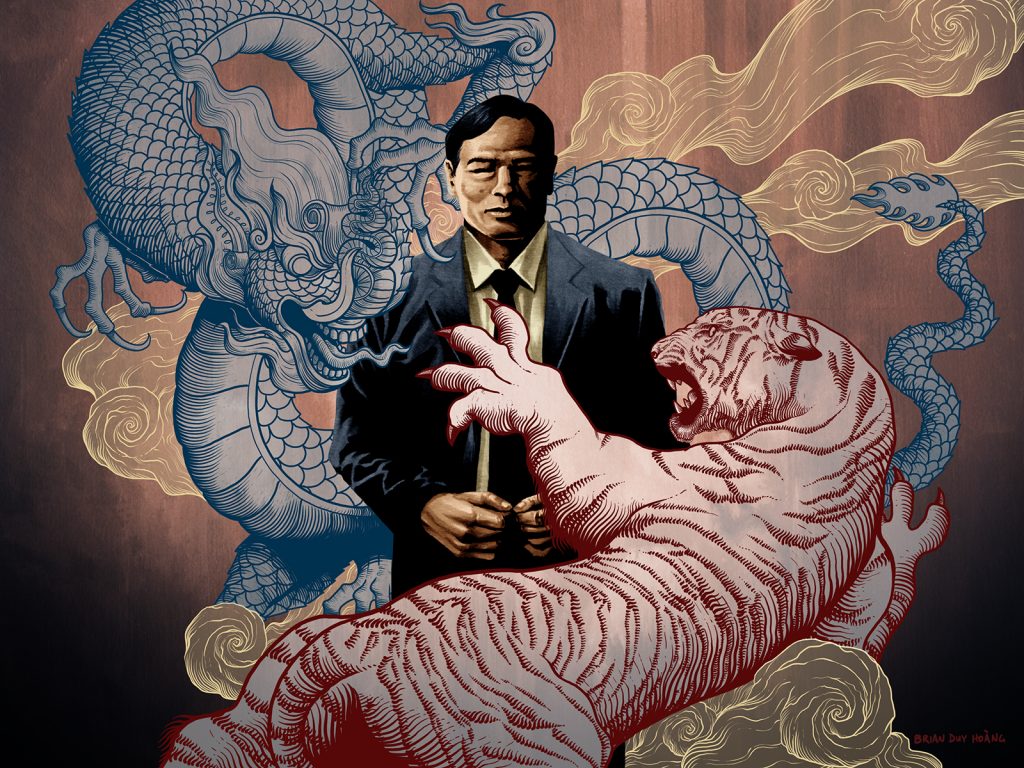
Originally released in 1982, Blue Dragon, White Tiger was the first novel by a Vietnamese American author composed in English to be published in the United States. Now, through a collaboration between Kaya Press and the Diasporic Vietnamese Artists Network, the groundbreaking book has been reprinted for the first time in more than forty years, complete with an introductory preface by the author, annotations, and an elucidating afterword written by Sydney Van To that draws out the parallels between Trần Văn Dĩnh’s life and that of his protagonist. As the subtitle suggests, the narrative is framed as a Tet story, set against the backdrop of the Vietnamese New Year celebration, which Dĩnh describes in his preface as a “yearly truce between the Blue Dragon and the White Tiger.” Vietnamese culture inherits the cultural concept of the four divine beasts from its northern neighbor, deriving from a Daoist astrological framework that assigns a divine guardian beast to each of the four cardinal directions: The Black Turtle and Vermillion Phoenix protect the north and south, respectively; the Blue Dragon serves as guardian of the east, emerging from the depths of the sea and representing the arrival of spring, the liveliness of yang energy, birth, and benevolence; conversely, the White Tiger protecting the west descends from the mountains, representing the earth, autumn, and the grounding energy of yin. The progression of time, changing of seasons, rise and fall of dynasties, and the sliding of the stars across the sky are all attributed to the dynamic tension between these guardian beasts and the cosmic forces they command. Dĩnh sets this up as the central imagery embodying all the dialectical tensions presented throughout the novel: East is in tension with West, communism with liberalism, Buddhism with Marxism, traditionalism with modernism, and so on. Each contradiction explored is another scale drawn onto the Blue Dragon, another stripe on the White Tiger.
Each contradiction explored is another scale drawn onto the Blue Dragon, another stripe on the White Tiger.
Blue Dragon, White Tiger follows a university professor named Tran Van Minh as he is recruited by the CIA to return to Vietnam to help fight communism. After arriving, though, Minh is quickly disillusioned by the corruption of the South Vietnamese Republic of Vietnam (RVN) government as well as the ongoing persecution of Buddhists, causing him to defect and join a Viet Cong sleeper cell in Hue. As a protagonist, Minh serves as a thinly veiled self-insert of the author, who cheekily admits as much in the book’s introduction—both Trần Văn Dĩnh and the book’s protagonist worked for the Ngo Dinh Diem government starting in 1961 as diplomats to Washington, D.C., and both resigned in 1963, horrified to hear of Thich Quang Duc’s self-immolation and the plight of Buddhists in their home country at the hands of the government they were working for. Both then devoted themselves to academia and peace activism in the United States.
When we are introduced to Minh, three years have passed since Diem’s deposition, and Minh is in a loving relationship with a young American woman, a former student of his named Jennifer with whom he has joined the peace movement. But this life of academia and activism is quickly interrupted when he is approached by a CIA agent named Frederick Adams who asks him to return to Vietnam and work again for the RVN government. Minh agrees to return, but narrates to the reader that it is because he’s become convinced that men “like Adams who still believed in . . . such abstractions as ‘the free world,’ ‘communism vs. democracy’ were going to destroy his people.”
Once back in Hue, Minh is forced to quickly confront firsthand all the harrows that the war has wrought on his country. He is granted a personal audience with the new president, who scolds him for his American peace activism and tasks him with teaching at Hue University while reporting on suspected communists among his students—justifying this repression “in the name of democracy and freedom.” Minh is repulsed by the open corruption and authoritarianism he experiences and reflexively finds comfort in returning to his cultural heritage, tradition, and history.
As a way of conveying this history, each chapter of the novel opens with translated verses of Buddhist scripture, folk songs, or wartime poems lamenting foreign occupation and kinsmen killing kinsmen. The narrative itself weaves together prose, poetry, and song, as Minh internally grasps back toward Vietnamese traditions, recounting foundational folktales and episodes of distant history. One chapter opens with a passage from the Dhammapada, the collection of short sayings of the Buddha preserved in the Pali canon: “However many holy words you read / However many you speak / What good will they do you / If you do not act upon them?” In this chapter, Minh moves through a Buddhist temple and encounters excerpted verses from the 13th-century Emperor-Monk Tran Thai Tong’s commentarial text Instructions on Emptiness: “Nothing is born / Nothing dies / When one understands this / Buddha appears / The round of avatars ends” appears calligraphed on a length of rice paper hanging on a wall, while a monk later quotes another passage from the text, saying,
“ ‘So long as you have not reached the Buddha’s heart, practice abstinence and recite prayers. But when you reach it, you will see that neither Buddha nor Bodhisattvas exist. Abstinence and prayers then become useless.’ ”
Later still, Minh is listening to the rain alternate between heavy downpours and lighter drizzles, and lines from a poem called “Nightly Rains” by Huy Can come to him: “My ears tuning to the rain dropping from the roof, / I heard that nature is cooler and cooler and / I heard that I am sadder and sadder.” Throughout this chapter, Dĩnh uses passages from literary works important to the Vietnamese in order to demonstrate to the audience how thoroughly Buddhist thought is entrenched in Vietnamese culture and history, and how dialectal thinking has been a cornerstone in Vietnamese philosophical thought for centuries, long before the Marxist version was introduced.
The novel’s hybrid form itself presents its own literary structure as a dialectical contradiction, with the excerpts of Vietnamese, Buddhist, Daoist, and Confucian literary works representing the Blue Dragon as Eastern literary tradition, and the prosaic novel form written in a close limited third person being the White Tiger as the literary form of Western tradition. The story is always framed in the balancing of and struggle between these kinds of dialectical contradictions—democracy and communism; north and south; matter and mind; yang and yin; most especially, the titular Blue Dragon and White Tiger—and presents these binaries as koans for contemplation, where to resolve the tensions between them would be to attain the liberating insight that would finally bring a lasting peace. What drives Minh forward is the struggle to understand: How can it be that the price that people must pay for freedom is the giving up of their rights and freedoms? By framing the narrative as a Tet story, in the détente between the divine guardians of the East and the West, the author presents the novel as taking place in the precise moment in time that the Vietnamese nation has a true chance at renewal and rebirth, if the forces represented by the Blue Dragon and White Tiger can learn to move in dynamic synergy and mutual support rather than antagonism.
Seeking clarity, Minh retreats from the city to the temple where he first took refuge as a child. There, the patriarch offers a brief dharma talk on Emperor-Monk Tran Thai Tong’s teachings about serving both religion and nation and recounts nursing an injured Viet Cong soldier back to health. Minh reflects on the patriarch’s sympathies, softening his initial assumption that Buddhism and Marxism must be irreconcilable. When Minh later discovers his old friend Loc is a Viet Cong agent, Loc deepens this shift in perspective, arguing that Marxist dialectics belong within a continuum of Vietnamese Buddhist and Daoist dialectical thought—that Marxism can be absorbed into Vietnamese identity just as the three teachings of Buddhism, Daoism, and Confucianism were. With Loc’s cell planning demonstrations at Hue’s Buddhist temples to commemorate the fourth anniversary of Thich Quang Duc’s self-immolation, Minh cautiously allows himself to be recruited, believing he can support the Marxist cause without abandoning his Buddhist devotion.
The Buddhist Crisis looms ever-present from that moment forward. As Minh helps to organize the demonstrations, the reader is inundated with scenes depicting the corruption of the Saigon government—the protest at his childhood temple is interrupted by helicopters belonging to the Army of the Republic of Vietnam (ARVN) lobbing grenades at peaceful demonstrators while the news media announces that the Viet Cong attacked in a false flag operation to draw support away from the government, and his own students are arrested and tortured for being suspected communists. When an American officer asks how the self-immolations could be considered ethical when Buddhism denounces suicide, Minh brings up Thich Nhat Hanh’s Lotus in a Sea of Fire and explains the reasoning given there that the practice can be a symbolic one of self-sacrifice and compassion, before mentioning that Thich Nhat Hanh is in exile, all of his works banned in South Vietnam and inaccessible. The story then weaves in the attempted self-immolation of the nun Nhat Chi Mai, the last public monastic self-immolation protesting RVN repression of Buddhists, as Minh is tasked with translating her letter. Scene after scene, the reader is shown how even years after the Buddhist Crisis was considered over, even with Ngo Dinh Diem deposed, the legacy of the crisis continued to live on—and would continue to live on so long as the country remained divided. In one scene, another American officer laments the failures of the RVN authorities to win the support of the Vietnamese people, summing up the sentiment of the novel’s first half with the remark, “Corruption is what finally kills a country—not communism.”
It would be a mistake to read the novel as pro-communist, however. As the novel progresses through its second half and a northern victory draws nears, Minh ultimately finds himself disappointed in the communists, too, realizing how quickly they are to turn on and alienate all the intersectional allies that supported them and with whom they had formed a coalition: the Buddhists, most of all, but also the students, the intellectuals, the peasantry, and communist sympathizers. It is because of Minh’s devotion to Buddhism that he remains skeptical of communism, despite recognizing their similarities and believing the two are possible to reconcile. He muses:
“The Buddhist way to the liberation of man was through nonviolence and the ‘middle-way,’ while the Marxist way was through revolutionary violence and the dogmatic belief in the laws of the motion of history. The price to pay for Marxist ‘nirvana’ would be the loss of the human personality and individual liberties . . . while for Buddhism it would be the disappearance of the ‘self.’ ”
Minh finds himself unable to join the Party, despite his work as an agent, and ultimately cannot support their methods after having experienced them, feeling that “to join the Party was to refuse to exist.” He realizes that the communists are simply using Buddhists for their own ends, and this situation is no better for Buddhism than RVN’s despotic hostilities—Buddhists in Vietnam were being made to choose between exploitation on one side and oppression on the other.
Trần Văn Dĩnh’s novel is a remarkable achievement of engaged Buddhism in literary form, capturing the political, social, and spiritual complexities that the American war in Vietnam wrought upon the Vietnamese people, north and south, those domestic and in diaspora, stitching in the most significant scenes and songs and stories of Vietnamese cultural heritage in an act of desperate preservation, in fear that the price the Vietnamese people would pay for their independence would be the loss of their traditional identity. It narrates the struggle of the Vietnamese people to preserve themselves culturally through decades of unspeakable horror, distilled through the perspective of Minh as he journeys through both sides of the conflict. Ultimately, it is this shared cultural heritage, tradition, and history of the Vietnamese people that Minh finds himself reverting to for comfort, and where he realizes the path to liberation and peace within himself, transcending the limiting boundaries of liberalism and communism.

Thank you for subscribing to Tricycle! As a nonprofit, we depend on readers like you to keep Buddhist teachings and practices widely available.