There is a recurring problem with every population that must migrate from one land to another: The next generation will want to assimilate. Then the mother tongue becomes a childhood memory. And the folktales aren’t retold. My parents came to America at the earliest onset of the Vietnamese refugee crisis. There was no time to pass on folktales. My parents worked while my siblings and I were left to ourselves, our grandmother tasked with guardianship duties she only seldom tended to. It’s doubtful we would’ve been interested anyway. Back then, being Vietnamese wasn’t something to be proud of—it was a source of shame. Survival meant assimilation. We didn’t watch or read Vietnamese media—the closest we came was Vietnamese-dubbed bootlegs of Chinese movies coming from Hong Kong. It was not until I was in my adulthood that I felt this cultural gap in my heart. I was in graduate school, learning how to hone my craft as a writer, and finding my most profound inspirations came from drawing on Vietnamese folklore, though I could approach them only through scattered, clunky translations. Even still, the tales stirred something deep inside my heart and began to heal traumas I didn’t know I had endured. I wrote more stories, crafting characters that could find resonance with and draw insight from imagery plucked from Vietnamese folklore and myth, slowly repairing my own broken connections to my heritage in the process.
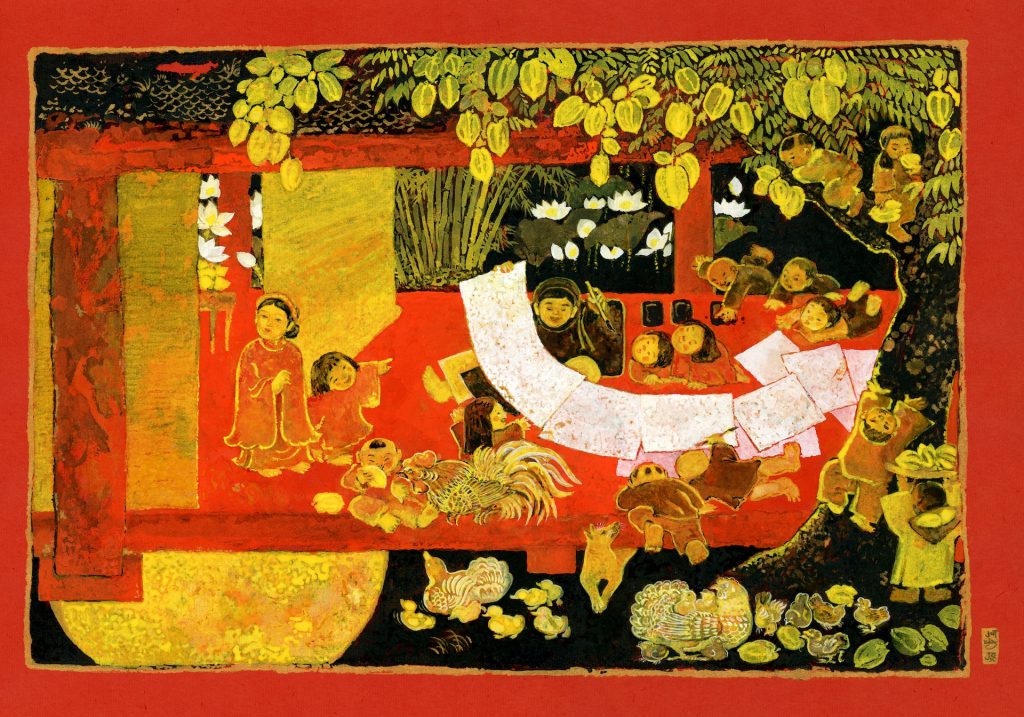
What I wouldn’t have given in this time for a resource like Major Books’ new translation of Nguyễn Đổng Chi’s Treasury of Vietnamese Folk Tales: Volume 1, which collects a range of traditional folktales in the most popular forms familiar to Vietnamese people today. The tales selected for the volume, deftly translated by Nguyễn Bình and Lan Võ, exemplify how thoroughly Buddhism has saturated Vietnamese folk culture, to the point of inseparability, with both its teachings and cosmology absorbed and integrated into the Vietnamese way of seeing the world. These are some of the most foundational stories to the Vietnamese people, each accompanied by beautiful illustrations, hand-painted by Jeet ZDũng and inspired by traditional Vietnamese art forms, depicting each scene in vibrant and fabulous detail: Heroines adorned in traditional áo dài leap defiantly into the air; celestial immortals abide in heavenly realms, lotuses blossoming all around them; enraged elemental gods crusade into battle against one another in seasonal clashes.
For the Buddhist reader—of Vietnamese heritage or otherwise—the folktales collected in this volume provide enormous insight into how Buddhism has become an indivisible aspect of Vietnamese culture itself. In the collection’s second story, “Mother Liễu Hạnh,” a fairy princess (tiên nữ, often understood as a “Daoist immortal”) is exiled from heaven, only to be relentlessly pursued and harassed by the Crown Prince of King Lê Thái Tổ. When the king makes prayers to the eight Vajrapani generals to intercede, believing Liễu Hạnh to be a demon bewitching his son, the narrative interjects to explain how Quán Âm, the bodhisattva of compassion, manifested the eight generals—powerful magic-wielding dharma protectors—from lotus flowers to vanquish evil from the East Sea a thousand years prior. Even very well-read and studious Buddhists may be unfamiliar with the concept of the dharma-protector spirit Vajrapani being split into eight separate individuals—while the eight Vajrapani (bát bộ Kim Cương) are mentioned in the liturgies used in Chinese Buddhism, their depiction in Vietnamese monasteries and temples in statuary form positioned in the eight compass directions (replacing the more common motif in Chinese temple architecture depicting the four heavenly kings) began in the Lê dynasty. The motif has since developed into a unique feature of Vietnamese Buddhist iconography: The ferocity of the warrior-spirits is tempered by the initial seed of compassion that birthed them, each Vajrapani general representing one aspect of the eightfold path. Together, they represent the adamantine strength necessary to engage with the world compassionately while protecting the mind from succumbing to defilements.

In the Liễu Hạnh folktale, the eight Vajrapani find their magic at a stalemate with Liễu Hạnh’s—owing to her being a daughter of the Jade Emperor—and call upon Quán Âm to aid in the fairy’s capture. When the king realizes Liễu Hạnh is not a demon seducing innocent men but a fairy descended from heaven unleashing retribution against lechers, he grants her amnesty. Liễu Hạnh is lionized in Vietnamese tradition as the Sacred Mother, protector of women and children, disciplinarian to the wicked; she has the honor of being the only female member of the Four Immortals (Tứ bất tử), the most recognizable and widely worshipped deities in Vietnamese folk belief.
The fifth folktale in the collection, “Tấm Cám,” is one of the most widely known Vietnamese traditional stories—a telling of what the European tradition knows as Cinderella that follows Tấm, a young orphan in the care of her father’s second wife, and her stepsister, Cám. The story starts off very much like more familiar versions of the tale, with the stepmother and stepsister forcing Tấm to labor tirelessly and tend to the housekeeping chores, until a local prince throws a festival to identify the woman who owns the lost slipper he’s found. But after Tấm weds the prince, there are two whole additional acts, as the wicked stepmother and stepsister scheme to have Cám take Tấm’s place as queen. In a departure from the Chinese telling, in the Vietnamese version the Buddha takes the role of Tấm’s fairy godmother, and the second act begins with the stepmother orchestrating Tấm’s death, with Tấm subsequently cycling through a series of rebirths to orchestrate her eventual vengeance. The telling included in Treasury masterfully renders Nguyễn Đổng Chi’s original adaptation into English, putting the full whimsy and adventure of the fairy tale on display for fans of either the European or Sinitic versions.
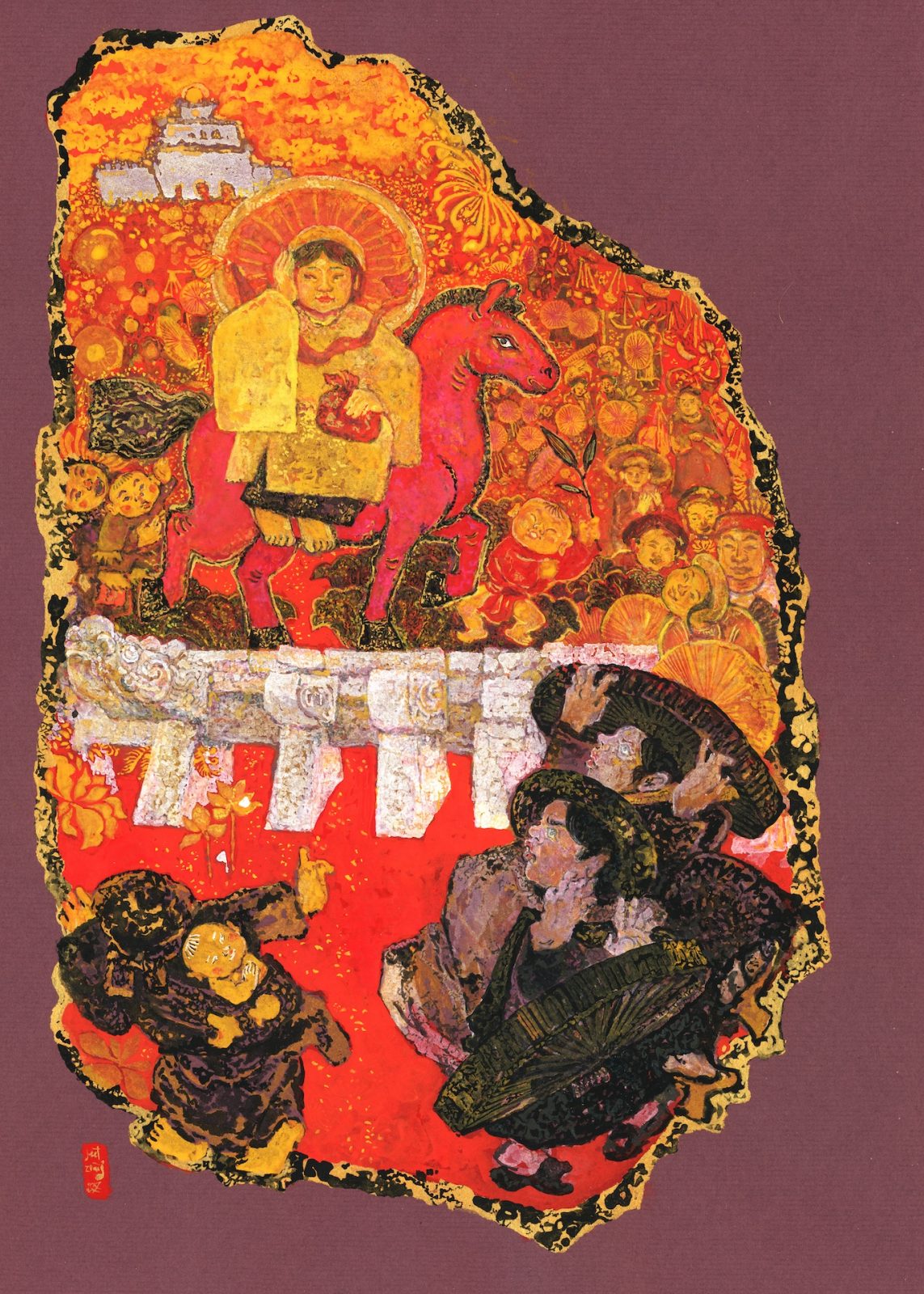
The majority of the tales collected here feature Vietnamese women, fairies, and goddesses punishing the wicked, defying lords, or putting terrible husbands in their place. Sociologists describe Vietnamese society as originally matrifocal—women were the heads of households, owned and inherited property, served as political and military leaders—with patriarchy imposed through Chinese colonialism and Confucianism. Though the thousand-year Chinese domination reordered the public sphere to give an appearance of patriarchy, the matrifocal structure persists in the domestic sphere to this day: Property rights typically pass down through maternal lines, as women are “keepers of the treasure chest” (tay hòm chìa khoá) and managers of a household’s finances. Traditionally, men are not even permitted to keep their own money, receiving only a small allowance at the matriarch’s discretion. Several of the folktales in Treasury are morality fables justifying why men are not to be trusted to manage a household’s finances, most humorously in the seventh and eighth stories, “A Wise Wife’s Teaching of Her Idiot Husband” and “Madame Dupe.” In both, the husbands are debaucherous or dim-witted and quickly lose their family fortunes—the former to gambling addiction, the latter to a beautiful woman’s witty scam—forcing their brilliant and capable wives to win it back. Along the way, moral values rooted in Vietnam’s Buddhist and Daoist backdrop are exalted in the female characters, such as filial piety and generosity to the sangha. In Confucianism, a dignified woman is expected to observe the “three submissions”: submission to her father before marriage, to her husband after marriage, and to her son after she is widowed. Folktales like “A Wise Wife’s Teaching of Her Idiot Husband,” “Madame Dupe,” and several others in Treasury subvert this imported moral virtue to emphasize one esteemed in Vietnamese social order, distinguishing Vietnam from the rest of the Sinosphere: An orderly home, in traditional Vietnamese thought, is one where husbands defer to their wives and entrust the well-being of their families to their wives’ wisdom.
One word of necessary caution is that the book assumes cultural knowledge that readers without personal connections to Vietnamese culture are unlikely to possess—the translation does not provide any context for who the Hung kings are, for instance, and much of Vietnamese culture is taken for granted. However, the folktales can provide novelty and contrast to Western fairy tale traditions, and offer teachings in Buddhist moral values for parents who might want to provide their children with some degree of immersion in Buddhist cultural frameworks, particularly in convert households.
For those of us who grew up Vietnamese American, the book fulfills a different, deeper kind of need. When I speak to other Vietnamese Americans around my age—those of us who experienced the United States of the ’80s, ’90s, and early ’00s—I find that many of us have gone through the same emotional arcs in relation to our Vietnamese identity: in our adolescence, shame that led to rejection; in our young adulthoods, grief over realizing how much of ourselves we felt we had to suppress in order to assimilate; and now, as many of us enter our middle age, a deep longing to rebuild and nurture our connections to our heritage and our ancestors, a galvanized sense of urgency to ensure the next generation never has to feel that in order to truly be American, they must become alienated from their cultural heritage. This translation of Nguyễn Đổng Chi’s Treasury of Vietnamese Folk Tales is a precious gem toward this end. I hope every Vietnamese family raising their children in the English-speaking world will share these stories with their young ones, the stories our people have been passing down for hundreds—sometimes thousands—of years. In the simple and joyous act of reading a fairy tale with our young ones, we honor and respect our ancestors, and dedicate our merit to them.

Thank you for subscribing to Tricycle! As a nonprofit, we depend on readers like you to keep Buddhist teachings and practices widely available.