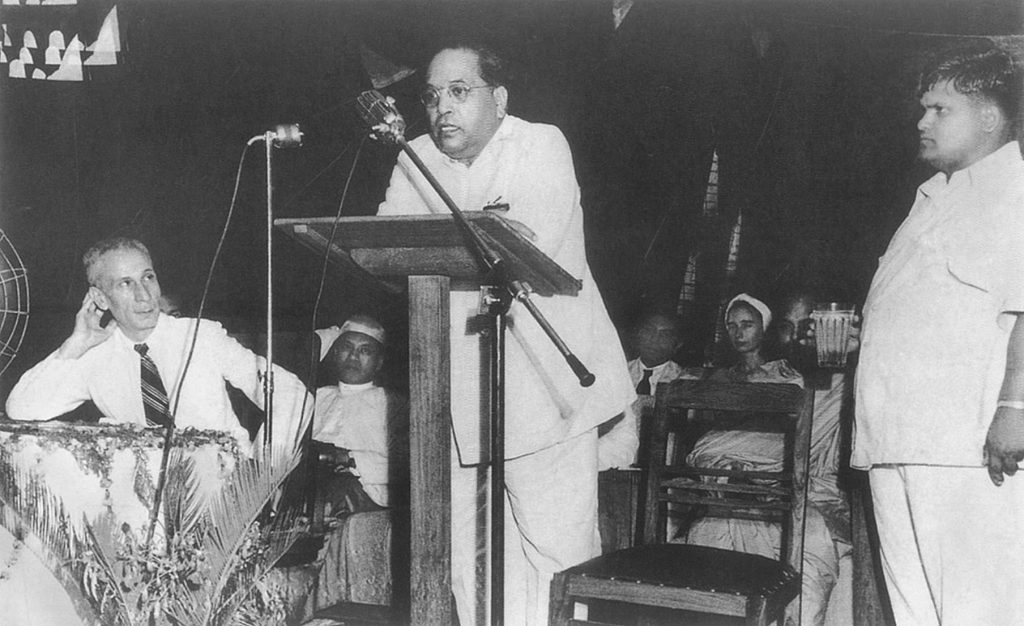
On October 14, 1956, B. R. Ambedkar, the Dalit activist and chief architect of the Indian constitution, led nearly half a million followers in a mass conversion to Buddhism. The conversion set in motion the development of a religious movement known as Navayana, or New Buddhism, which positioned Buddhism as a fierce rejection of Hindu nationalism and caste politics. In Ambedkar’s reading, Buddhism was uniquely suited to support a revolutionary reconstruction of Indian society grounded in religious transformation. In the years since his death, many Dalits have followed his example and converted to Buddhism as a form of protest and resistance.
In honor of the seventieth anniversary of Ambedkar’s conversion, Tricycle’s editor-in-chief, James Shaheen, sat down with scholar William Edelglass, who has written extensively about Ambedkar’s life and legacy. In a recent episode of Tricycle Talks, they discussed why Ambedkar believed reform was inadequate and true change required complete annihilation of caste, Ambedkar’s reimagining of the Buddha’s life story, and how Ambedkar understood Buddhism as a path of collective freedom from violence and social inequality.
First, for those who may not be familiar with Ambedkar’s story, can you tell us about his background? Ambedkar was the fourteenth child of a family who belonged to the Mahar jati. We often think of Indian society as being divided by caste, and really it’s better to think about jatis, which are regional groups. There are more than 4,000 jatis in India, and they’re endogamous, so you only marry within the group, and they have largely determined occupations, social status, and political and economic status. This is different from the four varnas, or the four castes, that we typically think of: Brahmins, warriors, merchants, and servants. The jatis in some ways fit into the varna system, and the Mahars that Ambedkar belonged to were a jati that was regarded as subcaste or outcaste. The term that was used in those days was untouchable.
Ambedkar’s family’s lives were determined and limited by their jati. So that meant that in school, for example, he sat in the back on a burlap sack. He was only allowed access to water when the servant was there who could pour it into his mouth, because the Brahmin view is that one needs to preserve purity, and some people were seen as impure because of their status and their occupation, and so their touch was regarded as polluting.
Ambedkar went through his life regarded as somebody who was polluted—and polluting—by many people around him. Nevertheless, he became the first person from his jati, the first Mahari, to go to college. He attended Elphinstone College in Bombay, and he was then awarded a scholarship to go to Columbia University in New York, where he studied philosophy, sociology, and history with John Dewey. He also went to the London School of Economics, where he received a master’s and a PhD in economics. He also studied law at Gray’s Inn and became a barrister. He came back to India as a highly learned man and became an advocate for the rights of Dalits, of people who were outcastes, and went on to live a life that was a life of a scholar, a professor, a teacher, and a dean, as well as a politician and an activist.
You mentioned that he went to Columbia and the London School of Economics, yet when he returned to India, he continued to face discrimination due to his caste. He began advocating for Dalit rights, but he later came to believe that reforming caste would be impossible, and he boldly argued instead for the annihilation of caste. So tell us about this shift in his perspective. Why was annihilation of caste necessary, and how did he understand this in practice? Annihilation of caste was necessary because from Ambedkar’s perspective, he spent fifteen years trying to reform the caste system to do away with untouchability. So, for example, in 1923, the Bombay Presidency, which is now the region around Mumbai, declared that all public water tanks would be accessible to everybody. But in the city of Mahad, as with many other places, the public water tank was only accessible to caste Hindus, Muslims, Christians, and their animals, and outcaste people were not allowed to access the water. They had to go to the outcaste part of town, which was some distance away. One of the occupations that outcaste people had to do was bring messages, so from villages all around, Dalits were coming in to do errands on behalf of caste Hindus in their local villages, but they were not allowed to access the water, even though by law they were supposed to be able to.
Ambedkar led a satyagraha, a protest movement, to access the water tank at Mahad. This was a very important movement; in fact, March 19 was regarded as Untouchable Independence Day because it celebrates that march to access water. He also led a movement for Dalits to access temples. And what Ambedkar came to realize was that because the caste system is so built into Indian Hindu Brahminical culture, it can’t be reformed. It needs to be annihilated. And so he wrote what was supposed to be given as a talk to a group of Hindu reformers. Even though they were very progressive and all wanted to do away with untouchability, they didn’t allow him to give the talk, which was on the annihilation of caste, because it went too far. That became the book he published in 1936, The Annihilation of Caste.
At the same time as he was making this transition away from reforming caste to the annihilation of caste, he came to recognize that the caste system is inherent to Brahminical Hindu culture. At the end of 1935, he declared very famously, “I had the misfortune to be born a Hindu, but I will not die a Hindu.” He then set off on a project of finding a new religious tradition.
Right, Ambedkar argued for a revolutionary reconstruction of Indian society grounded in religious transformation. So how did he view the role of religion in social change, and how did Buddhism become key here? Ambedkar looked at the comparative study of religion and thought that it was really helpful to recognize that the monotheistic traditions, and Christianity in particular, that Europeans have regarded as the one true religion are not the only religion, and there are these other religious traditions that also have value. In this respect comparative religion was a helpful discipline for him. At the same time, he felt there was a danger to the comparative religion approach because it seemed to suggest that all religions were equal. So he also felt there was a need for a normative, philosophical, critical approach to religion which would make evaluative judgments.
In his evaluative judgment, Hinduism, or certainly the Brahminical form of Hinduism, was violent and problematic because the caste system was at the heart of it, and the caste system he regarded as a system of graded inequality in which those above have contempt for those below, and those below have hatred of those above. That was the religious culture. And he said that the people who practice this graded inequality of caste weren’t bad; it’s their religion that teaches them to be this way.
In Ambedkar’s view, Buddhism is a way of life which, when cultivated well, allows us to engage with others across difference and build a broader community.
So his diagnosis was that religion can be problematic, but at the same time, he felt that there needed to be some kind of sacred morality or transcendent morality. Even though he was a politician for a long time, he still believed that the political structures were not enough to ensure equality and freedom. He wrote that the Constitution grants Dalits equality and freedom, but the culture in which they live denies them that equality and freedom. He draws from Edmund Burke here in saying that if one person commits a crime, you can punish them. If a whole society commits a crime, they’re not punished; it’s just the practice of the society.
In Ambedkar’s view, Buddhism—cultivating the precepts, cultivating the eightfold path, cultivating the paramis, or the perfections—is a way of life which, when cultivated well, allows us to engage with others across difference and build a broader community through maitri, or benevolence, and karuna, or compassion. For him, Buddhism is primarily about morality. It’s about a morality that transcends politics. It’s about a morality that is more than just self-interest in a liberal democracy. It is a morality that can be the basis for fraternity, liberty, and equality, which he thought of as being some of the primary teachings of the Buddha.
He eventually converted to Buddhism, as did nearly half a million Dalits. So can you tell us about his conversion and the twenty-two vows he crafted? In the 1930s, when he was looking at different traditions, Sikhs, Muslims, Christians, everybody wanted to have him convert because they felt that there would be all these other Dalits that would convert to their religious tradition. But it seems pretty clear that it was relatively early on that he decided on Buddhism because it was native to India and because of this long history of Buddhist reformation movements in India that were egalitarian.
So it is true that he only converted on October 14, 1956, and then he died six weeks later. But he had spent the previous decade of his life very committed to Buddhist study, learning Pali, reading hundreds and hundreds of books, and writing The Buddha and His Dhamma. During that time, he formulated what we can think of as Ambedkarite Buddhism, what he called Navayana, or New Vehicle Buddhism, and the twenty-two vows that were articulated in his conversion ceremony. Then there were four hundred thousand others who converted the next day, and then several million more by the end of the decade, and there continue to be mass conversions on occasion.
The twenty-two vows are very specific to a conversion from Hinduism to Buddhism. Some of the vows are about following the precepts, following the paramis, following the eightfold path, and some of the vows are very particular to someone converting from Hinduism: not taking the Hindu gods as supreme and not taking the Buddha as an incarnation of Vishnu, as many Hindus believe, in the project of appropriating Buddhism into a form of Hinduism.
So they are vows that really support someone who has been in this context of marginalization and in this context of subordination to fully affirm one’s own dignity as a Buddhist. And today, if you look at Dalit Buddhists in India, they have very high rates of literacy, they are doing much better economically, and they have a sense of dignity, in part perhaps because of these commitments to not buying into a worldview in which they lack dignity and are subordinated.
You mentioned The Buddha and His Dhamma, where Ambedkar is participating in a long Buddhist history of creatively reimagining the Buddha’s life. Borrowing from a phrase of the scholar Saidiya Hartman, you describe this as critical fabulation. So can you tell us about this project of critical fabulation? Saidiya Hartman is a scholar at Columbia, and Ambedkar’s approach to thinking about Indian historiography by using creativity and imagination bears some resemblance to what Saidiya Hartman calls critical fabulation. Hartman is primarily interested in the lives of those people who are not in the archive due to slavery and colonialism. So we don’t have documents about the interiority of their lives or their life experience, or much of their lives at all. The documents that we have are diaries of slave owners, for example, or ship manifests. And so she tells stories that go beyond the bounds of the archive to honor these lives and to make these lives present to us in part, she says, to make a place for the living. That is, how we see our history and who the people are in our history is important for how we live our lives today.
Ambedkar was engaged in a very similar project. Because there is no archive that can tell us about the origins of untouchability, the origins of Dalits, the origins of this very oppressive system, he takes intuitions and takes creative license to tell stories and to give a history in which Dalits used to be Buddhists, but they were defeated and they became outcasts, but they were defeated by Brahminical armies and Brahminical cultures. In doing so, he suggests that, in fact, Dalits today did have a noble egalitarian culture that was worth preserving and that there’s honor and dignity in their history, and that connecting to that history of honor and dignity and an egalitarian culture allows for Dalits today to have a sense of value, a sense of worth, and they can hold their heads up high as Buddhists and be part of this long tradition of egalitarianism in contrast to and antagonism with what he regards as a hierarchical, violent Brahminical culture.
You say that Ambedkar’s retelling is about finding an alternative to violence, or what you call antiviolence. So what is antiviolence, and how does it differ from nonviolence? Antiviolence is a term from the French political thinker Étienne Balibar. There is a wonderful scholar of Ambedkar, Aishwary Kumar, who in a footnote brought my attention to the ways in which Balibar’s term “antiviolence” was appropriate for Ambedkar. The reason why I use the term “antiviolence” is because it may be the case that violence and nonviolence are too simplistic a dichotomy.
One example from Ambedkar’s own life is his conflict with Gandhi around separate electorates for untouchables. When various representatives of Indian groups negotiated with the British, Muslims, for example, were given separate electorates. That is, they could elect their own representatives. Ambedkar felt that Dalits should also have the right to elect their own representatives, because if they were subsumed into the wider Hindu fold, they would not have any political power. The fear was that there would be a tyranny of the Hindu majority over Muslims and over Dalits. And so he negotiated separate electorates. Gandhi, who felt that that would separate Dalits from the rest of the Hindu population, went on a fast to the death, which was nonviolent, but essentially blackmailed Ambedkar and forced him to compromise the separate electorates that he had negotiated with the British.
What Ambedkar observed there is that something that can appear nonviolent actually can maintain a violent structure. So if you think of the ways in which every society has certain kinds of structures that subordinate and marginalize some and privilege others, those are what one might think of as forms of structural violence, and nonviolence can often be employed to preserve structures that are themselves violent. Ambedkar was more concerned with antiviolence, or using force against violence in such a way that the least amount of violence would be done. In an article he wrote at the very end of his life on the Buddha and Karl Marx, he says that the Buddha was against violence, but when justice demanded it, violence was okay to preserve justice. So antiviolence is an approach that acknowledges that nonviolence can preserve violent structures and sometimes some violence might be necessary to preserve a larger nonviolent structure.
I also wanted to ask you about Ambedkar’s legacy and the movement he inspired after his death. You give the example of the remarkable story of Chandrika Ramteke, an activist leader in the Ambedkarite movement who was instrumental in spreading Navayana, or New Buddhism, to rural villages. Can you tell us about Ramteke and the Dalit women who carried on Ambedkar’s mission? Ramteke’s father was an Ambedkarite activist, and because of that work, she was attacked, and she was married off in ninth grade to an older man who mistreated her. Despite that mistreatment, she became a prominent activist. And I think she’s an interesting example of what an antiviolent approach might be.
One of the political parties Ambedkar started was the Republican Party of India, which was primarily made up of Dalits. People often tried to prevent them from voting, so Ramteke would bring kerosene, matches, and chili pepper to the elections. If people got in the way of Dalits, she would throw chili pepper in their eyes. And if that didn’t work, she might go behind the first level of houses and light an outhouse on fire to get everybody to run and put out the fire so that Dalits could vote. She once laid down in front of a car that Indira Gandhi was driving in, which led to her having an audience with Indira Gandhi.
One of the things that I really appreciate about her is she was a fiery activist, but what she did was walk to different rural villages with other Ambedkarite Buddhist women and teach local Dalit women how to read The Buddha and His Dhamma, how to practice the five precepts, how to practice the eightfold path and the paramis, and they had a practice of reading The Buddha and His Dhamma a few pages every day. To me, there’s a nice example of someone who’s focused on the practices of an individual but also focused on the broader context. That would be a nice image of what an Ambedkarite Buddhist life might be like, not that we should all go to elections with chili pepper and kerosene—
Or burn down outhouses. Right, or burn down outhouses. But it’s not an either/or. The cultivation of right mindfulness, the cultivation of right concentration, the cultivation of right view, the cultivation of right livelihood—that all includes right action. That includes social engagement because of the ways in which suffering is caused by all kinds of social structures.
To be wise, benevolent, and compassionate is to be able to work with others with whom one disagrees, even if one disagrees vehemently, and to do so with a sense of still belonging to a larger community.
This connects to Ambedkar’s vision of democracy. He defined democracy as a political approach that allows for revolutionary change without bloodshed. And the way he unpacked that is that democracy is about getting along with other people with whom we disagree and not bloodying them when we win, not totally dominating them when we win, but always remembering that we are still part of a community and we will live to work together in the future, and we are always still maintaining a sense of community across difference without enmity. For him, maitri, or benevolence, and karuna, or compassion, and prajna, or wisdom, essentially get articulated as democratic virtues. To be wise, benevolent, and compassionate is to be able to work with others with whom one disagrees, even if one disagrees vehemently, and to do so with a sense of still belonging to a larger community.
We’re now seventy years out from Ambedkar’s famed conversion. So can you talk about the state of Ambedkarite Buddhism today? Ambedkar worked so hard, and he came from a very poor background. Four of his five children died in childhood. He got diabetes, continued to work all the time, and died relatively young. One of the tragedies of the Ambedkarite Buddhist movement was there weren’t really leaders in a position to take it on the way he could. There was fragmentation. And so the Ambedkar Buddhist movement has continued to grow and is continuing to develop, including internationally. There’s a Roma Ambedkarite school in Hungary, because there were Roma who recognized the parallels between the dynamics they were facing and the dynamics that Dalits were facing, and they found his analysis and response helpful. There are also Indigenous people in Taiwan and Japan who are interested in Ambedkar for similar reasons. And of course, today there’s a certain amount of dialogue between Ambedkarite Buddhism and Black Buddhism in the United States.
There’s no one Buddhism; there are many Buddhisms, and Ambedkarite Buddhism is one. But Ambedkarite Buddhism is one that provides a profound example of what deep individual practice can be in relationship with social practice.
But still, one of the things that I think Ambedkar would feel is unfortunate is that in India, Ambedkarite Buddhism is too much still Dalit Buddhism. It’s not something that has transcended caste. That said, seventy years is a long time in one perspective but a very short time in another perspective. My friend Santosh Raut, for example, is working on developing an Ambedkarite Buddhist seminary that would train people in India to teach Ambedkarite Buddhism and to go out as chaplains to Ambedkarite Buddhist communities to support them. I’m hopeful for what the future might bring, and I am hopeful that the fever of the particular brand of religious nationalism in India might break and that a more open egalitarian approach might be more welcome.
Anything else, William? One thing I want to emphasize is that sometimes there are debates, especially in Western Buddhist convert contexts, about whether Buddhism is political or not, or what’s the relationship between individual practice and social practice. One thing, of course, to keep in mind is there’s no one Buddhism; there are many Buddhisms, and Ambedkarite Buddhism is one. But Ambedkarite Buddhism is one that provides a profound example of what deep individual practice can be in relationship with social practice, and that they don’t have to be either/or.
This interview has been edited for length and clarity.

Thank you for subscribing to Tricycle! As a nonprofit, we depend on readers like you to keep Buddhist teachings and practices widely available.