
Thich Nhat Hanh—the world-renowned Zen teacher, author, poet, and peace activist—was born on October 11, 1926, in central Vietnam. Today marks the 100th anniversary of his birth, or what the Plum Village tradition calls his “continuation day” in recognition of the Zen teaching that there is no birth and no death.
Widely considered one of the most influential figures in contemporary Buddhism, Nhat Hanh, known to his followers as Thầy (Vietnamese for “teacher”), is best known for founding the Plum Village tradition and Order of Interbeing, authoring more than one hundred books, and pioneering the concept of “engaged Buddhism,” which revolutionized how Buddhist communities engage with social, political, and environmental crises.
In honor of his centennial, Tricycle reached out to a handful of teachers, writers, and students to share memories of the beloved teacher and peace activist and to reflect on how he transformed the landscape of contemporary Buddhism.
–The Editors
***
Born in the throes of colonialism and war, Thích Nhất Hạnh was extraordinary in his insight and ability to bring the dharma to the modern world. He showed us how to live with clarity of purpose even when all seems lost. For people like me, living in the wake of wars that destroyed ancestral homelands, he is proof that healing is possible—and that in healing ourselves, we end cycles of violence and bring more light to all of humanity.
–ADRIENNE MINH-CHÂU LÊ, historian and author
We are said to be very lucky if we are able to meet an enlightened teacher in our lifetime here on Earth. You may ask what is meant by an enlightened teacher (明師). I understand it as someone whose compassion and understanding have no limits. It is someone who does not want you to revere them, look up to them, take refuge in them, but who wants to show you the teacher you have in yourself. That person will ask you questions from time to time or say things that cut through your ideas and views about things. The ability to cut through a student’s obstacles is very precious. An enlightened teacher will go to any lengths to help their student wake up to the truth. An enlightened teacher transmits the dharma through every thought, word, and action. They do not waste their energy in thinking, saying, or doing things that are of no benefit to the world.
Now that our teacher no longer manifests in one particular physical form, we take refuge in his most precious legacy, the multifold sangha. A song he composed has the words:
In the here and now we are singing together
To light up the fact we have each other
In the here and now we are walking together
on our dearest mother earth.
That we have each other
brings us joy every day.
When one of us is suffering
we’ll be there right away.
Together we shall build the future
Holding hands, we’ll help the world.
At the time of the parinirvana of our teacher some of us worried about the future, but we have seen that the legacy of the dharma and the sangha he has left us means that every year more and more people take refuge in the Plum Village dharma doors. People asked: “Now that your teacher is no longer there, who will lead the Plum Village sangha?” We reply that just as Buddha Shakyamuni had no successor, so, too, does our teacher have no one successor. The successor is the sangha; each of us continues something precious that we received from our teacher. Our teacher devoted all his time and energy to building the multifold sangha. He could have devoted his time to writing books, but he did what the Buddha did his whole teaching ministry and devoted his time to building sangha.
The successor is the sangha; each of us continues something precious that we received from our teacher.
When we read our teacher’s poem “On the Edge of the Forest the Plum Trees Have Burst into Flower,” we are deeply moved by our teacher’s commitment to transmit all he has to his students:
Where are you going, my child?
Sometimes the mist has come and enveloped the isolated hamlet,
but you wander away, drawn by distant places.
I have called your name with each breath,
confident that you will find your way back.
Sometimes I manifest right on the path you are treading,
but you look at me as if I were a stranger.
Not seeing that the connection between us is there,
not remembering the vows you made set in gold and marble,
you have not recognized me.
Because your mind is caught in images of distant happiness . . .
you have left your teacher and your spiritual friends.
Looking at you alone and on unsteady feet,
I cannot help but feel deep compassion,
although I know that this is not true separation
because I am in each cell of your body.
So I promise I shall be there for you
when life is dangerous or hard.
Sometimes you have lain unconscious on the hot sands of a desert.
I have taken the body of a cloud to bring you cool shade.
Late at night the cloud condenses as dew,
and the nectar of compassion falls drop by drop for you to drink
to lessen your confusion. . . .
I bow down in gratitude before my teacher who has delivered and continues to deliver the pure and right dharma. I vow to continue my teacher by transmitting the dharma that I have received not just in words but, more importantly, in the actions of my daily life.
–BHIKSHUNI TRUE VIRTUE, the first Western European woman to be ordained by Thich Nhat Hanh, Fragrant Stream Monastic Cloister, Plum Village, France
I was 23 when I first saw Thầy, in the summer of 1997, at my first Buddhist retreat. I had recently graduated from Stanford, yet I was at a loss for how to understand the actual workings of my mind and how to truly live peacefully and happily with myself and others. As soon as I saw Thầy in that first dharma talk, I knew he was my teacher. It was an unexplainable feeling of recognition and absolute trust. I had planned to stay for two weeks. I stayed the whole month, canceled my plans to travel around Europe, and spent the following four months at Plum Village. Two years later, on December 4, 1999, Thầy ordained me as a novice nun.
As soon as I saw Thầy in that first dharma talk, I knew he was my teacher. It was an unexplainable feeling of recognition and absolute trust.
In the years since he passed away, I have kept returning to the question of what the most important thing he taught me was. The answer is love. He loved all of his students, and everything he did in his life was to nourish and train us. But I also knew and felt that he loved me, in every fiber of my being. There were hundreds of monastic students around him and thousands of lay students all over the world. And still, again and again, he found a way to let me know I was seen.
One of those moments happened in 2003, when I traveled with Thầy and several hundred monastic and lay students to China to offer retreats, public talks, and days of mindfulness. Like all teaching tours with Thầy, it was more like a pilgrimage, full of inner and outer blessings and challenges that call forth the best in us and help us compassionately recognize and befriend the worst in us.
At some point on the trip I started feeling very bad about myself. For several days I experienced gnawing self-doubt, fueled by self-judgment and aversion to who I felt I was, the kind of self-absorbed thinking that narrows your mind and cuts you off from others.
One morning we were traveling from one city to another, and I boarded the bus full of misery, utterly dejected. Thầy was sitting in the front row, as he always did, to make sure the driver stayed awake and that we would all be safe. As I reached the top step, I lifted my gaze and our eyes met. Thầy was looking at me most intently, with a compassion and love so huge I felt it physically. I had never seen that depth of kindness in someone’s eyes before, especially directed at me. It was as if a great being were looking at me through a magnifying glass of unconditional love. The look was so focused that it burned away my attachment to my story and the seductive hooks that kept me bound up in the small self. It was a moment of grace, and it took my breath away.
I had to keep walking past him to my seat, but inside myself I had stopped completely. I was changed. His brief look opened up a moment of timelessness in the midst of the pressures of worldly time, a moment of well-being and wholeness right in the midst of suffering. Thầy’s look taught me that awakening is possible in every moment, even if it is only a tiny waking up from the small story into the reality of this moment, where innate goodness and worthiness can always be affirmed.
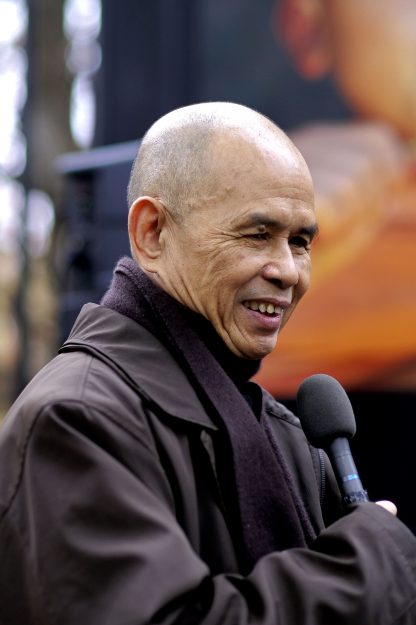
Later, I thought about everything Thầy might have been preoccupied with that day. We were a Buddhist delegation in a communist country that was at times welcoming, at times ambiguous, and at times suspicious of our presence. He was guiding several hundred followers while also offering culturally appropriate teachings to thousands of Chinese people. He had his own health and safety to be concerned about, and ours. And yet, in the midst of so much to organize and take care of, he was free enough to see me clearly, to care about me, and to zap me with incredible peace and freedom. I’m sure he zapped many others, on that trip and on all of his journeys. He is still zapping us now.
His love was never only personal. It also made room for people to belong. As the first Black monastic that he ordained, I felt this in a particular way. In 2003, a group of us, including the dharma teacher Larry Ward, approached Thầy and asked him to teach a retreat for people of color. Right away, he pointed to his own skin and said, “I am also a person of color,” and agreed. We were so happy and amazed when some 400 people signed up for this first-ever retreat of its kind in our tradition, held at Deer Park Monastery in 2004. He later asked me to edit his talks from those retreats into a book, Together We Are One, and insisted that Larry and I, as key organizers, have our own chapters in it.
Another time, as a novice nun in rural southwest France, I wrote Thầy a letter. Very few Black people came to Plum Village, so whenever one did, I was delighted and eager to talk with them. But I felt self-conscious about approaching them because they were Black, and worried that my reaction wasn’t equanimous enough. I didn’t quite know what to do with all of this. A few days later, all of us sisters were having tea with him, discussing what color to repaint the meditation hall. He looked straight at me and exclaimed, “Black is beautiful!” We all laughed. It was a powerful, direct Zen teaching that allowed me to break through my self-imposed hang-ups and simply love those in my presence with freedom and confidence.
I left the monastic life after fifteen years, but his teachings continue to guide me and remain the core of my life. I have followed him for nearly three decades now, and today I am a lay dharma teacher, still doing my best to practice mindfulness moment to moment. Thầy was born in 1926, and a century later I am filled with gratitude as I see how his monastic and lay students carry his teachings forward, in places as varied as monasteries and sanghas, schools, hospitals, workplaces, prisons, and homes. His presence is still helping so many people to transform and to suffer less. I was one of them, in more ways than I can count. One of those was on a bus in China, when a single look from him changed me. That look transmitted to me a deep desire to look at people in that way, with boundless compassion and love that, without any words, can relieve suffering and inspire great confidence and joy. That, to me, is how we continue him: not by admiring him from a distance but by offering that same attention to the person in front of us, and to ourselves.
May Thầy’s freedom always guide us and show us the way.
–KAIRA JEWEL LINGO, dharma teacher and author
Dear Beloved Thầy,
Although Thầy’s body has returned to the Earth, Thầy’s teachings and spirit continue to guide us in our daily lives. Every morning when I wake up, I gently rub my head and thank Thầy for creating this sangha that I may live and practice in. Thầy’s teachings and the way he embodied them have helped me transform suffering I once thought I would have to carry for the rest of my life, and have shown me a freedom and ease I did not know were possible. On my way to the Ocean of Peace Meditation Hall, I walk with the poem, “Let Thầy breathe. Let Thầy walk. Joy is the breathing. Happiness is the walking.” The image of Thầy walking peacefully to the meditation hall, something I saw many times, is vivid in my mind.
Thầy’s cushion is still in our meditation hall, present in our daily lives and at every important event. Thầy still sits on it—silently, like a mountain—so that his monastic and lay students have the opportunity to reflect and see the way forward. In gatherings and meetings, we always begin with “Dear Thầy, dear sangha” when we speak. How sacred and warm the word “Thầy” is to us! During formal meals, our young novices still offer the first cup of tea to Thầy with deep respect and affection. In the dharma talks we watch together twice a week, Thầy still smiles mischievously, imparts deep wisdom, and empowers our practice.
Beloved Thầy, the needs for practice keep growing, and more practitioners continue to attend our days of mindfulness and retreats. Deer Park Monastery has opened new dharma doors through initiatives such as the Long-Term Stay Program, the Action Wake Up program, the Happy Farm project, and the Thích Nhất Hạnh School of Interbeing. After every rains retreat, more young people declare their aspiration to ordain as monastics; to celebrate your 100th continuation day, the Deer Park Sangha will ordain six new novices this October.
When Thầy first passed away, many people felt sad and worried about the Plum Village tradition. Now everyone sees clearly that we all continue Thầy’s legacy, and that Thầy is always present for the sangha. How fortunate we are to have Thầy in our lives! Thầy opened the door to a way of living that has allowed us to discover ease, peace, and freedom. Who made our breaths of ease possible if not Thầy? Who offered us peaceful steps if not Thầy? Who gives us the opportunity to sit still, to learn the dharma, to develop our talents, and to serve society, if not Thầy?
How fortunate we are to have Thầy in our lives! Thầy opened the door to a way of living that has allowed us to discover ease, peace, and freedom.
There are times of disagreement, but we practice yielding, and we lean on our shared love for Thầy to protect and build our sangha. Though we cannot avoid some ups and downs, with Thầy guiding us, we do not falter. We only need to practice more diligently and to continue nurturing our trust in one other.
Thầy is the breath of mindfulness. Thầy is the peaceful step. Thầy’s love is simple and practical, expressed in words of trust, in compassionate gaze, in forgiveness, and in inclusiveness. We are Thầy’s continuation, and Thầy’s mind of love continues to shine our path. We are committed to living beautifully, so that future generations may have the same precious opportunities that Thầy has given us.
We humbly offer Thầy our deepest love and gratitude,
Your students, monastics, and lay practitioners
–SISTER DANG NGHIEM, Deer Park Monastery
As I was growing up in a Buddhist family in the Vietnamese American diaspora, Ven. Thich Nhat Hanh always had an oversized influence on my world. I spent my childhood Sundays at a small residential house in a woodsy area of northern Virginia that had been slowly converted into a Buddhist temple called Hoa Nghiem Pagoda, the very first in the state to serve the Vietnamese community. My parents were primarily Pure Land practitioners, but it wasn’t uncommon to hear the abbot devote part or sometimes even all of a dharma talk to discussing a poem composed by “Master Lang Mai,” literally “Master of Plum Village.” And before Plum Village had temples and monasteries in the US of its own, Thầy Thich Nhat Hanh helped to build out—and would tour and teach at—a network of Vietnamese Buddhist temples sprawling across the country, most especially along the East, West, and Gulf coasts.
As my political consciousness and sense of social ethics developed over the years, I discovered the venerable grand master’s friendship with Martin Luther King, Jr. and the tradition of engaged Buddhism he popularized and spread to Western communities. I saw how he was often cited as an influence on some of the American activists I most admired. I learned about the 1963 Buddhist Crisis and its aftermath; how the Unified Buddhist Church of Vietnam formed; how Venerables Thich Nhat Hanh, Thich Tri Huu, and Thich Tri Quang—inspired by Gandhi—led a resistance faction headquartered at An Quang Pagoda committed to nonviolent protest and civil disobedience against the Diem dictatorship. They were instrumental in toppling the regime, and they never once abandoned their pacifist ideals, no matter how many grenades were lobbed or rifles were fired or bombs were dropped. Growing up in Virginia, seeing the world revere a peace activist who looked like me, who came from my homeland and shared my heritage, was beyond heartening—the nineties and aughts were short on Vietnamese heroes.
In my young adulthood, I began exploring Buddhism again. I picked up a Thien practice and sought out instruction. It soon became clear to me that Master Lang Mai’s didactic methods had a profound influence on meditation as taught in Vietnamese Buddhism irrespective of tradition or lineage. As my interest started to fall deeper toward the side of scriptural study and the commentarial tradition, I discovered a trove of Thich Nhat Hanh’s lectures in Vietnamese on quite literally all the niche, obscure texts I was interested in and which I was having difficulty studying in English—twenty-six hours speaking on Maitreya’s Yogacarabhumi Shastra, the foundational commentary of the Yogacara (or Mind-Only) school; thirty-five hours meticulously dissecting Asanga’s Mahayanasamgraha, an encyclopedic compendium of Yogacara philosophy; another half-dozen hours on the Alambanapariksa, Dignaga’s comprehensive work on Buddhist epistemology; dozens more on two of the best-known Vietnamese commentarial works, Instructions on Emptiness and Rhapsody of Engaging the World, Joyful in the Way by Thien masters Tran Thai Tong and Tran Nhan Tong, respectively; and on and on.
No amount of words, no matter how exalting, could suffice to honor the grand master on his 100th continuation.
Though fluency had slowly been drained from me over the course of my teenage years, I was able to reclaim my grasp on understanding spoken Vietnamese through brute force. Listening to those lectures, I marveled at the master’s scholastic brilliance—he was able to describe a completely unified doctrinal system that was dynamic enough to contain all other Buddhist systems within it, from the radical simplicity of early Buddhist thought to the psychedelic cosmology of the Huayan school and everything in between, using elegantly simple language.
The scope of his brilliance was enormous. To be able to practice in his lineage, to study under his equally brilliant disciples and dharma siblings, to honor and revere him as an ancestor-master is meaningful beyond measure. I have learned so incredibly much from him, and I continue to learn so much more from the venerable brothers and sisters to whom Master Lang Mai transmitted the lamp. No amount of words, no matter how exalting, could suffice to honor the grand master on his 100th continuation. Deep down, I know how Thầy wants us as practitioners of the Lieu Quan lineage to honor him and to continue his legacy . . . we are to invite the bell and offer our attention: Breathing in, I know that I am breathing in; breathing out, I know I am breathing out.
–AN TRAN (dharma name Nguyen Ngo), author and Thien-Pure Land practitioner in the Lieu Quan lineage
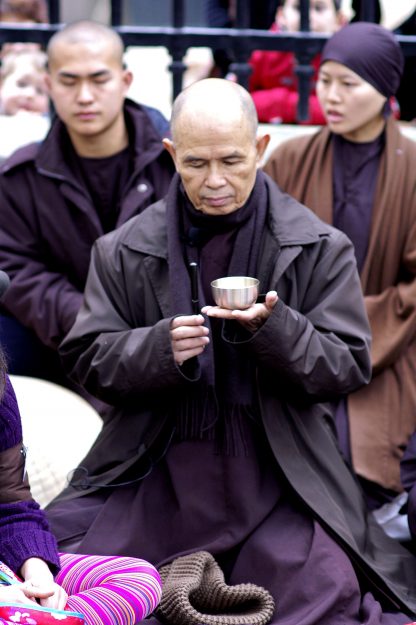
I have been ordained in Plum Village for thirty-three years, with Thầy as my teacher and guide throughout my spiritual journey.
When I first embarked on the monastic path, I had so many fears about the future. Would I be happy? Was this truly the right path for my life? It was daunting for a young person to make a commitment for a lifetime. There were so many uncertainties, and I wondered what my life would look like many years down the road.
Yet it was my faith in Thầy—in his life, his practice, and his teachings, which had already touched and transformed the lives of countless people—that gave me the confidence to take that step. With all my fears and anxieties about making a decision that would shape my entire life and future, I walked into the ordination and became a nun.
That step opened up a whole new world for me. It introduced me to different ways of living and helped me discover capacities within myself that I had never known existed. Over the years, these discoveries have transformed my life in ways I could never have imagined.
So when I am asked to write about my experiences with Thầy in an article of a thousand words, I find it difficult to know where to begin or what to leave out. Thirty-three years of walking with a teacher who has profoundly shaped my life cannot easily be captured in a thousand words. There are simply too many moments, teachings, and transformations that have become part of who I am.
A question that has come up again and again over the years is: What have I learned from Thầy?
My answer is that Thầy taught me everything I needed to learn and know for my spiritual growth on the path of awakening, understanding, and love. I have been deeply influenced, shaped, and inspired by Thầy’s teachings and by the way he lived his life.
Yet there is one teaching that touched me particularly deeply. Although Thầy had shared this story with us several times, it was reading Jim Forest’s account in Eyes of Compassion that gave me a fuller picture of what had happened and allowed me to see the story from a much wider perspective.
Thầy was at a church speaking about the war and the suffering of civilians in Vietnam. At one point, a reporter stood up and asked him a question, with a sharp sarcasm and anger in his voice: “If you love and care about your people so much, why are you here? If you care so much about those who are wounded, why don’t you spend your time with them?”
As he spoke, the whole room became tense. Thầy then began to speak quietly and calmly. He said that if you want to water a tree, it does not help to water the leaves; you have to water the roots. Many of the roots of the war were in America, and that was why it was necessary for him to be there.
This was the part of the story that Thầy often shared with us. But Jim Forest also described what happened afterward.
Following Thầy’s response, the atmosphere in the room was transformed. Thầy then quietly whispered something to the chairman and walked out of the hall. Jim followed him shortly afterward and found Thầy outside, struggling to breathe, almost gasping for air.
After several minutes, Jim asked Thầy what had happened. Thầy explained that the man’s comment had deeply upset him. In order to respond with calmness and understanding, he had made himself breathe very deeply and very slowly. He had slowed his breathing so much that it had lost its natural rhythm. Jim then commented that, even as a pacifist, Thầy had every right to be angry.
Thầy replied that if it were only about himself, it would be OK for him to be angry. But he was representing the peasants and civilians of Vietnam. Therefore, he had to show what we are capable of being at our best.
Every moment of Thầy’s life, he was representing the three jewels through his actions of body, speech, and mind; through his teachings and interactions with others; and through his sharing of engaged Buddhism with the world.
When I read this story from Jim, I was deeply moved. In my experience of Thầy, from the early 1990s until his illness, Thầy always embodied the Buddha, dharma, and sangha in their most beautiful expression. Every moment of Thầy’s life, he was representing the three jewels through his actions of body, speech, and mind; through his teachings and interactions with others; and through his sharing of engaged Buddhism with the world. Thầy worked selflessly and diligently, always finding ways to share the dharma. He lived as though he were constantly in the presence of the Buddha and the ancestral teachers, bringing mindfulness, compassion, and wisdom into everything he did. Thầy was a true continuation of the Buddha, dharma, and sangha.
I aspire to embody this same quality of living—as though I am always in the presence of the three jewels. I want to give my very best to the practice of the precepts, to mindful manners, and to being truly present in each moment, so that I, too, may be a true continuation of Thầy and of the Buddha.
–SISTER TUE NGHIEM, Plum Village monastic
On my desk is a photo of Thich Nhat Hanh taken in the early 2000s at a retreat for neuroscientists; he’s holding an adorable Winnie the Pooh bear. He offered a reading about Pooh Bear to teach about the wisdom of interbeing, a term he coined to explain interdependence and interconnectedness. He said that Pooh’s story for him was like reading a great sutra. Pooh Bear, like Thầy, was the embodiment of the unstoppable power of the present moment, of the simple gifts of moving at a human pace, of the joy of being fully alive and connected.
Nhat Hanh’s teachings are made for these times. In the hundred-plus books he wrote and the countless teachings he offered around the world, his message was simple and consistent and remains even more relevant today: The energy and practice of mindfulness, concentration, and insight helps us embrace suffering and calm the body and mind, to be peace and to create peace in ourselves and in the world, to be love within ourselves and to create love in the world. Pooh Bear, too, teaches us the inseparability of love and loss with these words: “How lucky I am to have something that makes saying goodbye so hard.”
In the Plum Village community, where I serve as an ordained dharma teacher, we train ourselves to be aware of suffering within us and around us, to understand, to listen, to embrace, to know the roots of our own suffering and then to help others with theirs. To do this, Thầy taught the practice of shamatha, or stopping, and vipassana, looking deeply to understand. We stop and feel, we connect with our feelings and emotions, with our body and mind, we calm racing thoughts and release tension in the body and mind, and begin to ask, perhaps to question, whether our views are correct. This is the opposite of the dominant culture, which offers distraction, disassociation, denial, urgency, or false optimism. This stopping invites us to cultivate a steady and a tender heart. This takes immense spiritual and emotional resources and maturity to remain open and responsive in the face of the individual, social, political, environmental, and cultural devastation, to the polycrisis or metacrisis. This doubling down to stop and stay with the tender and steady heart is an intervention to the impulse to turn away, training us to notice patterns that do not serve us and to instead choose love, peace, and compassion. This staying, this stopping, supports letting the reality of suffering be felt without hardening, denying, collapsing, bypassing, gaslighting, or reaching for premature answers rooted in distress, unconscious avoidance patterns, and more.
The wisdom of Pooh echoes Thầy’s teachings:
“Does that make the missing stop?”
“No,” said Pooh gently. “I don’t think love stops missing simply because time keeps moving.”
Perhaps our deepest transformation comes not from walling ourselves off from pain and discomfort but from stopping and listening to what the pain might be saying to us. When we listen in this way, we can be open to what we truly care about and love, what we are willing to protect and defend.
As we face the polycrisis of our time—war, displacement, genocide, racial and social injustice, climate crisis, and more, with destabilization and disruption—yes, a calm and soothed nervous system supports our well-being. To calm ourselves in the face of all this is an indispensable life skill. But this is not just about being regulated as things fall apart. Rather, from a place of calm and peace, we take action to understand that this is not about victory, with one side winning and the other losing, but instead, this is about justice that uplifts all. A living justice is sought for those living in urban heat islands and for those with environmental privilege, for the polluters and for the peacemakers alike.
What I am pointing toward is an “inner activism” grounded in love, peace, and compassion that expresses itself in outward action of love and service for the benefit of all beings everywhere. Meaningful social action begins with this “inner work”; it begins with our mind, our way of thinking, being, seeing, feeling, stopping, and looking deeply. This is the legacy of Thich Nhat Hanh. Mindfulness is not a tool to get somewhere, even if that somewhere is to feel better. It is not a means to an end but a path of practice, unattached to outcome.
With the insight of interbeing, we know that our individual practice of mindfulness cannot be separated from global ethics. Thầy has said that ethical Buddhism is very specific and very personal. We begin with our personal suffering in the form of tension and pain in our body and mind. We embrace this tension the way we would embrace our beloved. This is the path of transformation that supports not only individual transformation but also collective transformation. This is the power of Thầy’s teaching made manifest in the world.
Happy Birthday, dear Thầy.
—VALERIE BROWN, author, Buddhist-Quaker dharma teacher, facilitator, and executive coach
Growing up in the monastic community of Plum Village since 1993, I took many things for granted. Only slowly, over the years, did I begin to realize that many of the things that seemed completely “normal” to me were, in fact, rather revolutionary.
I first came to Plum Village as a teenager, in 1985. I came with my parents on vacation, not to meditate. I certainly did not come thinking that I would one day become a nun! Many years have passed since then. Some of us became monastics, while others remained lay practitioners and have continued to support and nourish the community to this day.
Perhaps this happened because Plum Village had always made room for children and teenagers. From the very first retreat in 1983, children were welcomed. At that time, it was one of the very few—and perhaps the only—Buddhist practice centers in the West to do so.
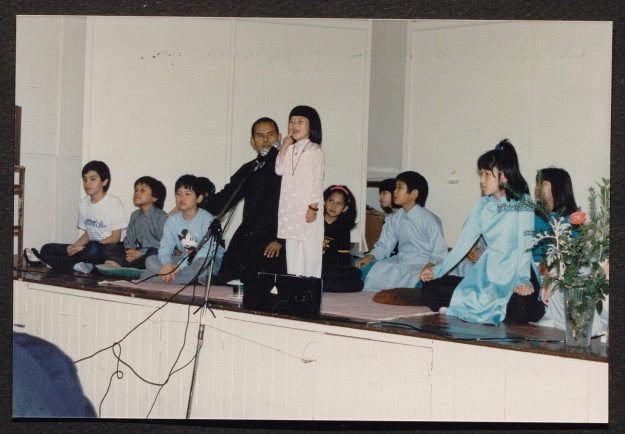
I later learned that since he was in his 20s, our teacher had always been very close to children and young people. In the temples where he stayed in Vietnam, he taught them through songs, plays, stories, and teachings. Children had always held an important place in his life of teaching.
He also had faith in laypeople. He invested his time and energy in training university students and other young people. One of them later became Sister Chân Không, our eldest sister, who devoted her whole life to practicing, building, and serving the Plum Village communities. Many others have continued to serve and nourish the communities as lay practitioners.
In Plum Village, lay practitioners also live and practice together with the monastics during the three-month rains retreat—a period of deep practice that had traditionally been reserved for monastics.

I also saw our teacher transmit lamps and gathas to lay students who became dharma teachers. In earlier Asian Buddhist traditions, this transmission from teacher to disciple generally belonged to the monastic world. Our teacher expanded this tradition in the West to include lay practitioners.
During the lamp transmission ceremonies, he placed his deep trust and confidence in his lay students through a gatha he wrote especially for each of them, weaving their dharma names into the verse. At the end of the transmission, he and the whole community would stand to welcome the new dharma teacher and bow respectfully to them. These dharma teachers became like his extended arms, going to different corners of the world to sow the seeds of peace and bring mindfulness practice to many people.
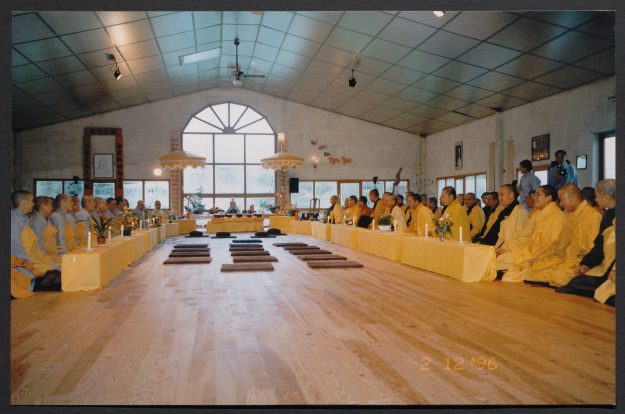
I also saw Tibetan nuns come to Plum Village to receive full ordination and become bhikshunis. At the time of the Buddha, a community of fully ordained women—the bhikshuni order—had already been established. But over the centuries, in some Buddhist traditions, this lineage had disappeared or was no longer maintained.
Our teacher transmitted the precepts to these nuns so that they could help restore the bhikshuni sangha in their own traditions. The same happened with Sister Linh Nghiêm, one of his disciples, who helped bring the bhikshuni order back to Thailand.
Then, in 2025, when Sister Linh Nghiêm went to Bhutan for the Global Peace Prayer Festival, the King of Bhutan wanted to meet with her because he was also interested in reviving and strengthening the presence and future of the bhikshuni sangha in his country.
Living in Plum Village, I had become so accustomed to certain things that I barely noticed how unusual they were. Then I heard Venerable Đàm Ánh, abbess of Phụng Thánh Temple in northern Vietnam, who had been invited to Plum Village for a Full Ordination Transmission Ceremony in 1998.
In Plum Village, monks sit according to their monastic seniority, and we, the nuns, do the same among ourselves. But we sit in front of the monks, rather than behind them, as is customary in many Asian Buddhist traditions. Venerable Đàm Ánh was deeply moved by this.
Every year on Lunar New Year, the community of monks touches the Earth before the nuns, and then we do the same before them. We make the vow to remember to look at each other as blood sisters and brothers, to protect each other by practicing the precepts and fine manners, so that we can live fully the life of a monk or a nun. Our teacher also taught us how to address one another so that we would remember that we are a family: brothers, sisters, fathers or mothers, grandfathers or grandmothers. . . .
And Venerable Đàm Ánh was deeply moved by something even more ordinary. When she had a meal with the Zen master, he served food to her in a very simple, almost family-like way. This brought tears to her eyes.
I thought: We are just having a meal. But for her, something much deeper was happening.
Then, in 2000, Deer Park Monastery was founded in southern California. Our abbess of New Hamlet in Plum Village was sent to help establish the new monastery, and, as a young dharma teacher, I was asked to take her place.
At the time, I did not realize that my teacher was quietly experimenting with another new tradition: young abbots and abbesses.
In many Buddhist traditions, the abbot or abbess of a monastery is usually the eldest or most senior monastic. In Plum Village, our teacher created a different structure. The abbot or abbess may be young. And, perhaps even more revolutionary—they are not the boss! They do not make decisions alone. Decisions are made collectively by the council of bhikshus or bhikshunis. The role of the abbot or abbess is more like that of a mother or father of the community: caring for the well-being and happiness of each person.
Young members, senior members, and everyone in between all have an important role. Younger members can offer their energy, skills, and enthusiasm to organizing, serving, and taking care of the practical aspects of community life. They help carry out decisions made by the council of fully ordained monastics.
Thich Nhat Hanh did not renew Buddhism only through his teachings, books, and talks. He also renewed it through the community he built—a family-like community of monastics and lay practitioners, women and men, young and old.
Because younger members are entrusted with responsibilities, abbots and abbesses have more time to care for the community, while senior monastics can devote more energy to spiritual practice and maintaining the quality of practice.
At the time, I thought I was simply doing what needed to be done. Only later did I realize: Oh! My teacher was actually creating a new model of Buddhist community. Apparently, I had been participating in a revolution without knowing it.
Looking back, I see that Thich Nhat Hanh did not renew Buddhism only through his teachings, books, and talks. He also renewed it through the community he built—a family-like community of monastics and lay practitioners, women and men, young and old. He created new ways for everyone to practice, bloom, and serve together in harmony.
He brought together the wisdom of seniority with the spirit of democracy.
And perhaps the funniest part is that, growing up in this tradition, I did not realize how revolutionary it was. I simply thought, “This is Plum Village. This is normal.”
–SISTER DINH NGHIEM, Plum Village monastic
[My husband] Larry and I were married at Plum Village in the summer of 1994.
We had a 7:00 a.m. walking meditation where two communities, one representing the bride’s family and one representing the groom’s family, converged on the small road outside the monastery. After the walk, we were invited to have tea in Thầy’s room. The rest of the community went to the zendo to meditate before our wedding ceremony.
We were served tea, and we sat in silence. Thầy looked at me and asked, “Did you sleep last night?” and I answered “No.” He asked if I was nervous, and I said “Yes.” He said we would sit together until we were solid. We had an opportunity to transmit the energy of joy to the entire community. Or we could transmit excitement. Excitement can fray the nerves, and joy can nourish our hearts. And we sat together for another hour. Over the years I have met monastic and lay friends who were with us that day, and they all comment on the experience of joy that perfumed the zendo. I learned how to bring my mindful attention to excitement and to take the time to settle into my body. It never fails; I experience joy every time.
***
We were standing outside the dining room at Lower Hamlet. It was 1993, and Thầy was sick and missed doing a dharma talk. This was an unprecedented experience. We were sharing about Thầy’s health when Thầy walked by. We, of course, stopped talking. He turned around and smiled and said, “Perfect health is just an idea.”
***
The day after 9/11, Thầy asked Larry to join him at Santa Cruz. Larry arrived at the monastery where he was staying, and Thầy said, “We are going to the beach.” The whole sangha changed the schedule, and they went to the Santa Cruz beach. Thầy said, “We need to spend the day at the beach.” Larry sat next to Thầy in silence. At one point, Thầy turned to Larry and asked, “Will there be a war?” and Larry answered “Yes. It is our conditioning.” Thầy nodded, and they sat together for a few more hours. In that time, tea and food would come and go. Some of the monastics found large strands of bright green seaweed, and they were jumping rope on the beach. Thầy asked Larry if he could join the sangha at Ground Zero, and he said yes.
Later Larry described this as one of his deepest experiences of meditation, these six hours on the beach with Thầy. Thầy later said that he knew that the solidity of the sangha would be absolutely essential for their practice at Ground Zero. Larry said this day changed his life.
***
Lay friends of ours that lived at Plum Village found a piece of property that was for sale near Plum Village. They encouraged us to meet with Thầy and to move to this place and to start a lay sangha. We looked at this very beautiful affordable property and met with Thầy. We asked if he would support us in moving to this property. We asked, and he sat, and he didn’t have a happy face. He looked at us pointedly and said, “What about the United States?” Thầy always said we had big dharma work in the US, and it was clear that he wouldn’t support this venture. The sangha later bought this property, and this is where there is the Son Ha Monastery.
***
We had breakfast with Thầy after our house was bombed. We managed to get to Plum Village for one month of practice. [I] had tears streaming down my face the entire hour. Thầy asked if our dog was OK, and we said “Yes.” We sat, we cried. Maybe fifteen minutes later he said, “I am sorry that this happened.” And about fifteen minutes later, he said, “Don’t put your energy there. You have a lot of work to do in the US.”

This hour with Thầy was an incredible gift. Most of our time was in silence. We had the experience of being held in love. When he said that he was sorry, that meant so much. And then he pointed us in the direction of our mission. I’m sorry this happened . . . and it did. Now, then, how do you want to direct your life?
***
Three times Thầy told Larry and me to “offer the dharma our way.” Three times he told us to “not [to] give in to despair.” This has been a mythic formula in our life. There is something magical about things that come in threes. We remember.
***
When we were at a three-week retreat at Plum Village, we met a high-ranking Venerable from Thailand known as Grandfather. He attended the retreat along with some of his students. He invited Larry and me to teach at his temple in Thailand. A year or so later, we met him at the gate of his temple grounds. He bowed and we walked in silence. In Asian countries, one generally meets with the venerables and then is taken to the main shrine room for three prostrations. We walked past the main temple, and he brought us to a garden where there was a life-size bronze statue of his teacher. He introduced us to his teacher, and then he said, “My teacher, my everything.” This is my experience of Thầy.
–PEGGY ROWE WARD, dharma teacher, cofounder and codirector, the Lotus Institute
Become Stardust
A great peacemaker has become stardust
Did you see my teacher become sparkling radiant light?
Did you catch the golden light as it tapped on your roof, vibrated the windows, shook the
leaves off the trees, dropped rain and snow and sunshine
everywhere? Did it tickle your neighbor, your cat, your dog, your beloveds?
This golden light caressed your shoulders and bathed your face
Did you feel this? Say yes.
Thầy told us decades ago that his dharma heir was to be us
The sangha, the beloved community. All of us.
That he offered all of us the feet of the Buddha and if we didn’t claim this gift, well, that
was too bad.
Now he has given us even more
We are his great continuation, the mind of love.
Where do peacemakers go when they pass over?
Dr. King, Mahatma Gandhi, Desmond Tutu, my beloved teacher
Where did you go?
There is no coming and no going for peacemakers.
Their voice remains in the green forest and in the city streets
Their smile settles into the marrow of our bones
Their courage invites us all to stand tall in our no fear.
Their footsteps echo in the halls of time
Their perfume of goodness cuts through hatred and enmity
Their beauty, their strength, their heart beat, lives on.
This love never dies. How could it?
My teacher’s hand is in mine
We slow our steps so our prints remain solid and clear
each step reflects my love for you.
Thầy’s smile in my smile, our smile
this soft and tender smile
We are breathing with Thầy’s lungs.
Thầy is breathing in us.
Thầy’s heart is beating in our chests
radiating light from hearts tenderized by love
Thầy, I will do my best to be a beautiful continuation
I know that is all you ask of me.
And this is the soft true vow I make to myself:
We will do our best to love everything and everyone,
even those shady and shaky bits.
There is no “I” with this vow.
We will do our best.
–Peggy Rowe Ward, True Original Vow
January 2022, after Thầy’s passing
Oregon Retreat
Sometimes stars fall to earth and walk among us
Reminding us too that we share in the night sky of emptiness
The teacher’s laughter still echoes in the mountains and valleys
Its sound opening so close to my heart I can feel its gate swinging with the touch of your love
How could this be?
It seems like only yesterday when we first met and said goodbye with our eyes and with our
smiles
Yet we meet again, here, now, moved by the river of love.
Waking up in the cave of my heart, satisfied, I bow to the Emerald Buddha shining near and far
calling me home
where I remain in love with the dharma light shining from your eyes.
–Larry Ward
Great Vow Zen Monastery, around 2015
When I first met Thầy in 1987 at the Ojai Foundation in California, he was 61. More than a hundred people had gathered beneath a large oak for a weeklong retreat for artists, and few of us had heard of him before. I was helping to record the retreat when I looked up and saw a monk in simple brown robes slowly walking toward the “Teaching Tree.” He moved with such gentleness and deliberation that everyone instinctively stopped what they were doing, rose, and bowed to him. He had an extraordinary presence.
Everything Thầy did seemed remarkably simple. He sat still, we listened to a bell, he taught, and then he walked. I had spent years searching for some way to experience peace, and suddenly I felt that peace in every step and every breath. Although I did not think he had noticed me, as we were saying goodbye, he looked directly at me, brought his palms together in a namaste, and said, “Bring the buddhadharma back to India.” His words stayed with me.
A few months later, after returning to India, I found myself wanting to see him again. I wrote to him and offered to host him if he ever came to India. After leaving the letter on my desk for three months, I finally posted it. To my surprise, he responded and asked whether I could organize a Buddhist pilgrimage for him and thirty of his students. I immediately accepted.
We began in Delhi, at my family home on Rajaji Marg. My family was curious, but slightly skeptical, and they watched as Thầy taught us how to walk mindfully. My parents and siblings followed silently in his footsteps, unable to help but feel his presence.
Over the next thirty-five days, I traveled with Thầy through Uttar Pradesh and Bihar, visiting places connected with the Buddha. Although I had visited some of these places before, having grown up in Patna, by the Ganges, seeing them through Thầy’s eyes was an entirely different experience. He had recently finished writing Old Path White Clouds, his biography of the Buddha, and at each site he seemed to bring the Buddha’s life vividly into the present.
What particularly changed my understanding was Thầy’s way of presenting the Buddha as a human being, not a god. Through his stories, the Buddha became a real person who was comfortable with everyone, regardless of their status or background. He could connect with beggars and farmers, rich and poor, young and old, doctors, teachers, Dalits, Brahmins, kings and prostitutes. He also had a connection with animals, insects, trees, crops, and flowers. Thầy approached the Buddha with the curiosity of a child meeting his teacher everywhere.
This made the places we visited feel alive. Thầy imagined the Buddha walking through the same landscapes, crossing the same rivers, eating the same food, and meeting the same children. One of his favorite places was Vulture Peak, overlooking Rajgir, where the Buddha had taught and where he loved to watch the sunset. Being there with Thầy allowed me to see the Buddha not as a distant religious figure but as someone who had lived, struggled, taught, and experienced the ordinary world just as we do.
Being there with Thầy allowed me to see the Buddha not as a distant religious figure but as someone who had lived, struggled, taught, and experienced the ordinary world just as we do.
At another point, while we were sitting beneath trees discussing the Buddha’s teachings, Thầy held my hand, transmitting in silence. I felt that I was seeing through his eyes and suddenly understood his teaching that everything is interconnected. I began to understand that nothing is truly born and nothing truly dies. Looking at my turban, he told me that the matter of life and death was as urgent as if my turban were on fire.
Later, in Kushinagar, Thầy and Sister Chan Khong shaved my head because they hoped I would become a monk. Part of me wanted this, but I ultimately realized that I wanted to remain in the midst of society, with its relationships, difficulties, and struggles, rather than living in a monastery. Thầy suggested that practicing outside a monastery could be much harder, but he did not discourage me from marrying. When I told him of my decision to marry Gitu, he kindly offered to officiate at our wedding at Plum Village.
His teaching remained with me whenever I struggled with choices. When I told him that I often found it difficult to choose between different options, particularly when all the choices seemed good, his answer was simple and profound:
“It does not matter what you do but how you do it.”
In 1999, Gitu and I were with Thầy when he told me that my name had been recommended for ordination as a dharmacharya. This meant that the lamp would be transmitted to me and that I would be authorized to teach. I was surprised and did not feel ready. When I expressed my doubts, Thầy simply told me that he had confidence in me.
Gitu and I decided to spend some time living in Plum Village so that I could grow more confident in my new role. Thầy did not live at the monastery every day but visited regularly to teach. Gradually, I began to understand that becoming a dharma teacher was not about becoming someone important; it was about carrying forward the way of practice and understanding that Thầy had shown me.
Thầy’s influence also shaped the way I approached family and everyday life. When Gitu became pregnant, he encouraged me to speak to the baby in her womb and to read the Lotus Sutra to the fetus. These teachings helped me see life as deeply interconnected, beginning even before birth.
Thầy eventually influenced my livelihood as well. After my first pilgrimage with him, he suggested that I organize annual pilgrimages following in the Buddha’s footsteps. What began as a challenge eventually became my practice of right livelihood. I have now been leading these pilgrimages for nearly forty years—not only in the footsteps of the Buddha but also, in many ways, in the footsteps of Thầy.
Since that first pilgrimage, I made it a point to spend about a month with Thầy each year, wherever he happened to be. Through all these years, he remained my guide, my teacher, and my spiritual father. And whenever I walk with others through the Buddha’s landscape, I still feel that I am following the footsteps of the monk who, beneath an oak tree in California, once asked me to bring the buddhadharma back to India.
–SHANTUM SETH, Buddhist teacher, Plum Village India; pilgrimage guide, Buddha Path
The Venerable Thích Nhất Hạnh, known to his students as Thầy (Vietnamese for teacher), was a prolific and innovative teacher of the dharma. Take, for example, one of Thầy’s many teachings on nonself, anatta. When he would offer a teaching, in the beginning, middle, or end, he would invite one of his students to sing. This invitation, with little or no preparation, helps one to let go of their ego. In that moment, if the practitioner can see the emptiness of a solid self, the ego-self is deflated, and singing on the spot is an act of letting go. This perception of a solid self we cling to, the not-ready-to-sing self, the self that fears being judged for not singing well, all falls away. In that moment we are a “singer” because we no longer cling to this “I” that is not ready, not a singer. And the penetrative understanding of nonself sinks in a little deeper as we spontaneously sing on the spot. Dear Thầy, dear Zen master, we love you and hold you with deep gratitude and kindness.
–MARISELA B. GOMEZ, MD, dharma teacher, physician-scientist, community activist, and holistic health practitioner
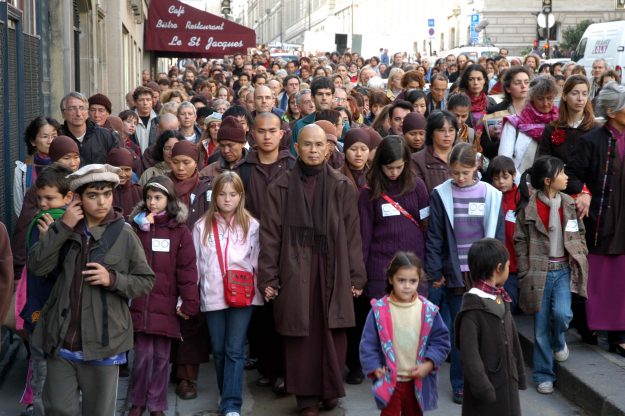
A monk goes AWOL along with two of his fellow novices from the Buddhist institute in the heartland of the faith and former imperial capital of Huế. They each take new names—his, “Nhất Hạnh,” meaning “One Action.” Together, they board a ship in Đà Nẵng bound for Saigon, where he publishes his first chapbooks of poetry—his later poems would be put to song throughout Vietnam—as well as a book on Eastern logic. With other young monastics he forges a new path of monastic life for the 20th century.
He would go on to cofound Tuệ Quang primary and secondary school at Linh Quang Temple with his brother, Thầy Thiện Tấn, in Đà Lạt; teach young people in the surrounding Central Highlands; and, eventually, with the support of one of his mentors, Venerable Huệ Quang, be named as the new editor-in-chief of the official monthly journal of the General Association of Vietnamese Buddhism, Phật giáo Việt Nam (Vietnamese Buddhism).
Uninspired by the traditional hierarchies in the monastic community, and devastated by his mother’s illness and passing, he acquired land in 1957 and began clearing it, along with a few close friends, in January 1958 to build huts to house a small community that embodied the virtues of brotherhood and sisterhood and the transcendence of ideology he knew were antidotes to the violence that divided Vietnam. This community, Fragrant Palm Leaves Hermitage, was a ray of light piercing through the dark waves of division and destruction—underwritten by foreign powers—that were tearing through the country.
In 1959, he traveled abroad for the first time to an international Buddha’s birthday celebration in Japan in 1959, where he was representing Vietnamese Buddhists. There, he gave his first public address in English. Later that year, he published an article in Phật giáo Việt Nam calling explicitly for renewal and unity of Buddhism in Vietnam; when this call stirred resistance, the journal’s funding was cut, and it ended that same year.
When one intellectual in the Fragrant Palm Leaves community was arrested by the Ngô Đình Diệm regime, Thầy returned to Saigon for safety and to see how he could help his friend. The subsequent police surveillance destroyed the peace of the community, and members were eventually forced into a strategic hamlet. With a deep sense of service to his country and its people, and encouraged by friends who said he could not accomplish his vision by staying in the country, he applied for a Fulbright scholarship to study at Princeton Seminary. This became a prevailing theme of his life—to model not being a victim and rather to try to understand how the nature of victim and perpetrator, colonized and colonizer, are not separate, are nondual.
At Princeton he found the quiet and space to heal the emotional wounds he had sustained from following an ideal—and inspiring many young people with that ideal—to unify Buddhists in Vietnam with one voice calling for peace.
The immolation of his elder dharma brother Thích Quảng Đức in a street of Saigon shocked the world, many of whom did not know much about this tiny country in Southeast Asia, which was already caught in the theater of one of the greatest political and ideological dramas of the 20th century: the conflict between communist forces and the US-backed South Vietnamese government, within the wider Cold War confrontation. Whereas much of the world saw a struggle to claim the future path of humankind, Thầy and his colleagues saw these competing visions pit brother against brother, north and south of the 17th parallel.
After further self-immolations and the August 1963 attacks on Buddhist pagodas, the young Zen master, as he later recollected in his private unpublished memoirs and as published in the 2022 Vietnamese biography Đi gặp mùa xuân, also made a secret plan to immolate himself in New York City, where he had been studying and teaching in the Union Theological Seminary and Columbia University. He believed the shock of this act would mobilize the peace movement in the United States. Thanks to a moment of humane concern from one of his mentors, Columbia professor and ethicist Horace L. Friess, who reminded the young monk that he could be a voice for his colleagues in Vietnam, Thầy abandoned his plan, and instead chose the path of life and teaching the dharma.
His subsequent return to Vietnam after the assassination of Ngô Đình Diệm, the founding of the School of Youth for Social Service in 1965, and his fearless calls for peace between the North and the South are well-known. On May 11, 1966, he came again to the US, invited by Cornell to teach Vietnamese Buddhism. The Fellowship of Reconciliation helped arrange his meetings with Dr. Martin Luther King, Jr. and Father Thomas Merton, as Thầy now became a global voice for peace in Vietnam. His June 1 Washington peace proposal caused South Vietnamese authorities to denounce him and deny his return, beginning what would become thirty-nine years of exile from his homeland.
Young Westerners and diaspora Vietnamese alike were drawn to his gentle presence and combination of mindfulness practice and engaged Buddhist peace activism. As he often said describing his exile, he was like a bee cut off from his hive, and had to rebuild his sangha in the West. This had its greatest flower and fruit in a few old farms near the Dordogne River in France, which he and his students settled in to practice mindfulness beginning in 1982, and which he eventually called Plum Village.
He was a young man who loved the world, who entered a path known for renunciation, and who held the suffering of the world unswervingly in his heart for our collective transformation and healing. Thank you, Thầy, for living your life as your message.
–BROTHER PHÁP LƯU, Plum Village monastic
Thich Nhat Hanh’s talk in June 1982, on the third and final day of the Reverence for Life Conference in New York City, was something remarkable. Even while he was still being introduced, Thầy began walking, at a snail’s pace—which I soon learned was his normal cruising speed—up to the speaker’s podium. Rather than stand behind the podium, however, he stopped in front and spoke from there. He spoke gently, in lyrical cadences, yet there was steel in his words. There was a similar pairing in the commanding presence he projected—light as a feather yet solid as rock. Within minutes the audience was transfixed.
He expressed himself in delicately accented, down-to-earth language, only occasionally citing explicitly Buddhist sources. He used stories and personal anecdotes to illustrate his points, he casually posed brief contemplations, and he read several of his own poems to stunning effect. At the heart of his talk, however, was a well-known passage from the Pali canon:
When this is, that is.
This arising, that arises.
When this is not, that is not.
This ceasing, that ceases.
This is the most succinct formulation of the Buddhist teaching of paticcasamuppada, or dependent origination, one of Buddhism’s core ideas. Starting with this most simple of expressions—When this is, that is—Thầy explicated dependent origination as a vision of radical interdependence, or what he called “interbeing,” in which all beings support and are, in turn, supported by all other beings. This elaboration of paticcasamuppada encompassed the foundation, the practice, and the fulfillment of spiritual life.
In the film Shakespeare in Love, there is a crucial moment immediately following the conclusion of the debut of Romeo and Juliet, the play set within the movie. After the final words are spoken, the audience, held in the thrall of a play that has shown “the very nature and truth of love,” is struck silent for a second or two before erupting into applause. That’s how I remember the brief, spellbound silence immediately following Thầy’s talk. It was a cinematic moment. He had, one might say, shown the nature and truth of interdependence.
–ANDREW COOPER, Tricycle’s features editor
Like many, my first encounter with the late Thầy Thich Nhat Hanh was through his writing. A bookstore I’d often visit had perched Thầy’s tiny meditation manual How to Walk on a prominent shelf, and the title caught my eye. How to walk? What could a book tell me about something that was so second nature? Somewhat annoyed, I snatched the book off the shelf. I did not expect that I’d finish half of it before leaving. I was captivated by Thầy’s simple yet deep teachings on not running from the present moment. I proceeded to purchase that book, along with How to Sit and How to Eat. Clearly, I needed some training in basic life skills, but what touched me was Thầy’s profound, down-to-earth wisdom.
I never did get the chance to meet him, but I practiced with several of his students who unknowingly nurtured my own aspiration to ordain—which I did some years later when I became a Theravada monk. When I walked, I felt as if Thầy walked alongside me. When I sat, he was there too.
I credit Thầy for introducing me to Buddhist practice. I’m no longer a monk, but I’m grateful he showed me a different way to be. A way to be at peace and to help others do the same.
–BRADLEY DONALDSON, lay teacher and former monastic
October 7 is a date that lives in infamy for millions of people worldwide. October 7 is the date the US bombed Afghanistan in retaliation for the September 11, 2001, attacks on the World Trade Center. This attack caused the death of thousands of civilians in New York City, setting off a nearly twenty-year war killing hundreds of thousands of people. October 7 is the date that Hamas attacked Israel and killed thousands of civilians, setting off the destruction of Gaza and genocidal obliteration against the Palestinian people. October 7 is now a date for remembrance and memorials, and it is also the date when I first learned about Thich Nhat Hanh—October 7, 2001—my 40th birthday.
About three weeks before September 11, 2001, I was planning a birthday party for my “big 4-oh,” what I considered to be the mark of middle age and a time to express gratitude for having lived longer than I had imagined I would. My plan for a celebration of my life with family and friends was interrupted by the collateral psychic damage I experienced from the World Trade Center bombings. I wasn’t in NYC on September 11, so why did I experience collateral psychic damage?
On September 11 I was at an airport in Tucson, Arizona, while the attacks were happening, so I, along with other would-be passengers, watched the attack on the large TV screen that had been rolled out of a bar and into the terminal walkway for us stranded strangers to watch together. The gasps, the expressions of horror, the disbelief, the confusion, and the need for care were all being expressed. I was like a sponge unable to construct a defense against the absorption of emotions. I also absorbed the fear and anxiety of my partner at home, who had planned to meet me at the airport. The emotions bled into chaos as airports throughout the country grounded and rerouted and communicated their plans.
No one knew exactly how or when they would make it to their destination, but when I finally arrived home by bus, I was in a state of shock about what I witnessed, and dread for what would come next. The meaning of turning the “big 4-oh” went from gratitude to the question, “How am I and how are we going to survive this?” Thousands of us did not survive. Countless people would not survive. I asked my family and friends not to bring me any gifts, because I needed only one thing: peace of mind.
There is a phrase in spiritual communities that says a teacher will appear when the student is ready, and I think there is truth and wisdom in that saying. I guess I was ready for someone like Thich Nhat Hanh because I accepted his book, Touching Peace, as a birthday gift from a friend who is Jewish, didn’t practice Buddhism, and knew nothing about the author. I also knew nothing about Buddhism. She thought the title would resonate with me, and she was right. I was intrigued.
As threatened, the US retaliated for the World Trade Center attacks, and did so by dropping bombs in Afghanistan on October 7 at 12:30 p.m. ET. My party was later that afternoon, so when I was given Touching Peace, I began reading it that evening or the next day. Here’s the first practice that, in my desperation, I did not hesitate to try:
“Breathing in, I see myself as a flower. Breathing out, I feel fresh.”
“Breathing in, I see myself as a mountain. Breathing out, I feel solid.”
“Breathing in, I see myself as still water. Breathing out, I reflect things as they are.”
“Breathing in, I see myself as space. Breathing out, I feel free.”
Little did I know what realms of consciousness, phenomena, community, practice, leadership, philosophy, psychology, interreligious dialogue, inspiration, art, ethics, and scholarship in spiritual care this visualization would lead me into and what I’d come out as. I touched a peace that Christians would say surpasses all understanding.
The visualization and mindful breathing was so powerfully grounding that over the course of the next several years, I joined three Community of Mindful Living Sanghas in the San Francisco East Bay, read upward of thirty-five of Thầy’s books, took the precepts, attended his BIPOC retreat at Deer Park, did some training with the Order of Interbeing aspirant group, and adopted his writings as my primary interlocutor for engaged Buddhism scholarship. Now, I’m honored to be a participant in Union Theological Seminary’s Thich Nhat Hanh Program for Engaged Buddhism’s Buddhist Civic and Spiritual Leadership and Movement Dharma Praxis Community.
As I look back on what I’ve learned from reading Touching Peace, I’ve learned that I am attracted to poets and poetry. The Touching Peace visualization is a poet’s invitation into seeing and living as a poet lives and comprehends. On October 7, 2001, I needed to learn how to see and feel the beauty of life even as governments and other agents of war sought to destroy it. I needed to be invited to feel my emotions deeply and recognize them as impermanent while also within the realm of my intentions and influence. I needed to learn that I am an aspect of the interbeingness of life and that not even war could change that. Through time, study, and practice, I’ve come to understand that this teacher who this student was ready for offered appropriately sized bits of wisdom to a culture steeped in defensiveness and aggression, that his spiritual formation is in the spirit of Samantabhadra Bodhisattva and the Avatamsaka Sutra. Now I know that October 7 can be a day of inspiration for all to learn how to live artfully in a world of hurt and strife.
“Breathing in, I see myself as space. Breathing out, I feel free.”
–AYO YETUNDE, community dharma leader, chaplain, and professor
⬥
This article will be updated with more responses as we receive them.

Thank you for subscribing to Tricycle! As a nonprofit, we depend on readers like you to keep Buddhist teachings and practices widely available.