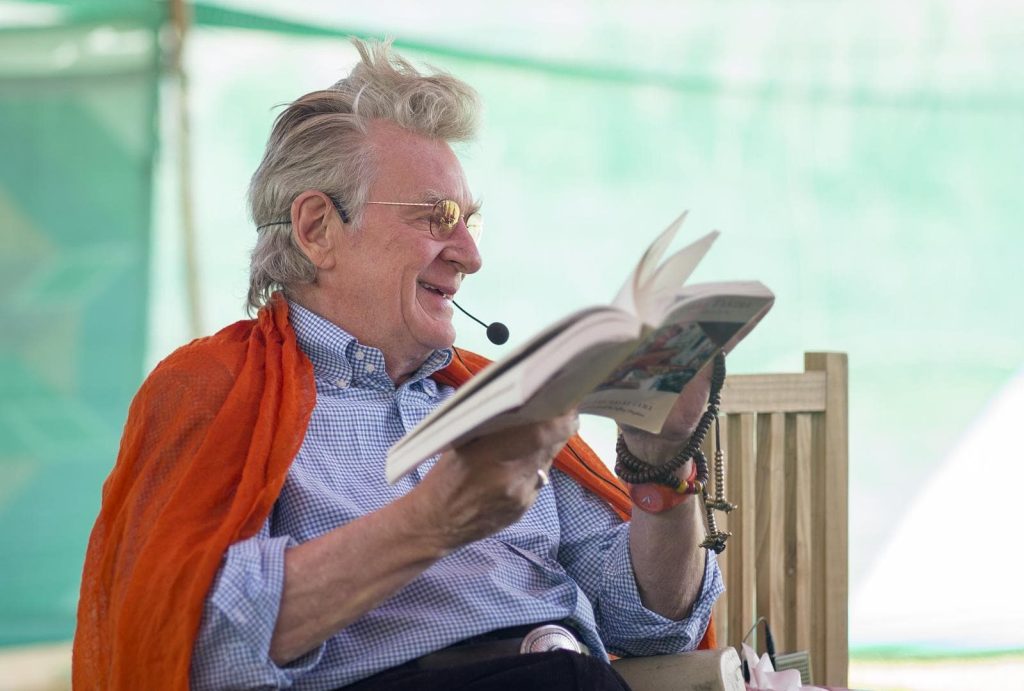
On Tuesday, June 16, 2026, the Western Tibetan Buddhist community lost one of their biggest acolytes in the passing of Robert Alexander Farrar Thurman, the internationally lauded scholar, esteemed professor, prolific translator, and author, affectionately known as Bob. As an author, Thurman is remembered for penning some twenty-three books, including scholarly works like The Holy Teaching of Vimalakīrti: A Mahāyāna Scripture, The Central Philosophy of Tibet: A Study and Translation of Jey Tsong Khapa’s Essence of True Eloquence, and a more general audience–geared translation of The Tibetan Book of the Dead. As an entrepreneur and promulgator of Tibetan Buddhism and culture, Bob is remembered for cofounding Tibet House as well as the Menla Retreat and Dewa Spa in Phoenicia, New York. (Thurman is also on record for being the first Western Tibetan Buddhist monk ordained by His Holiness the Fourteenth Dalai Lama, though he did disrobe some time later.) And yet to reduce and oversimplify Thurman’s contributions to the dharma is to miss the forest for the trees. More than anything, Thurman’s impact is felt in all of those who knew him and were touched by his teachings, his charisma, and his presence.
Tricycle reached out to a few of those who knew Thurman best to share their memories of the late academic, one of the most prominent and outspoken voices of Buddhism in America.
–The Editors
***
I first heard about Bob through his first wife, in about 1958 or ’59. He had been referred to as a Buddhist monk living in India. I was in high school at the time, and this image was as alien as spaceships and extraterrestrials.
I met Bob a few years later. He had disrobed and was very much an earthling, but throughout his life, he never lost the aura of being a rarefied version of human capacities.
–HELEN TWORKOV, author and founder of Tricycle: The Buddhist Review
Bob Thurman really had such a vast sense of caring for others. I remember joking once at Menla Mountain monastery that I felt somewhat intimidated about teaching alongside Dr. Bob Thurman and Dr. Mark Epstein without a doctorate attached to my name. Bob immediately bestowed an honorary doctorate upon me, dubbing me “Dr. Metta (loving-kindness).” I witnessed countless acts of kindness and inclusion by him and was quite genuinely in awe of that quality in him.
–SHARON SALZBERG, author, teacher, and cofounder of the Insight Meditation Society (IMS), in Barre, Massachusetts
While each of us is unique in our own way, Bob was uniquely so. His larger-than-life energy and love of the dharma were so infectious that they embraced everyone he met. It was impossible not to be swept up in his enthusiasm for the Buddha’s teachings and the greater happiness they offer. He leaves a profound legacy for all of us.
–JOSEPH GOLDSTEIN, author, teacher, and cofounder of IMS
When Sharon and I first started teaching with Bob at Tibet House on Saturdays, sometime in the nineties, he would take us out to a fancy place around the corner during the hour-and-a-half lunch break. The restaurant had white tablecloths and white cloth napkins and impeccable service, and we would gossip while having a three-course lunch, with coffee and dessert. It was the Upper East Side Bob (although the restaurant was near Union Square), and it was like being out with Big Daddy. It was so fun.
Bob’s favorite phrase was sunyata-karuna-garbham. He translated it as “emptiness as the womb of compassion.” He said it was usually coupled with advayam (nondual), gambhiran (profound), bhirubhishanam (frightening to the timid), and bodhi-sadhanam (enlightenment in practice). When I wrote to him once to ask him to explain it to me, he wrote me back the following, “Emptiness as nondual relativity leads to the realization of the absoluteness of the relative, hence one’s total interconnectedness with others in an inconceivable empathic oneness with them in mind and body, feeling both what they are feeling, and deeper, what they have of wisdom and love buried in deepest heart, luckily. Often the two are opposed to each other, therefore it is inconceivable to the binary conceptual mind.” Bob knew what he was talking about.
Bob liked me because, before I knew him, I had read his 200-page introduction to his 1984 magnus opus, Tsong-Khapa’s Speech of Gold in the Essence of True Eloquence: Reason and Enlightenment in the Central Philosophy of Tibet, and it had blown me away. He jokingly said I was the only person who had read the whole thing.
Once, when we were teaching together and I was going on about Winnicott and the good-enough mother and mindfulness as a transitional object, he pulled out an enlightenment poem he had translated by an 18th-century Mongolian lama named Jankya Rolway Dorje. “I will speak spontaneously whatever comes to mind,” the poem began. “I was like a mad child, long lost his old mother. Never could find her, though she was with him always!” It was a poem about mother voidness, emptiness as the womb of compassion. I started to cry.
–MARK EPSTEIN, author and psychiatrist
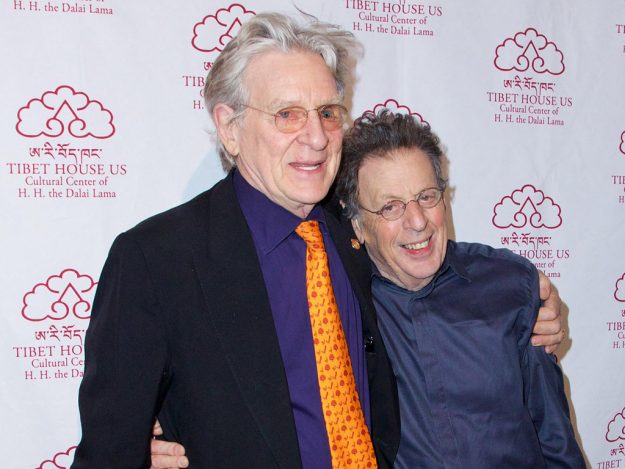
We were all there at the beginning of Tibet House. Bob was one of the people who brought it together. He was a teacher who really understood what he was teaching. He’s the one who had the real understanding.
–PHILIP GLASS, composer and cofounder of Tibet House
“Wherever you are, Robert Thurman, let go into the clear light, the pure clear light of your own True Nature.”
For most of your 84 years, in traveling, teaching, mentoring, you carried the medicine and the blessings of the dharma of awakening, letting its light of wisdom and compassion shine through your own brilliant mind. Thank you, Bob! Thank you for your gifts of dedication and scholarship and translation. Thank you for your tireless uplift of the peoples of Tibet and of Buddhism in the Western world, Thank you for your unwavering devotion to His Holiness the Dalai Lama. Thank you for teaching so many. Thank you for your discerning and sometimes uncompromising vision.
You were a big colorful force in the mandala of renowned teachers in the West. You were a leader, a colleague, and an admired friend. And the blessings you have left us all are many. May they carry you too. . . . Carried in the timeless refuge of the Buddha dharma sangha.
With 1,008 Bows
–JACK KORNFIELD, author, teacher, and cofounder of IMS
In the hours after Robert Thurman’s unexpected death, the world feels a lot less hospitable to me. Tenzin Bob Thurman was a Titan among Titans, and I think part of me assumed that, unlike us mere mortals, he wouldn’t be subjected to death. It’s funny how steadfast the allure of permanence is. Ever lurking in the hidden corners of our minds. Unfaltering even in the face of death.
Bob was extraordinarily generous. He started a precedent at Columbia University wherein non-Columbia students could attend his lectures. His classes on the history of Buddhism and Western philosophy were widely popular, but a few non-Columbia students, myself included, were fortunate enough to attend his Tibetan-language translation seminars.
For a couple of years, I sat meekly around a large conference table as Bob, his then-doctoral students—who are now formidable scholars in their own right—and my primary teacher, Lozang Jamspal, painstakingly translated Tibetan texts. I was in over my head and rarely spoke. To help me feel more comfortable, Bob nicknamed me Dharmamegha, a clever play on Megan and a reference to the Tenth Bodhisattva Bhumi.
During this time, I was asked to fill in for Sharon Salzberg, who had come down with the flu and was unable to teach an upcoming meditation class. Not only was I filling in for the iconic Sharon Salzberg, but it was my first time publicly teaching meditation. In preparation, I emailed Bob and asked him a single question: What is the difference between meditation and concentration? Bob wrote a three-page response, with key Tibetan and Sanskrit terms, plus a full paragraph explaining the nuances of each term. That one email, born from his unexpected kindness and generosity, became the backbone of how I teach meditation. More than fifteen years later, I still reference his pithy commentary.
Like all of us, I witnessed Bob aging. But even in old age—and, by the way, I don’t count 84 as old, so make of that what you will—Bob seemed to be getting stronger instead of weaker. Not necessarily in the physical sense but in the quality of his presence.
Like Manjushri, the Buddha of Wisdom, Tenzin Bob Thurman wielded a sword that he brandished with staggering brilliance and flair. But Bob could also be seemingly unwieldy with his sword, slicing through people and situations in confounding ways. As I witnessed Bob age from afar, it seemed that, at some point, he traded the outer sword for a deeper kind of strength. It was as if Bob’s world was becoming a kaleidoscope of wisdom and compassion experiences, and we mortals had a front row seat.
Bob’s presence on Earth was a tremendous source of strength. In the wake of his unexpected passing, I’m left realizing how much I relied on his dynamism and power. The Titan was holding me up without my even knowing it. And that—more than his inestimable scholastic, political, and yogic contributions—feels like the truest sign of his power and love.
Bob Thurman touched countless people and had deep friendships with some of the world’s highest lamas and luminaries. My heart goes out to his family and many friends who have far better stories to share than I do.
But on behalf of those of us who admired you from a distance, thank you, Tenzin-La. I’m sure you’re having a blast in the Pure Lands. Please don’t rush your time there, but do think of us mortals from time to time. We are certainly thinking of you.
–MEGAN MOOK, translator and meditation teacher
There are so many things that can be said about Robert Thurman. He lived a life that was rich in the dharma and incredibly full. Over the years, I had the chance to get to know Bob a bit. He was kind to me in two ways: the first was in discouraging me from applying to Columbia for grad school for Buddhist studies in 2002 and 2003. He shared an honest warning that confirmed for me what my root teacher had already told me, which was that the world of Buddhist studies would not satisfy me in the way I thought it would, and that within that world, I might become someone that I might regret becoming if I went down that road. He didn’t have to be that honest with me, but he was, and for this I am extremely grateful.
Twenty years later, Bob became a supportive ally in the initial work of fundraising and gathering momentum in manifesting the vision for Yangti Yoga Retreat Center. He and his wife, Nena, joined us as guests of honor in our launch dinner and the following year enthusiastically participated in a dialogue at the Rubin with his good friend and one of my teachers, Dr. Nida Chenagtsang, about dark retreat connected to a series of dark retreat workshops I led at the museum. He even occasionally met me by Zoom to talk to me about dark retreat. While he himself never had the chance to do a dark retreat, he was very curious about the practice. His showing up, to me, was something that he certainly didn’t have to do, but he did anyway, even amid an incredibly busy schedule.
One of the greatest strengths that Bob seemed to embody, and what he skillfully contributed to the wider Buddhist world in the West, was a tireless enthusiasm and a positivist perspective—he always seemed to be doing something. I also suspect that Bob was often doing more behind the scenes than [we] may have noticed or appreciated.
He was extremely good at pointing to the continued possibility of awakening happening in this lifetime—that it could happen any moment. This might not seem like a very important thing for many practitioners; however, it’s not uncommon to see the internal time frames around which people contextualize their practice and its fruition in terms of occurring over the span of incalculable eons. This, despite what we see in so many traditions, whether it be the practice of Dzogchen and Mahamudra or the practice of various tantric Buddhist practices, where it is said that awakening may be available to each one of us in this lifetime in the best of all scenarios, within the Bardo as the second-best outcome, or a rebirth as a Nirmanakaya form as the worst-case scenario.
Bob possessed the rare combination of being well-trained and well-read, well-studied and well-practiced. Indeed, for somebody around which all those conditions come together and to see their exuberance, their humor, their undying energy, and their sincere belief that awakening is possible, if not inevitable, is where I connect with him the most. His belief of the inevitability of awakening and that awakening is not something experienced in isolation but something that arises to be able to bring untold benefit, not just for ourselves, and not just for others, but for this very world of ours, the very earth that we walk on, the water that we drink, and the air that we breathe, is what I think will be recognized as part of his legacy.
His skill as an academic and translator and the energy and creativity that he brought to that work is what many will point to as his major contribution to the world. Bob once described Dzogchen, often called the Great Perfection or even the Great Completion, as the Great Connection. Dzogchen leads us toward an experience we can have, a visceral experience, that reveals the interconnected nature of all things. I love how dynamic this descriptive translation of this term is, and yet, while he was obviously a noted scholar, and I don’t think any aspect of that part of his work will fade, perhaps this is not actually the most important part of his legacy.
After all, new translations of texts seem to happen every five or ten years, and while Bob will obviously be recognized as a contributor to these kinds of endeavors, it is much harder for me to forget the charismatic enthusiasm that he embodied. Since Bob’s passing, I have spoken with dozens of his students who have named Bob’s enthusiasm as a causal factor that brought so many people into the practice of dharma. It’s the same enthusiasm, exuberance, and energy that have brought so many people to learn about Tibetan culture and the cause of the Tibetan people, the work to try to ensure the possibility of Tibetan freedom, the importance of the survival of Tibetan culture and Tibetan Buddhism, both within traditional Tibetan cultural contexts, but also within the hearts of non-Tibetans here in the West. Bob’s voice was clear in naming that the wisdom from this faith tradition and the wisdom of these cultural practices provide an important contemplative container the benefits of which can aid all of us no matter where we are in the world we may live if we put them into practice.
–LAMA JUSTIN VON BUJDOSS, American Vajrayana Buddhist teacher, writer, and the founder and spiritual director of Yangti Yoga Retreat Center
The dynamic presence of Bob Thurman may no more be on this plane of experience. Yet his legacy is one that exhorts us to constantly, tirelessly maintain curiosity about what is and what may be while maintaining high standards of behavior and integrity. Bob’s many appearances at the Rubin demonstrated that keenness to explore. It was inevitable that one of the pioneering figures in Tibetan Buddhist scholarship should show up at the Rubin Museum of Himalayan Art: Through his and Marylin Rhie’s catalog Worlds of Transformation (1999), Bob had been a key figure in helping position the Rubin’s collection as one deserving of scholarly attention well before the museum’s opening in 2004. As the person in charge of programs at the Rubin, I strove to put him in company that was not necessarily an obvious match. When he was able to, Bob happily complied. In the course of its twenty-plus-year history at 150 West 17th Street, Bob held the stage at the museum several memorable times. With Meredith Monk. With Peter Sellars. With the Tibetan dark retreat master Dr. Nida Chenagtsang. But the first time I invited Bob to the Rubin was part of an experiment. It was the fall of 2009. We were showcasing Carl Jung’s Red Book. This would be the first time that this spiritual self-investigation of Jung’s would be seeing the light of day. A facsimile was being prepared for publication by W.W. Norton at the same time. Other than the scholar and editor Sonu Shamdasani, no Jungian was actually familiar with its contents. That was a problem when it came to programming around the exhibition. Hence, the need for a radically alternative approach: I cultivated a Rorschach test of sorts. A Jungian analyst would select one of the vibrant fanciful images from the Red Book and present that folio—sight unseen—to a guest on stage, live, in front of an audience. The “patient” was invited to then simply tell the audience what it is that they saw. On opening up her folio, Marina Abramović famously declared, “I see kitsch!” But the late Gloria Vanderbilt came and talked about her son a lot; Sarah Silverman came and talked about her dad a lot; the Twitter founder Jack Dorsey came and talked about his . . . mom a lot. John Patrick Shanley, Charlie Kaufman, Alice Walker, David Byrne, Billy Corgan, Jonathan Demme, Cornel West, John Adams, Adam Gopnik, Marie Howe, Mad Men creator Matthew Wiener were among the forty individuals who took to the proverbial couch on the Rubin stage in the course of the five-month run of the exhibition.
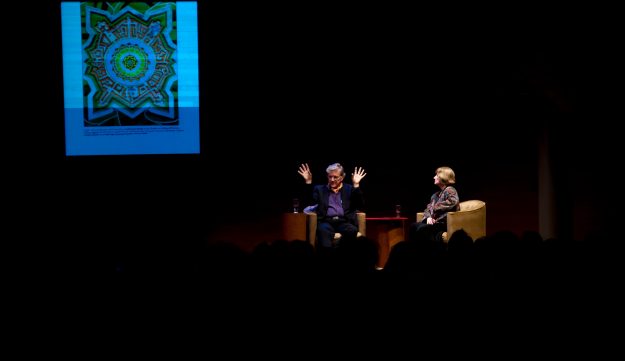
But on October 19, 2009, Professor Thurman was the first out the gate. Analyst Jane Selinske had chosen an image that at first sight resembled a bird’s-eye view of a fortified medieval town. The outline of the walls were themselves crenellated, a shape outlined by a moat surrounding this vigilant island, making for a striking pattern. This reading of the image—that of a moated medieval city—persisted throughout most of the conversation. And then Bob had the epiphany. During the Q&A section of the evening he was prompted to look at the enlarged projection of the image against the back wall of the theater behind him. Only then did he realize that we were not so much looking at a walled city but the primordial turtle. The anatomy of the universe. And, with that revelation, he produced a flood of such rich associations to Tibetan and Chinese cosmic mythology that it blew the roof off the event in the most satisfying way. It set the highest bar for the series. But, then, that is what Bob did: set high standards for us all to try and reach. Once upon a time, the Rubin Museum was to have been called the “Museum of the Mythic Image.” Bob referenced that little-known fact in his beautifully supportive response when I shared with him the news of the museum’s move to be a museum without walls. He immediately offered to help the initiative in any way he could. Wisdom. Compassion. Discernment. All in one. That was the Bob Thurman I knew.
–TIM MCHENRY, author, curator, and longtime program director at the Rubin Museum of Himalayan Art
Nearly two decades ago, I was taking classes at many different yoga and dharma centers in NYC. I knew that meditation was useful to me—it helped me feel steadier and more at ease with myself since I started practicing it—but I wasn’t sure if Buddhism was the path for me. I’d visited some centers that had insisted on the need to find a guru, or to make a commitment to a lineage, or to follow their training path only, and they seemed dogmatic and uninspiring.
Then I attended a class at Tibet House with Dr. Robert Thurman, whom I knew for his work with His Holiness the Fourteenth Dalai Lama, for his books, and for his support of the Tibetan people. Bob approached Buddhist philosophy in a way that was both intellectually rigorous and deeply devoted. His enthusiasm and encouragement drew me in, and though he transmitted complicated, academic, ancient sutras, like all great teachers, he was able to present them as exciting, accessible, and relevant. And he urged everyone to have fun—to delight in our goodness and wisdom. He helped me understand that Buddhism is a rational philosophy and that its methods can be practiced and perfected by anybody, including me, and his confidence in all of his students and humanity contributed to my decision to become a Buddhist student and, later, a meditation teacher.
–KIMBERLY BROWN, meditation teacher
I was not supposed to be in that class.
It was the fall semester of 1998, my second year as a graduate student at Columbia’s School of International and Public Affairs, and I had already selected the fifteen credits I needed toward my master’s in public policy. But a full-tuition payment allowed me to take up to twenty-one credits, and something—call it restlessness, call it a quiet internal ache I hadn’t yet learned to name—sent me leafing through the religion department course listings with an inexplicable sense of urgency. I was a skinny, almost-20-year-old Orthodox Jewish girl who prayed three times a day and had, until that moment, never given Buddhism a serious thought. And yet there it was: Indo-Tibetan Buddhism, taught by a professor named Robert Thurman.
I had never heard of Professor Thurman. I had no idea he was Uma Thurman’s father, or that he was the first American ordained as a Tibetan Buddhist monk, or that Time magazine would name him one of the twenty-five most influential Americans the following year. I just knew I had space in my schedule and something in me that desperately needed filling. I signed up to audit.
Dr. Thurman was unlike any professor I had ever encountered. He was enormous in every sense. He was physically present, intellectually alive, utterly uncontainable by a lecture hall. I sat there session after session, ostensibly worried about what my Orthodox peers would think of me for devoting time to what they might consider an idolatrous faith, and yet I felt, instead, a sense of expansion. An opening. Something I later learned to call göm—the Tibetan word for meditation, meaning “familiarization.” For the first time in my life, I felt like I was being invited to familiarize myself with something true.
I was auditing for no credit, so I had no assignments to submit, no tests to pass. What I had, instead, was permission to simply receive. And what I received changed the entire course of my life.
During one lecture, Dr. Thurman mentioned that Tibet House, the cultural center he had cofounded at the Dalai Lama’s request, offered free lectures, workshops, and meditation classes. He left some flyers at the front of the room. I grabbed one on my way out and stuffed it into my coat pocket, the way you hide something you’re not sure you’re allowed to want. That flyer led me downtown to a room on West 15th Street, with prayer wheels by the door and cushions on the floor. It led me to a teacher named Sharon Salzberg, who led me through my first loving-kindness meditation, and the first time she asked me to offer well-wishes to myself, I burst into tears, because in twenty years of prayer, no one had ever pointed me in that direction. The flyer led me to the beginning of everything.
I have told this story many times, in workshops and in the pages of my first book, because it is the story of how I became who I am. And at the origin of that story is Bob Thurman, who did not know my name (until two decades later), who probably taught hundreds of students like me across his thirty-year career at Columbia, who was simply being himself, brilliant, passionate, generous with information, and unwilling to keep the dharma behind glass, and who, by mentioning a flyer at the front of a room, utterly rewired my life.
That is, I think, what made him extraordinary. Not just the scholarship, though his scholarship was staggering. Not just the access he had to the Dalai Lama and to the intellectual circles of the West. What made him extraordinary was that he understood, in his bones, that wisdom is only as good as its capacity to reach people. He was a bridge-builder at a time when the bridges between Eastern contemplative traditions and Western seekers were fragile and few. He walked across them daily and held them open for the rest of us.
I am a meditation teacher now. I have sat with thousands of people in crisis; in parking lots and in boardrooms, in grief circles and in community centers. I teach loving-kindness. I point people toward their own hearts. Every single time I do this, there is a thread—however long, however tangled—that runs back to a flyer I grabbed at the front of a classroom in 1998, in a class I was not supposed to be in, taught by a man I had never heard of. I am because he was. Thank you, Bob. For the flyer. For the teaching. For holding the door open.
–DR. SHELLY TYGIELSKI, author and meditation teacher
Last week, among the entries for a weekly haiku challenge I oversee on Facebook, I found the following poem by Resa Alboher, a longtime dharma practitioner who coedits the Substack magazine Haiku Pause:
This departing spring
Taking Tenzin Bob with her
Into the clear light. . . .
The season word assigned for that week was “departing spring,” so that part was given. But Resa’s decision to pair it with the departure of Tenzin Robert Thurman on the eve of the summer solstice struck me as deeply appropriate.
One of the most important themes in Bob’s writing was reincarnation. His translation of the Bardo Thodol, known popularly as The Tibetan Book of the Dead, offered more than a guidebook to the intermediate state between this life and the next. It freed the linear Western notion of “life after death” into a realm of infinite possibility. The Path of the Bodhisattva was a theme that informed all of Bob’s writings and teachings, but it had its origin here, in his deeply held conviction that life is endless, compassion is boundless, and death is not the end. All of which were expressed in Resa’s poem.
In haiku poetry, the season word “departing spring” carries a poignant, melancholy feeling for the passing of the season, as expressed in one of Matsuo Basho’s most famous poems:
Spring has departed:
The birds cry out, there are tears
in the eyes of fish.
But the passing of spring also welcomes the fullness of summer, with its long days and lush green leaves. The four seasons offer their own version of the Bardo Thodol, as spring gives way to summer, summer to autumn, and autumn to winter—before the whole cycle begins again.
I’d had a day or two to take in Bob’s death before I read Resa’s tribute to her beloved Columbia professor from many years ago. But I wasn’t able to take it in. I’d known him since my days as a Zen priest in Manhattan in the 1980s. And when we’d moved to Woodstock in 1996, he became a neighbor we chatted with regularly at the grocery store. I was expecting to see him at a local event later in the summer, and I had to remind myself twice that this wouldn’t be happening now.
When I read the poem, I thought, “Well, the spring of Buddhism in America really is over, now that the bodhisattva has come to carry Bob off into the clear bardo light.”
–CLARK STRAND, author, teacher, Tricycle Haiku Challenge editor
“Tenzin” Robert Thurman’s dazzling qualities—his love of his family, his love of the dharma and teaching, his devoted scholarship, his magnificent, lionhearted ambassadorship for His Holiness the Dalai Lama and the people and land of Tibet—are attributes that others can speak of far better than I can. I do know that knowing Bob feels like a happy, two-decade-long blur of dharma, joy, and gratitude.
What made my heart soar about Bob was his heart. His devotion to the dharma felt boundless. He wrapped those he talked to in a cocoon of dharma, filled with warmth and joy. His brilliance seemed to illuminate the topic most dear to whoever he was talking to.
With me, it often happened to be art. He gave two dazzling talks to the Artist and Buddhist Contemplatives gatherings I organized. For the gathering at Garrison Institute, I had asked him to talk about the highest aspiration a Buddhist artist can have. He spoke of the bliss of wisdom realizing compassion, explaining that the activity of this bliss is the original source of beauty. And this bliss is compassion, since once bliss is experienced, one wants to share it. He titled the talk, “The Buddha Emanation Body as the Original Buddhist Art Piece.” It was luminous.
Just before his talk, Meredith Monk led everyone in a vocalization of Om and Bob delightedly joined in. As he was settling in to begin his prepared remarks, Bob went on an impromptu riff on the origins of Om and Ah. He said that Ah is the shortest sutra and, like everything having to do with enlightenment, it has a double meaning. Ah is a negation of the nonrelational element, it is emptiness. Ah is also the creative, Brahma sound in the Indian tradition. In between Big Bangs, it picks up all the other scattered, soundless letters, and, he said, “the poetry of the universe ensues.” It was quintessential Bob: spontaneous, deeply informed, illuminating about the topic at hand, and full of joy.
Bob’s love of the dharma and his love of sharing it were among his greatest qualities for me. I saw a recent clip where he said that when he was young, he realized the way he could really help Tibet wasn’t to be a monk, it was to represent His Holiness, the tradition, and help explain why it is important to the West. And he succeeded spectacularly.
I remember once watching him teach, and I could almost see his ego start to materialize. And then he took a beat, he may have even said something about noting it, and he changed his approach to one less likely to enlarge his ego—practicing in real time before a room full of students. It was so inspiring to me. No matter his worldly accomplishment and brilliance, in his heart he was a profoundly devoted student of the Buddha, dharma, and his teachers—whether they be high lamas or an eager questioner. He often credited his beloved wife, Nena, with keeping his ego in check in the best possible way.
There are so many things to love about Bob, and that quality is among my favorites: He always wanted to learn, and grow, and serve. Maybe better than most, he knew the vastness of the dharma and how far we all have to go. Even with his spectacular brilliance and accomplishment, he was at heart a student.
Since his passing, I hear his voice. It’s always jolly. Maybe because I am seeing so many loving tributes to him online, but I like to think his voice will always be there: laughing, loving, and full of dharma, encouraging me to live life as the happiest, best Buddha-in-training I can be. And I feel less fearful of death these days since his passing. If Bob can be up for the adventure, so can I. The best teachers are always teaching us beyond any perceived divide.
Our last project together was a Tibet House US live reading of The Way of the Bodhisattva honoring His Holiness’s 90th birthday last July. Bob introduced the event and gave a brief, gorgeous teaching on and reading of the first chapter. These last few weeks, he had been teaching on the treasured text on his Substack, racing to finish before His Holiness’s upcoming birthday. The teachings were brilliant—a profound, transformative guide to joyful, compassionate action—they were so very Bob. Before starting one teaching, Bob is on camera responding to Nena, who is making sure he would be done on time to see their grandson. I loved that moment. Bob loved the dharma, he loved his wife and family, and he just loved this world—even with bewildering technical difficulties—it was all of a whole, a Buddhaverse, as he would say, of infinite love.
He leaves the most dazzling legacy of love. Dr. Nida Chenagtsang, his dear friend and fellow teacher, said in a service after Bob’s passing that he was a dharma dad to so many. I believe Bob is somewhere celestial, joyfully talking to loved ones, all his teachers, and sending all that love right back to us all. Once, after he suffered a great loss, I saw him in a crowded lobby and asked how he was. He paused and said, “I could complain, but I won’t.” I will deeply miss Bob. I am so sad I won’t get to see him again, hear his jolly greeting, his new, vast, sparkling teachings. But instead of complaining or sitting in sorrow, I will feel it. I will remember, by his example, that in this interconnected, luminous world of ours, love is always bigger than our suffering.
–SARA OVERTON, artist
The first time I met Bob Thurman was in 2000 at the Buddhism in America Conference in Estes Park, Colorado, where I was asked to teach a workshop and to perform. After the performance, a very tall man came up to talk with me. I was looking up at him (I’m 5′ 2″), and I immediately felt his enormous energy, amusement, and great warmth. We talked at length about singing and how music is so important in this world.
Years later, we were both part of a retreat at the Garrison Institute, and I offered a breathing/moving meditation exercise where everyone sang the syllable “ah” on each exhale. Bob shared that “ah” was the most fundamental and primal syllable in the universe and told stories related to that. I and everyone else there were profoundly moved by the immensity and depth of his knowledge.
When Tim McHenry was in charge of programs at the Rubin Museum, he asked me to participate in a public talk about karma with Bob. To say that the thought of this was daunting is an understatement! I wrote to my teacher, Ani Pema Chödrön, and asked for her advice. She recommended that I read Karma: What It Is, What It Isn’t, Why It Matters by Traleg Kyabgon Rinpoche. I came feeling somewhat prepared, and then, at the beginning of the talk, I asked Bob what he thought karma was. In a flash, he was off to the races, his mind weaving, spiraling, making connections that neither I nor anyone else had ever thought of.
Conversing with Bob was like being taken on a journey into another realm, and at the same time, feeling totally grounded and in the moment. I always left inspired and transformed, as if my consciousness had expanded and I had become more aware of infinite possibilities in the universe. Bob was precise, brilliant, and articulate as well as playful and approachable. He was also radical, wild, and fearless.
Tenzin Robert Thurman changed the way so many people thought about the Buddhist path and its relationship to the world we live in. May we learn from and pass on the clarity and scope of his vision, his immense heart and radiance, for the benefit of all sentient beings.
–MEREDITH MONK, composer, performer, teacher, and interdisciplinary artist
⬥
This article will be updated with more responses as we receive them.

Thank you for subscribing to Tricycle! As a nonprofit, we depend on readers like you to keep Buddhist teachings and practices widely available.