
The advent of Zen practice in America is often traced to 1959, when Shunryu Suzuki Roshi (1904–1971) arrived from Japan, soon to become the founder of the San Francisco Zen Center. But fifty-four years before that, in 1905, Shaku Sōen Roshi (1860–1919) disembarked from a boat in San Francisco to teach Zen to Americans at the House of Silent Light, at the invitation of a woman named Ida Evelyn Russell (1857–1917).
Brian and Hidemi Riggs have made a significant contribution to the history of Buddhism in America. House of Silent Light presents a little-known piece of San Francisco history: the turn of the 19th to the 20th century, when Zen was first introduced to non-Asian Americans. The book is based on meticulous research into numerous sources, as is evident from the pages of footnotes and references, so putting the narrative together must have been something like doing a jigsaw puzzle.
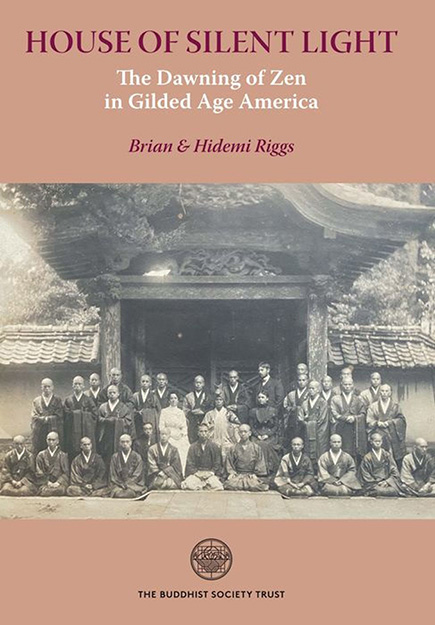
House of Silent Light: The Dawning of Zen in Gilded Age America
By Brian and Hidemi Riggs
The Buddhist Society Trust, 2024, 312 pp., $35.00, hardcover
House of Silent Light tells the story of two remarkable people and their crisscrossing paths. One of them, Sōen Roshi, attended the 1893 World’s Parliament of Religions in Chicago as a delegate, where he was the first Japanese Zen priest to speak publicly about Buddhism to Americans. The other is Ida Russell, the wife of Alexander Russell, a businessman, who founded the House of Silent Light in San Francisco at the end of the 19th century. While Sōen is well-known for introducing Buddhism to the US, Ida’s role in that introduction is not well-known. I’ve been practicing Zen for fifty years, but I had never heard of her until I read this book.
The third central character is the House of Silent Light itself, a mansion eight miles south of San Francisco’s center, on a bluff overlooking the ocean. The large estate had fields and orchards and a high fence around it, giving it an aura of mystery in a down-at-the-heels neighborhood of rough farms and roadhouses. It was here, at the close of the 19th century, that Ida, with the encouragement of her husband and the significant financial support of her close friend and wealthy philanthropist Elise A. Drexler (1866–1951), established a spiritual community for meditation, particularly the study of Zen. Ida was a Theosophist and a visionary, and the community she started was a place to train in a spiritual life: no tobacco, alcohol, or meat allowed, and a commitment to a simple life free of unnecessary material possessions. People were drawn to her, especially young women who had experienced a tragedy such as the loss of a child or the end of a marriage. There was a slightly shifting household of about eighteen residents at a time, most of them women, and over a few years, Ida and her husband adopted seven orphans, who were raised by Ida and a couple of her devotees, including Elise. Residents followed a daily schedule of meditation and prayer.
Ida wanted to learn more about Zen, and in 1903, she went with Elise to the 13th-century Engaku-ji, the only monastery in Japan that would accept two middle-aged American women as students. The abbot, Shaku Sōen, one of the scholar D. T. Suzuki’s teachers, was skeptical at first and assumed that the two women in their long dresses would last only a day or two. But no—they followed the same demanding schedule as the young Japanese monks, rising early and sitting zazen for long hours without moving, and they stayed for nine months. Sōen was impressed with Ida’s sincerity, and Ida was moved by Zen practice and by Sōen’s teaching.
All convert Buddhists in the United States benefit from Ida’s support of Sōen Roshi.
Two years later, in 1905, at Ida’s invitation, Sōen came, with a translator, to teach Zen at the House of Silent Light. He stayed for almost a year, giving regular dharma talks to the residents, and sometimes speaking at the Buddhist Mission in San Francisco. He and Ida developed a strong bond, even though they had no common language.
California has a history of attracting nontraditional spiritual sects, religious communities, and utopian communes, from Yogananda’s Self-Realization Fellowship to the hippie communes of the 1960s and ’70s, from Ananda Village to Scientology. The House of Silent Light is an early example.
That sense of openness and experimentation was still evident when I moved from New England to Berkeley in 1969, with my former husband and our small child. The Bay Area was a kind of mecca to us as countercultural activists. I marveled at the psychedelic buses and the tie-dyed T-shirts on Telegraph Avenue. I used to push my son in his stroller to an inspiring park nearby that was just then being spontaneously created by people in the neighborhood. Each time we went, it seemed there was a new feature, like a sandbox, or a huge vat of soup simmering over a wood fire. People’s Park didn’t last long, but Berkeley was one of the few places where such a thing could exist at all.
In the early ’70s, a friend told me about a Zen monastery deep in the mountains near Carmel Valley, where people lived as monks, baked delicious bread, and anyone could visit. I was immediately entranced: How magical, how spiritual! I was, by then, the single mother of two small children. My housemate and dear friend, also a single mother, agreed to take care of my kids, and I went to Tassajara, San Francisco Zen Center’s mountain retreat, for a weekend during the summer guest season.
I drove over a high mountain pass and entered a world quite different from the one I had left behind. I was a seeker, joining other seekers, coming to hear teachings and to practice meditation in the hope that Zen might awaken me. So were the people who went to the House of Silent Light. I got a taste during that first weekend, and as it turned out, I was able to spend extended time there as a monastic after my children were grown. Who knows how much the House of Silent Light helped pave the way for the establishment, decades later, of San Francisco Zen Center, the lineage in which I still practice?
After Sōen left the House of Silent Light for unknown reasons, the book branches out in two directions. One part goes on to tell of his travels in the United States. This history is interesting but not hidden, as he was an eminent Zen master. The other branch is the previously obscure story of Ida and of the life in the mansion that she presided over. This is the gift from the authors that I am most grateful for.
Ida’s enigmatic character engaged me. She encouraged the residents to renounce material possessions, yet she herself dressed in the latest fashion. She created a schedule that included Zen meditation, Christian prayer, and a daily lecture by Ida herself on Buddhism and spiritual values. There was morning meditation for everyone in the chapel, and in addition, Ida rose before dawn and meditated by herself every day. When Sōen was in residence, he offered dokusan, or private interviews, but Ida didn’t allow anyone besides herself to engage in this.
The residents were in the house during the 1906 earthquake, but the house wasn’t damaged, and no one was hurt. The cheaply built homes in the neighborhood did not fare as well, and, at Ida’s invitation, many families found temporary shelter living in tents on the estate.
Ida had a strange and tragic death. A specialist came to the house to perform a fashionable procedure—a facial treatment with carbolic acid, which removed the outer layer of skin, along with moles and blemishes. Ida experienced intense and worsening pain, was given morphine, fell asleep, and never woke up. It could have been a combination of the toxicity of the treatment and too much morphine—an ironic death for a woman who taught simple living and nonattachment to superficial things.
Ida was a woman with fascinating contradictions. She also dared to defy the norms and expectations of what a woman could do. She brought Zen to San Francisco, and I’m grateful to Brian and Hidemi Riggs for bringing her to me. And all convert Buddhists in the United States benefit from Ida’s support of Sōen Roshi, who, more than a century ago, led the way in making Buddhist teaching and practice available to Americans.
There were more names and facts in the text than I could keep track of, and I sometimes felt the story was hiding behind them. But the story is there, and it’s a good one. And the book’s rich historical detail makes it invaluable to libraries and scholars. It’s essential reading for anyone interested in California history, the history of Buddhism in the US, and the often-unacknowledged role of women like Ida in transmitting the dharma lamp to the West.

Thank you for subscribing to Tricycle! As a nonprofit, we depend on readers like you to keep Buddhist teachings and practices widely available.