
All my life, I’ve looked for shortcuts. As a young martial artist, I wanted to do 700 repetitions but get the benefit of a thousand. As a young film actor, I wanted to break out of the Asian market and into the Hollywood market with as few films as possible. And when I became passionate about Buddhism in the late nineties, I began to focus all my energy on the quickest possible path to enlightenment. I applied the same kind of thinking to my new goal: How can I do three months of practice but get the result of a year’s worth? I watched the Tibetan lamas: It was as though they’d gone to Buddhist boarding school. In my view, they’d been training nonstop since they were 5 years old, practicing eight hours a day, just as I’d done with martial arts. Now they were 30, and they’d been practicing for twenty-five years. How could I possibly catch up? How can I study more efficiently? There must be some way I could use three years, or ten years, to complete what they did in twenty-five.
Despite my desperation for enlightenment, the path to true freedom can be painfully slow. The Mahayana Buddhist canon teaches that it will take “three incalculable eons,” or kalpas, to achieve enlightenment. The Buddha illustrates the beginning of a kalpa as an enormous mountain, larger than Mount Everest. If every hundred years a silk scarf is wiped across the mountain, a kalpa will not end even when the mountain is worn down. And it will take three of these to become enlightened. Enduring three kalpas was unacceptable to me.
I found solace in the stories of great spiritual masters, all kinds of people who, despite all obstacles, achieved enlightenment in a single lifetime. I loved reading about the life of Lao-tzu, the legendary author of the Tao Te Ching, and the Sixth Chan Patriarch, who didn’t even know how to read. Milarepa was an even more miraculous case, as he killed many people in his youth yet achieved buddhahood in one lifetime. If the Buddha is said to have taught 84,000 paths to enlightenment, there must be one that fits my ambitions.
In the winter of 2003, I went on my first extended Buddhist meditation retreat, a Zen sesshin led by the renowned Master Sheng Yen. Most sects of Buddhism emphasize a step-by-step practice that resembles a conventional educational process: Grade school comes first, then high school, college, and graduate studies. Buddhist training has equivalents to all these stages. There are all kinds of preliminaries to complete before moving on to higher inquiries and insights. But Zen Buddhism, in my view, was the only sect that offered sudden enlightenment, called dun wu in Chinese. Sudden enlightenment was very attractive for shortcut-seekers.
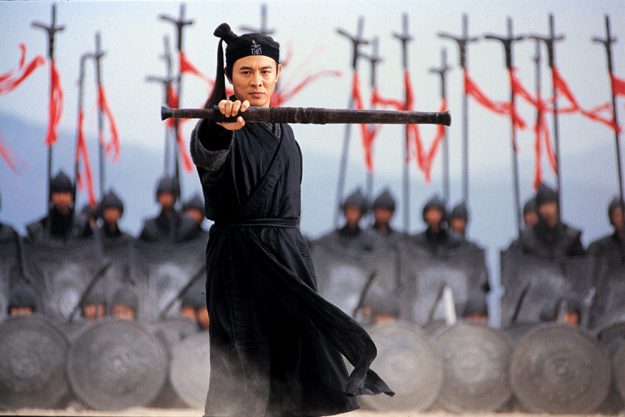
In 2003, my assistant Vincent’s godmother, Sister May, who had been studying with Master Sheng Yen for a long time, invited me to Taiwan to hold a public talk with the master. Before agreeing, I made a sincere request: “Please give me one day to ask Master Sheng Yen for help with my own practice. I really want to achieve enlightenment.”
My private meeting was scheduled for the day before our public forum. Because I was at a peak in my film career, the media buzzed about our meeting, and we were being swarmed by reporters chasing us for interviews. When I finally got to be alone with him, I quickly raised my core question: “How can I achieve enlightenment in the shortest time? Do you have a special secret?” Just as I had imagined masters of martial arts with the secrets to powerful techniques living in the mountains when I was younger, I now imagined that Buddhist masters had powerful secrets that could grant instant enlightenment.
Master Sheng Yen gave me a curious answer. “You are now standing at the edge of the cliff,” he said. “If you take one more step forward, you will become enlightened. It’s like you are standing in front of a paper window and you can easily pierce the paper with your hands.” Hearing exactly what I had secretly hoped for, I felt the excitement bubbling in me.
“What should I do?” I asked.
The master answered, “Give me ten days, and I can help you.”
I agreed immediately.
The master continued, “This winter, I will be teaching a retreat of ten days of silent meditation at the Dharma Drum Retreat Center in New York. I invite you to join me and participate.”
I flushed with anticipation. The invitation felt so irresistible that I re-arranged all my plans to attend. I was going to make good on my appointment with enlightenment no matter what.
Just as I had imagined masters of martial arts with the secrets to powerful techniques living in the mountains when I was younger, I now imagined that Buddhist masters had powerful secrets that could grant instant enlightenment.
At the end of November 2003, Vincent and I reported to the center in upstate New York. The retreat entailed ten days of silence without making eye contact with fellow retreatants. Tired of promoting films and answering empty interview questions, I felt safe. Here, nobody bothered me. The other attendees didn’t care at all who Jet Li was. They were here to meditate, just like me.
The formality and rigid rules are the backbone of the Zen sesshin. The first stick of incense must be burned at 5:00 a.m. every day. One stick of incense lasts for a meditation period of about forty-five minutes, followed by a short rest. From early in the morning until 10:30 p.m. at night, the participants spend almost all their time in formal silent meditation. In addition to practice periods, Master Sheng Yen taught for two hours each day. The only breaks from practice were three simple meals, work periods at the jobs we were assigned such as kitchen duty or bathroom cleaning, and sleep. Everyone eats the same meals, sleeps on the same floor, observes the same schedule, and takes turns washing the dishes and cleaning the toilets, without exception. I craved enlightenment, but I had also grown accustomed to a certain politeness in how I was treated, as well as a certain luxury in my lifestyle. The Zen retreat was like my life as a successful film actor had been turned upside down. I will admit that at first I found it very uncomfortable.
For the first seven days, my struggle was terrible. I fought against the harsh conditions of the retreat and against my own discomfort with them. I carried huge expectations of a dramatic liberation from the very bonds of life and death. Faced, instead, with the humble tasks of sitting still and scrubbing toilets, I suffered. For all my passion for renunciation, I had in some ways only redirected my ego’s ambitions away from worldly success and toward Buddhist success. Also, most of my experience with Buddhist practice up to that point was in the Tibetan lineage, which uses rich chanting and ornate rituals to bring one’s heart into practice. Now, in the austere Zen temple, I was instructed just to sit on the bare mat with my back straight. Essentially, doing nothing. Soon I was at a loss. By the end of the first day, my back ached. The next morning, the ache remained, only increasing throughout the retreat.
In the world I knew, if I worked more—practiced more kicks, filmed more scenes, signed more deals—I must get some of the results I desired. But in the retreat, it didn’t work that way. Even if you work hard, you may not get anything. Working hard may even be a hindrance. Practice has its own way of unfolding that can feel entirely illogical at first. You may even do everything “right” and get nothing; or you may do nothing and discover an insight. When I entered the sesshin, I assumed I could will my way into direct revelation of truth. Instead, I felt more like I’d entered the hall of mirrors in a carnival: My expectation was shattered into countless fragments, each one relative and impossible to grasp. This perplexity was an early glimpse into the spacious mind beyond the self.
Although my enthusiasm for Buddhism was genuine and my desire to be liberated from suffering was sincere, I still brought a lot of my old self-centered thinking to my early practice. I still wanted to be successful and powerful, only now I wanted to be a special Buddhist rather than a special movie star. Essentially, I had tried to trade worldly hooks for spiritual ones. The Tibetan master Chögyam Trungpa coined a term to describe this: “spiritual materialism.” He defined it as the tendency of practitioners to use spiritual practices, beliefs, and experiences to reinforce the ego rather than transcend it. This subtle form of self-deception can hinder genuine spiritual growth and give rise to a false sense of superiority. Where I had previously been hooked by my desires for wealth and fame, now I was caught by seeking the most distinguished master and undergoing the rarest initiations.
The first few days of the retreat were without personal guidance, and I began to experience doubt. How could I possibly get enlightened in ten days? I started to wonder if Master Sheng Yen had tricked me, or worse, that I had been cheated by a spiritual swindler. Had I really left behind my film work and my family for this?
After three days, my mind started to settle. One afternoon, I walked outside and saw something strange. A bird was flying through the cloudless sky, but it didn’t look right. The flight of the bird wasn’t happening in a continuous, fluid motion like a film; instead, it was skipping across the sky in a series of still images, as if I were watching the flight path of the bird as a sequence of slides clicking past one by one in a viewfinder. I stood there transfixed, wondering if all the sitting and straining in the meditation hall had distorted my vision. After staring at the bird in the sky for many minutes, I realized the opposite was true: For the first time in my life, my vision was clear.
Most of the time, our eyes automatically fill in the connective tissue between the images we see, giving the illusion of continuous motion as in a film. Rarely do we slow down enough to see the series of still images that our eyes actually register. That afternoon on the retreat, I was seeing each point in the flight of the bird without the middle that provides continuity and makes it a movie.
As a movie actor, I was highly aware of the incongruity between the process of filming and the final product audiences see on-screen. I knew about the thin wires we used to help us perform acrobatic stunts, and the booming sound effect added to a harmless punch to make the blow appear devastating. I knew that the countless hours of tape would be edited, treated for color, and given a soundtrack to direct the emotions. By the time viewers watched the film, the raw materials would be so transformed and heightened as to be unrecognizable. This was the magic.
However, it had never occurred to me that my mind was creating a movie from the raw materials of my senses. My mind, it turned out, was constantly editing, speeding up, slowing down, filling in, coloring, transforming, and distorting the data from my senses. Sometimes this was in the interest of efficiency; other times the movie magic was in the service of my ego, as when a memory of a painful interaction where I felt wronged was given brilliant Technicolor and blaring sound it surely lacked in reality. What else am I missing? I wondered. Unless you see through the illusion that life is a movie, you’ll always be bumping into the other actors—and often the props. Everything depends on perspective.
Where I had previously been hooked by my desires for wealth and fame, now I was caught by seeking the most distinguished master and undergoing the rarest initiations.
This truth came alive for me as a spiritual insight a couple of days later. When I entered the retreat, my mind was lost in vast speculations and tangled ideas. I obsessed over paradoxes I had encountered in my reading. Some books said there is just one Buddha. Others said there are five Buddhas. Some said you cannot count how many Buddhas there are in the universe.
Finally, I invoked Manjushri, to whom my grandmother had taught me to pray. Manjushri! I thought in my heart. Just tell me the truth! Is it one or is it many?
Then, in my mind, I saw softly flowing water that formed a huge statue of a Buddha. The Buddha was solid like crystal but formed by the water’s movement.
Ah! I thought. That’s one. That’s the truth.
Then the Buddha began to move. And I saw many, many, many Buddhas stretching behind it and ahead of it and in all directions.
OK! I thought. There are many. That’s the truth.
Then it shifted back to one, and I suddenly understood: From this perspective, it’s one; from that perspective, it’s many. If you want to see one, there’s one; if you want to see many, there are many. But it’s not one, and it’s not many. Everything depends on perspective.
Of course the image was, in the end, a creation of my own mind. Not everyone will see the same image. But the image helped me persist on the retreat, because I felt I was beginning to move, even in the smallest increments, from a theoretical understanding of Buddhist truth to an understanding rooted in my own experience.
I shared my vision with one of the younger Zen priests administering the retreat through the traditional written question-and-answer method. He came to my room and told me, “This is a Zen temple. Don’t bring Tibetan tantric visualizations into it. Just practice being.”
I was really frustrated. In the past, when I shared questions or insights with my teachers, they responded eagerly. Now, a younger man who wasn’t even the master I admired was denying the one thing that was sustaining my practice. By the fourth day, I worried I wouldn’t become enlightened at all.
My disgruntled mood continued until the seventh day. Although I was disturbed in my heart, I continued to follow the practice instructions. Then I gave up. I said to myself, Forget everything. This was all a mistake. I came to the wrong place. I was cheated.
In my exhaustion and frustration, I forgot all about the expectations I carried and just sat with my experience. At last, I didn’t cling to anything. Everything dropped away, and I was left with only the longing to know the Buddha inside myself.
Gradually, an image emerged. I seemed to see myself as a person looking in agitation for enlightenment but unable to find it. Everything he does is in vain. I tried to describe the feeling in an anecdote.
There is a team of ten people sitting in a circle. Everyone’s shirt is marked with a number. I stand up and ask number 1 to my right, “Where is 0?”
He says, “Next to me.”
I go to the next person and ask, “Where is 0?”
He also says, “Next to me.”
I go to the next person, and the next, down the line until number 8, who says, “Two down.”
I walk two down, past number 9, but then I hit number 1 again. I ask number 1 again, “Where is 0?”
He gets impatient and says, “Didn’t I just tell you? Next to me.”
I feel annoyed that all these guys are playing with me. Then I look down. I’m wearing number 0! Because I, frantically searching outside, had never looked down at the simple answer inside myself.
Although, through my studies, I thought I understood what it meant for buddha-nature to be inherent, the words finally settled in me. My fervent external search would inevitably result in suffering. I could become my own boss only by looking within.
I wrote down my vision and gave it to Vincent, who gave it to the assistant master.
“Not Zen!” he said. “This is just some Tibetan craziness.”
But after writing down my story, I found that I had finally calmed down when I returned to my seat. I could sit quietly, not looking at the scenery outside, not caring about time and space. The last two days passed very quickly.
At the end of the retreat, Master Sheng Yen appeared before us for the final time. In the very last minutes, he said, “I have a story.”
“Imagine there is a team of ten people sitting in a circle . . . ,” he began.
As I realized he was sharing my story, I felt a sudden warmth in the center of my chest. He understands what I’m feeling! I thought. I finally understood something! The joy and pride rose into my face, and my mouth curled into a soft private smile.
The other students could relate too. They had also gone from meditation center to meditation center, and from master to master, searching for something outside themselves.
But Master Sheng Yen didn’t tell anyone that this story was from Jet Li. He just wanted to tell the story. He didn’t even look at me while he told it. However, unlike when my red donation envelope full of 1,000 yuan for Lho Kunsang Rinpoche disappeared among the others, this time I didn’t feel the need for public recognition of my contribution.
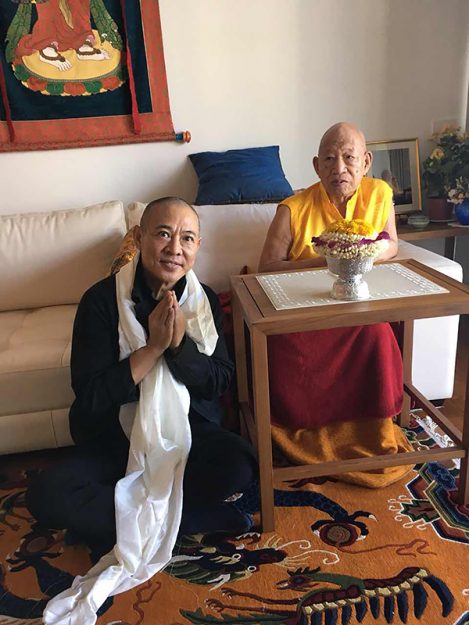
With that, the retreat was over. Shedding my role as a retreatant, I stepped outside. Snow was falling; the air was freezing. Some distance ahead, a small group of volunteers washed bowls. The sight of their humble labor out in the snow touched me deeply. I burst into tears and cried and cried. I finally understood the answer to a question that I had carried for a long time: How can a little bit of practice help millions of people? I had read and had heard many teachers saying that if a practitioner just lights a little incense or makes a small offering or washes a bowl, it will generate good karma for many, many people.
“How can it be?” I asked myself.
When I first heard the teaching, I thought it was a nice idea from 2,500 years ago but inapplicable today. In this moment, though, I felt the truth of the teaching in my bones. If one person washes dishes as a sincere expression of their fervor for awakening, they allow a hundred people to meditate. And if one of those hundred people becomes a Buddha, perhaps not even in this lifetime, that Buddha will benefit countless beings. Those beings will help more people, and in a million lifetimes, that one person’s simple act of washing dishes will surely help a million people. I saw these acts of selfless service extending out into the time beyond like a lamp in the darkness.
We’re often stuck in a limited view of time. We think only about a hundred years ago or a hundred years in the future. But the Buddha taught that we are unable to calculate the impact of a small act of service with our constrained understanding of time. We do what we can, anticipating results we can observe immediately, without seeing how great our influence can be. This is the time scale of beyond life and death.
Finally, I thought to myself, the teaching is close to me. I believed I was important, and that my life is the center of everything, but I’m just a little part of something very big.
The human words for this are very circumscribed. It encompasses many feelings all at once: gratitude, relief, humility, bittersweetness. As the Buddha taught, “Dharma felt with the heart is far beyond what words can describe.”
All the teachings in my books could not compare to what I learned from the tears I cried that day.
♦

From Beyond Life and Death by Jet Li, published by Tarcher, an imprint of Penguin Publishing Group, a division of Penguin Random House, LLC © 2026 by Jet Li.

Thank you for subscribing to Tricycle! As a nonprofit, we depend on readers like you to keep Buddhist teachings and practices widely available.