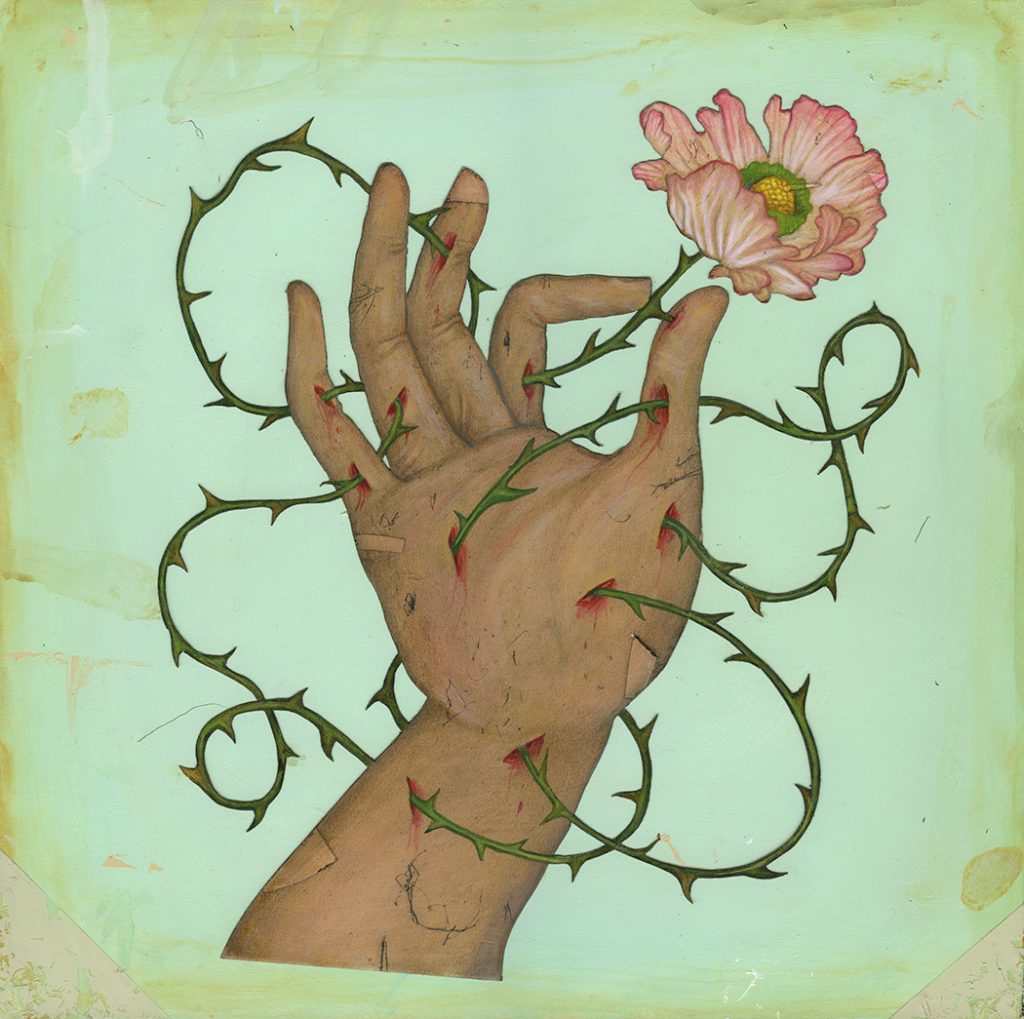
The Buddha is famed, or perhaps notorious, for having asserted in his earliest teaching that suffering and pain (dukkha) are an intrinsic experience in living and inescapable for anyone or anything that lives. All our feelings, thoughts, and actions are caught in an endless net where every effort to escape pain only creates more suffering. Pain exists as minor discomforts, such as our continual need to move slightly when muscles tire, to blink, to burp, to go to the bathroom, to have a glass of water, to scratch a passing itch, to sneeze. It continues to headaches, stomachaches, cramps, to upsetting thoughts and fears. These lead to efforts to find remedies and earn the means to afford them. In turn, one may recognize one is living in a world that is inconvenient, unfair, inefficient, indifferent, and from that realization emerges despair, hopelessness, which parents, lovers, friends, and counselors fail to ameliorate. And then there are the extreme pains caused by tragic losses, accidents, injuries, and physical sickness like cancer. There is the pain of dying. Yes, there are many kinds of pleasures, but they are impermanent. There are many people who sustain us in this life, but even if they remain constant, they sicken and die. While we exist, there is no way to avoid extreme pain, and there is no moment in which our movements of mind and body are not animated by the desire to mitigate our discomfort.
In discussing the pain that derives inevitably from the fact that we, like all living beings, are composed of many elements, the great 5th-century Theravada master Buddhaghosa said that all forms of life are painful “because they are continuously oppressed, hard to bear, the basis of pain, a disease, a tumor, a dart, a calamity, an affliction, a plague, a disaster, a terror, a menace, no protection, no shelter, no refuge, a danger, the root of calamity, murderous, subject to cankers, Mara’s bait, subject to birth, subject to aging, subject to illness, subject to sorrow, subject to lamentation, subject to despair, subject to defilement, and so on.”
Chögyam Trungpa Rinpoche once remarked: “Pain is the most real thing.” And, indeed, one does not need to look too closely to see that pain and the effort to avoid it are the root motivation of much of our individual behavior, our legal systems and social conventions, and even our most exalted spiritual paths.
We should then look more directly. To begin with, we almost always think of the pain we experience as not being “us.” Intense pain is something we perceive as, by its very nature, an attack on our basic sense of being ourselves. Pain is not “us”; it is against “us.” It signals some kind of destruction. We cannot assimilate the experience of pain into our continuing. Pain does not care whether we are old or young, rich or poor, lucky or unlucky, clever or foolish. It’s some kind of alien undoing. We do not want to observe it carefully because we want it to end. It commands our attention, but when the pain diminishes, we want to forget the specific feeling, and we do. And this is also the case with the painful awareness of having acted shamefully. We become contracted in anticipating pain, fearing it, hiding from it.
Elaine Scarry, in her extraordinarily original and courageous book The Body in Pain, talks about pain, principally in its political contexts of torture and war. Nonetheless, her more general observations explore implications of pain’s omnipresence. For one thing, the experience of pain isolates us. We are very aware of being alone within any specific, all-consuming pain we feel. Yes, we can make a crude communication about our pain’s severity using a 1-to-10 scale, and certainly that’s something. But no one can understand the way that pain is affecting us, fragmenting us in ways that echo with despair, fear, anger, disorientation. We are alone in that. Language is utterly insufficient in communicating the intensity of this assault, this rupture. It is a sudden thing. All at once, there is nothing to do but cry out, scream. We have suddenly been drawn into somewhere wordless. This elemental structure in thinking and communicating is, at least for an instant, useless, cannot contain or serve us. And in that sense, our consciousness itself becomes formless.
What Scarry says of torture is true of pain itself: It is “an undoing of civilization [. . .], the uncreating of the created contents of consciousness.” The point here is that although pain may be the logical result of certain kinds of thought, inner physical processes, and actions, the experience itself breaks apart our sense that our life is in some way coherent. When we are in pain, the grammar of our inner life falters, becomes untwined.
Recently, a medical condition has required that I be subjected to at least eight treatments, repeated weekly, in which I experience brief but intense pain. “This will hurt,” said the nurse. “And you won’t get used to it.” I’d had two quite similar procedures previously, so I knew what I was in for. “How will I bear it?” I asked her. I really didn’t know. She smiled: “We’ll talk and we’ll become friends.” I thought that this was a lovely thing to say, but, indeed, this is what has happened. Two nurses, Crystal and Susan, have taken care of me, and we have chatted. The pain, even though they always warn me, is always sudden and shocking. Sometimes we are talking about things in their life, sometimes about things in mine. “Keep talking,” sometimes they say; sometimes, “Breathe.” The pain is never less. But they provide a human context and a human continuum. I look forward to getting to know these perceptive, humorous, generous, and profoundly kind women, and this somehow absorbs the physical dread. I feel deep and very personal gratitude even at this very moment. A kind of happiness too.
And it is helpful that both women are also completely truthful. As I was leaving, after the course of treatment had completed, Susan said: “We’ll see you again.” I stopped short, not quite shocked but definitely surprised. “We’ll be doing this again?” “That’s what usually happens.” “Ah, I see.” I was reminded of a dinner conversation I’d had recently with Enrico Cortesi, an oncologist of great compassion and clarity. This was some time before I had been diagnosed but now seemed deeply applicable. He’d said, “The problem for the patient is to realize that life continues while there is no cure.”
And so, if we are to live with pain in ways that do not completely define us or drive us into permanent rage, or despair, we must indeed look to the widest possible living context. The 14th-century Tibetan sage Longchen Rabjam, at the end of his Precious Treasury of the Basic Space of Phenomena, describes our embodied physical existence (nirmanakaya) this way: “The essence of the nirmanakaya is the ground for the arising of responsiveness.”
Thus, our human situation, our body, is, by its very nature, grounded in responsiveness, a basic readiness to engage the specific qualities and circumstances of others. Bodily form is the confluence of innumerable elements, qualities, and dispositions. Sensation and awareness arise inseparably and are naturally integral to our being. Mutual responsiveness, our innate linkages vibrate within and around us. Our body is the location and focus of anguish and pain; at the same time, our physical sensoria make us aware of breezes, clouds, wet and dry, stars, aromas, melodies, mountain echoes, pine trees, sweet and bitterness, heat and cold, the rough and the smooth, our consciousness of the world, its past, the universe, and all the many beings who live here with us. Mutual communication continues whether we are aware of it or not, whether we want it or not.
Mutual sympathy, kindness, goodness, love, and generosity sustain our continuing existence here. Knowing this and seeking to reinforce it, humanity has created civilizations, laws, and countless arts, even as we, consumed by fear and hatred, have also waged innumerable wars and legitimized innumerable tortures. The violent isolation of pain, whether caused by design or by sickness and misfortune, occurs irresistibly and inevitably. In the extremity of pain, the vastness of shared feeling is constricted. Excruciation and the continuity of our mutual awareness cannot dissolve into or obliterate each other. Claustrophobic pain and vast expanse are inseparable, are our continuum.
Many portals connect solitary agony and a larger sense of communion. Good or bad intent may open or close these doors. Each of us, when in extremity, may, in that moment, find it impossible to escape the net of anguish, but a single person with a simple gesture can open such a door for us. Similarly, we, as single beings, can open such a pathway to others who are in pain. Responsiveness, fundamental and innate compassion make this always so.

Thank you for subscribing to Tricycle! As a nonprofit, we depend on readers like you to keep Buddhist teachings and practices widely available.