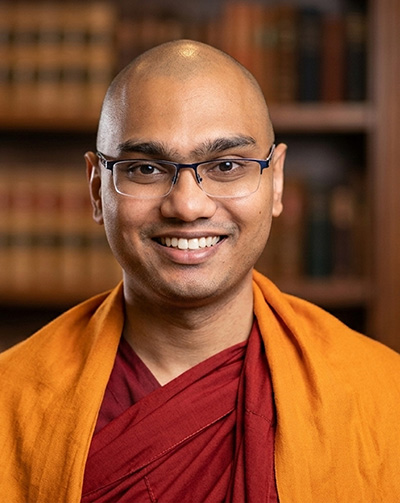
Where did you grow up? I grew up in Sri Lanka, surrounded by the rhythms of Buddhist life from a very early age. Temples, chanting, and the fragrance of incense were simply part of daily existence. That early immersion planted seeds that would take root much later in my life.
What led you to monastic training? Interestingly, it was a Catholic school education that first opened the door. Being exposed to different religions and traditions gave me the opportunity to see Buddhism comparatively—and that perspective only deepened my enthusiasm for its teachings. A turning point came when my chemistry tutor began discussing Buddhist philosophy during our sessions and introduced me to Venerable Kiribathgoda Gnanananda Thero, a teacher who had devoted himself to translating the original Buddhist scriptures into our native language. Reading through around 2,000 of those texts gradually made the path clear. By the end, becoming a monk felt not like a leap of faith but like a natural conclusion.
What is the topic of your dharma talk, and why did you choose it? My talk explores how samatha and vipassana meditation can work together to help us overcome anger. I chose this topic because anger is one of the most universal sources of suffering—and also one of the most misunderstood. People often feel ashamed of their anger, or try to suppress it, without realizing that the practice gives us precise, gentle tools to understand it at its root and let it go.
Are there any common misconceptions about samatha and vipassana? One of the most common is that they are two separate, competing practices. In reality, they are deeply complementary. Samatha—or “calm-abiding meditation”—steadies and clarifies the mind. Vipassana—or “insight meditation”—uses that clarity to see deeply into the nature of our experience. Another misconception is that vipassana means analyzing your thoughts. It is not analysis; it is clear, open observation. We are not thinking about anger—we are watching it arise, and watching it pass. Over time, this observation deepens our understanding of the mind itself, until we develop genuine mastery over our inner life.
What part of the teachings do students struggle with most? Without question, it is working with the mind’s stories. When anger arises, the mind immediately generates a mental narrative—vivid images, replayed conversations, worst-case scenarios. Students often believe these stories are simply the truth. What the practice reveals is that these are mind-made pictures, often only loosely connected to what has actually happened. Learning to see and gently release those images—rather than feeding them—is transformative, but it takes patience and repetition.
Do you have any tips for integrating practice into daily life? Start small and start honestly. Even five minutes of calm, focused breathing in the morning creates a different relationship with the rest of your day. More importantly, bring the observing quality of vipassana into ordinary moments—a difficult conversation, a traffic jam, a flash of irritation. Ask yourself: “What story is the mind telling right now? What image is feeding this feeling?” You don’t need to fix it. Simply seeing it clearly is often enough to loosen its hold. The cushion is the training ground; daily life is where the practice becomes real.
♦
In June, watch Reverend Amitha Khema’s dharma talk, “Using Samatha and Vipassana to Overcome Anger,” at tricycle.org/dharmatalks.

Thank you for subscribing to Tricycle! As a nonprofit, we depend on readers like you to keep Buddhist teachings and practices widely available.