Tricycle is pleased to offer the Tricycle Talks podcast for free. If you would like to support this offering, please consider donating. Thank you!
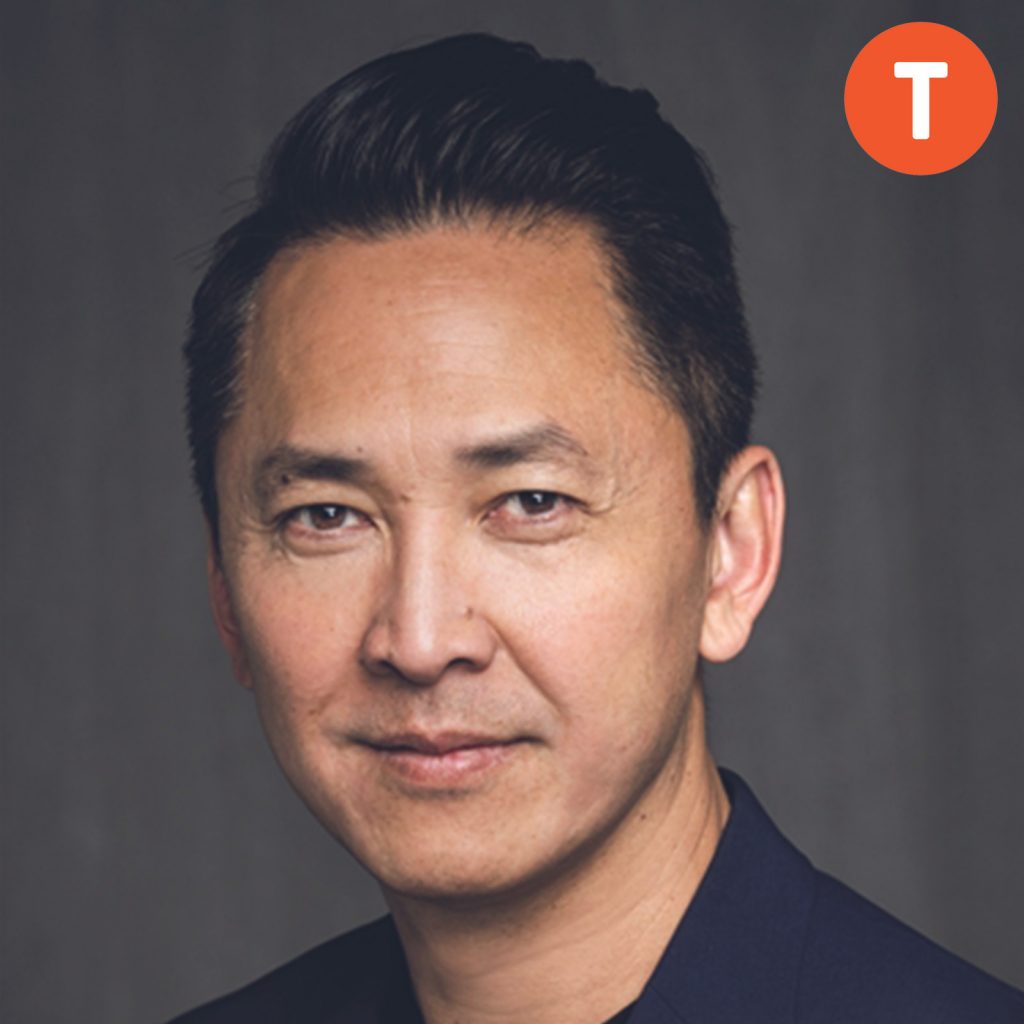
When Viet Thanh Nguyen was growing up as a refugee in the United States, it was hard for him to find stories that represented his experience. Now, as a Pulitzer Prize–winning novelist, he is determined to center the narratives of Vietnamese writers and artists in the diaspora. His most recent book, The Cleaving: Vietnamese Writers in the Diaspora, which he coedited with Isabelle Thuy Pelaud and Lan Duong, is the first anthology to gather the voices and perspectives of Vietnamese diasporic authors from around the globe. Featuring dialogues among thirty-seven writers and artists, the book explores themes of history and memory, the ongoing legacies of colonialism and war, and the role of art in reckoning with the realities of diaspora and displacement.
In this episode of Tricycle Talks, Tricycle’s editor-in-chief, James Shaheen, sits down with Nguyen to talk about how writing can be a tool for fighting back against erasure and exploitation, why he rejects the trope of being a voice for the voiceless and believes instead that we should abolish the conditions of voicelessness, how contributors to the collection complicate notions of authenticity and authority, and how political imagination can be a resource for building a better future.
Read an excerpt from The Cleaving, “Songs of the Living and the Dead,” featuring Nguyễn Phan Quế Mai and Hoa Nguyen.
Tricycle Talks is a podcast series featuring leading voices in the contemporary Buddhist world. You can listen to more Tricycle Talks on Spotify, Apple Podcasts, and iHeartRadio.
♦
We’d love to hear your thoughts about our podcast. Write us at feedback@tricycle.org.
Viet Thanh Nguyen: I think limited solidarity is to look at someone and to see a relationship, a kinship, that exists, which is affirmed by common sense. One immigrant who is Chinese looking at another immigrant who is Chinese, of course they’ll feel solidarity. That’s limited solidarity. But what does it mean for an immigrant of one background, one history, to look at an immigrant of another background, another history, and also feel solidarity? That’s radical solidarity. The radical solidarity comes from recognizing shared humanity, shared histories, shared destinies that can bring us together rather than tear us apart. James Shaheen: Hello, and welcome to Tricycle Talks. I’m James Shaheen, and you just heard Viet Thanh Nguyen. Viet is a Pulitzer Prize–winning novelist and a professor at University of Southern California. His most recent book, The Cleaving: Vietnamese Writers in the Diaspora, is the first anthology to gather the voices and perspectives of Vietnamese diasporic authors from across the globe. Featuring dialogues among thirty-seven writers and artists, the book explores themes of history and memory, the ongoing legacies of colonialism and war, and the role of art in reckoning with the realities of diaspora and displacement. In my conversation with Viet, we talk about how writing can be a tool for fighting back against erasure and exploitation, why he rejects the trope of being a voice for the voiceless and believes instead that we should abolish the conditions of voicelessness, how contributors to the collection complicate notions of authenticity and authority, and how political imagination can be a resource for building a better future. So here’s my conversation with Viet Thanh Nguyen. James Shaheen: Okay, so I’m here with Viet Thanh Nguyen. Hi Viet, it’s great to be with you. Viet Thanh Nguyen: Hi, James. Glad, glad to be here. James Shaheen: So we’re here to talk about your new book, The Cleaving: Vietnamese Writers in the Diaspora. It’s the first anthology of writings by Vietnamese diasporic writers. So to start, can you tell us a bit about the book and what inspired you to put it together? Viet Thanh Nguyen: You know, the origins of The Cleaving actually go way, way back to my time as an undergraduate student at UC Berkeley, when I was an aspiring writer and confused young individual, and myself and my other Vietnamese American friends who were interested in the arts and literature looked around, and we thought, “Where are all the Vietnamese American artists and writers, and how do we support them? How do we promote them?” We started our own arts organization, and we started to stage events and things like that. That eventually grew into an organization called Diasporic Vietnamese Artists Network, which is the organization that sponsored this book. And over the past few decades, we just built a network of writers from all over the diaspora that’s in the United States, France, Germany, Canada, Australia, so many places where Vietnamese people ended up as a consequence of the war in Vietnam. And one of the successful aspects of the diaspora has been that we have produced a lot of Vietnamese writers writing in various languages. Some of them have become very successful, and others are not as visible, but they’re not any less important. And so The Cleaving is our attempt to bring together nearly three dozen of these writers into dialogues with each other. And that’s what you see in the book. James Shaheen: So you say that writing and storytelling are some of the most important tools for fighting back against erasure and exploitation. So can you talk a bit about writing as a form of resistance? Viet Thanh Nguyen: Well, domination is certainly a form of power that happens both through physical violence, legal violence, governmental violence, things like that. But domination also happens through art and narrative and storytelling and so on. And so the great demagogues in history have always been great storytellers and have been able to compact complex issues into things that audiences could understand immediately. And so for any of us who happen to be artists or storytellers, I think we understand that. We understand that despite the fact that we typically live in societies that tell us art doesn’t matter, we also live in societies in which we see evidence all the time that art and storytelling matter. And so for the people who have been dominated in various ways, I think we have turned to the arts as a form of survival, certainly as a form of affirmation. Through the arts, we keep alive histories, cultures, memories. And through the arts we also stage, as you say, resistance. We critique the ways by which injustice has taken place in the past and in the present, and the arts also allow an imagination of the future, sometimes a utopian imagination, sometimes a dystopian imagination, but nevertheless, an imagination that offers a way forward from the present impasses. James Shaheen: You know, you also say that writing is the art with the lowest price of entry. Could you say more about that thought? That was pretty amusing. It’s no less difficult for that. Viet Thanh Nguyen: Yeah, well, maybe some other people might challenge that notion, like maybe dance has the lowest form of entry, for example. But writing certainly has one of the lowest forms of entry, because really the only thing that one requires to write is a sheet of paper and a pencil, or a pen at the most basic, or an iPhone even, or a laptop, or a typewriter back in the day. And the only thing that’s otherwise required is the imagination, the discipline, and the suffering of the writer or the artist. So I think that’s why writing has been a tool, has been a weapon, has been an art that so many disempowered, dispossessed, oppressed peoples have turned to. It’s one of the ways by which we see that the more expensive the art form is, like, let’s say moviemaking and cinema. These are typically the art forms that are the slowest to respond politically. It’s not that they can’t be political; it’s just that it takes a long time to get something so expensive as Hollywood to turn its gigantic aircraft carrier in a certain direction and to make some kind of a movie that responds to a political crisis. And there’s so many people involved in the making of such an endeavor that you have a lot of compromises that often have to take place. Now, the writer can respond immediately; the writer can respond without compromise, which is why I think when we see political crises and horrors unfold, it’s oftentimes the poets that respond, because in some ways poetry is even more flexible and faster to write than a memoir or a novel or even journalism. James Shaheen: I guess that makes sense. I think of documentary filmmaking, which is often quicker to respond than, say, blockbuster movies, if they even do respond. But in this vein, you describe The Cleaving as an effort to reach what you call narrative platitude, where no single story has to carry the burden of representation. So can you talk about that aspiration and also what you mean by narrative platitude? Viet Thanh Nguyen: You know, I grew up as a refugee in the United States from Vietnam in the 1970s and 1980s, hungry for stories that would do certain things for me. It’s certainly stories that would allow me to escape, to feel pleasure, to have fantasies and so on, but also stories that would explain my past and my present to me. I was growing up at a time in which I was aware that I was a refugee from Vietnam and that there was a war and I was deeply curious about it. And I was trying to read and watch everything I could get my hands on about Vietnam and its history but also the Vietnam War. In the United States at that time, most of what was available were stories being told by Americans and mostly by white Americans. And so when I was watching things like Hollywood’s Vietnam War movies, these were movies that could be great works of art—sometimes they weren’t, sometimes they were—but also movies in which Vietnamese people did not feature as human beings for the most part. To watch those stories was really devastating for me to see that this was the way that Vietnamese people were being seen by Hollywood and even by non-Hollywood versions of entertainment as well. It was painful to see the racism and the sexism that were being intertwined with the depictions of Vietnamese people. That, as I came to understand retrospectively, was narrative scarcity. That’s when almost none of the stories are about you, and when a story about you comes along, you get very excited. You get very nervous, like, “Oh, at last. Here’s a story about my particular people.” And you put what has been called the burden of representation on that single story, that this single novel or movie is somehow going to represent all of your people, which is impossible to do. That’s an impossible burden that so-called minorities who live in narrative scarcity have. And for those of us who live in narrative scarcity, we can never say that something is just a story because we know that it bears the burden of so much more than just one work of art—it bears the hopes and aspirations and fears of an entire people. If you have ever watched or seen a movie or a novel or a story and you felt that it didn’t represent you or your people in some way and your reaction was, “That’s just a story,” and you can walk away, you live in narrative plenitude, because you know that there are thousands of other stories about you that you can turn to, and so a single story doesn’t matter as much. So that’s what narrative plenitude is. Narrative plenitude is the sign that you live in some kind of environment in which you have power. You are part of a majority. You may not feel like you have power, but that’s one of the forms of power that you have, which is the power of being assured that stories will feature you. James Shaheen: Right. So along those lines, the book was born out of a desire to lift up new voices and reject the overused premise of being a voice for the voiceless. Now, that’s a trope that rubs the wrong way. So in fact, you say that rather than seeking voices for the voiceless, we should abolish the conditions of voicelessness instead. So can you talk about this trope in your rejection of it? Viet Thanh Nguyen: Well, certainly I’ve been called a voice for the voiceless, and that’s not to say that I’m unique in any way. I think any writer or artist or political person or activist who comes from some kind of less visible population, for whatever reason, and this person emerges and somehow their story becomes visible or audible in some way, oftentimes dominant society will call this person a voice for the voiceless. In some ways, of course, this is meant to be a compliment for that person. But it implies that the community or the people for which that person speaks is voiceless. Here I follow Arundhati Roy, when she says that there’s really no such thing as the voiceless; there’s only the deliberately silenced or the preferably unheard. And that’s what’s obscured by the idea of a voice for the voiceless. A voice for the voiceless just assumes automatically that certain populations simply can’t speak, whereas those of us who come from these populations know that we can always speak. If you talk about any kind of refugee or immigrant or minority population and the people who live within those populations, they will tell you that these people are usually really, really loud. So they are silenced rather than unheard. Of course, the other question is, who’s doing the hearing? The voiceless themselves know they’re not voiceless because they can hear each other. It’s dominant society that can’t hear these voices when they speak. And so it’s really important to both bring out why this idea of a voice for the voices is so problematic and to emphasize that what’s really happening here is a question of power: Who gets to silence? Who gets to amplify? Who gets to hear? Who gets to choose to hear? What this does is that it situates art and storytelling in a context, both of art, which is to say aesthetics, but also of power as well. And so for those of us who believe that art and storytelling matter, I think we have to have a complicated understanding of what that means in relationship to power. Individual artists and individual works of art matter, but can they transform all of society? Occasionally, some rare work of art may be able to do that, but typically works of art, I think, work in operation with sociopolitical cultural movements, entire struggles and communities, in order to, as I said, abolish the conditions of voicelessness. And that’s the real project for me: not simply to elevate individual writers or artists but to elevate this idea that we are all engaged in this collective effort to ensure that more and more people can be heard. So I think the book does this work of trying to help to abolish the conditions of voicelessness while hopefully also taking a position of humility, knowing that some of the writers are more known to non-Vietnamese people than others, but that there’s so much talent in there that we can’t predict what the long-term effect is going to be. And so that’s partly what it means to have a narrative plenitude is just to have as many different voices as possible. Because if we’re talking just about the United States, but it’s true for other countries as well, in these national publishing industries, especially if you’re talking about so-called minority populations, these industries and the larger dominant societies usually only have attention to pay to one or two voices for the voiceless and not to the full diversity of voices that are out there for any given community. And so that’s what The Cleaving is trying to do is to say, look, we know that there are a handful of Vietnamese diasporic writers that have been recognized in their different countries, but there are so many more. James Shaheen: You know, you make that all clear in the book, but one thing that really struck me when I was reading it, I think about when I was in junior high school and the first wave of Vietnamese people from Southeast Asia arrived and populated our schools. And it just is, on the other hand, pretty impressive to me that in fifty, fifty-five years, there’s a whole body of literature as evidenced by your book. But isn’t it rather remarkable that in a relatively short period of time, there’s this whole body of literature in many languages? Viet Thanh Nguyen: I think it is remarkable. Of course, as a confused young person at Berkeley, I wanted it to happen much faster and much more and more quickly. That was the 1990s, so only really fifteen years after the end of the Vietnam War. When you’re a young person, fifteen years is a very long time, but of course, in the scale of life and humanity, it’s a very short period of time. I think it takes a generation for something like an immigrant or a refugee community that’s been displaced, moved to another country, moved into another language, another culture, it takes a generation for that population to really absorb all of the historical trauma and all the confusion and all the pain, and also then to process all of that in another country, in another culture and another language. So I don’t think we’re unique in that sense in the Vietnamese diaspora, but I think that the Vietnamese diaspora, as this collection testifies to, has been, as you said, pretty remarkably successful in both the quantity of writers and storytellers that it has produced, but then also the ways in which some of these people have become recognized and celebrated in their host countries. There’s a lot to be celebrated there, but I also think that it’s important for me to remember, what are the historical circumstances that enabled this to happen? I mean, the Vietnamese people were not the only Southeast Asians who came out of Southeast Asia to the diaspora, including the United States. There were also Lao, Cambodians, Hmong people, and they’ve all produced literature, but none of them have produced the same quantity of literature, and none of them have gotten the same recognition. And I think it’s so important for me to stress that in my thinking, this is at least partly because of just the historical realities of Southeast Asia, that Vietnam is a larger country than Laos and Cambodia has a larger population. It has a certain legacy from its colonization by the French and the Chinese that have produced a more literate and literary culture than in Laos and Cambodia. And so there are so many historical complexities about the way that the Vietnamese people have been shaped by power and how we responded to it that has laid the conditions for the emergence of a Vietnamese diasporic literature. James Shaheen: Right. You know, in your introduction you cite the novelist Toni Morrison, who wrote in Beloved, “This is not a story to pass on.” So you talk about the seeming paradox here: Don’t ignore the story, yet don’t keep telling it. Can you say more about this? How can both admonitions be true at the same time? Viet Thanh Nguyen: Well, I’ll toss out another literary quote, which is by F. Scott Fitzgerald when he said, I’m paraphrasing, the sign of a truly sophisticated intelligence is the ability to hold two opposing ideas in mind at the same time. And of course, you know, it’s much easier to have just one idea in mind, and something like the end of Beloved demands that we recognize that two things can exist simultaneously. Morrison is speaking about the complexities of what it means to deal with trauma, horror, injustice, pain, all these kinds of things from the past that any sensible person would want to forget. And yet, if we forgot those things, those things will return again. That’s part of the claim of a work like Beloved and of Morrison’s work in general. And so that’s a complicated dialectic or two-step way of thinking that the ending of Beloved is trying to get us to contemplate: that we have to do that. We both have to try to forget the horrible past in order to move on, and yet we have to remember the horrible past in order to move on as well. I don’t have a simpler answer than to say that that is the bind that is important to all of us, whether we happen to be so-called minorities and we’re talking about the Vietnam War, which is something that we have to forget and to remember at the same time, or whether we’re talking about the United States in general and we talk about something like the Civil War. People would say the Civil War is over, and I would say the Civil War is not over. Both things are true at the same time. And because we have never fully dealt with the complexities of what it means to remember and to forget and what remembering and forgetting would actually entail, we have been doomed actually to repeat the historical problems that led to the Civil War and are still with us today. James Shaheen: You know, it is interesting. I was going to make that point that it’s more generally applicable that we both have to remember and to forget in order to move on. But sometimes it takes a marginalized population to sort of point that out. It’s easy if you belong to the dominant culture not to really think about that. It would be very easy. But Toni Morrison makes that clear. I think you and DVAN work together to make that clear. Viet Thanh Nguyen: I think you’re right. I think you’re right. And I think that, again, part of the privilege of narrative plenitude or being a part of a majority is that you won. Whatever “you” is, whatever group you belong to, you won in whatever conflict it was. And so then there is a huge incentive to forget the complicated past and to remember only the good parts. And because no group has ever become successful without some form of injustice or power or violence, then of course what’s being forgotten is that injustice, which will return. If you’re a minority, you don’t have that luxury. You often exist because of injustices of various kinds, and that in itself is not meant to turn the so-called minority into any kind of privileged population because there are a lot of people from so-called minority populations who have learned the wrong lessons from history, who are not able to hold two ideas in their minds at the same time, who want revenge, who want to repeat the very injustices that brought them into being in the first place. But to be in that historical situation, to live in historical conditions that Ralph Ellison and James Baldwin, when it came to talking about Black Americans, described as conditions that were Kafkaesque and surreal, if one recognizes the surreality of what it means to live the injustices of a society that denies those injustices, that does provide a level of really important insight that everyone can benefit from, both people of that particular so-called minority population, but larger society as a whole. James Shaheen: Yeah, you mentioned the Civil War, and I agree with you. It’s ongoing in many ways. So I don’t think anyone gets away with not coming to terms with those two truths. But, you know, whether people wake up in time is another matter. So you raise the question: Must we always be defined by horror? Yet at the same time it’s important not to let the stories be told by the oppressors. So how has this dynamic shaped your own fiction and how you relate to telling these stories? Because on the other hand, if you don’t tell it, it’ll be told. As we already know, the general narrative about the Vietnam War is from the perspective of the people who waged it. Viet Thanh Nguyen: Well, part of the bind is, and as you see this in The Cleaving and all the different writers in their projects, sometimes you do have to deal with the horror. You have to deal with the trauma or the tragedy that shaped your particular population. And for the Vietnamese diaspora in recent history, it has been the war in Vietnam. But at the same time, are you supposed to be defined by that forever? And so there are really interesting writers in the diaspora who don’t deal with the war. They deal with other kinds of things. And now we see all kinds of interesting work that’s science fiction and fantasy and romance that has nothing explicitly to deal with the war in Vietnam. So again, both of those movements are necessary, and it would be a mistake to choose only one or the other. So in my case, so much of my work has been about the war in Vietnam, and I think that’s because psychically, I was shaped by it, having been 4 years old at the end of the war and indelibly stamped by the refugee experience and by the impact of colonialism and war on my parents, and therefore on myself. And so several of my books deal explicitly with the war in Vietnam. However, I do think about future works where I don’t have to write about the Vietnam War. I’m looking forward to that. But that doesn’t mean that it’s all one or the other, your personal atrocity and trauma and moving beyond that to something else. I think there’s something in between that’s also really, really crucial. And that is that just because you want to move past your own trauma and tragedy doesn’t mean that you have to forget that trauma and tragedy exists. So most people know my work through the novel The Sympathizer, because it’s about the Vietnam War and I’m Vietnamese, and therefore that’s what they want to read. But the sequel to The Sympathizer, The Committed, is set in Paris because my narrator is part French, part Vietnamese. That was very deliberate on my part. And the French have gotten away with what they did to Vietnam through colonization. And so that novel is trying to connect these. I make this argument that the things that happened to the Vietnamese because of the Americans were also already there with the French as well. And then the final third novel, the final novel of the Sympathizer trilogy that I’m writing now, begins in El Salvador in 1984. And somebody may reasonably ask, why would a Vietnamese American novelist who’s been mostly known writing about the Vietnam War write about El Salvador in 1984? Well, historically, it’s because the United States pivoted immediately from the war in Vietnam to Central America where horrifying things happened in the 1980s that most US Americans have forgotten or never known about. So for me, that was a really important move. This is a really important move to make to demonstrate that I would like to move past the Vietnam War, but to do so, for me personally, it means connecting what happened to us as Vietnamese people with what happened to other peoples, in this case, Salvadorans. And so that choice exists for all of us. Again, it’s not either or. It’s not simply remember or forget. What could also happen is that we can choose to remember the ways in which we’re connected with other peoples as well, both through things that could be very beautiful and pleasurable, but also through these horrors of history as well. James Shaheen: So like your own writing, the collection is very international in scope, and it relies on a specific formulation of diaspora derived from the Greek etymology “scatter across.” So how were you and your coeditors thinking about the meaning of diaspora when you put the book together? Viet Thanh Nguyen: I think we think about it in terms of power and in terms of culture. So why are these people scattered all over the place? It’s not some kind of accident in history. It was through particular things like colonization and capitalism and war and all these kinds of historical movements of power and conflict and struggle. But once these seeds have been brought to different places, they grow. They produce unique kinds of cultures that have Vietnamese elements but are also shaped by the contexts that people find themselves in. So as I mentioned before, we have significant diasporic populations in Canada, Australia, Germany, France. We even have one writer that we have, Vaan Nguyen, who ended up in Israel with 300 other Vietnamese refugees. Now, each of these national contexts is very different from the other. And so that’s part of what’s fascinating about the anthology is to see how the Vietnamese diaspora signifies differently in different countries. I’ll just pick one that I know fairly well, which is France, which has one of the largest diasporic Vietnamese populations and has several well-known French Vietnamese writers. And the place of the Vietnamese in France is in some ways similar to what it is in the United States, where the Vietnamese are well-regarded by the French. They’re seen as a model minority and so on. But the way that the French think about race is very different from the United States. Here in the United States, we believe, or we have believed, in multiculturalism, pluralism, the mixing of different cultures and the assertion of different identities. In France, it’s more about humanism. It’s this idea that you may come from different places, but once you’re in France, you should become French. And so the French Vietnamese are embedded in that particular idea where, for them, the idea of being French Vietnamese is not something that really is normal here. Being Vietnamese American in the United States, that’s part of a discourse that is well-developed. But in France, when we went to France as Vietnamese Americans, we had to make deliberate efforts to cultivate relationships with French writers of Vietnamese descent and to say, look, we should have a coalition. We should make these kinds of connections. And they weren’t used to thinking about themselves in that way. James Shaheen: Why is that exactly? Just because of how the French relate to what it means to be French? Viet Thanh Nguyen: This idea for the French that to assert these kinds of group identities like ethnicities or origins elsewhere, these are divisive. These are ways to reduce one’s humanity. These are ways to give in to political and cultural ideas of communitarianism that will divide the republic. And so there’s this optimistic belief in the idealism of a universal humanism within the French Republic that’s based on citizenship and assimilation. And it’s a beautiful idea in some ways. I don’t think it’s better or worse than the American ideal because if you look at both France and the United States, even though they have these competing notions of what is citizenship and what is national identity, the issue in the end is they both are racist countries. So if you go to France, there’s huge amounts of racism directed against Arabs and Algerians, North Africans, Black people. And of course, French dominant society tends to blame those populations for not being willing to assimilate. If you talk to those people, they’re like, “Well, it’s not because we don’t want to assimilate, it’s because the French are racist.” So what’s the right answer? So even though there are these two very different French and American systems, I think what binds them is not that either one is impossible. It’s that both France and the United States have not fully reckoned with their past and their present. You know, we as Americans have some sense of how we have not fully grappled with racism and slavery and the Civil War, et cetera. In France, I don’t think that the French have really grappled with their colonial legacies. And so, again, back to remembering and forgetting, if national societies are not capable of addressing their pasts, then it doesn’t really matter how idealistic their notions of their identities are in the present. That past will come back, will intrude, will make that idealism impossible to realize. James Shaheen: As you’ve mentioned, the book consists of a collection of dialogues between Vietnamese diasporic writers and artists. So why did you choose the form of dialogue? It feels like another form of making these connections across the diaspora. Is that right? Viet Thanh Nguyen: Yeah, well, the Diasporic Vietnamese Artists Network is an arts organization that we built out of this spirit of collaboration and community. That was always the emphasis. It was never supposed to be an organization that was like the National Endowment for the Humanities, where the real mission there is to support individual writers and artists. This was a community-based organization. This is an organization that’s based on these ideas of solidarity and the spirit of collaboration and the idea that individual egos shouldn’t really matter as much as the willingness to help all of us together. And so there, in that sense, I think the idea of conversations worked better for us than the idea of monologues or essays or interviews where only one person was speaking. We thought that if we bring all these writers together and produce some interesting pairings, we’ll have some friction, we’ll get some new ideas that will come out of it. And the basis for all of this was that we staged a series of residencies in different locations where we would bring eight or nine or ten writers from different countries together for a week or two weeks or a month and just put them in a group where they could do their own work, but then they would also communicate and collaborate with each other, which included these conversations. So I think that was the ambition. And part of the assumption there was that even though everybody in the collection is of Vietnamese ancestry in some way, it doesn’t mean they’re all the same. We had writers in one residency from Australia, from France, from the United States, from Canada, each of them, again, with national contexts and experiences that rendered them quite different from the other. And so those differences in those similarities emerge in these conversations. James Shaheen: So the book takes its title from a poem by Li-Young Lee, another person I’ve had on the podcast. The title, of course, is “The Cleaving.” So can you talk a bit about the story behind the title? Viet Thanh Nguyen: Yeah, well, Li-Young Lee, the book he wrote, The City In Which I Love You, was something that I read as an undergraduate, and it blew me away with its beauty and its vision. One of the poems in The City in Which I Love You is titled “The Cleaving.” And in it, the poetic narrator is watching a Chinatown butcher cleave a duck in half. And the poet meditates on this notion of cleaving. What does it mean? Well, it certainly means to cut something apart in two, but cleaving also means paradoxically to bring two things together at the same time. And so the poem is about this idea of the multiplicities of cleaving, but since it’s talking specifically about Chinatown and the Chinatown butcher, it’s also about what it means to be an immigrant, to be a refugee, to be displaced, to be an outsider in some community. So it was just such a powerful image and metaphor, but also, of course, a beautiful poem. And it stuck with me and it stuck with a lot of people because when I bring up that poem, “The Cleaving,” a lot of people say, “Oh yeah, I read that poem and it stayed with me as well.” And so that poem cleaved to me also and never left me. And I think it was me who suggested the title to my fellow editors Isabelle Thuy Pelaud and Lan Duong, and we all agreed that this was the title we needed for the book. James Shaheen: So in that poem is the line, “This immigrant, this man with my own face.” Can you say something about that? Viet Thanh Nguyen: The poetic narrator sees the butcher, knows he’s an immigrant, shares a face in some ways with that immigrant, and that’s a powerful image. I think those of us who are part of diasporic communities or even any community that finds itself outside of its original context, so let’s say you’re an expatriate somewhere with all the ideas that being an expat brings you. You move with a sense of privilege and so on. Even so, if you’re an expatriate in some other country from your country of origin and you meet someone with your face, I think there’s a sense of resonance, identification, kinship. It’s not necessarily a utopian identity. All kinds of things can go wrong, but nevertheless, there’s that sense of mutual recognition that’s happening. I think my interpretation of Li-Young Lee’s poem is that when the poetic narrator sees the immigrant, the man with his face, the way that the cleaving works here is that they share something similar, but they may also be cleaved apart at the same time. The butcher is a butcher working in a working-class environment. The poetic narrator is not necessarily that person. So even within the same community that’s cleaved together, it can be cleaved apart by its differences. And I think that’s part of the recognition in that image. Anyone who’s grown up in a community, whether it’s a national community like the United States or a subcommunity like an immigrant or refugee migrant community, knows that yes, the community is brought together by its similarities and split apart by its differences. We see that happening in the United States as a whole. The cleaving works at the national level here, but it works within immigrant and refugee communities as well. So that, again, I think is where this idea of a man with a similar face comes up for Li-Young Lee, and it means a lot to me because the opening line of The Sympathizer is “I’m a spy, a sleeper, a spook, a man of two faces.” I use that idea of duality at the level of the face to generate this sense of both how we as individuals might be cleaved from ourselves and how communities can be cleaved from themselves as well. James Shaheen: So this notion of cleaving shows up in the collection’s exploration of identity and authenticity, particularly related to authority. So can you talk a bit about the challenges of writerly authority and how the contributors to this volume complicate notions of authenticity and identity? Viet Thanh Nguyen: Well, I mean, authenticity is such a powerful idea, and I think we’ve all been affected by it in different ways. Certainly in the United States as a whole right now and in so many other countries where populism and nationalism are on the upsurge, what goes along with that is authenticity. What is the authenticity of the nation? Who are the people of the nation, and what is the authenticity of the people and its culture? In some ways, this can be very obviously affirming. A lot of people are seduced by the idea of authenticity. They want to feel a sense of wholeness, a sense of being, as the term authentic implies, true to some kind of origin. And yet that’s also really dangerous. We have so much history, so many historical examples of how this kind of nationalist authenticity has led to horrifying disasters because part of what authenticity entails is being able to define what is not authentic. And once you do that at the level of a nation-state, what’s going to happen is either you create minority populations or you take minority populations and you render them inauthentic in some way, and therefore you subject them, make them vulnerable to things like deportation and detention and things like that. And that’s exactly what we’re seeing in the United States at the present moment for people who are of these minoritized populations. The dilemma, I think, is that the desire for authenticity exists for us as well. I grew up in a Vietnamese refugee community very aware that this Vietnamese refugee community really clung to notions of authenticity. My father, when I was growing up, would tell me often, “You are 100 percent Vietnamese.” What does that even mean? But that idea embedded itself in my mind because I knew I wasn’t 100 percent Vietnamese biologically. If I did the whole DNA test, I’m pretty sure there’d be a lot of Chinese in there somewhere. But just at the level of culture growing up, a lot of Vietnamese refugees would look at me and would think, “You’re way too Americanized. You are not 100 percent Vietnamese.” And so at that level, there’s a lot of humor and play to be had around inauthenticity and authenticity that’s fun. You know, we’re all in quest of the most authentic Vietnamese cuisine, or the most authentic cuisine that you can imagine, but over all of that is this overarching sense that authenticity is completely a positive thing. And I think this collection tries to warn against that because even though it’s about Vietnamese people of various kinds, it’s stressing the idea that there are so many different ways to define what that means to be Vietnamese. And that’s a form of resistance against this idea that you can say something is 100 percent Vietnamese. Because while that might be fun when you have very little power as a minoritized community, when you take it to the national level and there is power, that idea that you can define something as being 100 percent of anything is potentially very, very dangerous. James Shaheen: You know, authenticity is a funny word. It’s one that I hear come up more and more often, and sometimes I think it’s because people want what they claim is the real, in a world where it’s so difficult to know what’s real and what’s fake. And yet it was interesting to me that you pointed out the problematic nature at the same time of authenticity and the real. But anyway, how do you navigate your own authority as a writer? Viet Thanh Nguyen: Oh, well, when I was trying to be a writer for many decades, I had no authority as a writer. And so that was a very uncomfortable place to be in as I went through all the typical travails that writers go through. And then with The Sympathizer as a breakthrough work, all of a sudden I had all this authority. I don’t want to brag about it, but the novel won a Pulitzer Prize. And the only reason I bring it up is because in the context of authority, winning prizes, including that one, brings a lot of authority, and there’s a relationship between the author and the authority, and I think it’s deeply, deeply problematic. To be imbued with authority is obviously empowering in a lot of ways and can be a lot of fun. But I’m always very suspect of that authority as well, because where does that authority come from? If you receive a prize or a recognition or a title of a certain kind and everybody goes ooh and aah over it because they know it brings along all this prestige and power, where does that prestige and power come from? And so the author who has authority certainly is hopefully getting it because they have worked really hard to achieve a certain level of capacity with their art. But there are these implications that the author with authority is also embedded in the various systems of power that grant authority, that recognize authority. And that is something that I think is hard for authors or for anybody, really, to grapple with the complications of their own authority. And for me, what that means at the level of art is that I believe that what art should do, that the most meaningful kinds of art, the most meaningful kinds of art should speak truth to power, whatever truth is, whatever power is. That’s just a guiding principle. But what happens when the author is a part of power? That’s a huge dilemma that I constantly think about for other writers, obviously, but also for myself as well. James Shaheen: Yeah, I mean, you won a Pulitzer. The Sympathizer was turned into a successful HBO series. So in that sense, you have been inducted or drawn into the dominant culture. So that’s why the question about authority is so interesting to me. You also describe the tension in putting this collection together between promoting diasporic Vietnamese collectivity and articulating a logic beyond identity altogether. So can you talk about this tension and how you and your coeditors navigated it? Because I imagine there are a lot of different takes among that community on this issue. Viet Thanh Nguyen: Yes. That’s an understatement, I think. Most minority communities, and especially refugee and migrant communities, are riven by conflict. You know, there’s all kinds of debates over who gets to speak, again, what’s authentic, what stories should be told, who gets to be the representative. And so dissensus, conflicts are all part of the landscape. And sometimes that can be just dissensus at the level of debate, but sometimes it can go into violence, as characterized the early Vietnamese refugee communities. So I think we were quite aware of these kinds of issues because over the course of the last thirty or so years, as I’ve worked with the groups of people that eventually formed the Diasporic Vietnamese Artists Network and we had earlier versions of the organization and we did things like stage poetry readings and plays and things like that, we ran directly into the problem of who gets to speak and what stories get get to be told. Just to give you one example, in the early 1990s, in an early iteration of DVAN, we staged a play by a major Vietnamese novelist who wrote a play. And the play was about a community in Vietnam who have found the bones of a dead American soldier, and they want to try to sell those bones because they know Americans will pay money for these things. It’s a story about reconciliation, but it was written by a former North Vietnamese soldier who became a writer. And when we staged that play in San Francisco at San Francisco State, I mean, we got protested against. Hundreds of people took buses to San Francisco State to protest this play, even though the play was explicitly about reconciliation, because the author was a former North Vietnamese soldier. So we’ve always been aware of the political conflicts that are deeply embedded in this diasporic community. To take it back to your early question about diaspora, many diaspora communities are formed out of civil war, out of violence, out of ruptures that don’t go away simply because a population has been transported to another country. Oftentimes those conflicts resurface. Again, they’re about power in terms of actual power about a state, but also about community and about governance, and also about art and storytelling. So there’s no easy answer really to the question. It’s just simply that storytelling and organizing the arts is itself a form of power. Maybe a minor form of power, but nevertheless a form of power. And we have to engage with that ethically. So we’ve never tried to silence anybody, but we also know that the form of stories that we seek to tell are in and of themselves already controversial within a refugee community or migrant community. Because most of these voices are of a second generation, people not writing in Vietnamese but in the language of the host country, most of these writers would probably be considered liberal to left by the migrant community or the refugee community. And so those tensions are so intimately felt by all of us. And we’ve all pondered and wrestled with it. And in the end, there’s really nothing left to do but simply to just put our own stories out there in as much diversity as we can while also recognizing that there’re other stories that we’re not telling. James Shaheen: The final chapter of the collection concerns the future and the possibility of what critical theorist José Esteban Muñoz calls “collective political becoming.” So can you talk a bit about how you’re thinking about futurity? How can political imagination, for instance, be a resource for building a better future, especially building communities of care and raising political consciousness? Viet Thanh Nguyen: I think for me, when it comes to organizing, whether it’s organizing political movements or in this case organizing an artistic movement, one of the things that has to happen is that the organizers have to have a sense of humility and also confidence. It’s a very contradictory position to be in. I think the organizers of DVAN and the editors of this book, I think we have very confident visions about art and politics and history and all that, because we have a certain understanding of these things and how we have been shaped by our own history. But the sense of humility comes in from this idea that if you build an organization, if you build a movement, part of what you’re trying to build is the possibility of perpetuation, that this movement has to renew itself in some way, and it’s not going to renew itself by only being dependent upon the labors and the ideas of the original people who started the movement or the organization. It has to be dependent upon new people, new generations being brought in, who have their own ideas, and that these new people, younger people with newer ideas, the older folks have to make room for them, have to actually create the conditions for our own obsolescence and displacement. That’s kind of a difficult place to be in, and I hope we can achieve it. I hope we are achieving it now. And that’s part of what you see in The Cleaving, that there are younger writers in there who are expressing a sense of aesthetics and a sense of history that are far removed from my own. And I think that is a good thing. And again, this is part of the paradox. I think especially for people who attain a sense of power in some ways, a sense of authority in some ways, even if they’re a part of a so-called minority community, it can be hard to give up that power. It can be hard to give up that privilege. It can be hard to give up that authority. And yet that’s exactly what needs to take place. And so I hope that’s part of the legacy of the Diasporic Vietnamese Artists Network and of The Cleaving: that these things were started by a generation that is mine, but that it’ll be taken over by a newer generation with an equally set of compelling, newer stories to tell. James Shaheen: You know, you do talk about the cleavages that emerge in the diasporic community as it matures or develops. You also talk about building solidarity, particularly radical solidarity, as opposed to what you refer to as limited solidarity. So can you talk about what you mean by radical solidarity, and I guess you would have to point out what you mean by limited solidarity too. Viet Thanh Nguyen: Let’s go back to that idea of the immigrant and his face that was in Li-Young Lee’s poem. What does it even mean to see somebody else’s face and to think, “Wow, your face is like mine”? You know, Jim, if I were to look at your face, your face is like mine too. We have two eyes, a nose, mouth, two ears, all that kind of stuff. But in the discourse of Li-Young Lee’s poem about the immigrant, seeing the immigrant and his face reflecting the poetic narrator’s face, if I were to use that discourse, I would look at you, Jim, and say, we’re not alike. You know, we share these certain features, but we don’t have other features. And so that’s where limited and radical solidarity come into play. I think limited solidarity is to look at someone and to see a relationship, a kinship, that exists, which is affirmed by common sense. One immigrant who is Chinese looking at another immigrant who is Chinese, of course they’ll feel solidarity. That’s limited solidarity. But what does it mean for an immigrant of one background, one history, to look at an immigrant of another background, another history, and also feel solidarity? That’s radical solidarity. So for example, for me to write a novel that begins in El Salvador, I hope that’s radical solidarity. I hope that’s me saying everything that’s happened to Vietnamese people that I hold so intimately, that I’m so aware of, all those things, many of those things happen to Salvadorans as well, and we’re bound by that history. We’re bound as human beings by that history. And just because we speak different languages and we have certain superficial characteristics that are different and so on and our foods are different doesn’t mean that we can’t have solidarity. The radical solidarity comes from recognizing shared humanity, shared histories, shared destinies that can bring us together rather than tear us apart. And so that’s part of the cleaving as well. And so that metaphor of the cleaving is still so very powerful. Limited solidarity cleaves us together with certain people and then cleaves us apart from other people who we say we have nothing in common with. Radical solidarity does something quite different. It cleaves together two people, two populations that are being told they have nothing in common together. James Shaheen: So that radical solidarity is something you link to the practice of radical refusal. Could you say more about that? Viet Thanh Nguyen: If we look at our present situation as Americans, I think there is so much opportunity for radical refusal. Actually, if we look at our entire history as of the United States, there have been so many opportunities for radical refusal. There have been so many moments where the nation and the state have said to the people, “You have to do X, Y, or Z. You have to join this war effort. You have to demonize this population.” And so many people have gone along with that demand. Radical refusal is to look in the face of power that’s saying you have to join this struggle against some kind of other, and to say, no, I don’t want to do that because I think that’s wrong, or that’s unjust in some way. And so if we look at today what’s happening with ICE, I’ve called what’s happening with ICE, these deportations, these detentions, these are happening in the relationship of what I would consider to be concentration camps. What’s being done to people in the streets I would consider to be these rituals of humiliation that at least one-third of the country seems to enjoy. We have to radically refuse that. We have to radically refuse to participate in that. We have to radically refuse to legitimize the conditions by which this is happening or what’s happening with bombing Venezuela or bombing Iran or supplying the bombs to Israel to bomb Gaza and Lebanon. All these things are being offered to the American people. And so many Americans either are enthusiastically assenting or being silent and being complicit in their ascent. Radical refusal, I think, is speaking out in some way, vocally, publicly, to state that you are not going to legitimize and to agree with these abuses of power. It’s not the only thing you can do. It’s probably not the last thing you can do, but I think the first thing that you can do is to radically refuse what you see as unjust. James Shaheen: You know, as we get close to the end of our hour, I’d just like to say that we began the conversation with Toni Morrison, so it feels fitting to return to her words as we close. Your coeditor Isabelle Thuy Pelaud quotes Morrison’s speech after winning the Nobel Prize in literature. She said, “I stood at the border, stood at the edge, and claimed it as central. I claimed it as central and let the rest of the world move over to where I was.” So can you talk about this refusal of marginality and how it guided the collection? Viet Thanh Nguyen: Yeah, I think there is a temptation when you’ve been marginalized in some way and put off to the side to accept your marginality, to think that you have very little to offer, or that if you have something to offer, you have to apologize for it or you have to translate it or you have to make other people comfortable with it, whatever it happens to be, “it” probably being your language, your culture, your food, your customs, your ideas, your history, and so on. So Morrison was a Black woman publisher and editor in the 1970s in the publishing industry and also an aspiring writer. And I think what she articulates in that speech is her thinking at that time that she was not going to apologize for being Black, for being a Black woman. She was not going to move herself over to the center of the publishing world and to the center of the white world, but instead to write exactly from where she was and to speak without translation or explanation because her primary audience was other Black people. I think that that model is universally true. That’s where power comes from. In storytelling we would not expect a great writer who is a white man to explain being a white man, whatever that is. You know, we would not expect an American writer to explain being an American. They simply speak from their self and their position and their subjectivity, and there’s power to be had from that. And so that’s also then the model for anybody who’s marginalized as well, is to believe that you don’t have to give up whatever it is that defines you as a minority or as an other, but you should speak as if you are already major. You should speak as if you are speaking to your own people. You should speak as if you don’t have to explain anything. And I think that’s actually very, very hard to do for everyone. We’re all tempted to marginalize ourselves, or many of us are tempted to marginalize ourselves, and it takes a lot of courage to get to the position where you can feel as if you can say, “I’m not going to explain to anybody, and I’m going to speak first and foremost my own truth.” That’s true for all individuals but especially true for those rendered collectively as being other or marginalized or subordinated in some way. James Shaheen: You know, I interviewed Ruth Ozeki, and she said that when she wrote about a woman who was Asian, people assumed she was talking about herself, whereas if a white woman had written about a white woman, they wouldn’t make that assumption. It kind of goes to what you’re talking about. But she didn’t explain, “Hey, by the way, this isn’t me.” She just wrote it. Viet Thanh Nguyen: Well, I mean, it’s one of the reasons why I wrote The Sympathizer in the way that I did, because no one reads The Sympathizer and thinks that’s me, because he is a spy and a murderer and a womanizer, an alcoholic, and all these kinds of things. And I don’t present in those kinds of ways. And so I think it’s absolutely true. Artistic freedom is the ability to say whatever one wants to say, something, again, that those with narrative plenitude take for granted, a privilege that they take for granted, and those who live in narrative scarcity cannot. James Shaheen: So one more question before we close. In thinking about political imagination, I also wanted to ask you about the genres you’ve chosen to work in. So of course you’re famous for your novels, but you’ve also published two children’s books, people may not know that, including one that you wrote with your son. So I wonder if you could talk about this decision to publish children’s books and how this relates to this notion of imagination and futurity. Viet Thanh Nguyen: I never wanted to be a father. That’s an honest admission. And I never thought I would write children’s books. And I’ve done both those things, and I’ve done them with great pleasure and with recognition that part of why I was terrified of becoming a father was I was just not certain that I was going to be a good father and that I was capable of the kind of love that I knew would be required due to my own traumatized refugee background and all that kind of thing, which is covered in my book, A Man of Two Faces. But it turns out I think that I’m a pretty good father, I am capable of love, my children seem to like me, and so on. But part of what happened there was as I observed these children growing up, my son and daughter, I observed that they both had this capacity for incredible imagination and play in their own ways and that their worlds were not defined by rules. And what happened is that the older they got, the more rules were imposed on them and the more they internalized rules. Now, that’s all a part of growing up and becoming socialized. And once we learn to play within the rules, of course, we learn to play certain kinds of games that are acceptable to adult society, and that becomes art or whatever. And yet part of the beauty of children’s literature, the best of it is that it expresses a world in which there are no rules. That’s part of the incredible power of the imagination of children and of the writers who can speak to them. And part of what I see in children’s literature is that it’s incredibly freeing not to have rules. Children’s writers can do whatever they want, anything. No one ever asks twice. No one says, “Oh, why did that children’s writer or artist do that?” No one ever says that. But an adult writer who deviates from whatever adults think are the rules that define a kind of genre, whether it’s a novel or a poem or a memoir, or whether it’s a genre like romance or science fiction or fantasy, adults will go like, “Why did they do that? Now, that’s an experimental text.” That’s such a horrible, horrible idea and actually a horrible term. I really prefer the idea that these works and these writers, adults who do these kinds of things where they disrespect whatever conventions and rules exist, are being playful, just like children are being playful, and adults can’t deal with it, so they say experimental instead. Now, I prefer the term playful. So reading and writing children’s literature has taught me a lot about playfulness, and I took that sense of freedom, and I’ve explored that in my novels as well but also in this memoir, A Man of Two Faces, which some readers characterize as being experimental because it does things like use poetic line breaks and use white space in the text, none of which are actually very hard to read, none of which are actually experimental because other writers have done them before. They’re just playful. And so I’ve learned so much from my children and from children’s literature about the beauty of disregarding rules. Yes, you have to follow them sometimes, but part of the beauty of being both a child and an adult, as we try to be both things at the same time, is to know that rules are meant to be both followed and broken. And it’s up to us to have a playful sense of who we are as individuals, as parents, as children, as artists. It’s up to us to know when to make that decision to follow or to break the rules. James Shaheen: Yeah, I guess there is such a thing as a literary hall monitor, you know. Okay. Anything else before we close? Viet Thanh Nguyen: Nope, that’s been a great interview, Jim. James Shaheen: Okay. Viet Thanh Nguyen, it’s been a pleasure. Thanks so much for joining us. For our listeners, be sure to pick up a copy of The Cleaving, available now. James Shaheen: You’ve been listening to Tricycle Talks with Viet Thanh Nguyen. To read an excerpt from The Cleaving, visit tricycle.org. Tricycle is a nonprofit educational organization dedicated to making Buddhist teachings and practices broadly available. We are pleased to offer our podcasts freely. If you would like to support the podcast, please consider subscribing to Tricycle or making a donation at tricycle.org/donate. We’d love to hear your thoughts about the podcast, so write us at feedback@tricycle.org to let us know what you think. If you enjoyed this episode, please consider leaving a review on Apple Podcasts. To keep up with the show, you can follow Tricycle Talks wherever you listen to podcasts. Tricycle Talks is produced by Sarah Fleming and the Podglomerate. I’m James Shaheen, editor-in-chief of Tricycle: The Buddhist Review. Thanks for listening!

Thank you for subscribing to Tricycle! As a nonprofit, we depend on readers like you to keep Buddhist teachings and practices widely available.