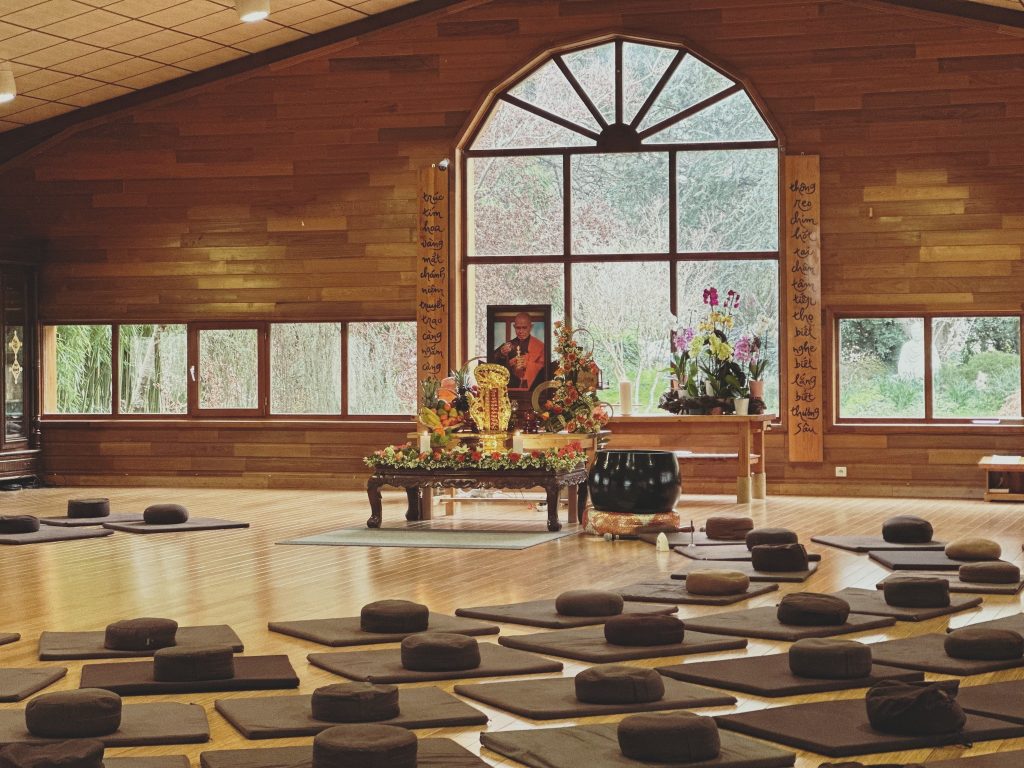
To meditate is to be alive. To meditate is to connect. To meditate is to really feel that you are a miracle of life. By developing agency over our own breathing, we can strengthen deep looking and understanding, which, in turn, can give us a taste of freedom. Meditation allows us to be exactly how we are and who we are in this moment.
Like any other practice, it gets easier over time. Sitting meditation was hard for me when I first became a monk at the age of 13. When I was young, I was never taught to sit still. I was never told how to feel the body, how to be aware of the mind. Arriving in Plum Village and making the decision to become an aspirant monk, I had to dive into the world of the monastics. In Plum Village, sitting meditation takes place every morning and every evening. I confess: At the beginning, I just forced myself to sit on the cushion. There was little joy or freedom in it! The hardest part was just staying awake in the morning meditation—it was so early! I often fell asleep; I tried many techniques to stay awake. The most effective was sitting in full lotus position—the sensation of pain in my legs kept me awake.
Our practice is a practice of nonviolence. Though we may have a perception that meditation means being still the entire time, giving yourself permission to bring ease into the body is important. When there is pain in sitting meditation, we can stretch our legs and release any tension that has built up. We can be flexible with our bodies and our breath in meditation. Be kind to yourself.
Over time, sitting meditation has become my foundation of stillness. It’s like exercising: When you first start stretching, there’s pain. When you start lifting weights or doing pull-ups, your muscles become sore. When I began meditating, the soreness was the agitation—the mind wanting me to move, wanting me to leave this hall. My mind often questioned me: What are you doing here? Exactly in those moments I got to hear myself and to identify the emotions that were present.
Sometimes we make the mistake of thinking our sitting seeks to achieve something, to do something. But meditation is being. The sitting is to be alive, to be very present. Our own ideas can get in the way of our thinking that we have had a successful or fruitful meditation. We’re so convinced that there’s something to do, that we’re doing it wrong, and we don’t allow ourselves to be as we are. Meditation is simply embracing and allowing us to be in the present moment in a really deeply attentive, curious way—it is the quality of our presence. With this perspective, I see how normal it was for me to fall asleep and to feel annoyed during meditation as a teenager—it was the first time in my young life I wasn’t filling my days with video games and cartoons. After a childhood full of white noise, the silence became very powerful as I continued to sit in stillness with the Plum Village community.
Sitting meditation is a cultivation of true presence. It is a practice of learning to simply be there for yourself. We give our suffering permission to be present and embrace it and care for it.
We talk a lot in Plum Village about the power of presence. Sitting meditation is a cultivation of true presence. It is a practice of learning to simply be there for yourself. We give our suffering permission to be present and embrace it and care for it. We can even say to uncomfortable sensations: Thanks to the stillness, you are being transformed by us. As a teenager, I often felt like I wasn’t doing anything when I meditated, and I wondered where the healing was that all the adults were talking about. Sitting meditation has ripened for me over time; I have come to recognize the healing of the moments of peace, calm, love, and presence I experience. I feel this energy palpably healing past wounds, including the lack of peace I experienced from having been bullied or abused. The sitting is the healing, the sitting is the peace.
On a busy day, the sitting itself is purely to sit and do nothing. When you don’t want to go sit is exactly when you need to go sit—these are moments when nobody will bother you. You can have thirty minutes of uninterrupted stillness. If you don’t go sit, people will interrupt you. People will ask for your attention. You will get lost in emails, project planning, or whatever else is on your to-do list.
Practicing Meditation
I’d like to invite you into a meditation practice. Wherever you are, please begin by feeling the weight of your body. Become aware of your body. Begin to know you are here, to know you are breathing. You are alive. This is love. This is acceptance. Perhaps you can say, silently or out loud, I am here for myself.
As you sink into your body, feeling the weight, start to release any tension. If there is tension in your face, offer yourself a smile. If it’s your shoulders that are tense, allow yourself to just put the burden down, put the worries down. If it’s your arms, your fingers, your palms, maybe you’ve been holding on to something for so long. At this moment, just release it—it’s not going to go anywhere, you can pick it back up later. For now, allow yourself to feel the relaxation of releasing the tension in your arms, your hands, your fingers. What are you grabbing on to?
Now, let us bring our awareness to our breath. I invite you to experiment with aligning the following phrases with your breath as a way to gather your attention:
As I breathe in, I know I am breathing in. As I breathe out, I know I am breathing out. This is an in-breath. This is an out-breath.
Your mind may wander to the past, to the future, or to a story. Allow these thoughts to melt away. Allow yourself to just be with the breath. Let the mind gently come back to the body:
Breathing in, I follow my in-breath from the beginning to the end. As I breathe out, I follow my out-breath from the beginning to the end. Feeling my abdomen rising and falling as I breathe in and out, my breath is life. I arrive deeper in my body; I arrive more deeply in the present moment.
As I breathe in, I offer myself my true acceptance. As I breathe out, I smile with acceptance. Even if you didn’t have the best day, even if you said something you still regret.
I smile, I accept.
I vow to speak more mindfully, more lovingly, and to act with compassion. If I am full of love, full of compassion, full of wellness, I can cultivate this and offer it to those around me.
Breathing in, I enjoy this present moment where life is happening. Breathing out, this is a wonderful moment. Breathing in, I am grateful that I am alive.
Breathing in, I smile to life with gratitude. Breathing out, I offer love.
Breathing in, I recognize my capacity. Breathing out, I give myself space. Breathing in, I am enough. Breathing out, I offer myself tenderness, kindness, and warmth. Breathing in, I accept myself. Breathing out, I smile.
Breathing in, I am in touch with all the wonders of life. Breathing out, I am grateful for all those wonders.
Breath
For those people who are at ease connecting to their breath, this is mindfulness itself. Taking refuge in each breath from the beginning all the way to the end, whether we are sitting in meditation or going about our daily life, develops presence. Nothing can interfere with this moment. We are truly present for our breath, truly present for ourselves. In the simple process of identifying our in-breath and out-breath and following their entire length, we develop two of the core Buddhist teachings: mindfulness and concentration. Together, these can generate new insights.
The breath helps bridge our mind and our body. You don’t have to think about the breath as you feel the breath—the breath is already happening. By knowing you are breathing, you know you are here; because you are here, you have agency. By being present, we allow ourselves to be the best version of ourselves.
Following our breath is very important. Although we can be mindful, we can be aware, we may lose our mindfulness really quickly—we have the habit of thinking of the next thing already. It’s like looking at a beautiful sunrise. As the sun starts to show itself, there is an awe, a feeling of wow. But we’re so conditioned to quickly take it for granted, we often move on to think about the next thing within a few seconds, losing our connection to that moment.
By knowing my breath, I know myself.
Mindful concentration has transformed my sitting meditation—I recognize how quick I am to jump from topic to topic, from thought to thought, feeling uneasy and agitated. But when I have the foundation of my breath to take refuge in, every time a thought comes, I say, “I’m just going to stick with my in-breath from the beginning to the end.” I start to develop stillness. This has translated throughout my whole life—whenever I am emotional, I feel my breath changing. When I’m agitated, my breath is very different. When I’m angry, my breath changes. By knowing my breath, I know myself. By making the connection between our emotions and our breathing, we can accompany whatever emotion is arising and not allow it to hijack our awareness.
Allow your breath to become your foundation of being in each moment. The breath is the fundamental place to take refuge in. It shines the light of mindfulness on what is happening inside of us and around us. We don’t suppress anger; we don’t suppress irritation; we identify the feeling: I’m irritated right now. If you cannot identify your breath, don’t even think about identifying your feelings and emotions.
The power of mindful breathing is that you don’t lose yourself. If anything, you allow yourself to be truly here for exactly what is happening. You aren’t hijacked by the mind, by emotions, or by feelings. The breath is a thread of seeing, thinking, and saying things more compassionately. Essentially, as a meditator, this is what we want to bring to the table in every connection: understanding, compassion, and love.
♦
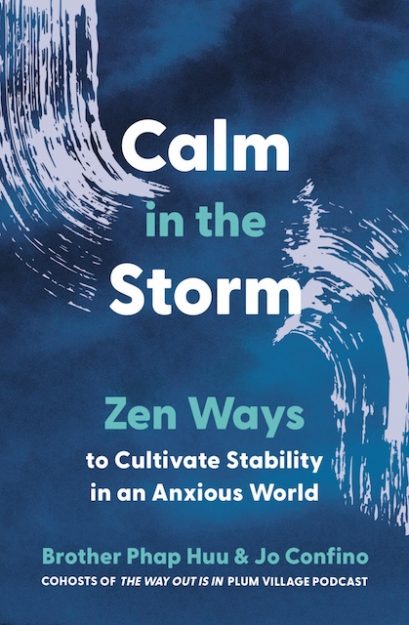
Reprinted from Calm in the Storm: Zen Ways to Cultivate Stability in an Anxious World by Brother Pháp Hữu and Jo Confino, 2025, with permission from Parallax Press.

Thank you for subscribing to Tricycle! As a nonprofit, we depend on readers like you to keep Buddhist teachings and practices widely available.