
Language is a fundamental part of who we are, and there are profound consequences when we cannot express ourselves in our mother tongue. Since fleeing Tibet in 1959, the Dalai Lama has worked to preserve Tibetan culture while also encouraging Tibetans to engage confidently with the modern world. As the vehicle for philosophy, narrative, and liturgy, the Tibetan language remains central to the transmission of Tibetan Buddhist tradition.
Tibet is home to an extraordinary diversity of languages, many of which are threatened by environmental and political changes. Tibetan is still widely spoken in daily life and religious settings, yet Mandarin increasingly dominates public institutions; Chinese-medium preschools and kindergartens are now widespread. In diaspora communities, there are many incentives and pressures for younger Tibetans to adopt dominant languages. Yet these same forces have also created opportunities for collaboration and preservation outside Tibet.
Switzerland was among the first countries to welcome large groups of Tibetan refugees and is home to the largest diaspora community in Europe. Franziska Oertle is a Swiss scholar who studied Tibetan in Nepal before becoming one of its most respected teachers in Asia, Europe, and the United States. Her students say she has “cracked the code” of teaching colloquial Tibetan. I recently spoke with Franziska about her efforts to make Tibetan language learning more widely accessible around the world.
What first inspired you to learn Tibetan? We have four national languages in Switzerland, and even as a child, I loved learning them—I was a total language nerd. I was also fascinated by foreign cultures and religions. In 2005, I attended a public teaching by His Holiness the Dalai Lama. I felt such a strong heart connection to him—but I was so frustrated that I had to listen through a translator! I remember thinking, I want to understand this myself. A year later, I quit my teaching job, left my apartment, family, and friends behind, and moved to Nepal to study Tibetan.
I met you around this time at Ka-Nying Shedrub Ling Monastery in Kathmandu, aka the White Gompa. You really stood out because of your passion for indigenous grammar and your dedication to learning the colloquial language. Yes, my interests were quite different. My friends called me the “black sheep” in the White Gompa! I became so fascinated with Tibetan grammar that I decided to research—and eventually write my thesis on—The Thirty Verses and The Application of Gender. The latter is a very difficult text, even for native speakers. I wanted to know how Tibetans themselves interpreted these texts, so rather than relying on previous academic research, I studied them with local scholars and only Tibetan sources. I took countless classes with Mingyur Dorje-la, who was considered one of the most knowledgeable Tibetan linguists in Nepal. My master’s thesis is simply the work of a grammar lover who wanted to make these crucial Tibetan texts more accessible to an English-speaking audience.
What is it about the Tibetan language that you find so compelling? I could say so many things—for me, it’s such a special language! For starters, it’s important to know that colloquial and literary Tibetan are very different. In some cases, scholars who have spent decades translating Tibetan Buddhist texts can’t order a cup of tea because they don’t know the spoken language. On the other hand, the average Tibetan on the street would likely struggle to read classical texts because of the vocabulary and the complexity of the literary grammar.
Buddhist philosophical concepts are reflected in and expressed through the Tibetan language and grammar. Tibetan distinguishes between what we have seen ourselves—direct evidence—and what we know through inference. Its grammar also captures the degree of volition behind an action, distinguishing between things done intentionally and events that simply happened to us. Tibetan is shaped by the grammatical principle of bdag and gzhan, the mutual dependence of “self” and “other.” In these ways, the language reflects a wide range of philosophical ideas, although these intricacies are often overlooked in language manuals written by non-Tibetans.
Language is an expression of culture, and culture is expressed through language. Both are living, evolving organisms.
Tibetan also has a fascinating honorific register. Many European languages distinguish between formal and informal pronouns, but Tibetan—like many other Asian languages—also has honorifics for nouns, adjectives, and verbs. Honorifics are not only used for people but also for sacred places, revealing a great deal about what is valued in Tibetan culture. Because honorific language is not used in the same way in all regions of Tibet, there is even a term for mixing honorific and nonhonorific forms: zhe sa rkang chag, literally, “honorific with broken legs.”
Is it this connection to culture that makes language preservation such an important goal for the Dalai Lama and other Tibetan leaders? I cannot speak for them, but I believe that language is deeply intertwined with culture. Language is an expression of culture, and culture is expressed through language. Both are living, evolving organisms. His Holiness has also spoken about the connection between language and identity.
Tibetan speakers have always been relatively few in number, and we know that the number is declining. It’s a sad reality. The hundreds of thousands of Tibetans who fled into exile had to abruptly learn how to navigate modern life. Maintaining their language and culture on top of that has been an enormous challenge. His Holiness understood this well, which is why he founded the Tibetan Children’s Village soon after arriving in India in 1959.
How do you see your work contributing to this effort? For the past fifteen years or so, I’ve worked to make books and resources for learning spoken Tibetan more widely accessible. Unlike classical Tibetan—which has been studied in universities for decades—colloquial Tibetan is an underdeveloped field of study. I feel deeply inspired by His Holiness, but I’m not a Tibetan Buddhist, so this is my way of expressing my gratitude—of honoring and repaying the kindness of so many Tibetan Buddhist teachers.
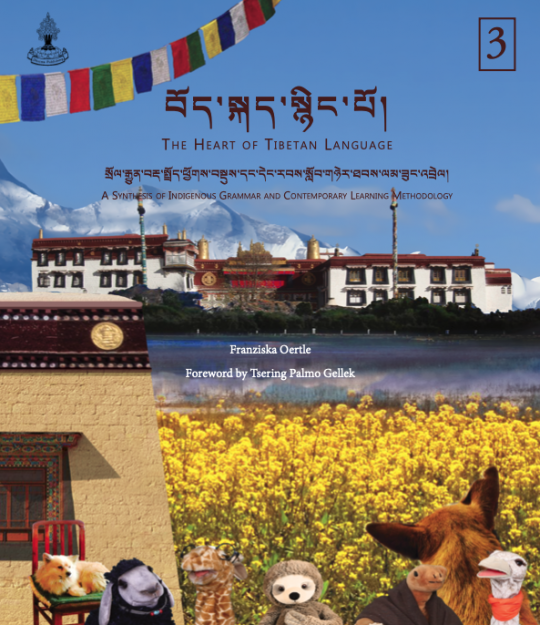
I’ve published three out of four volumes of The Heart of Tibetan Language: A Synthesis of Indigenous Grammar and Contemporary Learning Methodology, along with innovative online courses that guide students through the textbooks. These days, I teach Tibetan online and at the Sarnath International Nyingma Institute. These textbooks have been translated into Spanish and Portuguese and will be available very soon in Italian and German.
I always design and teach language courses alongside Tibetan tutors and teachers, and it’s been very meaningful and enriching for all of us. My native-speaker colleagues often use the word po pa to describe the sense of pride in their culture and the uniqueness of their language when they see non-Tibetans taking an interest in it. Po pa doesn’t have a straightforward translation into English, but it conveys a sense of self-confidence. Together, we are helping to preserve Tibetan.
What is unique about the approach you take to teaching Tibetan in your books and courses? The Tibetan educational system is generally quite conservative, with grammar instruction traditionally passed down orally from teacher to disciple. I believe that preserving this knowledge requires presenting it in a way that is engaging rather than dry or intimidating. My textbooks draw on my graduate research and are designed to make profound grammatical concepts accessible without oversimplifying them.
Tibetan has a reputation for being particularly difficult, but I don’t entirely agree with this assessment. Certain aspects of it are undeniably challenging—for example, spelling! The dialects are also very different, so even after learning one dialect, you can meet someone from a different area and understand almost nothing. But it’s unfair to say that Tibetan is much harder than other languages. It just needs to be presented and taught well.
Language learning—and this is now well established—is much more than just memorizing vocabulary and grammatical structures. Learning changes our relationship to ourselves and to others, and this process is different for each person. For that reason, my pedagogy is student-centered, and the tone is friendly and encouraging.
What are the complexities of being a Swiss woman teaching Tibetan? How have you navigated your role as a cultural outsider? When I first arrived in Nepal, I knew very little about Tibetan culture. Living with a Tibetan family for many years, together with the guidance of friends and colleagues, has given me a much deeper understanding. But no matter how well I speak the language, how many times I’ve met His Holiness, or whether I’m a Buddhist, I’m not Tibetan. I’m Swiss.
Generally, I’ve felt very respected for my work. His Holiness wrote the forward to my first textbook. I’ve spoken about the books on Tibetan radio, and the first book was launched at the Library of Tibetan Works and Archives. The entire event was held in Tibetan. As I mentioned, colloquial and literary Tibetan are very different—so seeing the spoken language in print can come as a surprise for Tibetans! But overall, people have shown a great deal of appreciation for my sincere efforts to understand and support their language and culture.
As you look ahead, do you see new ways in which your work can contribute further to this kind of cultural exchange? Yes, we have many exciting plans and projects already underway. I consider myself a bit of a global citizen, and I dream that my Tibetan language textbooks and our online courses become available to dedicated learners in many different parts of the world.
The first step is to have my books translated into more languages. Mandarin and Russian are at the top of our wish list. Our long-term vision is to offer all volumes of the textbook series, along with the complete online courses, in multiple languages so that people around the globe can study Tibetan with joy and a smile in their own mother tongue.

Thank you for subscribing to Tricycle! As a nonprofit, we depend on readers like you to keep Buddhist teachings and practices widely available.