
“What is the mind?” This central question in Buddhism has always gripped Tricycle founder Helen Tworkov. In Lotus Girl: My Life at the Crossroads of Buddhism and America, Tworkov recounts with impressive clarity not only the key events and people in her life that drive at this question but also what she was thinking at the time and how her thinking evolved as she immersed herself in Buddhist practices and communities. Across the book, Tworkov shows us firsthand that the habits, neuroses, and fears we carry are not ours alone, and even if we can’t rid ourselves of them entirely, we can at least relate to them with more spaciousness and less suffering.
When Lotus Girl first came out in 2024, Tworkov spoke with Tricycle’s editor-in-chief, James Shaheen, in an interview on Tricycle Talks, and a story from the book about Pema Chödrön appeared in Tricycle magazine. In the interview below, Tworkov speaks with Tricycle Senior Editor of Audience Engagement Alison Spiegel about the universality of her inner experiences, the Buddhist principles she still finds extraordinary, and how she’s learned to view herself and the world with more equanimity.
The interview has been edited for length and clarity.
Your memoir, Lotus Girl, is just out in paperback. Why did you want to write the book, and why did it feel like the right time to write it? I think for a long time I had wanted to write something about Buddhism in America, something about that story. Part of the inspiration was the histories I had been reading, which followed a very conventional style of going from one great-man event to the next. Since my own life was so embedded in the dissemination of dharma into the convert community in America, I knew that wasn’t the whole story. I was a member of a vast number of people who were on the ground doing nitty-gritty work, stumblebums that we were, and I saw the evolution of it in a very different way from “this great man came to America, and then that great man came to America. This is how it started, and this is what happened.”
As for the timing, I had thought for years about how to do this, and I’m not a historian. I’m not a scholar. The idea of doing research for this book bored me to death. I had no interest. So I finally got this idea: Oh, I could do it as a memoir. That was how it came about.
Early in the book, you recall experiences with psychedelics and city forays, including lunches with Charles Mingus and working the hat check at the original jazz club, the Five Spot. You write that you were living with a sense that something was missing, that your life “lacked something, some crucial ingredient.” Can you talk about how this sense of lack showed up in your early life? Where do you think it came from? I don’t know that I can point to an origin story for myself, but I think that sense of lack is very common to the human condition. Every kind of human dysfunction that I later discovered in Buddhism is treated as the human condition. I just assumed [it] was endemic to my own dysfunction. I didn’t know that the sense of missing something was the most common human experience once somebody took on the question of who they were and what their life was about.
You write about traveling in Asia in your early 20s: Japan, Cambodia, India, and Nepal. In Japan, you read D. T. Suzuki and concluded that, “Buddhism told the truth about things that Americans lied about.” Can you explain what you are referring to? When I was a child, we didn’t talk about death. I didn’t go to any funerals. That wasn’t uncommon. It was my personal life, but it seemed pretty common. I grew up in New York City. Perhaps in small villages and small towns, children are more included in the social rituals of living and dying within their own churches or religious communities. I didn’t have that as a secular Jew. I was not in any way associated with a community like that, and so death became a kind of dirty word. It was something that wasn’t spoken about. I had relatives who died when I was little, and I did not go to their funerals. There was a sense of having to protect the children from something so unpleasant or difficult.
So when I read D. T. Suzuki and he talked about dying as if it was like, “Yeah, well, you know, that’s the way it is, folks,” it was a bit shocking, the ease with which he spoke about it. I wasn’t used to that at all.
In India, in the city of Varanasi, looking at the Ganges River, you remembered hearing how Allen Ginsberg and others had once jumped in, and you recalled envying their freedom. Did this experience of feeling envious of the freedoms and privileges afforded to men come up frequently in your life at this time? How did you cope with it? In one way, I’m very much a second-generation feminist. That came a little bit later. At this point in my life, I was completely immersed in what we would now casually refer to as patriarchy. It was the air I breathed, and I think I was still too young to look at it in a more analytical, more distant, or more objective way. So, yes, there was an envy there. Even when I recalled, at that point, reading On the Road or reading Jack Kerouac, there was an envy of what those guys could do. They could travel around the country by themselves. I certainly could not, and so there was that difference. But I think it took a few more years, especially in trying to do things within my own society, before I became more sensitized to it.
But you did travel to Asia by yourself. In one way, maybe you were swimming in it, but in another way, it feels like you were above it. That’s true. I remember having a conversation with a friend when I came back from Asia, and they were astonished that I could be so brave. I sort of didn’t know what they were talking about. I didn’t have a sense of courage. I was so fearful in other ways. For example, I couldn’t walk into a party by myself, but I could go to Asia by myself. I could never have traveled in America alone. There were a lot of things that other people could do that I couldn’t do, and I was very aware of that. I had a lot of friends in New York, even when I was younger, who had come from other places. I’m the only one who took a taxi home regularly to avoid the subway. But I didn’t have any trouble walking around India.
What you feel courageous about, or what becomes an obstacle, isn’t always logical.
While you were in Nepal, you visited a Tibetan refugee camp and were struck by the easy abandonment of suffering. Recalling your Jewish family, you wrote, “Nothing in my background suggested that a people persecuted with the intention of extinction could express carefree exuberance.” What did their joy teach you about suffering? It taught me that you could hold suffering and joy together. I didn’t know that. There was a lot of dysfunction in my personal family. Whether that was completely separate from the Holocaust or not, I can’t say. I grew up in the shadow of the Holocaust. My father was born in Eastern Europe, and my mother was born in New York. Certainly, they were very aware of it when it was going on. Did that influence their own issues with depression, and the depression in their families? Was it completely separate? Probably not. But I don’t know how to put all that together.
What you feel courageous about, or what becomes an obstacle, isn’t always logical.
What I do know is that in my secular Jewish upbringing, especially on my mother’s side, suffering was always presented as a very noble quality. If you were a particularly happy person, you were an idiot. She liked to say that if you were too cheerful, it just meant you were brainless.
That experience at the refugee camp really was a pivot for me, because I suddenly had to understand how much of my own suffering was created by my mind, and how much of my mother’s suffering was created by her mind. It takes away the whole blame game, which Americans, for all their rallying around independence, love nothing better than: to blame everybody around them. You don’t get to do that once you understand. It’s not that the people around you can’t be held accountable in certain ways. But it changed my whole understanding of the mind, of what the mind could do, of suffering, and that you have to take responsibility for your own suffering.
It’s a basic, fundamental principle of Buddhism. I first learned it some fifty years ago, and it still strikes me as absolutely extraordinary.
Why was the issue of blame, or taking ownership of your own mindset, so salient for you? I was very involved with the Vietnam War in the late ’60s. I married a draft resister. We were in the middle of this Vietnam nightmare, and we were so angry. Suddenly, these Buddhists started showing up, teachers for the convert communities, and basically they were saying, “Hey, guys, hold on here. There’s nothing out there that justifies continuing your anger. Nothing.”
It wasn’t that we couldn’t hold the government accountable. Accountability and blame are a little different. In [the forthcoming book I cowrote with Mingyur Rinpoche,] A World of Difference, some of these questions come up. But what we had to learn is that if you’re very angry, you’re contributing anger to the world. Anger can be a wonderful wake-up call. But certainly around Vietnam, for my generation, we wore our anger like a badge of courage. We thought the more angry we were, the more it indicated to ourselves and others that we cared deeply about Vietnam and about the killing of innocent people. But that turned out to be completely arrogant on our part. It wasn’t the arising of anger, because that can be very helpful, but holding on to it, indulging in it, talking about it, fomenting it. . . . All of that was contributing anger. That was really hard for us to accept.
Buddhism is always teaching how we relate to something. It’s not the thing itself. It’s not the war, and the inequality. What creates our own unhappiness is how we relate to that.
Do you still wrestle with taking responsibility? The habit of blame is such a delicious emotion. “I’m right and you’re wrong.” How delicious is that? So as an intellectual idea, I feel like I’ve over and over again learned the truth. But I really have habituated patterns of “That person’s wrong,” and then I relate to it very differently. I can talk myself down. I can take a look at it. I can laugh at it. I don’t hold on to it. But it’s not like it doesn’t arise. It arises.
At one point in Lotus Girl, you talk about attending a workshop with Chögyam Trungpa Rinpoche, whom you had heard about but never met in person. When you left the workshop, you wrote that your big takeaway was a reverence for lineage, which distinguished the Tibetan Buddhist teachings from your previous spiritual experiences. Why was this such a big turning point for you? At that point, I had been experimenting with these homegrown New Age offshoots, and one in particular called Arica, which is actually a completely extraordinary program, but it didn’t have deep roots. I had heard about Trungpa Rinpoche, but I had heard things that I didn’t want to get too close to. But he was one person in this lineage, and the idea that you could have this long-lasting lineage of mind-to-mind transmission for hundreds of, even a thousand, years meant that no one person in it was the whole story. There was something much bigger than one person.
In the workshop that I went to, Trungpa Rinpoche was teaching on Milarepa, the most iconic, most beloved figure in his own lineage. To have that extraordinary breadth, going back to the 11th century and to modern-day America, and to see what the possibilities of transmission were and what was being transmitted. . . . We weren’t talking about cultural transmission. We weren’t talking about all the things that were problematic about Trungpa. That’s not what was involved in the transmission. It purified, or distilled, so-called personality in a way that was extremely trustworthy.
You were also a student of Thinley Norbu Rinpoche, Dudjom Rinpoche’s son, and he told you to relax your mind. Why was this such pivotal advice for you, and why was it hard to follow? I think “relax” is still a word the Tibetans use, and I still think it’s problematic. In my language, “relax” is like, you know, sit back, smoke a joint, have a glass of wine, go to the beach, go to a movie. That’s my version of relax. “Relax your mind” does not exactly mean that. “Relax your mind” is more like recognizing the way in which the mind is bound so tightly, as if it’s imprisoned behind prison bars that are [as] tight as anything. To loosen those is to loosen the ego, to loosen the self-preoccupation, to loosen the self-centeredness. That’s not so easy, especially when you’re starting out. So the idea of “relax your mind” was a very attractive possibility, but I had no way to relate to it.
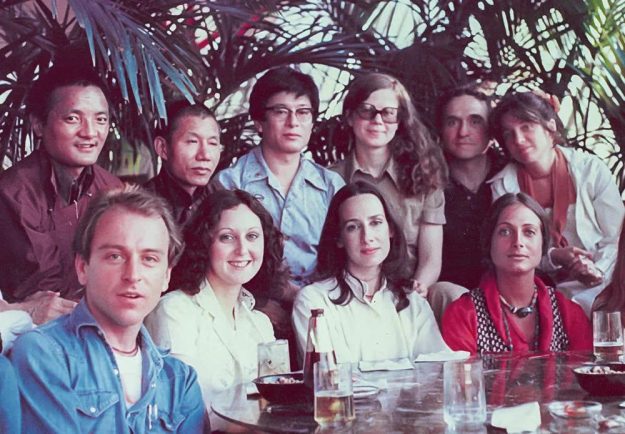
I didn’t understand, until I got deeper into my own meditation practice, how tightly bound, how imprisoned, we keep our minds. With that recognition, of course, “relax” had a different connotation.
Throughout the book, you return to the tension between delighting in your friends and your social life, your dog, your worldly attachments, even as you immerse yourself more in Buddhist practices and the teachings of nonattachment. Have you satisfactorily resolved this tension? I would say, in a certain way, yes, but not because I don’t get seduced by worldly invitations or worldly delights. It’s somewhat satisfactory because I don’t get sucked in in quite the same way I used to, and I’m more accepting of it when I do. It’s not, “Oh, no, I did that again.” It’s more like, “Oh, well.” So the dysfunction, or the disjunction, isn’t quite as strong.
You also write about your own depression, even at a young age. You describe spending a whole year in bed, paralyzed, and thinking about family members who suffered from mental illness. But you write that you were determined not to become “hostage to genetics.” While many of us who can relate to this would choose to run away, Buddhism teaches us we can’t outrun our past. You described looking around one day and realizing you didn’t feel depressed anymore. What finally changed for you? I don’t really know, and I don’t think it was an aha moment. My recognition of it was quite sudden. I was walking to the zendo. It was early in the morning, and the recognition was sudden. Like, “Oh, I feel really different. So what is that?” And then I realized that this heaviness I had always known, especially early in the morning, was simply not there, and I was stunned.
But I think what happened suddenly was the recognition. The process of lightening up, the process of not holding this like a boulder so close to my heart, had been happening for a while. And I think the meditation practice that I did, even though I look back on it as not very strong, was strong enough, it turned out, to make some shift.
When you launched Tricycle in 1991, scandals had been surfacing in the Buddhist convert world for a few years. Can you describe the scene of Buddhism in America at the time? Before any of the scandals broke, there was a group of us who had been talking about starting a magazine, and it looked like such a lark. How much fun could this be? We could come together from different traditions, and we could work together, a group of friends, and it just seemed like an idealistic, wonderful thing to do. And then the scandals started to break, one after the other. The Zen communities, Tibetan communities, the Theravada communities.
Rick Fields and I were having conversations about Tricycle. He had written this wonderful book called How the Swans Came to the Lake: A Narrative History of Buddhism in America, and, as I say in Lotus Girl, he joked that the sequel would be How the Swans Drowned in the Lake.
Buddhism wasn’t so strongly established that we could just assume it was going to weather all of this. The scandals were about sex, alcohol, and money. It wasn’t obvious to us that it was going to last, so things suddenly became a little precarious, and the interest in starting a Buddhist magazine became kind of serious. We needed a forum. We were on the telephone all the time; it’s all we talked about. But you couldn’t write about it anywhere. None of the house organs would allow anything to be written, and so the whole aspiration of why to start something shifted, and it became a different kind of project.
It wasn’t obvious to us that it was going to last, so things suddenly became a little precarious, and the interest in starting a Buddhist magazine became kind of serious.
There were several incidents, and then finally one broke into the press. The idea that it was going to be handled by an unsympathetic press was very disheartening. We thought: We want to handle it.
Can you describe your relationship with Rick Fields? The first time I met him was at a weekend workshop with Dudjom Rinpoche. It was in the mid-’70s, and we were introduced. He said something like, “I think we were siblings before we were born,” and I thought, “This is the dumbest pickup line I ever heard.” I was very dismissive, very disdainful.
It turns out that he knew about a chapter in my parents’ life that I did not know. Our parents had shared a loft together on East 22nd Street, something like that. It was in the ’30s, and he knew this history, and I didn’t quite believe it because I had never heard it. So I went to a pay phone that was inside the restaurant in the lobby, and I called up my mother, and I said, “You know these people?” And she said, “Yes.” So then I hung up, and I went back, and I sat down next to Rick, and I just started relating to him as a brother from that day forward.
Can you talk a little bit more about the founding values behind Tricycle? What was important to you? The job of starting a magazine was absolutely enormous. But in terms of content, it was pretty simple. I believed strongly in basic Buddhist concepts: the suffering of the mind, impermanence, the absence of what we call a “self.” Those are basic Buddhist concepts, and they were very important to me then, and they’re still very important to me. They still stand out as the most extraordinary concepts. You could do all these fancy practices and deity practices, this practice, that practice, but for me, those fundamental truths still hit home the deepest. So the question was how to get that out there, what to do about that, and how to present it.
You’ve just coauthored a new book with Yongey Mingyur Rinpoche, titled A World of Difference: Finding Peace and Freedom in Times of Fear and Chaos. The book makes ancient Buddhist teachings and practices applicable to our lives today. So what is the purpose of sitting silently in meditation when it seems that the world is on fire? I would say that sitting in meditation allows us access to a part of ourselves that we could call the inner refuge, which is always there but that we don’t always recognize as there. If we can connect to it, we have a place that does not go up and down along with the news events. It doesn’t go up and down like the stock market. It doesn’t blow around like the weather. It’s not affected by hurricanes and windstorms. It’s always available to us as a very stable and stabilizing force. Traditionally, that’s called buddha-nature.
With Mingyur Rinpoche’s new book, A World of Difference, the subtitle is Finding Peace and Freedom in Times of Fear and Chaos. The beauty of this book is that he’s writing again about buddha-nature but for non-Buddhists. There have been hundreds and thousands of words written about this subject. However, Mingyur Rinpoche’s brilliance in this book, from my point of view, is to give incredibly pragmatic, flat-footed examples and exercises to actually show you how to connect to this.

Thank you for subscribing to Tricycle! As a nonprofit, we depend on readers like you to keep Buddhist teachings and practices widely available.