
Today three children, two girls and a little boy, came from the village to play with Thanh Thuy (pronounced “Tahn Tui”). The four of them ran off to play on the hillside behind our house and were gone for about an hour when they returned to ask for something to drink. I took the last bottle of homemade apple juice and gave them each a full glass, serving Thuy last. Since her juice was from the bottom of the bottle, it had some pulp in it. When she noticed the particles, she pouted and refused to drink it. So the four children went back to their games on the hillside, and Thuy had not drunk anything.
Half an hour later, while I was meditating in my room, I heard her calling. Thuy wanted to get herself a glass of cold water, but even on tiptoes she couldn’t reach the faucet. I reminded her of the glass of juice on the table and asked her to drink that first. Turning to look at it, she saw that the pulp had settled and the juice looked clear and delicious. She went to the table and took the glass with both hands. After drinking half of it, she put it down and asked, “Is this a different glass, Uncle Monk?” (a common term for Vietnamese children to use when addressing an older monk).
“No,” I answered. “It’s the same one as before. It sat quietly for a bit, and now it’s clear and delicious.” Thuy looked at the glass again. “It really is good. Was it meditating like you, Uncle Monk?” I laughed and patted her head. “Let’s say that I imitate the apple juice when I sit; that is closer to the truth.”
Without a doubt, Thuy thought that the apple juice was sitting for a while to clear itself, just like her Uncle Monk. “Was it meditating like you?” I think that Thanh Thuy, not yet five, understands the meaning of meditation without any explanation. The apple juice became clear after resting awhile. In the same way, if we rest in meditation awhile, we too become clear. This clarity refreshes us and gives us strength and serenity. As we feel ourselves refreshed, our surroundings also become refreshed. Children like to be near us, not just to get candy and hear stories. They like to be near us because they can feel this “freshness.”
Tonight a guest has come. I fill a glass with the last of the apple juice and put it on the table in the middle of the meditation room. Thuy is already fast asleep, and I invite my friend to sit very quietly, just like the apple juice.
A River of Perceptions
We sit for about forty minutes. I notice my friend smiling as he looks at the juice. It has become very clear. “And you, my friend, are you? Even if you have not settled as thoroughly as the apple juice, don’t you feel a little less agitated, less fidgety, less disturbed? The smile on your lips hasn’t faded yet, but I think you doubt that you might become as clear as the apple juice, even if we continue to sit for hours.
“The glass of juice has a very stable base. But you, your sitting is not so sure. Those tiny bits of pulp only have to follow the laws of nature to fall gently to the bottom of the glass. But your thoughts obey no such law. To the contrary, they buzz feverishly, like a swarm of bees, and so you think you cannot settle like the apple juice.
“You tell me that people, living beings with the capacity to think and to feel, cannot be compared with a glass of juice. I agree, but I also know that we can do what the apple juice does, and more. We can be at peace, not only while sitting, but also while walking and working.
“Perhaps you don’t believe me, because forty minutes have passed and you tried so hard but weren’t able to achieve the peace you hoped for. Thuy is sleeping peacefully, her breathing is light. Why don’t we light another candle before continuing our conversation?
“Little Thuy sleeps this way effortlessly. You know those nights when sleep eludes you, and the harder you try to sleep the less you can. You are trying to force yourself to be peaceful, and you feel the resistance inside of you. This same sort of resistance is felt by many people during their first experiences with meditation. The more they try to calm themselves, the more restless they become. The Vietnamese think this is because they are victims of demons or bad karma, but really this resistance is born out of our very efforts to be peaceful. The effort itself becomes oppressive. Our thoughts and feelings flow like a river. If we try to stop the flow of a river, we will meet the resistance of the water. It is better to flow with it, and then we may be able to guide it in ways we want it to go. We must not attempt to halt it.
To keep this sun always shining inside of us, illuminating each rivulet, each pebble, each bend in the river, is the practice of meditation.
“Keep in mind that the river must flow and that we are going to follow it. We must be aware of every little stream that joins it. We must be aware of all the thoughts, feelings, and sensations that arise in us—of their birth, duration, and disappearance. Do you see? Now the resistance begins to disappear. The river of perceptions is still flowing, but no longer in darkness. It is now flowing in the sunlight of awareness. To keep this sun always shining inside of us, illuminating each rivulet, each pebble, each bend in the river, is the practice of meditation. To practice meditation is, first of all, to observe and to follow these details.
“At the moment of awareness we feel we are in control, even though the river is still there, still flowing. We feel ourselves at peace, but this isn’t the ‘peace’ of the apple juice. Being at peace doesn’t mean our thoughts and feelings are frozen. Being at peace is not the same as being anesthetized. A peaceful mind does not mean a mind empty of thoughts, sensations, and emotions.”
Sunshine and Green Leaves
Beginning meditators usually think they must suppress all thoughts and feelings (often called “false mind”) in order to create conditions favorable to concentration and understanding (called “true mind”). They use methods such as focusing their attention on an object or counting their breaths to try to block out thoughts and feelings. Concentrating on an object and counting the breath are excellent methods, but they should not be used for suppression or repression. We know that as soon as there is repression, there is rebellion—repression entails rebellion. True mind and false mind are one. Denying one is denying the other. Suppressing one is suppressing the other. Our mind is our self. We cannot suppress it. We must treat it with respect, with gentleness, and absolutely without violence. Since we do not even know what our “self” is, how can we know if it is true or false, and whether or what to suppress? The only thing we can do is to let the sunlight of awareness shine on our “self” and en-lighten it, so we can look at it directly.
Just as flowers and leaves are only part of a plant, and just as waves are only part of the ocean, perceptions, feelings, and thoughts are only part of the self. Blossoms and leaves are a natural manifestation of plants, and waves are a natural expression of oceans. It is useless to try to repress or stifle them. It is impossible. We can only observe them. Because they exist, we can find their source, which is exactly the same as our own.
Since we do not even know what our “self” is, how can we know if it is true or false, and whether or what to suppress?
The sun of awareness originates in the heart of the self. It enables the self to illuminate the self. It lights not only all thoughts and feelings present. It lights itself as well.
Let us return to the apple juice, quietly “resting.” The river of our perceptions continues to flow, but now, in the sunlight of awareness, it flows peacefully, and we are serene. The relation between the river of perceptions and the sun of awareness is not the same as that of an actual river and the actual sun. Whether it is midnight or noon, whether the sun is absent or its penetrating rays are beaming down, the waters of the Mississippi River continue to flow, more or less the same. But when the sun of awareness shines on the river of our perceptions, the mind is transformed. Both river and sun are of the same nature.
Let us consider the relationship between the color of leaves and sunlight, which also have the same nature. At midnight, the starlight and moonlight reveal only the form of the trees and leaves. But if the sun were suddenly to shine, the green color of the leaves would immediately appear. The tender green of the leaves in April exists because the sunlight exists. One day, while sitting in a forest, mimicking the Prajna Paramita Heart Sutra, I wrote:
Sunshine is green leaves
Green leaves are sunshine
Sunshine is not different from green leaves
Green leaves are not different from sunshine
The same is true of all forms and colors.
As soon as the sun of awareness shines, at that very moment a great change takes place. Meditation lets the sun of awareness rise easily, so we can see more clearly. When we meditate, we seem to have two selves. One is the flowing river of thoughts and feelings, and the other is the sun of awareness that shines on them. Which is our own self? Which is true? Which false? Which is good? Which bad? Please calm down, my friend. Lay down your sharp sword of conceptual thinking. Don’t be in such a hurry to cut your “self” in two. Both are self. Neither is true. Neither is false. They are both true and both false.
We know that light and color are not separate phenomena. In the same way, the sun of self and the river of self are not different. Sit with me, let a smile form on your lips, let your sun shine, close your eyes, if need be, to see your self more clearly.
I just told you to put down your sword of conceptualization and not cut your self into sections. Actually, you couldn’t, even if you wanted to. Do you think you can separate the sunshine from the green color of the leaves? You can no more separate the observing self from the self observed.
♦
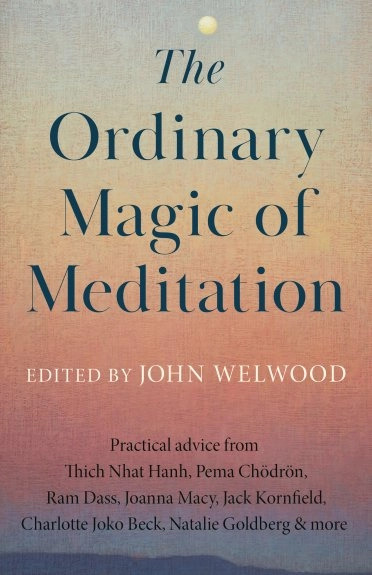
Adapted from The Ordinary Magic of Meditation © 2026 edited by John Welwood. Reprinted in arrangement with Shambhala Publications, Inc. Boulder, CO. www.shambhala.com

Thank you for subscribing to Tricycle! As a nonprofit, we depend on readers like you to keep Buddhist teachings and practices widely available.