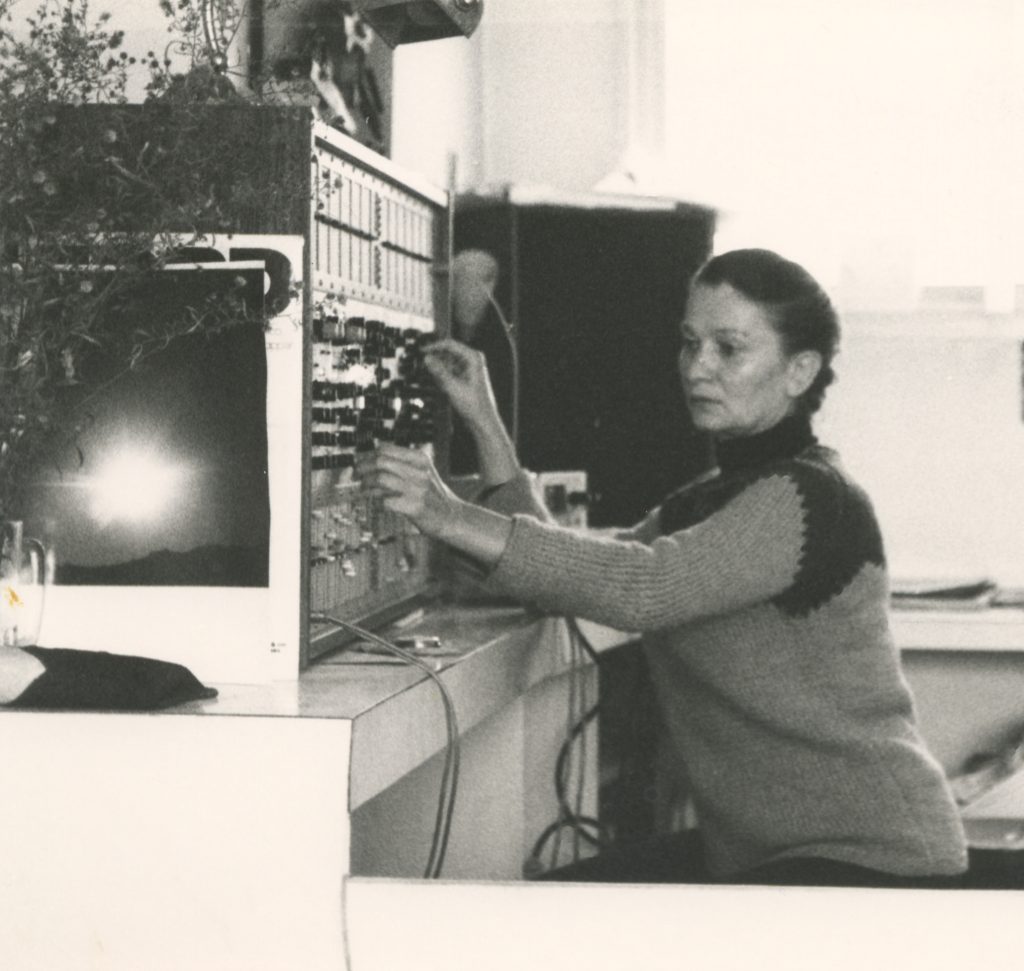
Even before she was introduced to Tibetan Buddhism, in 1974, French experimental musician Éliane Radigue’s lengthy, immersive, and extremely subtle electroacoustic works were already inviting comparisons to meditation, coaxing audiences to reorient themselves toward infinitesimal, centerless auditory phenomena and, in the process, toward listening itself. Performance reviews from the late 1960s and early ’70s capture the contemplative quality of this early work in terms strangely suggestive of Buddhist teachings: “One kept waiting for something to happen. Then one became aware that on a far smaller level, the sounds were constantly permutating in texture, that a steady stream of sonic activity was, in fact, taking place right at the edge of one’s perceptions.”
 Alien Roots: Éliane Radigue
edited by Charles Curtis and Lawrence Kumpf
Blank Forms Editions, 2025,
407 pp., $25.00, paper
Alien Roots: Éliane Radigue, edited by Charles Curtis and Lawrence Kumpf, offers a vibrant, exploratory account of Radigue’s life and work—a document that’s especially moving in the wake of her death, at 94, in February 2026. Published by the Brooklyn-based new music laboratory Blank Forms, the volume brings together archival materials and new critical writing to form something closer to a documentary portrait than a conventional biography. Among many other stimulating questions, Alien Roots tacitly asks how Buddhist practice has operated as a lived discipline within a creative life, shaping modes of attention, ethical orientation, and artistic process. In this sense, the book is compelling not only as a study of an influential experimental composer but also as an accessible record of how Buddhism has exerted cultural force beyond explicitly religious institutions, leaving traces in sound, perception, and practice. The book’s generous documentary texture—letters, sketches, rehearsal notes, and photographs—grounds its more demanding ideas in the contingencies of a life worked into art throughout the past six decades.
Radigue’s immersion in Buddhist practice after meeting the Tenth Pawo Rinpoche in 1975 initially seemed to overshadow her work with sound. Entering a yearslong retreat, she retired from her experimentation with the ARP 2500 analog modular synthesizer, the extremely complex instrument on which she’d created some of her most compelling early work. When Rinpoche later encouraged her to return to her musical career in 1979, however, and to create music “as an offering,” her engagement with the slow unfolding of almost inscrutable sonic phenomena resumed much as before—now developing explicitly alongside her dharma practice, and perhaps with gathering clarity. A Village Voice profile in 1982 observed that “the music still challenged the listener to slow down, be patient, and observe subtle changes.”
The resonance—or feedback loop—between Radigue’s work with sound and her spiritual practice emerges as one of the book’s central threads. Rather than isolating biography from technique or belief from composition, this book lingers in the space where these domains blur, suggesting how Radigue’s sonic experimentation and her Buddhist practice have developed in sustained, reciprocal relation.
Although materials collected in Alien Roots show how closely Radigue has collaborated with various avant-garde luminaries—through correspondences with figures such as Steve Reich, Pauline Oliveros, and Phill Niblock—the composer herself long remained reclusive. Only in recent years has her audience begun to widen and diversify, a shift owing in part to the French label INA GRM’s career-spanning, fourteen-disc reissue of her synthesizer works in 2018, as well as to her extraordinary productivity throughout the 2010s, during which she created dozens of new works, many composed for specific acoustic instrumentalists. This renewed attention may also reflect a broader desire among contemporary listeners for forms of listening that cultivate patience, attentiveness, and a heightened awareness within an often alienated auditory culture.
Alien Roots thus adds vigor to the final, especially generative, chapter in the composer’s career, an opportune—if poignant—moment to be immersed in what she has called her “unreal, impalpable music.” This exploration of her biography, techniques, and artistic and historical significance will be most readily appreciated by readers interested in musical experimentation since the mid-20th century, but there’s much for those simply curious about artists and their spiritual lives.
For both the initiated and the newcomer, Curtis’s introductory chapter offers an orientation to the composer and her work. Biographical detail mingles with insider perspectives on Radigue’s innovative processes with tape, acoustical feedback, and the ARP 2500 synthesizer, as well as, more recently, with acoustic instruments and the performers—like the author himself—who bring them to sound. Although Curtis approaches Radigue’s techniques with evident expertise, as someone who has worked in close collaboration with the composer, he never gets stuck in technical specifics but uses his observations to think more lyrically about her artistry and what’s singular and transformative in her work.
Rather than isolating biography from technique or belief from composition, this book lingers in the space where these domains blur
Emphasized throughout Curtis’s essay is the composer’s intense relationality with her sonic material and her approach to control—themes that might lend themselves to a specifically Buddhist, or at least contemplative, appreciation of her output. It’s nigh impossible to write music in a traditional sense for microphone feedback or the ARP 2500’s analog synthesis, for example. Instead, Curtis observes that Radigue created pieces by establishing the conditions under which sounds arise, then draws out exceptionally sophisticated acoustical phenomena through continuous monitoring and refinement in response to what emerges. It’s not top-down control but an integrative, relational process, facilitated by attentive listening. Curtis writes, “The act [of composition], then, is casting out information into a swirl, attending to the results, and attempting to shape them despite their unruliness. This dynamic presupposes a readiness to relinquish subjective domination, to renounce a posture of prediction in favor of what may be—in effect, to coexist with the material in a kind of entente.”
For the listener, the result is “a music, for lack of a better term, of personal experience,” one that “radically embraces an expressive state of uncertainty.” We are confronted with unfamiliar sounds that don’t move as we expect music to but instead unfold as “breath, pulsation, beating, murmurs, and the richness of the natural harmonics that radiate from [them],” directing attention toward acoustical phenomena and our own ears’ participation in the experience they create. What Curtis’s chapter so valuably clarifies is that the thrill of listening to Radigue lies in this continuous attunement to a sound-world poised between volatility and refinement—an immersive experience of sonic contingency and interrelation. As the composer herself remarks in a 1972 interview collected in Alien Roots, “It’s all an education of perception and sensations.”
On one hand, Alien Roots never insists upon Radigue’s embrace of Tibetan Buddhism as the sole or even primary framework for appreciating her work. Another critical essay by musician and writer Madison Greenstone, for instance, as well as the book’s concluding discussion among Curtis, Greenstone, and the composer Anthony Vine, places the phenomenological richness of Radigue’s music in revealing relation to broader currents in contemporary art and thought. Yet an intriguing, mutually generative relationship between Radigue’s “education of perception and sensations”—so often received as “meditative”—and her Buddhist practice since 1974 is nonetheless cued at several points throughout the book.
In her own statements, the composer is at once very explicit and guarded about this relationship. In a 1998 interview with Ian Nagoski, she comments, “I came to Tibetan Buddhism through music. . . .Buddhism came to me through music. I don’t try to understand anything about that, I just quote the facts as they are. . . .Maybe I was involved already with Buddhism in some way, and I didn’t know it. . . . I don’t know. There are a lot of questions for which I have no answers.”
Responding to such suggestive remarks, two essays in Alien Roots look at the “coming together” of Buddhist teachings and sonic experimentation in Radigue’s work since her mid-1970s conversion experience. Electroacoustic musician Daniel Silliman offers a highly technical reading of Radigue’s 1988 composition Kyema, suggesting that its sequence of subtle transformations encodes the six bardos of the so-called Tibetan Book of the Dead tradition. Tibetan Buddhism expert Dagmar Schwerk’s essay offers a more expansive reading of Kyema and its companion pieces, Kailasha and Koumé, revealing both the continuity between Radigue’s listening practice and Tibetan teachings on “taking sound as dharma” and the significance of Pawo Rinpoche’s instruction to create music as an offering.
While both essays are suggestive of the Buddhist charge in Radigue’s music, neither is entirely conclusive. Schwerk’s contribution is exceptionally provocative in this regard, opening onto further critical reflection on how something spiritually transformative—in this case, aspects of the Buddhist dharma—might be present in or operate through music, particularly music so far removed from traditional Buddhist contexts. Such questions invite broader consideration, not only of Radigue’s work but also of other Buddhist-influenced experimental composers, including Lou Harrison, Toshiro Mayuzumi, and Pauline Oliveros.
As a whole, Alien Roots: Éliane Radigue does deft and timely work toward its basic aims: reorienting readers to the remarkable career and works of an important, now recently departed, artist, invigorating listening through historical, technical, and critical observations, and lingering with questions—perhaps terminally elusive—about the transformative potential of this music. The book’s archive of a little-known musical world may initially seem forbidding to some readers, but what it does best, while drawing on the extraordinary spaciousness of Radigue’s compositions, is to invite and leave room for an open, “educative” engagement with the music itself. The essays are more suggestive than argumentative, interspersed with letters, sketches, and dialogues that serve as quiet, disarming reminders of the multidimensionality—and frequent inexplicability—of an artist’s life work.

Thank you for subscribing to Tricycle! As a nonprofit, we depend on readers like you to keep Buddhist teachings and practices widely available.