
Equanimity is a quality or virtue that many different religions and philosophies throughout the world and across the span of history have prized and cultivated. But Buddhism seems to have articulated this quality most fully. Even more important, Buddhism teaches practical tools and techniques to cultivate equanimity.
In the Visuddhimagga, the great treatise on Theravada Buddhism from the 5th century, Bhikkhu Buddhaghosa defines equanimity in ten different ways. In Pali, the word most often translated as “equanimity” is upekkha, meaning to observe with even-mindedness or nondiscrimination, which can sometimes express itself as impartiality and at others as seeing the big picture. An entire book could be written to explore and tease apart these different expressions of equanimity, requiring a serious Buddhist scholar who understands Pali and has devoted many years to the study of the whole system.
Buddhism is also known for its many lists, and equanimity figures prominently on at least four of these, where it is often expressed as the highest virtue or attainment. Of the schemas that include equanimity, the one that most fully articulates it is the four brahmaviharas (“celestial abodes,” to indicate just how sublime these virtues are):
loving-kindness (metta)
compassion (karuna)
sympathetic joy (mudita)
equanimity (upekkha)
They are considered sublime because their reach is boundless—and are therefore also called the four immeasurables, especially when we extend their reach to all sentient beings. They represent the most wholesome ways of relating to ourselves and others.
Each of the four immeasurables has both a far and a near “enemy.” The far enemies are fairly obvious: They are the opposite of each of the virtues. For example, the far enemy of loving-kindness is hatred, and the far enemy of compassion is cruelty. The near enemies are both more interesting and subtler. They masquerade as the “real thing” but lead us down a completely different path. For example, the near enemy of compassion is pity. Pity is often mistaken for compassion, and yet it separates us from the person suffering rather than connecting us to them. Pity says “poor you,” while I remain “up here” untouched by your pain.
The far enemy of equanimity could express itself as either volatility or reactivity. A key distinction here is that it’s possible to feel highly aroused on the inside without reacting with volatility on the outside. Another way to think about upekkha is seeing without being caught by what we see. This doesn’t mean not seeing, nor does it mean trying to control or suppress what we do see. It’s not controlling what we experience but rather relating to it differently—from an open perspective, without grasping after, rejecting, or ignoring it.
Relating to ourselves and our world from an open, nonjudgmental perspective is what mindfulness is all about.
Relating to ourselves and our world from an open, nonjudgmental perspective is what mindfulness is all about. More of the world at large has now embraced the practice of mindfulness because of its potential to bring ease into our daily lives. Mindfulness is about creating a space that enables us to be with experience just as it is. As we remove friction in the system by letting go of resistance, our experience naturally changes. It becomes more equanimous. Mindfulness and equanimity are intimately connected. Sharon Salzberg calls equanimity “the secret ingredient of mindfulness.” Mindfulness is both a route to and a function of equanimity. By the same token, equanimity can be a route to and a function of mindfulness. They mutually support and lead to each other.
Concepts like equanimity are often best evoked through metaphors. In Buddhist teachings, a metaphor that is often used for equanimity is grandmotherly love. Whether it is seeing with a grandmother’s eyes or relating through a grandmother’s heart (robai-shin from Zen Buddhism), the grandmother is able to love fully without being caught in the dramas of her grandchildren’s lives. She doesn’t take things personally and sees all children as deserving of love and care. She has seen through the trappings of identity and power and has the wisdom of perspective. A grandmother’s eyes are quiet eyes: They neither seek to possess nor disown. The grandmother’s gaze epitomizes unconditional goodwill.
What Equanimity Is Not
It’s as important to understand what equanimity is not as to understand what it is. This is especially true because equanimity’s subtleties make it subject to frequent misinterpretation.
Equanimity is not being “blissed out” or detached from the world. It is not withdrawing into ourselves and losing touch with the people or issues we care about. In fact, it is most decidedly not about “not caring.” We may find, as we progress through practices to cultivate equanimity, that it becomes more possible to engage with the challenges we face and not to be thrown into chaos or become overwhelmed—to maintain a sense of space and peace. It’s never the point of equanimity to become a robot or a statue but rather to become ever more human in the best sense of the word.
Balance is also an essential component of equanimity. Being wobbly is perhaps the most obvious far enemy of balance. However, stasis or stagnation can also be considered a far enemy of balance. Think of a surfer riding a wave. A surfer’s momentum is critical to the balance that keeps them from sinking. This is, in fact, the opposite of stagnation or stasis.
When talking about balance, a lot of us have an image of the balanced scales of justice, held by a woman in ancient Roman robes who personifies the law. Those scales are static, not moving. We may think that if we can assume that static pose of the woman holding the scales perfectly evenly, that will be equanimity. But people aren’t made of stone or marble. We’d actually get very tired holding up those scales.
The American Buddhist teacher Shinzen Young sees coagulation as the opposite or far enemy of equanimity, which he defines as noninterference with the flow of sensory experience. Our experience of ourselves and the world around us is constantly changing. Attempting to stop that flow—interference—is an illuminating way to look at and understand what equanimity is not.
An even more illuminating exercise in learning what equanimity is not is looking at its near enemies, states often mistakenly seen as equanimity. Near enemies are deceiving counterfeits. They lead to separation rather than connection and reify the sense of a separate self, all the while innocently masquerading as the “real thing.” The most significant near enemies of equanimity are indifference, detachment, apathy, and passivity.
Identifying near enemies clearly reveals and exposes the ways we can get off track with equanimity. Examining them is particularly important because equanimity can be subtle, quiet, soft, and a bit amorphous. Teasing apart these misleading versions of equanimity can lead to what my mentor, the prominent mindfulness teacher Jon Kabat-Zinn, calls an “orthogonal rotation of consciousness.” What this refers to is the process of rotating your perspective ever so slightly—leading to a shift in viewpoint that changes everything. Having taught mindfulness, forgiveness, compassion, and equanimity for the past thirty years, I have seen both the stubborn persistence of misconceptions and the power of clear seeing.
Intentionally regulating emotions is a slippery slope toward suppressing them.
A central misunderstanding in mindfulness is that “successful” meditation involves getting rid of thoughts. No matter how much I emphasize, both in instructions and in our discussions before and after meditation practice, that we are changing our relationship to thought rather than getting rid of thought, this misunderstanding persists. In fact, students often believe they heard it in the instructions when it wasn’t there!
I’ve noticed something similar when I teach classes on forgiveness. Students understand intellectually that forgiveness doesn’t mean condoning or saying what someone did is OK. It is simply the unburdening of the heart from past resentments. They buy in 100 percent intellectually, but when it comes to doing the practice, the resistance and questions that come up have to do with a mismatch between their emotional experience and their intellectual understanding. In other words, I’m not willing to forgive because I’m afraid that means, somehow, that I’m letting the other person off the hook, even though I understand full well that forgiveness doesn’t mean that.
There is an analogy to be drawn with equanimity. Equanimity doesn’t mean not having feelings. It doesn’t mean not having strong feelings. It doesn’t mean that we have to limit our feelings in any way whatsoever. Equanimity is about our relationship to our feelings; it’s not about changing them.
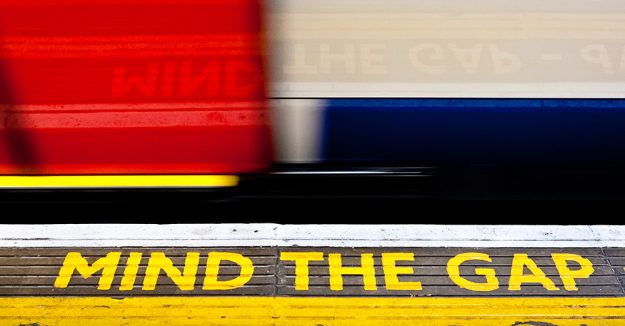
Again, this is easy to understand intellectually, and yet, in this same pernicious way, how we embody it can be at odds with how we understand it. For those who would like to cultivate equanimity, to enjoy and share its benefits, there seems to be a gap between hearing and understanding the words and operationalizing them. And it is this gap that fascinates me as a teacher because it’s part of the tricky mind that says, Yeah, yeah, yeah, I get it, but then why can’t I do it? So first and foremost, let’s address the gap. Let’s put it front and center and look closely at it (Mind the gap!), and then let’s approach it from lots of different angles.
Indifference and detachment mean both disconnected and not caring, and they are the most common mistaken interpretations of equanimity. Indeed, equanimity is actually an expression of concern that, far from ignoring its object, connects more fully to it. A classic stereotype of indifference masquerading as equanimity is a stoner saying, “Yeah, it’s all good, man,” while disappearing more and more deeply into a smoky cloud of unawareness.
We’ve also seen that apathy and passivity are far from being aspects of equanimity. Balance is an active, dynamic process, as seen in the image of the surfer and also of a spinning top or gyroscope. The gyroscope maintains balance due to the speed of its spinning. It’s an apt metaphor for equanimity because of the elegant mechanism that constantly recalibrates in order to remain upright or on course while forces of varying velocity bear down from all directions. The gyroscope doesn’t reject strong bouts of wind, nor does it get attached to calm waters. And, just as a gyroscope functions only in the context of setting a trajectory, likewise, setting our intentions helps us maintain balance and equanimity in the face of unpredictable and uncontrollable outward conditions.
Interestingly, a second, lesser-known Pali word for equanimity is tatramajjhattata, which actually means “to stand in the middle of.” Here again, this suggests the opposite of detachment. Instead, equanimity requires us to be up close with experience, standing wholly in the midst of the arising and passing of it all. It involves radical permission to feel and is, in fact, the opposite of suppression. It frees up coagulated energy and allows for a more fluid and balanced response to what we encounter in our daily lives.
Ironically, even the Merriam-Webster’s Dictionary definition of equanimity contains some potential near enemies as synonyms. One synonym is the French word sangfroid, literally translated as “cold blood,” which is often used in English. While the French word more precisely suggests coolness under pressure, the idea of being cold-blooded would suggest that equanimity involves being ice-cold. But, to the contrary, equanimity involves warmth and active engagement.
Another confusing synonym Merriam-Webster’s gives for equanimity is “composure.” This, unfortunately, implies the controlling of emotional or mental agitation by an effort of will. Composure often involves willfully trying to regulate our emotions. That’s the opposite of flow. It’s regulation, tightness, and impedance in the system. Though we typically think of emotion regulation as a good thing, it can result in feeling less compassion for others. Intentionally regulating emotions is a slippery slope toward suppressing them.
If the dictionary itself offers these synonyms of equanimity, then it’s not surprising how easy it is to get confused or misled and go down the wrong path when seeking equanimity. It’s a dynamic quality that has nothing whatsoever to do with apathy.
♦
Adapted from Quiet Strength: Find Peace, Feel Alive, and Love Boundlessly Through the Power of Equanimity. © 2026 by Margaret Cullen, reprinted with permission from HarperCollins.

Thank you for subscribing to Tricycle! As a nonprofit, we depend on readers like you to keep Buddhist teachings and practices widely available.