On flows the river ceaselessly, nor does its water ever stay the same. The bubbles that float upon its pools now disappear, now form anew, but never endure long. And so it is with people in this world, and with their dwellings.
In our dazzling capital the houses of high and low crowd the streets, a jostling throng of roof and tile, and have done so down the generations—yet ask if this is truly so and you discover that almost no house has been there from of old. Some burned down last year and this year were rebuilt. Others were once grand mansions, gone to ruin, where now small houses stand.
And it is the same with those that live in them. The places remain, as full of people as ever, but of those one saw there once now only one or two in twenty or thirty still survive. Death in the morning, at evening another birth—this is the way of things, no different from the bubbles on the stream.
Death in the morning, at evening another birth—this is the way of things, no different from the bubbles on the stream.
Where do they come from, these newborn? Where do the dead go? I do not know. Nor do I know why our hearts should fret over these brief dwellings, or our eyes find such delight in them. An owner and his home vie in their impermanence, as the vanishing dew upon the morning glory. The dew may disappear while the flower remains—yet it lives on only to fade with the morning sun. Or perhaps the flower wilts while the dew still lies—but though it stays, it too will be gone before the evening.
I came into house and property through my paternal grandmother, and lived there for many years. Later, my ties with the place were broken, I came down in the world and, for all my fond memories, I eventually had to leave my home. Past 30, I chose to build another little house.
It was a mere tenth the size of my former home. I built only a single dwelling for myself; there was no means to add any decent outbuildings. I managed to put a wall around it, but funds did not stretch to a front gate. I used bamboo as the frame for a shed to hold the carriage. Things were always far from safe whenever snow fell or the wind blew. The place was near the river so was in deep danger of flooding, and robbers were a source of constant worry.
All told, I spent some thirty troubled years withstanding the vagaries of this world. At each new setback, I understood afresh how wretched my luck is. And so, in the spring of my 50th year, I came to leave my home and take the tonsure, and turned my back on the world. I had never had wife and children, so there were no close ties that were difficult to break. I had no rank and salary to forgo. What was there to hold me to the world? I made my bed among the clouds of Ohara’s mountains, and there I passed five fruitless years. Now at 60, with the dew of life about to fade, I have fashioned for myself another dwelling to hold me for these final years. I am, if you will, like a traveler who throws up a shelter for the night, or an old silkworm spinning his cocoon. It is not a hundredth the size of the house of my middle years. As I complained my way through life, each passing year has added to my age, and each move reduced my dwelling.
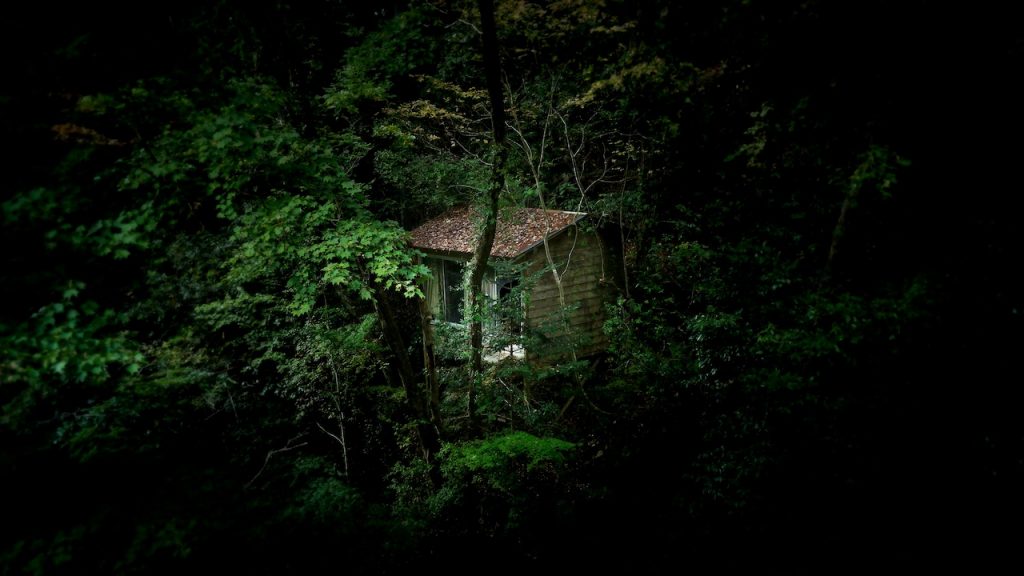
This house looks quite unlike a normal one. It is a mere ten feet square, and less than seven feet high. Since I was not much concerned about where I lived, I did not construct the house to fit the site. I simply set up a foundation, put up a bit of a roof, and fastened each joint with a metal catch, so that if I didn’t care for one place I could easily move to another. Just how much trouble would it be to rebuild, after all? The house would take a mere two cartloads to shift, and the only expense would be the carrier.
Since retiring here to Mount Hino, I have added a three-foot awning on the east side of my hut, beneath which to store firewood and cook. On the south I put up a veranda of bamboo slats, with an offerings shelf at its western end. Inside there is a standing screen dividing off the north-west section of the room, where I have set up a painted image of Amida with another of the bodhisattva Fugen hung next to it, and a copy of the Lotus Sutra placed before them. At the room’s eastern edge I have spread a tangle of bracken to serve as bed. A shelf hangs from the ceiling in the southwest corner, holding three black leather boxes that contain extracts from the poetic anthologies, musical treatises, Essentials of Salvation, and so forth. Beside this stand one koto and one biwa. The koto is the folding kind, the biwa has a detachable neck. Such is my temporary abode.
As for its surroundings, to the south is a bamboo water pipe, and I have placed rocks there to make a pool. The forest is close by the house, so I am not short of brushwood to gather. The name of the place is Toyama. Vines cover the paths, trees throng the nearby valley, but the land is open to the west. Indeed, there are not a few aids to my meditations. In spring I gaze upon swathes of wisteria, which hang shining in the west like the purple clouds that bear the soul to heaven. In summer I hear the song of the hototogisu, and at each call he affirms his promise to lead me over the mountain path of death. In autumn the voice of the cricket fills my ears, a sound that seems to sorrow over a fleeting life so soon cast off. In winter, the snow fills me with pathos. The sight of it piling high only to melt and vanish is like the mounting sins that block our path to redemption, which penitence will erase.
When I tire of chanting the nenbutsu and feel disinclined to read the sutras, I can choose to rest and laze as I wish. There is no one to stand in my way or to shame me. Though I have taken no vow of silence, my solitude protects me from the evils of speech. I make no special effort to abide by the precepts, but with such conducive surroundings, what could lead me to break them?
On mornings when my thoughts turn to the “white retreating waves” of this transient life, I gaze out to the boats that ply the river at Okanoya, and savor as my own the feelings of the old poet Novice Mansei. On evenings when the wind rustles in the leaves of the katsura trees, I cast my thoughts back to Xunyang Inlet, and pluck my biwa in the way of Isunenobu. And if the mood is still upon me, often I play to the sough of wind in the pines the piece called “Autumn Wind Music,” or “Flowing Spring” to the murmur of running water. My skill is poor, but then I do not aim to please the ears of others. I play alone, I sing alone, simply for my own fulfillment.
Like the moon that hangs above the mountain rim, my life now tilts towards its close. Soon I will enter the darkness of the three paths. What point is there in mulling over past actions?
The Buddha’s essential teaching is to relinquish all attachment. This fondness for my hut I now see must be error, and my attachment to a life of seclusion and peace is an impediment to rebirth. How could I waste my days like this, describing useless pleasures?
In the quiet dawn I ponder this, and question my own heart: You fled the world to live among forest and mountain in order to discipline the mind and practice the Buddhist way. But though you have all the trappings of a holy man, your heart is corrupt. Your dwelling may aspire to be the hut of the holy Vimalakirti himself, but the practice you maintain in it cannot match even that of the fool Suddhipanthaka. Have you after all let the poverty ordained by past sins distract you? Or have your delusions tipped you over into madness?
When I confront my heart thus, it cannot reply. At most, this mortal tongue can only end in three faltering invocations of the holy, unapproachable name of Amida.
Written in his hut on Toyama at the close of the third month in the second year of Kenryaku, by the monk Ren’in.
♦
From Essays in Idleness and Hojoki by Kenko and Chomei; translated by Meredith McKinney, introduction and notes by Meredith McKinney, published by Penguin Classics, an imprint of Penguin Publishing Group, a division of Penguin Random House, LLC. Translation and editorial materials copyright © 2013 by Meredith McKinney. First published in Great Britain by Penguin Classics 2013.

Thank you for subscribing to Tricycle! As a nonprofit, we depend on readers like you to keep Buddhist teachings and practices widely available.