Few figures in the history of Buddhist philosophy have provoked as much interpretive anxiety as the 8th-century Indian thinker Candrakirti. His uncompromising stance that nothing whatsoever possesses an intrinsic nature (Skt.: svabhava) has long raised a vexing question: If all claims about reality are ultimately empty, what becomes of truth, knowledge, and ethics? Critics have argued that Candrakirti’s position leaves us with little more than convention, threatening a slide into what’s been called a dismal slough of relativism and nihilism.
By the Light of the Moon, by the respected scholars Jay L. Garfield and Sonam Thakchöe, is a major intervention in this long-standing dispute over how Candrakirti should be interpreted. To see why his claims have seemed to carry such dire philosophical consequences, something must first be said about the role that philosophical reasoning has traditionally played in Buddhist practice.
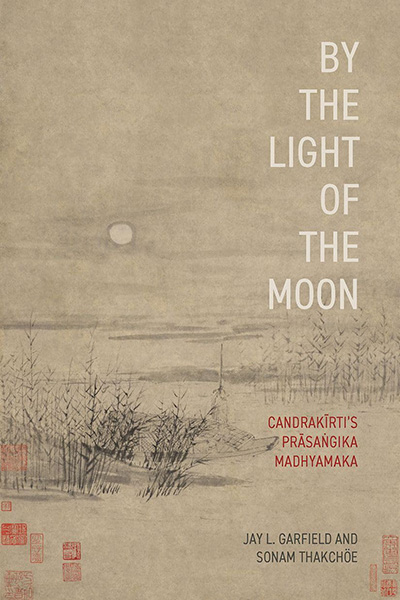
By the Light of the Moon: Candrakirti’s Prasangika Madhyamaka, by Jay L. Garfield and Sonam Thakchöe. Oxford University Press, 2025, 208 pp., $24.99, paper.
The Buddha taught a path to the cessation of existential suffering, diagnosing its cause as ignorance of impermanence and nonself. His prescription involved practices designed to overcome such ignorance by installing habits to counter its perpetuation—not only rule-governed conduct and meditation but also the cultivation of wisdom through philosophical reasoning. That Buddhist practitioners might need to engage in philosophical analysis may seem surprising. But core Buddhist claims are highly counterintuitive, and one will want to know that there are good reasons to accept them—reasons grounded in how the world itself is, independently of subjective biases.
In working out the details, Buddhist philosophers arrived at the position that, strictly speaking, only momentary and noncomposite things could be genuinely said to exist. All the rest is merely conventional; our commonsense ontology is made up of things we take to be real only because of the algorithms our cognitive systems employ. The test of something being ultimately real, they held, is having an intrinsic nature: being something that could be that way even if nothing else existed simultaneously. Applied to our existence, this test rules out a real “I,” whether as a simple “soul pellet” or as a composite entity made up of suitably arranged psychophysical constituents.
The Madhyamaka school, founded in India by Nagarjuna (c. 150–250 CE), complicates this picture. It agrees with other Buddhist schools that only what has intrinsic nature can be real and that persons lack intrinsic nature. But it goes on to add that the entities other Buddhists hold as ultimately real—dharmas—are likewise devoid of intrinsic nature or empty, not really real. Candrakirti takes this especially seriously. His overall stance might be expressed by the paradoxical-sounding statement: The ultimate truth is that there is no ultimate truth. The seeming paradox dissolves once we distinguish between “ultimate truth” as what must be understood to attain liberation and “ultimate truth” as a statement accurately representing how things strictly speaking are. To attain cessation of suffering, we must quit chasing after the one true theory of the ultimate nature of reality.
We can see how this stance might lead straight to a dismal slough of relativism and conventionalism. The things we ordinarily think of as real turn out to be useful fictions, with nothing standing behind them to explain their utility. The result in metaphysics is called global antirealism, which, in turn, poses a threat of global skepticism. For if there are no inquirer-independent facts about how the world is, what guarantee is there that a better rival cannot supersede our consensus view of reality?
This dispute extends to ethics as well. Among the highest-order facts anti-
realists deny are those that ground ethical norms. The metaphysical realist takes the consequence of antirealism to be that moral rules could be only what a given society (or its elites) happens to agree they should be, with ample room for differences across cultures. Dismal, indeed, the metaphysical realist will say.
Garfield and Thakchöe set out to acquit Candrakirti of the charge of dismalism. Their basic strategy is to invoke the Buddhist doctrine of dependent origination, understood as the claim that everything is connected through interdependent relations. Here is how they put it:
Candrakirti demonstrates that the emptiness of emptiness amounts to the empirical reality of dependent origination. This moderate realism about conventional truth, in turn, allows him to make sense of ethical motivation, action, and perfection, and so of the path of a bodhisattva.
To attain cessation of suffering, we must quit chasing after the one true theory of the ultimate nature of reality.
Candrakirti’s global antirealism is committed to the thesis that the very idea of ultimate truth is incoherent. But Garfield and Thakchöe take this to lead, in turn, to a reassessment of the conventional truth and the world of things it purports to represent. They readily concede that Candrakirti characterizes those things as illusory, insofar as the commonsense beliefs about them are largely false: The color we see in a rose is not in it at all, color perception being a matter of interaction between the reflectance properties of the flower surface and the neurophysiology of our visual system. But still, they insist, there is something true to be learned from this: that the rose is red. Conventional truths are the only sorts of truth on offer. Since we need to know the truth to act prudently, we should acknowledge that the consensus views about the objects of our commonsense world may often deserve the accolade “true.”
Indeed, Garfield and Thakchöe take Candrakirti to allow for the possibility of cognitive improvement, as when experts challenge what is commonly accepted. Nothing then seems to stand in the way of “naturalizing” Candrakirti’s Buddhism, of making it compatible with the place of the natural sciences in the modern worldview. We just need to overcome our deep-seated tendency to suppose there must be such a thing as how things ultimately are, independently of our interests and cognitive limitations. There is the “how things are,” but it is a delusion to suppose that this must rest on the firm foundation of things with intrinsic natures. The tag from the old Zen koan gets it right: When one’s enlightenment deepens, rivers are once again rivers and mountains are mountains.
This book admirably supports such a quasi-realist understanding of Candrakirti and connects that reading to certain currents in modern and recent philosophy. But there are difficulties as well. For instance, Garfield and Thakchöe are not always fair in their representation of those who read Candrakirti differently. One might come away seeing Tom Tillemans (who coined the phrase dismal slough) as a die-hard dismalist, when, in fact, his reading of the record is far more nuanced. They also occasionally render svabhava not as “intrinsic nature” but mistakenly as “intrinsic existence.” Likewise, for their attributing to the important 6th- and 7th-century Buddhist epistemologists Dignaga and Dharmakirti an internalist account of justification—the view that we have knowledge only when we can articulate our reasons for belief. For Dignaga and Dharmakirti, like other Indian theorists of knowledge, it is enough that one’s true cognition was produced in the right way, whether or not one can explain its justification.
If all claims about reality are ultimately empty, what becomes of truth, knowledge, and ethics?
There are also conceptual difficulties. One sometimes hears it said that Candrakirti established the emptiness of all conventionally real phenomena, and Garfield and Thakchöe appear to agree with this judgment. But traditional Tibetan commentators argue that Candrakirti refutes only the specific positions of his metaphysical realist opponents—those who hold that things possess intrinsic, mind-independent natures—rather than advancing a positive claim about all possible theories of reality. Any attempt to accomplish the latter would require an account of reality’s fundamental structure, something no global antirealist believes there could be. In its absence, the claim that all things are empty is hostage to the possibility that a hitherto overlooked realist option is waiting around the corner. Moreover, once we acknowledge that conventionally accepted views are open to improvement, we can raise questions about what epistemic improvement entails. Take the claim that the microbial theory of disease is an improvement over our ancestors’ demonic possession theory. To call this an improvement is to suggest that it brought us closer to the truth about how things really are. Plato’s question rears its head: Can there be a better without a best?
These and related difficulties suggest that we may wish to consider an alternative account of what Candrakirti was doing. Garfield and Thakchöe represent him as developing answers to central philosophical questions in metaphysics, epistemology, and ethics. Other Buddhist thinkers recognized the important role philosophical analysis plays in the soterial project of ending suffering. Candrakirti certainly agrees that such analysis is crucial in undermining a common way of conceptualizing the “I.” But he might have believed that philosophical theorizing can take us only so far on the path to liberation, beyond which it must be abandoned. (Philosophers do, after all, have a way of vehemently insisting that they are right.) The teaching of emptiness might then be seen not as a bit of philosophy but rather as a sort of upaya, or life hack. Seen in this way, it poses no threat to the realist’s project of keeping us out of the dismal slough.

Thank you for subscribing to Tricycle! As a nonprofit, we depend on readers like you to keep Buddhist teachings and practices widely available.